 XLSlides
Research nobody could show
On 3 June 2021, at a Senate estimates hearing in Canberra, Labor Senator Katy Gallagher asked officials of the Department of Social Services what $1.76 million of research had produced. The research had been bought through a contract for a review of a disability jobs program, and she said nobody could show her the result. “It looks dodgy,” she told them, as reported by SBS News.
The consultants were from Boston Consulting Group. This case follows one work order from a $999,999 review to a $3.3 million contract, and sets out what the department’s own documents, BCG’s report and the Senate record show about how it grew.
Source context: [4]
The program
Disability Employment Services, known as DES, is a federal program that helps people with disability, injury or illness find and keep work. The government does not deliver it directly. According to BCG’s review, more than 100 providers, both charities and companies, supported close to 280,000 participants as of March 2020. Providers earn service fees every quarter, and outcome fees when a participant stays in work for 4, 13, 26 or 52 weeks. Fee payments to providers totalled $900 million in 2018–19. Costs were rising quickly: the review found that caseloads had risen by 46% in under two years, while employment outcomes had risen by only 8%, and that government spending on the program had grown by about 48%.
Source context: [3]
The hire
In April 2020, as the pandemic took hold, the department wanted a mid-term review of the program. It did not run an open tender. It placed an official order with BCG under a whole-of-government business advisory panel, through a deed with BCG dated 11 November 2015. The work order commenced on 30 April 2020. Panels are how large firms often sell to governments: a supplier qualifies once, then receives work orders without a new competition each time. The review was priced at $999,999 including GST, one dollar under a million.
The extra line
The work order carried something more. According to a later departmental minute, another part of the department, the Social Security Stream, used the same order for BCG to research payment rates for people with disability and people with a partial capacity to work. The order’s scope listed the implications of COVID-19, alignment with payment rates across the welfare system, previous reviews and “any other matters the department deems relevant”.
The research was priced at $880,000. On 7 May 2020, an email recorded that a deputy secretary had approved the amendments “to incorporate the research project”. The order’s total was set at $1,879,999, GST inclusive.
It grew
Then it grew. On 25 June 2020, an internal message recorded that the Secretary had agreed to BCG “doing another 8 weeks of work on the research project. For an additional $880K.” A deed of variation was signed on 29 June. “We had some delays as they got the price down,” an email said. The new total was $2,760,000.
In July came a third piece: a review of Employment Services Assessments, the assessments that help direct people into the program, for $560,000. A deputy secretary approved it on 12 August, and the variation was finalised on 14 August, taking the order to $3,321,000. SBS later reported that an initial estimate had been $1 million to $1.5 million.
Follow the money
Of the $3.321 million, the review the order was named after accounted for $999,999 and the assessment review for $560,000. The largest piece was the research, at $1.76 million across two phases, more than half the total. The money moved quickly. On 29 June 2020, an email recorded that BCG had agreed to invoice $200,000 plus GST that day for work completed, and $600,000 plus GST on completion in the next financial year. For BCG, it was one contract among many: InnovationAus analysis of tender notices put the firm’s federal contracts at $39 million in 2020–21, up from $17.9 million the year before. For the program, the stakes were larger. The review found that the average cost of each 26-week employment outcome had risen to almost $40,000, from $28,000 before the 2018 reforms.
Separate, register, describe
- 01Separate each workstream
Give every piece of work in a shared order its own scope, price, owner and deliverables.
- 02Register every deliverable
Log each document sent, with its date, recipient and the part of the scope it answers.
- 03Describe the work accurately
Help the client give oversight bodies a precise account of what was bought and delivered.
The report
The review was completed in August 2020. It described fast-rising caseloads and costs, mixed service quality and “ineffective market mechanisms”, and it set out 61 numbered recommendations. Recommendation 42 said the department should reduce outcome fees. The report became public in May 2021, after a freedom of information application by The Guardian, as The Conversation reported. According to Mark Warburton, a former senior public servant writing in Pearls and Irritations, an official had earlier told senators that the review “didn’t really make recommendations per se”, and the record was corrected only after Gallagher insisted.
The hearing
At the June 2021 hearing, senators asked what the additional research had produced. “Nobody can show me what you got, what the advice was, what was the result of the research,” Gallagher said. “It’s not chicken feed, it’s not the department’s money, it’s public money.” She said it looked as if the department had “gone out of your way to hide a contract”. The department said that was not the case.
Deputy Secretary Matt Flavel said the research had helped inform policy advice, including on people with a partial capacity to work on the JobSeeker payment and how COVID-19 was affecting them. “There was a fair bit of pressure on the department through COVID,” he said, and in those circumstances he did not think it was unusual to seek extra expertise. Officials said the additions were made within procurement rules.
Source context: [4]
The reckoning
On 17 February 2022, the questions came back. Gallagher said she was “very concerned about the accuracy of the answers that the committee has received” and was considering a referral to the privileges committee, The Mandarin reported. The new Secretary, Ray Griggs, told the hearing that a desktop review had found “non compliance” with internal processes and “less than better practice” against the Commonwealth Procurement Rules. “It’s clear that it wasn’t well handled,” he said, according to The Canberra Times. He said consultancy contracts over $1 million would now need his sign-off. The minister, Anne Ruston, said she did not believe an official would intentionally mislead the committee.
The government changed in May 2022, and we found no record that a privileges referral was made. No one was charged, no finding was made against BCG, and we found no public comment from the firm. The government later announced that Inclusive Employment Australia would replace the program from 1 November 2025.
THE SEQUENCE
A timeline of the case
The panel deed
BCG’s deed under the government advisory panel, later used for the work order. [1]
Work order begins
A $999,999 mid-term review of Disability Employment Services. [1]
Research added
Amendments approved “to incorporate the research project”; total $1,879,999. [2]
Eight more weeks
A deed of variation adds $880,000 of research; total $2,760,000. [2]
A third piece
A $560,000 assessment review takes the order to $3,321,000. [2]
The review is finished
61 numbered recommendations, including lower outcome fees. [3]
The review is released
Published after a freedom of information application by The Guardian. [8]
“It looks dodgy”
Senators ask what the $1.76m of research produced. [4]
“It wasn’t well handled”
The new Secretary reports non-compliance with internal processes. [6]
The program is replaced
Inclusive Employment Australia replaces DES, as announced. [10]
A review with a passenger
The engagement began as something easy to explain. In April 2020, the Department of Social Services wanted a mid-term review of Disability Employment Services, a program that, according to the review itself, cost about $900 million a year in fees to providers and served close to 280,000 people. It ordered the review from Boston Consulting Group under a whole-of-government panel arrangement, for $999,999 including GST.
The difficulty was the passenger. The same work order carried a second piece of work for a different part of the department: research into partial capacity to work and payment rates for people with disability, with the implications of COVID-19 and “any other matters the department deems relevant”. It was priced at $880,000. The order was named after the review, so anyone reading the contract’s title would assume the review was the main event. It was not. Once the research was extended, it accounted for $1.76 million of a $3.321 million order, more than half of the total.
Bundling is not wrong in itself. A panel order that covers related work can save time, and the officials told the Senate that the additions were within procurement rules. But a document whose label no longer matches its contents creates a reporting problem that will surface sooner or later. The strategic sourcing and procurement presentation guide sets out how to present a contract so that each component, its owner and its price can be seen separately.
When the price moves faster than the paperwork
The documents released under freedom of information show how quickly the order changed. On 25 June 2020, an internal message recorded that the Secretary had agreed to another eight weeks of research “for an additional $880K”. A deed of variation was signed on 29 June, and an email the same day said BCG would invoice $200,000 plus GST that day “for work completed”. On 12 August a deputy secretary approved a third piece, a $560,000 review of Employment Services Assessments, and the variation was finalised on 14 August. In under four months, the order grew from $1,879,999 to $3,321,000; by our arithmetic, that is an increase of about 77%.
Each step had a documented approval. The pattern is the issue: three decisions, by different people in different parts of the department, each reasonable on its own, and no single moment at which anyone was asked whether the work order as a whole still made sense. For a consultant, that pattern is also a risk. A growing order can look like success inside the firm and like scope creep from outside. A steering committee presentation that shows the cumulative value of every variation, not just the latest one, makes that question unavoidable.
A deliverable is whatever you sent
In estimates in June 2021, Senator Katy Gallagher asked what the $1.76 million of research had produced. “Nobody can show me what you got,” she said, as reported by SBS. According to Mark Warburton, a former senior public servant writing in Pearls and Irritations, documents later released under freedom of information showed the research had produced a series of PowerPoint materials, including an executive summary, a discussion paper, a single parents addendum and a compendium, which the department argued did not constitute a report. That is his account of the records, and it is the most practical lesson in the case.
For consultants, there is no such thing as an informal deliverable. A slide deck sent at the end of an engagement is a work product, and it may be requested by a parliamentary committee, an auditor or a journalist under freedom of information. The safest discipline is to keep a deliverables register for every engagement: each document, its date, its recipient and the part of the scope it answers. An executive summary slide that states what the engagement delivered, in plain terms, is also the summary you would want read out in a hearing.
Accurate answers are part of the service
The second strand of the controversy concerned what officials said. Asked whether BCG’s review made recommendations, an official said it “didn’t really make recommendations, per se”, according to Warburton; the published review contains 61 numbered recommendations, and the record was later corrected. In February 2022, Gallagher said she was “very concerned about the accuracy of the answers” and was considering a referral to the privileges committee. The minister, Anne Ruston, said she did not believe an official would intentionally mislead the committee, and we found no record that a referral was made.
Consultants rarely give evidence themselves, but their work is often described by people who did not read it closely. When a client prepares answers about your work for a parliament, a board or a regulator, offering an accurate one-page description of scope, deliverables and recommendations is a service, not an intrusion. A stakeholder analysis that lists the oversight bodies likely to ask about an engagement helps identify those moments in advance.
What the department changed
The most useful outcome came from inside the department. The new Secretary, Ray Griggs, carried out a desktop review and told the Senate in February 2022 that it found “non compliance” with internal processes and “less than better practice” against the Commonwealth Procurement Rules, according to The Canberra Times. “It’s clear that it wasn’t well handled,” he said. He also said consultancy contracts worth more than $1 million would now require his sign-off, and that senior executives had been put through refresher training on procurement.
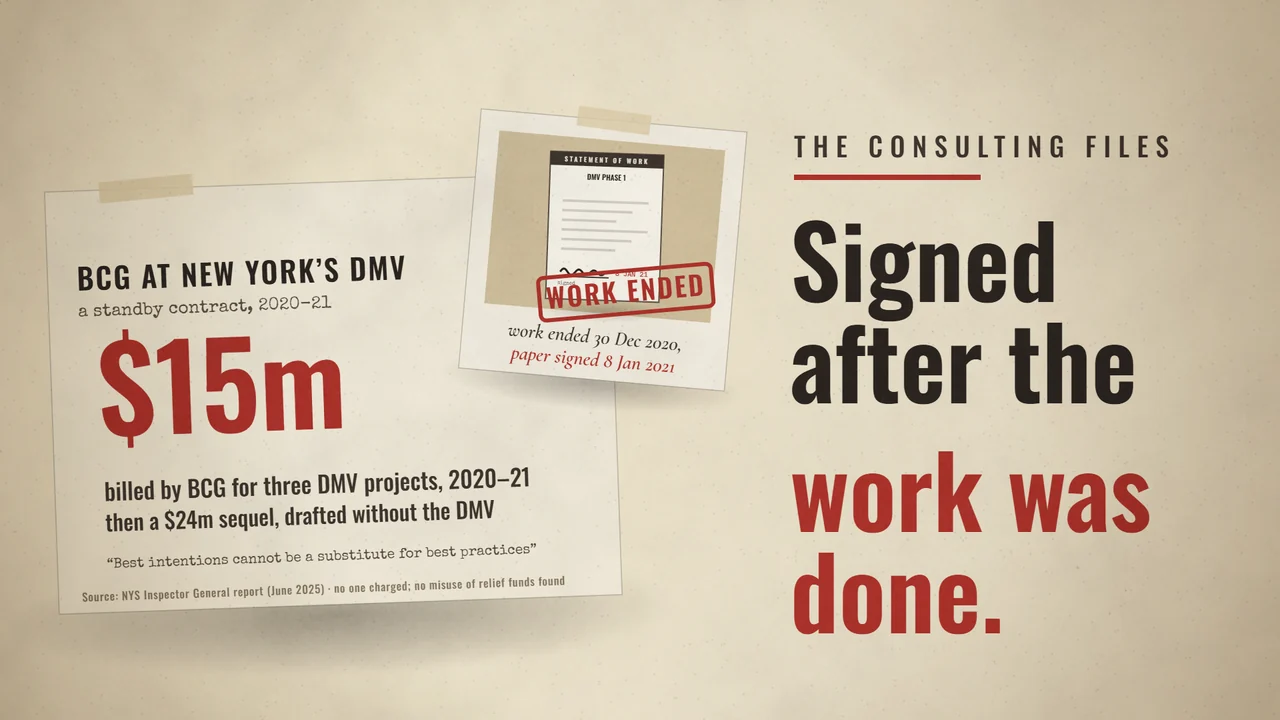
Those changes target the weaknesses the case exposed: a large order assembled in pieces, without a single senior decision on the whole. The case does not involve any finding against BCG, and we found no public comment from the firm. The New York DMV case shows the same tension in a different system: useful work, weak paperwork and an oversight report about the client’s process rather than the consultant’s conduct.
Three habits for consultants
First, keep each component of a work order visible. If a second workstream joins a contract, give it its own scope, price, owner and deliverables, even when the paperwork is shared. Second, register every deliverable, because a deck is a report when someone asks what was produced. Third, help your client describe your work accurately, especially when the description will be given to a parliament. A consulting proposal deck that separates each workstream from the outset is the simplest place to start.
The program itself has moved on. The government announced that Inclusive Employment Australia would replace Disability Employment Services from 1 November 2025. The questions about the work order remain a useful case study, because none of them depended on whether the research was good. They depended on whether anyone could say clearly what had been bought.
TAKE IT INTO THE NEXT MEETING
Three practical lessons
Keep the passenger visible
When a second workstream joins a work order, give it its own scope, price and owner, even if the paperwork is shared.
A deck is a deliverable
Anything sent at the end of an engagement may be requested by a parliament or under freedom of information. Register it.
Watch the cumulative value
Each variation can be approved on its own. Someone must also decide whether the whole order still makes sense.
Questions about the case
Did BCG do anything wrong on the disability employment review?
No finding was made against Boston Consulting Group, no one was charged, and we found no public comment from the firm. The concerns raised in the Senate, and the Secretary’s review, concerned the department’s procurement processes and the accuracy of its answers.
How much did the BCG work order cost?
It began at $1,879,999 and reached $3,321,000, GST inclusive: $999,999 for the mid-term review, $1.76 million for two phases of payment-rates research and $560,000 for a review of Employment Services Assessments.
Was the matter referred to the privileges committee?
In February 2022, Senator Katy Gallagher said she was considering a referral. We found no record that one was made; the government changed in May 2022.
THE EVIDENCE TRAIL
Sources & editorial notes
Adapted from the original XLSlides documentary, with additional analysis. Published 27 November 2026. Sources have different roles: primary records, investigative reporting and the positions of affected parties.
- Department of Social Services: FOI 2021-111, work order 90012506 with Boston Consulting Group ↗Primary record: the panel deed date, the 30 April 2020 commencement, the scope including the payment-rates research and the $1,879,999 ceiling. The site timed out to automated checks; read via an archived copy.
- Department of Social Services: FOI 2122-115, deeds of variation and internal emails ↗Primary record: the 7 May, 25 June and 29 June 2020 emails, the $2.76m and $3.321m variations and the August 2020 approval minute. The site timed out to automated checks; read via an archived copy.
- Boston Consulting Group: Disability Employment Services mid-term review, August 2020 ↗The review itself: participants, providers, fees, caseload and cost growth, cost per outcome and the 61 numbered recommendations. Read via an archived copy.
- SBS News / AAP: officials defend $1.7 million spend on ‘hidden’ research, 3 June 2021 ↗The estimates hearing: Gallagher’s quotes, Flavel’s explanation, the department’s denial and the initial estimate.
- The Mandarin: senator claims public servants ‘misled’ committee over contract’s purpose, 17 February 2022 ↗Gallagher’s consideration of a privileges referral; her claims, not findings.
- The Canberra Times: public servants accused of misleading Senate over controversial contract, 17 February 2022 ↗Ray Griggs’s desktop review, “wasn’t well handled”, the new $1m sign-off rule and the minister’s response. Its $1.6m contract figure is not used.
- Mark Warburton, Pearls and Irritations: time to revisit integrity in the Australian Public Service, July 2022 ↗Opinion by a former senior public servant: the “per se” answer, the corrected record and the PowerPoint deliverables. Attributed as his account.
- The Conversation: employment services providers profit more than job seekers, 20 July 2021 ↗Release of the review after The Guardian’s freedom of information application, and its findings on market mechanisms.
- Consultancy.com.au: government consulting revenue soars again for McKinsey and BCG, 7 March 2022 ↗InnovationAus figures for BCG’s federal contracts: $17.9m in 2019–20 and $39m in 2020–21. Context only.
- Australian Labor Party: delivering inclusive employment in Australia, 20 July 2025 ↗The announcement that Inclusive Employment Australia would replace DES from 1 November 2025.
Image credits & licences
Original illustrations and typography: XLSlides. Documentary stills have been resized and converted to WebP for this article. Underlying images retain the credits supplied with the episode.
- BCG logo: public domain, via Wikimedia Commons.
- XLSlides logo: XLSlides.
- Other organisations are typeset name cards; people are silhouettes; Parliament House, documents, slides and charts are drawn. Scenes marked "illustrative" are not to scale.
FROM EVIDENCE TO A RECOMMENDATION
Make the reasoning visible.
Use clear action titles, sourced exhibits and an explicit decision. XLSlides helps turn your analysis into an editable presentation; the evidence and judgment remain yours to verify.
Build a case-study presentation