 XLSlides
A new institute and a contract notice
On 18 August 2020, the Health Secretary, Matt Hancock, announced a new organisation for England: the National Institute for Health Protection. It would have, he said, “a single and relentless mission”: protecting people from external threats to the country’s health. It would bring together Public Health England, NHS Test and Trace and the Joint Biosecurity Centre under Baroness Dido Harding.
Three weeks earlier, on 29 July, a contract notice had appeared on the government’s Contracts Finder website. The supplier was McKinsey & Company. The value was £563,400, for 40 days of work. The first item on the brief, as Civil Service World reported that day, was to define options for “the vision, purpose and narrative” of a permanent Test and Trace organisation. This case sets out what the contract covered, what it cost and what happened to the institute it was meant to inform.
The client
In May 2020, England was building a system to test people for COVID-19 and trace their contacts. It was called NHS Test and Trace. It had no customers or revenue; every pound came from the taxpayer, and by December the National Audit Office put its budget for 2020–21 at £22 billion. It had been stood up in a hurry, and nobody had yet settled what it should become in the long run.
To lead it, the Prime Minister accepted the Health Secretary’s recommendation of Dido Harding on 6 May, according to the High Court’s later judgment. She was a Conservative peer, chair of NHS Improvement and a former chief executive of TalkTalk. She was not paid for the role beyond her existing NHS Improvement salary, the court recorded. And, Civil Service World noted, she had started her career at McKinsey.
The firm
McKinsey sells the time of small teams of consultants for short, intensive projects. In Whitehall, the fast way to buy that time is a framework agreement: suppliers are approved in advance, and a department can then place an order, called a call-off, without running a new open tender. This order was placed by the Crown Commercial Service on behalf of the Department of Health and Social Care, under reference CCCC20A97, and the notice records the procedure as a call-off from a framework agreement. It gives a closing date of 15 May 2020. The contract was awarded on 18 May, and the work began the same day. The notice itself was published on 29 July, a month after the work had ended.
Source context: [1]
The brief
What was McKinsey asked to do? The contract, as quoted by Civil Service World, said that while Test and Trace was “being rapidly stood up to meet near term objectives, work is required to develop options for the longer term future of the organisation”. The objectives were to define options for five things: “the vision, purpose and narrative; end-to-end journeys; organisation, roles and talent; interfaces and governance; and integrated roadmap all for the medium-term entity”. Between May and June, the consultants worked with Harding and other members of the Test and Trace leadership team. They helped set design principles and performance objectives, mapped the user and data journeys across which the organisation would operate, and weighed possible organisational structures with their pros and cons. A business plan for Test and Trace was published at the end of July, shortly after the work was completed.
Source context: [2]
Follow the money
The contract said: “For the avoidance of doubt, the total contract value will not exceed £563,400.00 exc. VAT.” Civil Service World reported that the department expected to spend all of it. City A.M., citing the Financial Times, wrote that McKinsey was paid the sum; strictly, it was a ceiling. On our arithmetic, 40 calendar days from 18 May to 26 June gives about £14,000 a day, weekends included. That is an average for a whole team, not a contractual day rate, and we could not find how many consultants it bought. The small print had another detail. According to Civil Service World, McKinsey would own all the concepts, tools, databases and other outputs it generated; the department received a worldwide, royalty-free, non-exclusive licence to use and copy them.
One of many
This was one order among many. On 28 August, Civil Service World reported two more McKinsey contracts: £749,300 from the Cabinet Office to support its Covid-19 task force, and £385,400 from the health department for six weeks’ work on testing capacity. By October, according to Tussell data reported by The Guardian and summarised by Consultancy.uk, the government’s bill for pandemic consultants had reached £175 million.
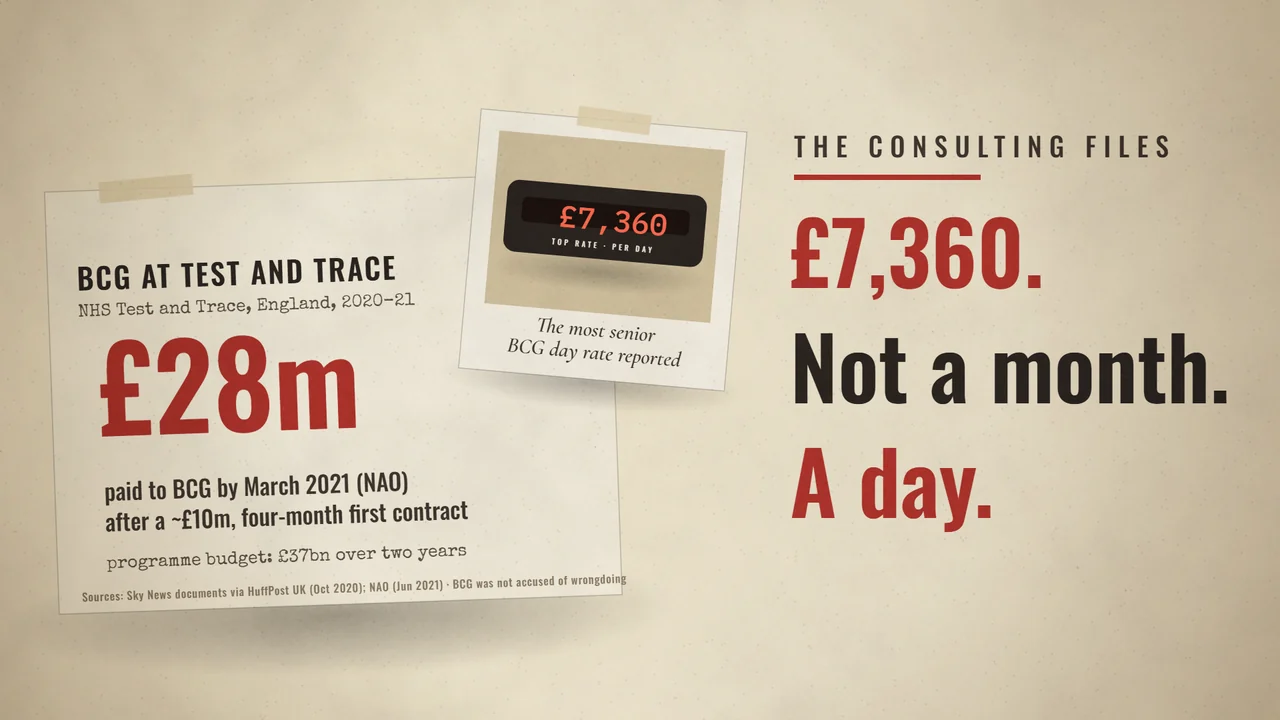
Inside Test and Trace, the Public Accounts Committee later described around 2,500 consultants, on day rates ranging from an average of £1,100 to £6,624. And in a letter of 15 September 2020, later leaked to The Guardian, the Cabinet Office minister Lord Agnew wrote: “We are too reliant on consultants.” Aside from poor value for money, he said, it “infantilises the civil service”.
Scope it, own it, record it
- 01Name the decisions
Describe deliverables by the choices they let the client make, not by consulting shorthand.
- 02Agree who owns the outputs
Decide which tools and materials the public body must own outright before work starts.
- 03Record who commissioned it
When the client’s leader is a former colleague, document who decided to buy the work and how.
The reaction
When the contract came to light, the headlines wrote themselves: more than half a million pounds for a narrative. City A.M. linked it to the scrapping of Public Health England, reported days before Hancock’s speech. A department spokesperson told Civil Service World that the work was not connected to the abolition of Public Health England, and that the contract was to consider a range of options for a long-term test and trace organisation.
There was a question about data, too. The contract set terms for any personal data McKinsey might be authorised to process, but a further clause said such sharing was “not necessary” for the work. “No personal data has been shared and the contract included a clause specifically to protect such information,” the department said. A McKinsey spokesperson told City A.M.: “Our UK public sector work is contracted by government officials under existing public procurement rules.” The department said all contracts had been awarded in line with procurement regulations. We found no allegation that McKinsey broke any rule.
The appointment
The sharper questions were about how the client’s leaders were chosen. None of the appointments later examined in court involved public advertisement. Harding had been chosen for Test and Trace in May, and in August she was named interim executive chair of the new institute in the same way. The Good Law Project and the Runnymede Trust brought a judicial review.
On 15 February 2022, the High Court ruled. Most of the claims failed, including those of indirect discrimination and apparent bias, and the Good Law Project was found to lack standing to bring the equality-duty challenge. But the court granted the Runnymede Trust a declaration that the Health Secretary had not complied with the public sector equality duty in deciding how to appoint Harding as the institute’s interim executive chair in August 2020, and Mike Coupe as director of testing in September 2020. That finding was about how ministers made the decisions. It was not a finding against Harding, and McKinsey was not a party to the case.
Source context: [6]
What happened next
The new institute was meant to be formalised and operating from spring 2021. On 24 March 2021, the government announced instead the UK Health Security Agency, “previously the National Institute for Health Protection”, with Dr Jenny Harries as chief executive and Ian Peters as chair. Harding handed over after a transition through April, and the agency was formally established that month. By our count, the institute’s first name lasted about seven months.
Two weeks earlier, the Public Accounts Committee had reported on Test and Trace and its £37 billion allocation. “Despite the unimaginable resources thrown at this project Test and Trace cannot point to a measurable difference to the progress of the pandemic,” said its chair, Meg Hillier. The public record does not show how much of McKinsey’s organisation design survived into the new agency.
THE SEQUENCE
A timeline of the case
Harding chosen for Test and Trace
The Prime Minister accepts the Health Secretary’s recommendation, the High Court records. [6]
McKinsey call-off awarded
Work on options for a permanent Test and Trace organisation begins the same day. [1]
The work ends
The contract’s end date, 40 days after it began. [1]
Notice published
The £563,400 call-off appears on Contracts Finder. [1]
A new institute
Hancock announces the National Institute for Health Protection under Harding; the contract is reported the same day. [4]
Two more McKinsey contracts
£749,300 from the Cabinet Office and £385,400 for testing capacity. [7]
“Too reliant on consultants”
Lord Agnew’s letter to departments, later leaked. [9]
Public Accounts Committee report
MPs question the return on £37bn and the reliance on about 2,500 consultants. [10]
UK Health Security Agency
The institute is renamed, with Jenny Harries as chief executive. [12]
High Court declaration
The Health Secretary did not comply with the equality duty in deciding how to appoint Harding and Mike Coupe. [6]
A normal brief in an abnormal setting
Read on its own, the brief is unremarkable. In May 2020 the Department of Health and Social Care asked McKinsey to help define options for a permanent organisation to run NHS Test and Trace: “the vision, purpose and narrative; end-to-end journeys; organisation, roles and talent; interfaces and governance; and integrated roadmap”. Every organisation design project covers some version of those five things. A new public body needs a reason to exist, a picture of the services it delivers, a structure, a set of boundaries with its neighbours and a plan for getting there.
What made the brief newsworthy was the setting. Test and Trace was being built at speed, with a budget that the National Audit Office later put at £22 billion for 2020–21. Its leader, Dido Harding, had started her career at McKinsey. And the contract notice became public on 29 July 2020, three weeks before the Health Secretary announced a new National Institute for Health Protection under her leadership. None of that makes the work improper, and we found no allegation that McKinsey broke any rule. It does mean that ordinary consulting language was read in an extraordinary light. The consulting proposal deck guide treats the scope statement as the most important slide in a proposal; in public work it is also the sentence most likely to be quoted.
Narrative is a real deliverable
It is tempting to treat “narrative” as the soft part of the brief. It is not. When a programme becomes an institution, the story it tells about itself decides what it measures, which services it keeps and who it answers to. Civil Service World reported that the consultants worked with Harding and her leadership team on design principles and performance objectives, and weighed possible organisational structures with their pros and cons. A Test and Trace business plan was published at the end of July, shortly after the work ended. Those are substantive choices.
The difficulty is that a taxpayer reading a public notice sees a phrase, not a method. The words “vision, purpose and narrative” next to £563,400 produced the headlines; the design principles, journeys and governance work did not. A practitioner’s answer is to describe deliverables by what they let the client decide: options for the organisation’s remit, structure and governance, with the trade-offs of each. The target operating model presentation guide shows how to present that kind of work as a set of decisions rather than a set of words.
The money, read carefully
The figures in this case are easy to overstate. The £563,400 is the contract’s ceiling before VAT; the document said the total “will not exceed” it, and Civil Service World reported that the department expected to spend all of it. Some coverage said McKinsey had been paid the sum. Our arithmetic gives 40 calendar days from 18 May to 26 June, or about £14,000 a day, but that is an average across an unknown team, not a contractual day rate. We could not find how many consultants worked on it.
The context matters as much as the number. In August 2020 Civil Service World reported two more McKinsey contracts, £749,300 from the Cabinet Office for its Covid-19 task force and £385,400 from the health department for work on testing capacity. By October, according to Tussell data reported by The Guardian, the government’s pandemic consulting bill had reached £175 million. In March 2021 the Public Accounts Committee described around 2,500 consultants in Test and Trace, on day rates from an average of £1,100 up to £6,624. Set against that scale, one £563,400 order was small. It became a symbol because its brief was easy to quote. The BCG Test and Trace case covers the day-rate debate in more detail.
Who owns the toolkit
One clause deserves more attention than it received. According to Civil Service World, McKinsey would own all concepts, tools, databases and other outputs it generated, and the department would receive a worldwide, royalty-free, non-exclusive licence to use and copy the tools. That is a common arrangement for consulting firms, which reuse methods across clients. It is less obviously right for a public body designing a permanent institution.
A buyer can ask three questions before signing. Which outputs are specific to this client and should belong to it outright? Which are the firm’s existing methods, which the client only needs to use? And can the client hand the material to the next adviser or to its own staff without asking permission? The strategic sourcing and procurement presentation guide sets out how to bring intellectual property terms into a sourcing decision rather than leaving them in the small print.
Separate the questions
The sharpest criticism in this story was not about McKinsey. Harding was appointed to lead Test and Trace, and later the new institute, without public advertisement. In February 2022 the High Court granted the Runnymede Trust a declaration that the Health Secretary had not complied with the public sector equality duty in deciding how to appoint her as the institute’s interim executive chair, and Mike Coupe as director of testing. The other claims failed. The finding concerned how ministers made those decisions. It was not a finding against Harding, and McKinsey was not a party.
Good case writing keeps those threads apart: a framework call-off, a former employer, a public appointment and a later court ruling are four different questions with four different answers. Merging them suggests a conclusion that no source supports. For consultants, the practical point is narrower. When the client’s leader is a former colleague, the firm should expect the connection to be noticed, and should be able to show who decided to buy the work and how. An org chart that names the commissioning officials is a simple start.
A body that changed its name
The institute the work fed into had a short life under its first name. Announced on 18 August 2020, the National Institute for Health Protection was meant to be formalised and operating from spring 2021. On 24 March 2021 the government announced instead the UK Health Security Agency, with Jenny Harries as chief executive and Ian Peters as chair; Harding handed over after a transition through April. By our count, the first name lasted about seven months. We cannot say how much of McKinsey’s organisation design survived into the new agency; the public record does not show it.
That is the final lesson. Organisation design is only as durable as the political decisions around it, and an adviser cannot control those. What an adviser can control is the clarity of its scope, the ownership of its outputs and the record of who asked for the work. “We are too reliant on consultants,” Lord Agnew wrote to departments in September 2020. The change management presentation guide is a reminder that transferring capability to the client is part of the job.
TAKE IT INTO THE NEXT MEETING
Three practical lessons
Write the scope as a taxpayer would read it
“Vision, purpose and narrative” is normal proposal language. On a public notice next to a six-figure sum, it becomes the headline. Describe the decisions the work supports.
The contract is a deliverable too
Fees, dates and intellectual property terms in public work will be read aloud. Agree who owns the outputs before work begins.
Old ties are never private
When the client’s leader started at your firm, expect the question. Make sure the buying decision and its process are documented by the client.
Questions about the case
Did McKinsey do anything wrong on the NHS Test and Trace contract?
We found no allegation that McKinsey broke any rule. The notice describes a call-off from a framework agreement; McKinsey said its UK public sector work follows existing procurement rules, and the department said all contracts were awarded in line with procurement regulations.
How much was McKinsey paid for the “narrative” work?
The contract set a ceiling of £563,400 before VAT for work from 18 May to 26 June 2020, and Civil Service World reported that the department expected to spend all of it. About £14,000 a day is our average, not a contractual rate.
What did the High Court decide about Dido Harding’s appointment?
In February 2022 it declared that the Health Secretary had not complied with the public sector equality duty in deciding how to appoint her as the institute’s interim executive chair. Other claims failed. The finding was not against Harding, and McKinsey was not a party.
THE EVIDENCE TRAIL
Sources & editorial notes
Adapted from the original XLSlides documentary, with additional analysis. Published 27 November 2026. Sources have different roles: primary records, investigative reporting and the positions of affected parties.
- Contracts Finder: Department of Health and Social Care call-off with McKinsey & Company, reference CCCC20A97, published 29 July 2020 ↗Primary notice: procedure (call-off from a framework agreement), buyer, supplier, closing, award and contract dates, and the £563,400 value. The site blocks automated checks; read in a browser.
- Civil Service World: McKinsey banks £560,000 consulting on “vision, purpose and narrative” for new test and trace body, 18 August 2020 ↗The contract’s brief, ceiling, data and intellectual property clauses, and the department’s responses, as read from the contract document.
- City A.M.: McKinsey paid £560,000 to consult on Public Health England axeing, 20 August 2020 ↗Coverage linking the work to Public Health England, with McKinsey’s and the department’s statements.
- GOV.UK: Matt Hancock, the future of public health, speech of 18 August 2020 ↗The announcement of the National Institute for Health Protection and its “single and relentless mission”.
- GOV.UK: government creates new National Institute for Health Protection, 18 August 2020 ↗Official release: the institute’s remit, Harding as interim executive chair and formalisation planned from spring 2021.
- High Court: R (Good Law Project and Runnymede Trust) v Prime Minister and Secretary of State for Health and Social Care [2022] EWHC 298 (Admin), 15 February 2022 ↗Primary judgment: the appointment decisions, the claims that failed and the declaration on the Health Secretary’s public sector equality duty. McKinsey was not a party.
- Civil Service World: McKinsey drafted in to support task force coordinating Covid-19 policy, 28 August 2020 ↗The Cabinet Office (£749,300) and testing-capacity (£385,400) contracts.
- Consultancy.uk: government’s bill for coronavirus consultancy now £175 million, 22 October 2020 ↗Trade summary of Tussell data reported by The Guardian on pandemic consulting spend; aggregate, not McKinsey-specific.
- The Guardian via Yahoo News: Whitehall “infantilised” by reliance on consultants, minister claims, 29 September 2020 ↗Syndicated report of Lord Agnew’s leaked letter of 15 September 2020; context on government-wide consultant use.
- Civil Service World: MPs question return on DHSC’s “staggering” £37bn NHS Test and Trace programme, 10 March 2021 ↗The Public Accounts Committee’s findings on consultant numbers, day rates and outcomes, and Meg Hillier’s statement.
- National Audit Office: the government’s approach to test and trace in England, interim report, 11 December 2020 ↗The £22 billion 2020–21 budget for NHS Test and Trace.
- GOV.UK: new UK Health Security Agency to lead response to future health threats, 24 March 2021 ↗The renaming, Jenny Harries and Ian Peters, Harding’s handover and formal establishment in April 2021.
Image credits & licences
Original illustrations and typography: XLSlides. Documentary stills have been resized and converted to WebP for this article. Underlying images retain the credits supplied with the episode.
- Dido Harding photo: House of Lords / Roger Harris, CC BY 3.0, via Wikimedia Commons (cropped, sepia).
- McKinsey & Company logo: public domain (text logo), via Wikimedia Commons.
- XLSlides logo: XLSlides.
- Other organisations are name cards; other people are silhouettes; scenes marked "illustrative" are drawn, not to scale.
FROM EVIDENCE TO A RECOMMENDATION
Make the reasoning visible.
Use clear action titles, sourced exhibits and an explicit decision. XLSlides helps turn your analysis into an editable presentation; the evidence and judgment remain yours to verify.
Build a case-study presentation