 XLSlides
Twenty-two meetings with a minister
On 23 October 2023, in a Senate estimates hearing in Canberra, Senator James Paterson asked the Department of Home Affairs how many times the minister had met representatives of McKinsey as part of its contract. The answer, from a senior official, was that the department believed it was about 22 times, a number it was still checking with the minister’s office.
The minister was Clare O’Neil, Minister for Home Affairs and Cyber Security. Before politics, she had worked at McKinsey. And McKinsey had just spent three months helping her department write Australia’s plan to defend itself online. This case follows that engagement: how it was bought, how it grew and what the Senate heard about it.
The breach
The strategy began with two hacks. In September 2022, an attacker reached customer data at Optus, one of Australia’s largest telecommunications companies. The privacy regulator later alleged in court that the privacy of about 9.5 million Australians had been seriously interfered with; the information included home addresses, birth dates, phone numbers and email addresses. Optus apologised and said it would respond to the claims.
Weeks later it was the health insurer Medibank. The regulator alleges that about 520 gigabytes of data were taken, affecting about 9.7 million people, and that the stolen information was posted on the dark web. Medibank said it would defend the proceedings. Months earlier, in August 2022, O’Neil had said she would tear up the previous government’s strategy. The goal, as she put it, was to make Australia the most cyber secure country in the world by 2030.
The business
Writing a national strategy is a large project, and Home Affairs set up two kinds of help. The first was an expert advisory board: the former Telstra chief executive Andrew Penn, Air Marshal Mel Hupfeld and Rachael Falk of the Cyber Security Cooperative Research Centre. The board released a discussion paper in early 2023. The second was rented capacity. Project management, analysis, briefings and meeting notes are the kind of work that firms such as McKinsey sell to governments by the week. For McKinsey, the contract was a return to federal work: InnovationAus reported that the firm had gone through a long spell without federal contracts after criticism of its net zero modelling for the previous government. The new government, for its part, had pledged to reduce its use of consultants.
The tender
On 10 February 2023, Home Affairs published a request for quote. It closed a week later, on 17 February. According to InnovationAus, the department approached three firms from a panel of more than 400 pre-approved suppliers of management advisory services; two companies bid, the department told the Senate. McKinsey won. The contract ran from 27 February to 24 April 2023. Its value was $863,636 before tax, about $950,000 with the goods and services tax, and its scope, as the department described it, was project management, policy analysis, stakeholder engagement and related support for the strategy.
The old firm
There was one detail that made the contract newsworthy from the start. From 2009 to 2013, Clare O’Neil had been an engagement manager at McKinsey. When InnovationAus asked about it in March 2023, her office declined to comment and referred questions to the department. The department’s answer was clear. It said the minister and her office were not involved in the request for quote, the evaluation or the selection of the preferred supplier, and that there was no real or perceived conflict of interest. It said McKinsey had not been engaged to undertake core policy work, only project management, policy analysis and other support, and that consultants were engaged consistently with the Commonwealth Procurement Rules.
Source context: [3]
The extension
On 24 April 2023, the day the first contract ended, it was extended for five more weeks, to 31 May. The extension was worth $1,304,100 before tax. Asked in estimates whether it had gone to tender, an official answered: “No, it didn’t.” The department said value for money was considered as part of the process, and gave the reasons as the volume of work, further analysis of policy issues and public submissions, and work on international best practice and standards.
Information Age reported the extension as $1.34 million; this article uses the Hansard figure. By our arithmetic, the first contract cost about $106,000 a week and the extension about $246,000 a week, more than twice as much.
Compete, separate, record
- 01Compete the extension too
Treat a follow-on as a new purchase, with its own justification and a comparison against the original award.
- 02Separate the decision-makers
Record every past connection between officials and the supplier, and show who chose the firm.
- 03Keep the record of the advice
When experts advise through meetings, make sure the minutes are accurate, attributed and kept.
Follow the money
Together, the two contracts came to about $2.17 million before tax. In an answer to a question on notice from Senator Paterson, reported by iTnews in July 2023, the department said it had paid McKinsey almost $2.4 million for developing briefings and background content, stakeholder engagement, minutes for industry meetings and project management. That is consistent with the Hansard figures plus tax.
Other outside help was much smaller. CyberCX received $170,500 for a report on global approaches to threat sharing and threat blocking, and the law firm Clyde & Co just over $63,000 for legal advice. Total spending on developing the strategy was just over $2.8 million, so by our arithmetic roughly six in every seven of those dollars went to McKinsey. After the extension ended, the department decided not to extend again and, in its words, took a different course of action.
The hearing
The October hearing added detail. The minister had met McKinsey representatives about 22 times, the official said, and the expert advisory board had met McKinsey eight times. The board’s terms of reference had said there would be a final report. There was none: the department said the board’s advice had been iterative. Asked whether McKinsey or the minister’s office had requested the extension, an official replied: “I don’t believe so, no.” Senator David Shoebridge asked how many McKinsey staff had done the five weeks of work, and the department took the question on notice.
The strategy
On 22 November 2023, the government released the 2023–2030 Australian Cyber Security Strategy, built on six “cyber shields” and backed by $586.9 million of funding to 2030. The minister said it would put Australia on track to be a world leader in cyber security by 2030. The opposition was unimpressed. Senator Paterson called the strategy underwhelming and too little too late, after more than a year in development and millions spent on high-priced consultants. No wrongdoing has been found or alleged against McKinsey or the minister, and the department said it followed the Commonwealth Procurement Rules. We found no public comment from McKinsey on the work.
THE SEQUENCE
A timeline of the case
The Optus breach
The regulator later alleges that about 9.5 million Australians’ privacy was interfered with. [9]
The Medibank breach
About 520GB of data taken and later posted on the dark web, the regulator alleges. [8]
A one-week request for quote
Home Affairs seeks support for the cyber strategy; two companies bid. [1]
McKinsey starts
The first contract, $863,636 before tax, runs to 24 April. [1]
The extension
Five more weeks for $1,304,100 before tax; it does not go to tender. [1]
No second extension
The department takes “a different course of action”. [5]
The bill
Almost $2.4m to McKinsey out of $2.8m spent on developing the strategy. [4]
Senate estimates
About 22 meetings with the minister; no final report from the expert board. [1]
The strategy
Six cyber shields and $586.9m to 2030; the opposition calls it underwhelming. [7]
Renting a project office for a national strategy
Most of what Home Affairs bought from McKinsey in 2023 was not strategy in the textbook sense. According to the department, the firm was engaged for project management, policy analysis and other support, and was not engaged to do core policy work. Its deliverables, in the department’s later description, were briefings and background content, stakeholder engagement, minutes of industry meetings and project management. That is a recognisable product: a temporary project office that lets a department run a large consultation and drafting process without hiring permanent staff.
The difficulty is that the line between running a process and shaping its result is thin. Whoever writes the briefing notes decides what the minister reads first. Whoever drafts the meeting minutes decides how industry’s views are recorded. Whoever synthesises public submissions decides which themes look strong. None of this is improper, and nothing in the public record suggests that McKinsey overstepped its brief. But a buyer who says “no core policy work” should be able to show, in the statement of work and in the deliverables, where the boundary sat. The cybersecurity board presentation guide is a reminder that the people who frame a cyber risk for decision-makers have real influence over the decision.
The first contract is rarely the last
The commercial pattern in this case is common. A short engagement is bought through a fast, competitive process: a request for quote that was open for one week, sent to three firms on a panel of more than 400, with two bids, as InnovationAus reported. The first contract was $863,636 before tax for about eight weeks. Then, on the day it ended, it was extended for five weeks at $1,304,100 before tax, and the department told the Senate that the extension did not go to tender, while value for money was considered.
By our arithmetic from the Hansard figures, the first contract ran at roughly $106,000 a week and the extension at roughly $246,000 a week. There may be good reasons for that: more people, more submissions to analyse, a tighter deadline. The department pointed to the volume of work, analysis of policy issues and submissions, and international best practice. But an extension that costs more than the original contract, at more than twice the weekly rate, without a fresh competition, is exactly the kind of number that gets read aloud in a parliamentary hearing. The strategic sourcing and procurement presentation guide covers how to present variations so that the comparison with the original award is visible before anyone else draws it.
For firms, the lesson is to price and document an extension as if it were a new sale. State what changed, why the incumbent is better placed than a new supplier, and what the extra weeks will deliver. If the justification only makes sense to the people in the room, it will not survive estimates.
When the minister used to work for you
Clare O’Neil, then Minister for Home Affairs and Cyber Security, worked at McKinsey as an engagement manager from 2009 to 2013. The department said that the minister and her office were not involved in the request for quote, the evaluation or the selection, and that there was no real or perceived conflict of interest. No wrongdoing has been found or alleged against her or the firm.
That answer is the right one to give, but it is not the end of the matter for the buyer. When a decision-maker has a past connection to a supplier, the process has to carry more weight, because outsiders cannot see the people’s intentions, only the paperwork. A competitive first stage helps. An untendered extension weakens it, even if it is lawful, because it is the moment at which the incumbent’s advantage is greatest. And a minister who meets the supplier about 22 times during a short engagement, as an official told the Senate, may be doing exactly what a minister should do when she owns a strategy. The public sees only the count. A stakeholder analysis template that records each decision-maker’s relationships and the safeguards around them is a cheap way to anticipate that question.
Meetings, minutes and the missing report
The October 2023 hearing produced a second detail that matters for practitioners: the expert advisory board, whose terms of reference said there would be a final report, did not produce one. The department said the board’s advice had been iterative, and that the board met McKinsey eight times.
Iterative advice is a legitimate way to work. It is often faster and more useful than a polished report that arrives after the decisions are made. But it changes the accountability trail. When the experts advise through meetings, and the consultant writes the minutes, the written record of what the experts said is, in part, the consultant’s work product. A government that later needs to show how independent advice shaped the strategy has to rely on those records. Consultants who take minutes for a client should treat them as evidence, not admin: accurate, attributed, reviewed by the people quoted and kept. The meeting notes to deck generator is built on the same principle, that a summary is only as good as its fidelity to what was said.
A small contract with a long memory
By the standards of government consulting, this was not a large engagement. About $2.4 million including tax went to McKinsey out of about $2.8 million spent on developing the strategy, according to the department’s answer reported by iTnews. Smaller amounts went to CyberCX and Clyde & Co. The strategy itself, released on 22 November 2023, came with $586.9 million of new funding to 2030.
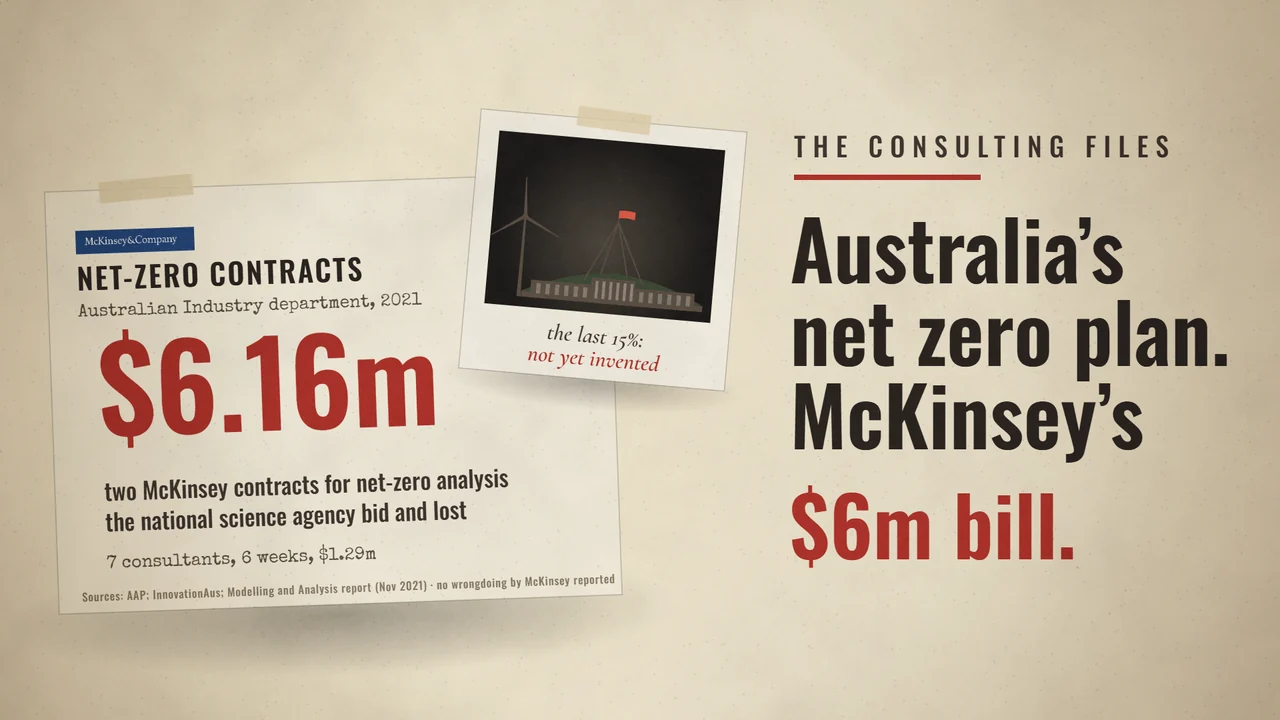
Yet the engagement attracted scrutiny out of proportion to its size, for reasons that had little to do with the work. McKinsey had recently returned to federal work after a period without contracts that followed criticism of its net zero modelling for the previous government, as InnovationAus reported; the net zero modelling case shows how that earlier engagement shaped perceptions. The new government had promised to reduce its use of consultants. And the minister’s former employment gave every number a second reading. The opposition’s criticism of the final strategy, “too little too late” after “millions spent on high-priced consultants”, drew on that context.
For consulting firms, the point is that reputational risk is cumulative across engagements. The scrutiny attached to one contract will be applied to the next one in the same market. The same pattern appears in the BCG disability employment review, where a contract variation in another Australian department became a Senate story.
Three questions to ask before the extension
The case condenses into three questions that a buyer or a consultant can ask before signing a follow-on piece of work. First, would this extension survive a public comparison with the original award, at the weekly rate and not just the total? Second, has every past connection between the decision-makers and the supplier been recorded, with the safeguards that apply to it? Third, if the advice is iterative, who keeps the record, and would the experts recognise their own views in it?
None of these questions implies wrongdoing. They are the questions that a Senate committee will ask anyway, months later, with less context. Asking them first is cheaper, and it makes the answer more convincing. The consulting proposal deck guide shows how to put scope, team and price on a single page, which is also the page a reviewer will look for when the work becomes news.
TAKE IT INTO THE NEXT MEETING
Three practical lessons
Price the extension as a new sale
A follow-on that costs more than the original contract will be compared with it. Explain what changed and why the incumbent is the right choice, before anyone asks.
History raises the bar
When a decision-maker used to work for the supplier, the process has to carry the weight. Record the connection and the safeguards, and keep the minister out of selection.
Know what you are paid for
Project management is not policy, but briefings and minutes shape a plan. Define the boundary in the statement of work and keep the record honest.
Questions about the case
Did McKinsey or Clare O’Neil do anything wrong?
No wrongdoing has been found or alleged. Home Affairs said the minister and her office were not involved in choosing the supplier, that there was no real or perceived conflict of interest and that it followed the Commonwealth Procurement Rules.
How much did McKinsey earn from the cyber strategy?
Two contracts worth $863,636 and $1,304,100 before tax, about $2.17 million, or almost $2.4 million with tax, out of about $2.8 million spent on developing the strategy. The extension did not go to tender.
What did McKinsey do on the strategy?
According to the department, briefings and background content, stakeholder engagement, minutes of industry meetings and project management. It said McKinsey was not engaged to do core policy work.
THE EVIDENCE TRAIL
Sources & editorial notes
Adapted from the original XLSlides documentary, with additional analysis. Published 27 November 2026. Sources have different roles: primary records, investigative reporting and the positions of affected parties.
- Parliament of Australia: Senate Legal and Constitutional Affairs Legislation Committee, estimates, Home Affairs portfolio, 23 October 2023 (Hansard) ↗Primary record: the request for quote, the two bids, the contract and extension values and dates, the untendered extension, value for money, the meeting counts, the missing board report and the question on notice. The site blocks automated checks; read in a browser.
- InnovationAus: McKinsey behind government’s new cyber strategy, 21 March 2023 ↗First report of the contract: the one-week request for quote, three firms approached from a panel of more than 400, the value with tax and McKinsey’s spell without federal work. The site blocks automated checks; read in a browser.
- InnovationAus: McKinsey’s $1m cyber strategy contract has no “core policy work”, 23 March 2023 ↗The department’s statements on the minister’s non-involvement, conflicts of interest, scope and procurement rules; O’Neil’s McKinsey role and her office’s non-comment. The site blocks automated checks; read in a browser.
- iTnews: cyber strategy has cost Home Affairs $2.8 million so far, 20 July 2023 ↗The department’s answer to a question on notice: almost $2.4m to McKinsey and what it bought, CyberCX, Clyde & Co and the $2.8m total.
- Information Age (ACS): government paid McKinsey $1.3m for five weeks’ work, 26 October 2023 ↗Coverage of the estimates hearing: the untendered extension, 22 meetings, eight board meetings, no final report, the board’s members and the decision not to extend again. Reports the extension as $1.34m; Hansard’s figure is used.
- Senator James Paterson: underwhelming cyber strategy too little too late, 22 November 2023 ↗The opposition’s criticism, and its account of the minister’s August 2022 promise to tear up the previous strategy and her 2030 goal.
- Minister for Home Affairs and Cyber Security: cyber strategy signals generational shift in response to growing threat, 22 November 2023 ↗The government’s release: six national cyber shields, $586.9m to 2030 and the world-leader goal.
- Information Age (ACS): court documents on the Medibank breach, 18 June 2024 ↗The privacy regulator’s allegations about the Medibank breach: about 520GB taken, about 9.7 million people and publication on the dark web. Allegations, not findings.
- AAP: privacy commissioner sues Optus over data breach, August 2025 ↗The privacy regulator’s allegation about the 2022 Optus breach, about 9.5 million Australians, and Optus’s response. Allegations, not findings.
Image credits & licences
Original illustrations and typography: XLSlides. Documentary stills have been resized and converted to WebP for this article. Underlying images retain the credits supplied with the episode.
- Clare O'Neil photo: Yu Chu Chin, CC BY-SA 4.0, via Wikimedia Commons (cropped, sepia).
- McKinsey & Company logo: public domain (text logo), via Wikimedia Commons.
- XLSlides logo: XLSlides.
- Other organisations are typeset name cards; other people are silhouettes; Parliament House, documents and charts are drawn. Scenes marked "illustrative" are not to scale.
FROM EVIDENCE TO A RECOMMENDATION
Make the reasoning visible.
Use clear action titles, sourced exhibits and an explicit decision. XLSlides helps turn your analysis into an editable presentation; the evidence and judgment remain yours to verify.
Build a case-study presentation