XLSlides
A climate plan without its numbers
On Thursday 28 October 2021, at a Senate estimates hearing in Canberra, senators asked to see the modelling behind the government’s new plan to reach net zero emissions by 2050. Prime Minister Scott Morrison had unveiled the plan two days earlier, and the COP26 climate summit would open in Glasgow three days later. A senior official said the modelling was complete but “not yet suitable for publication”.
Then came a second answer: part of the analysis had been bought from McKinsey & Company, for more than $6 million. This case is about a climate plan, the procurement of the evidence behind it and the question that follows any outsourced analysis: who did the thinking, and who answers for it?
The client
The client was the Australian government, and its problem was economic as much as environmental. Australia is a major exporter of coal and gas. According to plan documents reported by The New Daily, 90% of its exports went to countries with net zero targets, and world coal demand could fall by nearly 60% by 2050. Net zero had divided Morrison’s coalition, and some Nationals MPs opposed it. The plan’s slogan was “technology, not taxes”: no carbon price, but more than $20 billion of public investment in low-emissions technology by 2030. To make that case, the government needed numbers.
Source context: [10]
The contracts
In February 2021, the Department of Industry, Science, Energy and Resources hired McKinsey on a contract listed on the government’s tender website simply as “professional advice”. The task was to take the stretch goals of the government’s technology investment roadmap and work out how they could be reached and what that would mean for the economy. The contract started at $1.9 million and, after two amendments, was worth $4.86 million.
In late September, a second contract followed: $1.29 million for about six weeks of bottom-up analysis of emissions cuts and jobs, sector by sector. According to InnovationAus, the minister, Angus Taylor, later confirmed in written answers that McKinsey had specified seven staff, and that the contract set no work hours. Together, the two contracts came to about $6.16 million.
The science agency
McKinsey was not the only bidder. At the same hearings, Dr Peter Mayfield, an executive director of the CSIRO, Australia’s national science agency, confirmed that there had been a tender, that the CSIRO took part and that it was not successful. He said he had “great confidence” in the agency’s ability to do such work. Labor senator Jess Walsh called it “a strange process”.
The Treasury’s role was limited. Its secretary, Steven Kennedy, told senators it had not conducted a detailed assessment of the McKinsey modelling, and Labor senator Jenny McAllister pointed out that its involvement had been confined to two officers.
The secret
The government treated the base modelling as a cabinet-in-confidence document and claimed public interest immunity, keeping it from the Senate despite a Senate order to produce it. Officials said the analysis was finished but still in technical language inside spreadsheets, and the Prime Minister said it would be released in the next few weeks. “Why does this all have to be in secret?” Senator McAllister asked.
In the House of Representatives, Labor leader Anthony Albanese moved a motion accusing Morrison of misleading parliament over the modelling; the government used its majority to block it. Australia went to Glasgow with a plan, but without the published numbers behind it.
Follow the money
The $6.16 million was spread over most of a year: a modest engagement for a large consulting firm. The second contract is easier to read. On our arithmetic, $1.29 million for seven consultants over six weeks is roughly $30,000 per consultant per week. Because the contract set no hours, that is an average, not a rate.
InnovationAus later compared the modelling with a government advertising campaign on emissions, which cost about $31 million. Senator McAllister called that “a ratio of five to one: advertising and spin to policy”. The department’s secretary, David Fredericks, said both purchases were good value for money in two quite different markets.
Keep public evidence contestable
- 01Define the question in public
Publish what the analysis must answer and which assumptions the government fixed in advance.
- 02Separate author and owner
Name who produced each estimate and who in government accepted it as policy evidence.
- 03Release before the decision
Publish the model, assumptions and limits in time for parliament to test them.
The numbers
On 12 November 2021, as the Glasgow summit was ending, the government published the modelling. The report says the modelling was undertaken by the department using the Global Trade and Environment Model, with economists drawn from ABARES, the Treasury, the Productivity Commission, the CSIRO and the department, and was complemented by analysis commissioned from McKinsey. The department’s best estimate allocated about 20% of the reduction to cuts already achieved, 40% to the technology roadmap, 15% to global technology trends and 10% or more to offsets: about 85% in all. The final 15% would come from “further technology breakthroughs”. The report said each Australian would be almost $2,000 better off in 2050 than under a no-action scenario. Its estimate of a net gain of up to 62,000 jobs in regional, export-facing mining, energy and heavy industry came from McKinsey’s supplementary analysis. The report also stated that it did not assess the costs or impacts of climate change.
The critics
Critics were not persuaded. The Climate Council called the modelling “pure spin” and said it did not consider climate impacts on the economy. Professor Phillip Adams of Victoria University observed that McKinsey’s job numbers were described as “broadly in line” with the government’s own, and wrote: “It might have just turned out that way, or the government might have picked or asked for results that mirrored its own.” The CSIRO Staff Association said the work could have been done in-house and that it was hard to know whether the $6 million represented value for taxpayers.
Separately, on 27 October 2021, the day after the plan was launched, The New York Times reported that McKinsey had worked with at least 43 of the world’s 100 biggest corporate polluters. A McKinsey spokesman said that cutting emissions requires engaging with high-emitting sectors to help them transition.
The other side
None of the reporting reviewed for this article accused McKinsey of breaking any law or of failing to deliver what it was hired to do. The department said it was responsible for the plan and the modelling: “We were very much responsible for the production of the plan,” a senior official told senators. The minister said McKinsey had “fit-for-purpose capabilities and subject-matter knowledge”, and the published report lists economists from the Treasury, the Productivity Commission and the CSIRO on the modelling team.
The story had a coda. In February 2022, the CSIRO itself awarded McKinsey a $1.21 million contract to help it review, simplify and streamline its organisational processes and systems, according to the CSIRO Staff Association.
THE SEQUENCE
A timeline of the case
First contract
The department hires McKinsey for “professional advice”; $1.9m, amended to $4.86m. [1]
Second contract
$1.29m for about six weeks of sector analysis by seven specified staff. [4]
Plan unveiled
Morrison announces net zero by 2050 under the slogan “technology, not taxes”. [10]
Senate estimates
Officials disclose the McKinsey contracts; CSIRO confirms it bid and lost. [6]
Modelling published
The report credits supplementary analysis commissioned from McKinsey and leaves 15% to breakthroughs. [11]
CSIRO hires McKinsey
A $1.21m contract to review and streamline the agency’s own processes. [13]
Who did the thinking is a fair question
The Industry department’s position was clear: it was responsible for the plan and the modelling, and McKinsey supplied supplementary analysis. The published report supports that description. It says the core economic modelling was run by the department using the Global Trade and Environment Model, with economists drawn from ABARES, the Treasury, the Productivity Commission and the CSIRO, and that it was complemented by analysis commissioned from McKinsey.
The same report also shows how much of the argument rested on McKinsey’s work. The estimate of a net gain of up to 62,000 jobs in regional mining, energy and heavy industry came from McKinsey’s supplementary analysis, and the department’s best estimate of abatement shares drew on it. That does not make the analysis wrong. It does make the question “who did the thinking?” reasonable, and it explains why senators asked it so insistently. When a contractor’s numbers carry part of a policy argument, the public will want to know where the line between adviser and decision-maker sits.
Secrecy changes how evidence is read
For about two weeks, the modelling was described as complete but not suitable for publication. The government claimed public interest immunity, and Australia went to Glasgow with a plan but without the published numbers. When the report appeared on 12 November 2021, it was detailed and candid about its limits, including that it did not assess the costs or impacts of climate change.
The delay cost more credibility than the content itself might have. Analysis withheld at the moment of decision invites the assumption that it would not survive scrutiny, even when that assumption is unfair. For any organisation that commissions analysis to support a public decision, the practical rule is to agree the publication plan before the work starts: what will be released, in what form, and when. The executive summary slide guide is a useful discipline here, because a decision summary that can be published is easier to defend than a spreadsheet that cannot.
Procurement choices are part of the evidence
The CSIRO bid for the work and lost. The sources reviewed do not explain the evaluation in detail, and the department maintained that the contracts were value for money. Even so, choosing a private consulting firm over the national science agency for analysis behind a national climate plan was always going to be read as a statement about whose expertise the government trusted. Senators and the CSIRO Staff Association read it that way.
There are legitimate reasons to prefer an outside firm, including speed, sector databases and a team that can be deployed immediately. The lesson is not that public agencies should always win. It is that the reasons for the choice should be recorded and, where possible, explained, because the procurement decision becomes part of the evidence about the analysis itself. The France consulting-spend case shows how quickly questions about who advises a government can turn into a broader inquiry into reliance on consultants.
Remember what the plan left unexplained
The most quoted feature of the published modelling was its final 15%. The department’s best estimate attributed about 85% of the reduction to identified sources, and left the remaining 15% to “further technology breakthroughs”. That is not hidden; the report says it plainly. It is also the part of the plan that critics found hardest to accept.
For analysts, the lesson is to make the residual visible and owned. A chart that shows an unexplained gap is more honest than one that hides it, but it should also say who is responsible for closing the gap and how progress will be tracked. A board or cabinet presented with an 85% plan should be asked to approve the 85% and to decide explicitly how the remaining 15% will be managed. The ESG and sustainability board presentation guide recommends separating committed actions from aspirations for exactly this reason.
Arithmetic travels faster than context
Seven specified consultants, about six weeks and $1.29 million: someone will always do the division. On our arithmetic, that is roughly $30,000 per consultant per week. Because the contract set no hours, the figure is an average rather than a rate, and it does not reflect senior oversight, databases or prior work that may have been used. None of that context fits into a Senate question.
Firms bidding for public work should assume that every contract value will be divided by every headcount and duration that becomes public. The better response is to explain the price in terms of what was delivered, not to resist the division. A business case calculator can help separate the components of an engagement so that the cost of each output is explicit before anyone else calculates it. The Test and Trace day-rate case shows how a single rate can dominate public discussion of an entire programme.
Independence is about method as well as people
The economist Phillip Adams pointed out that McKinsey’s job numbers were described as broadly in line with the government’s own, and that the government might have asked for results that mirrored its position. That is a criticism of method, not of honesty, and it applies to any analysis commissioned to support an existing policy. If the brief fixes the conclusion, the analysis can only confirm it.
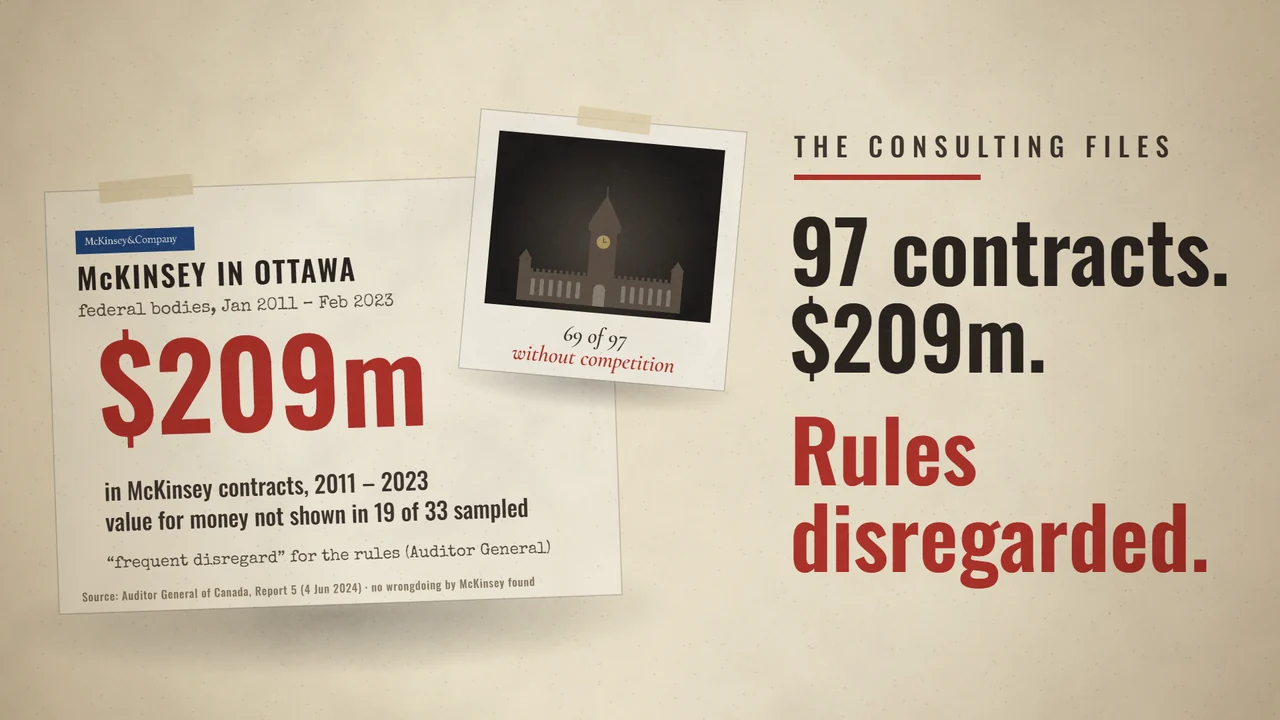
Commissioning bodies can reduce this risk by publishing the question and key assumptions, asking for sensitivity analysis on the assumptions that matter most, and inviting independent review before the results are used. Advisers can help by stating which inputs were set by the client and which were their own. The Canadian federal contracts case shows a related problem: when files do not record what was asked and what was delivered, reviewers cannot judge value later.
The client owns the conclusions, and the scrutiny
The department was right that a government owns its plan. Ownership comes with the obligation to explain the evidence. In this case, that explanation arrived late, under pressure and after the decision had been announced internationally. McKinsey was not accused of wrongdoing in any source reviewed here, and the criticism was directed at the government’s process.
For consultants, the practical takeaway is still direct. When your analysis may become a government’s public evidence, agree early how it will be attributed, when it will be released and how its limits will be stated. Write it so that it can be read aloud in parliament without embarrassment, because sooner or later, it may be.
TAKE IT INTO THE NEXT MEETING
Three practical lessons
Your analysis can become the policy argument
When a government cites your work, your name, fees and assumptions may be read out in parliament. Write the work so that it can be defended in public.
The client owns the conclusions, and the scrutiny
A government may rightly say it owns the plan. If the numbers stay secret, observers will still ask who wrote them. Agree early what will be published, and when.
Price is a story too
A fixed-price contract with named staff and no hours will be divided by someone. Be ready to explain what the team produced, not only what it cost.
Questions about the case
How much did Australia pay McKinsey for net zero analysis?
About A$6.16 million under two 2021 contracts: one that grew from $1.9 million to $4.86 million after two amendments, and a second worth $1.29 million for about six weeks of work.
Did McKinsey do the government’s net zero modelling?
Not all of it. The published report says the core economic modelling was run by the Industry department with economists from several agencies, complemented by supplementary analysis commissioned from McKinsey, including the jobs estimates.
Why was CSIRO part of the controversy?
CSIRO, the national science agency, bid for the work and was unsuccessful. Senators and the CSIRO Staff Association questioned the decision. In 2022 the CSIRO itself awarded McKinsey a separate $1.21 million contract.
THE EVIDENCE TRAIL
Sources & editorial notes
Adapted from the original XLSlides documentary, with additional analysis. Published 13 November 2026. Sources have different roles: primary records, investigative reporting and the positions of affected parties.
- InnovationAus: Govt paid McKinsey $6m for net-zero modelling work, 29 October 2021 ↗The two contracts, the amendments, the AusTender description and the department’s “very much responsible” statement. The site blocks automated checks; read in a browser.
- InnovationAus: Govt bypassed CSIRO to give $6m net-zero contract to McKinsey, November 2021 ↗Dr Peter Mayfield’s estimates evidence on the tender and Senator Walsh’s comment.
- CSIRO Staff Association: CSIRO staff slam outsourced net-zero modelling, 26 November 2021 ↗The union’s criticism and value-for-money question; a party’s view, not a finding.
- InnovationAus: Just seven McKinsey staff used on $1.2m, six-week report, November 2021 ↗The minister’s written answers on staffing and hours, his defence of McKinsey, and the Adams and Climate Council critiques.
- InnovationAus: Govt spends 5x more on climate ads than net-zero modelling work, 2022 ↗The roughly $31m campaign, Senator McAllister’s ratio and the secretary’s value-for-money reply.
- AAP, via Bega District News: Firm reaped $6 million for climate work, 28 October 2021 ↗Exact contract values, the cabinet-in-confidence position and the “next few weeks” promise.
- The Canberra Times: senators press for net zero modelling, 28 October 2021 ↗“Not yet suitable for publication” and Senator McAllister’s secrecy question.
- The Canberra Times: Treasury concedes no detailed assessment of the modelling, 27 October 2021 ↗Treasury’s limited role and the public interest immunity claim.
- RenewEconomy: net zero modelling complete but unpublished, 28 October 2021 ↗Spreadsheet-stage modelling and the blocked House motion.
- The New Daily: Morrison’s net zero plan unveiled, 26 October 2021 ↗The plan’s launch, export and coal-demand figures, technology investment and coalition politics.
- Australian Government: Long-Term Emissions Reduction Plan – Modelling and Analysis, November 2021 (APO copy) ↗Primary report: modelling team, McKinsey’s supplementary analysis, abatement shares, the $2,000 and 62,000-jobs estimates and stated limits.
- Consulting.us: McKinsey employees call out firm for advising the largest polluters, 29 October 2021 ↗Summary of The New York Times’s 27 October 2021 report and McKinsey’s response.
- CSIRO Staff Association: CSIRO calls in McKinsey for streamline project, 15 February 2022 ↗The CSIRO’s $1.21m contract with McKinsey and the agency’s description of its purpose.
Image credits & licences
Original illustrations and typography: XLSlides. Documentary stills have been resized and converted to WebP for this article. Underlying images retain the credits supplied with the episode.
- McKinsey and The New York Times logos: public domain (text logos), via Wikimedia Commons.
- XLSlides logo: XLSlides.
- People are shown as silhouettes and organisations as name cards; everything else is drawn. Scenes marked "illustrative" are not to scale.
FROM EVIDENCE TO A RECOMMENDATION
Make the reasoning visible.
Use clear action titles, sourced exhibits and an explicit decision. XLSlides helps turn your analysis into an editable presentation; the evidence and judgment remain yours to verify.
Build a case-study presentation