XLSlides
A Senate answer about China
On 6 February 2024, the leaders of four consulting firms testified at a U.S. Senate hearing about their work for foreign governments. One of them was Bob Sternfels, the global managing partner of McKinsey & Company. Asked about China, he said, as reported by the Associated Press, that McKinsey had never worked for the Chinese Communist Party or the central government in China, “to the best of my knowledge”.
Eight months later, three members of Congress quoted that answer in a letter of nearly 17 pages and said McKinsey may have misrepresented its relationship with the Chinese government. Their claims are allegations, and McKinsey declined to comment on them. This case follows a firm that served clients on both sides of a growing rivalry, and asks what it owed each of them.
The business
McKinsey sells advice: teams of consultants, priced by the project, for companies and governments around the world. Press reports put its revenue at between $15 billion and $16 billion a year, and Consulting.us reported about 45,000 employees in 2025. Two of its markets matter here. One is the U.S. government, which McKinsey says it serves through a separate legal entity, with separate operational structures and, where required, separate information technology. The other is China, where McKinsey set up in the 1990s. By 2021, according to NBC News, its website said it had more than 1,000 people in six offices and had completed more than 1,500 engagements in five years.
Side one: the Pentagon
Federal spending records show that since fiscal year 2008, U.S. agencies have obligated about $1.17 billion in contracts to McKinsey. By far the biggest buyer is the Department of Defense, at about $568 million, close to half. These are USAspending.gov contract obligations queried in November 2026; earlier reporting and the 2024 congressional letter used different totals for different periods.
According to NBC News, the defence work covered weapons budgets, the Pentagon’s IT network, the modernisation of naval shipyards, technology for the Space Force and the Air Force, and management of the F-35 fighter programme. NBC reported that one 2015 contract gave McKinsey’s team access to classified information.
Side two: China
In 2018, The New York Times reported, as summarised by Consultancy.asia, that McKinsey had advised at least 22 of China’s 100 biggest state-owned companies. McKinsey responded that the reporting gave a misleading picture of its work. One of those companies was China Communications Construction Company (CCCC), which announced in 2015 that McKinsey had made recommendations on its overall strategic objectives.
According to U.S. authorities cited by NBC News, CCCC and its subsidiaries built artificial islands in the South China Sea, and experts told NBC that more than 3,000 acres were turned into military bases. In 2020 the Pentagon listed CCCC among companies with ties to the Chinese military. NBC noted that the listing came after McKinsey’s contracts were already in effect. McKinsey has also acknowledged commercial links to COSCO, China’s state shipping group, which has not been blacklisted.
The firewall
How can one firm serve both? McKinsey’s answer is the firewall. It told NBC News that it follows strict protocols, including staffing restrictions and internal firewalls, to avoid conflicts of interest and protect client information. It said its work in China was mostly for private-sector and multinational companies, and that it does not serve any clients in China on topics connected to defence, intelligence, justice or police issues.
NBC found that four federal contracts it obtained, including with the Defense Department and the Navy, made no mention of McKinsey’s clients in China. Under federal law, contractors must disclose possible conflicts of interest. Whether those contracts required such a disclosure is a legal question that no court or agency is reported to have decided; Consulting.us noted in 2022 that there were no allegations at that time that McKinsey had violated contracting laws.
Follow the money
Over about 18 fiscal years, the Pentagon’s $568 million works out to roughly $30 million a year, and all federal contracts together to about $60 million a year. On our arithmetic, against revenue of about $15 billion, that is less than half of one per cent. The China side is harder to measure, because McKinsey does not publish what it earns there. The lawmakers’ 2024 letter gives one figure: it alleges that McKinsey accepted nearly $1.4 million from the Chinese government in 2019 to develop a strategic plan for the city of Qingdao. Both sides were small slices of revenue. The concern raised by critics was never the size of the fees, but who was in the room.
A firewall protects information; disclosure informs the client
- 01Map the client portfolio
List clients by country, ownership and sector, including state-owned and later-listed entities.
- 02Test against each buyer’s rules
Check each government engagement’s conflict-of-interest clauses against that portfolio before signing.
- 03Disclose and refresh
Tell the client what it needs to judge the conflict, and repeat the check when lists or sanctions change.
Washington reacts
Senator Marco Rubio had earlier proposed that federal contractors disclose any contract with the Chinese government or entities it controls, describing McKinsey’s China ties as an “institutional conflict of interest”, according to Nextgov. In July 2022, after NBC’s reporting, Senators Joni Ernst, Gary Peters and Maggie Hassan introduced the CONSULT Act, which would require firms to disclose work for adversaries such as China and Russia or risk losing federal contracts. “The U.S. is playing a dangerous game,” Ernst said.
Senator Josh Hawley went further. His Time to Choose Act would bar agencies from hiring consulting firms that also advise covered Chinese government entities. On 15 May 2024, the Senate Homeland Security and Governmental Affairs Committee passed it by 10 votes to 1, according to Mayer Brown. Committee approval is not enactment.
The letter
In October 2024, Representative John Moolenaar, chair of the House Select Committee on the Chinese Communist Party, and Senators Rubio and Ernst wrote to the Defense Secretary and the Attorney General. Their letter alleged that McKinsey had worked on China’s 13th Five-Year Plan, and that in 2020 bankruptcy court filings McKinsey itself had listed Chinese government bodies among its clients. That, they argued, contradicted Sternfels’s February testimony.
They asked the Justice Department to examine whether McKinsey’s defence contracts complied with federal law, and the Pentagon to reconsider whether McKinsey should remain eligible for them. McKinsey declined to comment on the letter, while saying that it does not work for the Communist Party or the central government in China. The sources reviewed for this article do not report any resulting charge or debarment.
The other side
McKinsey has not been charged with any crime. NBC News reported that there is no evidence or allegation that McKinsey damaged U.S. national security. The firm has said it complies with all applicable U.S. contracting laws, including those on conflicts of interest. Its China business shrank. The Wall Street Journal, as cited by the Associated Press, reported that McKinsey cut back on government-linked clients there and cut nearly 500 jobs, about a third of its workforce. The sources reviewed show no enactment of either the CONSULT Act or the Time to Choose Act. A narrower rule did take effect: under section 851 of the defence authorisation act for fiscal year 2025, from 30 June 2026 the Pentagon may not contract with entities that retain lobbyists for Chinese military companies on its list, as described by Covington & Burling.
THE SEQUENCE
A timeline of the case
McKinsey enters China
By 2021 its website described more than 1,000 people in six offices. [1]
Two engagements
CCCC announces McKinsey’s strategy recommendations; NBC reports a 2015 defence contract with classified access. [1]
The New York Times report
McKinsey is reported to have advised at least 22 of China’s 100 biggest state-owned companies. [5]
CCCC listed by the Pentagon
The Defense Department lists CCCC as having ties to the Chinese military, after McKinsey’s contracts were in effect. [1]
NBC News investigation
Four federal contracts obtained by NBC do not mention McKinsey’s China clients. [1]
CONSULT Act introduced
Senators Ernst, Peters and Hassan propose disclosure of work for adversary governments. [3]
Senate testimony
Sternfels says McKinsey has never worked for the CCP or China’s central government “to the best of my knowledge”. [6]
Time to Choose Act in committee
A Senate committee approves the bill 10 to 1; no enactment is reported. [8]
Lawmakers’ letter
Moolenaar, Rubio and Ernst allege misrepresentation and ask DOJ and DoD to act. [7]
A narrower rule takes effect
Section 851 restricts Pentagon contracts with entities retaining lobbyists for listed Chinese military companies. [10]
A firewall and a disclosure answer different questions
McKinsey’s defence of its position rested on a firewall: staffing restrictions, internal controls and a separate legal entity for U.S. government work. Those measures answer an important question, which is whether confidential information from one client can reach another. They do not answer a second question, which is whether the client knows enough about the firm’s other relationships to decide for itself whether it is comfortable. The first is a control the firm operates. The second is a judgment that belongs to the client.
Much of the dispute in this case sits in the gap between those two questions. NBC News reported that four federal contracts it obtained made no mention of McKinsey’s clients in China. Whether any of those contracts legally required such a disclosure is a matter for contracting officers and lawyers, and no charge or finding is described in the sources used here. For practitioners, the useful point is narrower and more practical: a well-built firewall does not relieve a firm of the obligation to tell a client what the client needs to know. When the client is a defence department, the threshold for “needs to know” is likely to be low.
The same pattern appears in the bankruptcy disclosure case, where the question was not whether McKinsey misused information but whether courts had been told enough about its connections. In both cases the safest assumption is that the client, not the adviser, decides which relationships matter.
Client portfolios now carry geopolitical risk
For most of the period covered here, advising a large Chinese state-owned construction or shipping group was a commercial decision. China was a major market, its state-owned companies were among the largest buyers of strategy advice in the world, and many Western firms served them. The New York Times reported in 2018 that McKinsey had advised at least 22 of China’s 100 biggest state-owned companies.
What changed was the context. In 2020 the Pentagon listed China Communications Construction Company among companies with ties to the Chinese military. NBC noted that the listing came after McKinsey’s contracts were already in effect. A client that looked unremarkable when the work was signed became, a few years later, a client that members of Congress could cite in a letter about defence contracting.
That sequence matters for every firm with a global portfolio. Sanctions lists, entity lists and procurement restrictions change faster than engagement cycles. A practical response is to treat the client portfolio as a risk register that is re-screened whenever a relevant list changes, not only at the moment of contracting. The enterprise risk management presentation guide offers a structure for showing a board which exposures have moved since the last review and what has been done about them.
The money was small, the exposure was not
On our arithmetic from USAspending.gov, the Defense Department’s roughly $568 million in obligations since fiscal year 2008 averages about $30 million a year. All federal work together averages about $60 million a year, which is well under one per cent of McKinsey’s reported revenue. The China side cannot be measured from public sources; the only figure in this record is the lawmakers’ allegation of nearly $1.4 million for a Qingdao strategic plan in 2019.
Small fees can still carry large consequences. The risk in this case was never that either client generated a large share of revenue. It was that the same firm was trusted by two governments whose interests were increasingly in conflict, and that its explanations would be tested in public. A firm that measures risk only by revenue will underweight engagements like these. A better measure considers who the client is, what access the work gives, and how the relationship would read in a hearing.
Testimony is a disclosure too
The cold open of this story is a qualified answer given under oath: McKinsey had never worked for the Chinese Communist Party or the central government in China, “to the best of my knowledge”. Eight months later, three lawmakers alleged that the firm had worked on China’s 13th Five-Year Plan and had listed Chinese government bodies among its clients in 2020 bankruptcy filings. McKinsey declined to comment on the letter, and the allegations were not adjudicated.
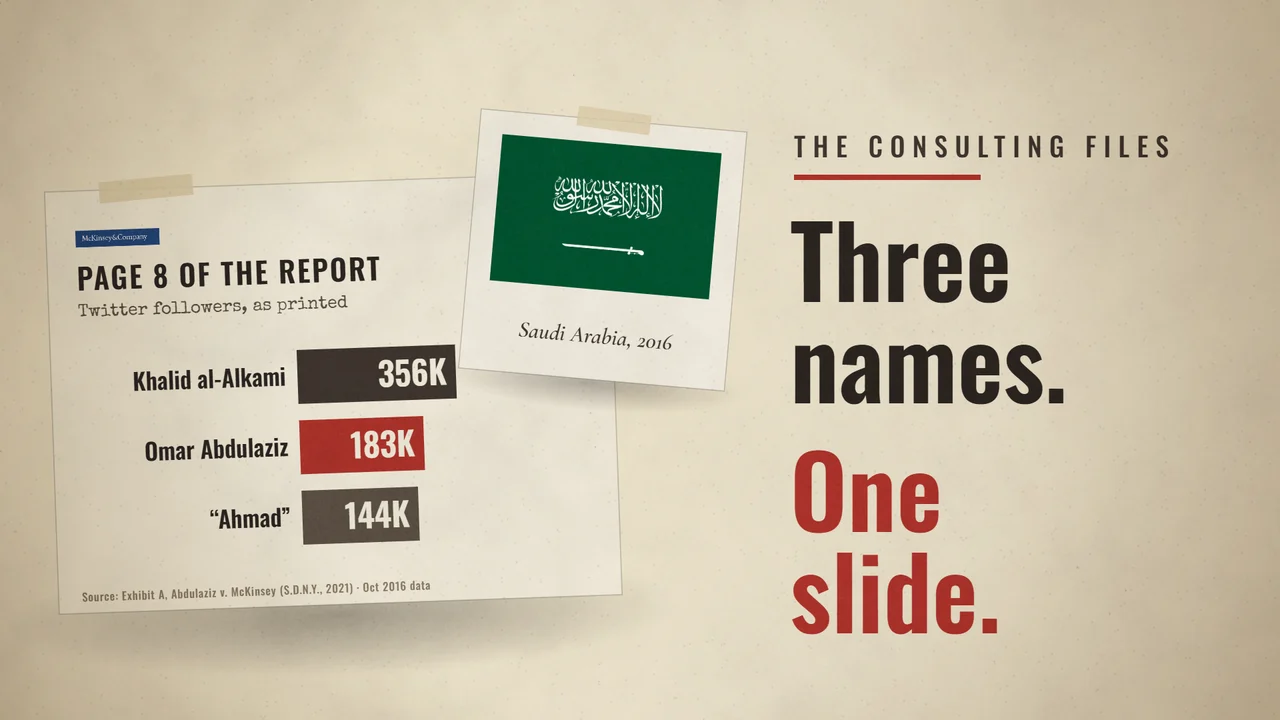
Whatever the merits, the episode shows how statements made in different forums can be set side by side. A court filing, a client list, a website boast about engagement numbers and a hearing answer are all public statements about the same firm. Before senior leaders testify, the facts they are likely to be asked about should be checked against everything the firm has already said elsewhere. The Saudi Arabia report case shows a related lesson: once a firm’s work for a foreign government becomes a public issue, every earlier document becomes part of the record.
Separate entities need separate evidence
McKinsey said it serves the U.S. government through a separate legal entity, with separate operational structures and, where required, separate information technology. Structural separation of this kind is common in regulated industries, and it can be effective. Its value depends on evidence that the separation works: who is staffed where, which systems are shared, how exceptions are approved and how the arrangement is audited.
When a firm relies on separation as its answer to a conflict question, it should be able to show that evidence to a client or a regulator quickly. Policies alone are rarely persuasive in a hearing. Logs, staffing rules, audit results and named owners are. The Puerto Rico debt case shows how an information barrier can come under scrutiny even when no misuse is alleged.
Legislation lags, but buyers do not wait
None of the bills described in this case appear to have become law. The CONSULT Act would have required disclosure of work for adversary governments; the Time to Choose Act would have barred agencies from hiring firms that advise covered Chinese government entities. A narrower rule did take effect in June 2026, restricting Pentagon contracts with entities that retain lobbyists for listed Chinese military companies.
Firms should not read the absence of a statute as the absence of a requirement. Government buyers can ask questions in solicitations, add clauses to contracts and weigh reputational risk when choosing suppliers, without any new law. The practical course is to prepare as if disclosure were already required: maintain an accurate, current view of sensitive clients, decide in advance how it will be shared with government buyers, and make sure the answer is consistent across contracts, testimony and public statements.
Presenting the conflict question to a client
When a firm serves clients on different sides of a geopolitical divide, the clearest way to handle it is to put the question on the table early. A short disclosure note can state the relevant client categories, the controls in place, the evidence that they work and the point of contact for further questions. That is uncomfortable, but it is far less uncomfortable than having a journalist or a congressional committee present the same facts first.
The management consulting presentation guide recommends leading with the decision the audience must make. In a conflict disclosure, that decision is whether the client is content to proceed with full knowledge of the firm’s other relationships. Giving the client that choice is the core of the lesson here.
TAKE IT INTO THE NEXT MEETING
Three practical lessons
A firewall is not a disclosure
Internal controls protect information inside your firm. Disclosure lets the client decide whether the arrangement is acceptable. Government buyers usually need both.
Client lists carry geopolitical risk
A client that is unremarkable when you sign can be listed by a government two years later. Re-screen the portfolio when sanctions, entity lists or procurement rules change.
Testimony must match the record
When leaders describe the firm’s clients under oath, check the answer against filings, contracts and earlier public statements. A qualifier such as “to the best of my knowledge” does not prevent a later dispute.
Questions about the case
Was McKinsey charged over its China work?
No. McKinsey has not been charged, and NBC News reported no evidence or allegation that it damaged U.S. national security. The October 2024 letter asked the Justice Department and the Pentagon to review its contracts; the sources reviewed report no resulting charge or debarment.
How much did the Pentagon pay McKinsey?
USAspending.gov shows about $568 million in Defense Department contract obligations to McKinsey from fiscal year 2008 to 2026, out of about $1.17 billion across all federal agencies. Other sources give different totals because they cover different periods and methods.
Did the CONSULT Act or the Time to Choose Act become law?
The sources reviewed show no enactment of either bill. The Time to Choose Act passed a Senate committee 10 to 1 in May 2024. A narrower provision of the fiscal year 2025 defence authorisation act took effect on 30 June 2026.
THE EVIDENCE TRAIL
Sources & editorial notes
Adapted from the original XLSlides documentary, with additional analysis. Published 13 November 2026. Sources have different roles: primary records, investigative reporting and the positions of affected parties.
- NBC News: Advising both Chinese state companies and the Pentagon, McKinsey comes under scrutiny, 13 November 2021 ↗Principal investigation: defence work, the 2015 classified-access contract, CCCC, COSCO, four contracts without China clients, McKinsey’s firewall statement and the “no evidence or allegation” line.
- NBC News: Senators push for stricter rules on companies advising U.S. adversaries, 13 July 2022 ↗The CONSULT Act and McKinsey’s statement on compliance and its separate legal entity for U.S. government work.
- Nextgov: Bipartisan group seeks to limit who federal agencies can contract with, 15 July 2022 ↗CONSULT Act sponsors, Ernst’s quote and Rubio’s earlier disclosure proposal.
- Consulting.us: U.S. senators push for stronger conflict-of-interest rules, 18 July 2022 ↗Trade cross-check of the CONSULT Act, noting no allegations at that time that McKinsey violated contracting laws.
- Consultancy.asia: McKinsey hits back at New York Times accusations, 20 December 2018 ↗Summary of The New York Times’s 2018 report (22 of China’s 100 biggest state-owned companies, including CCCC) and McKinsey’s response.
- Associated Press, via KSAT: GOP lawmakers seek investigation of consulting firm over its work in China, 18 October 2024 ↗Sternfels’s February 2024 answer, the lawmakers’ letter, McKinsey’s no-comment and the Wall Street Journal’s report of China job cuts.
- House Select Committee on the CCP: release on the McKinsey letter, 18 October 2024 ↗The lawmakers’ allegations: the 13th Five-Year Plan, 2020 bankruptcy filings and the Qingdao plan; requests to DOJ and DoD. Allegations, not findings.
- Mayer Brown: U.S. Senate committee passes legislation on consulting firms that also work for China, 23 May 2024 ↗Law-firm summary of the Time to Choose Act and the 10–1 committee vote.
- USAspending.gov: federal award search (McKinsey & Company contract obligations by awarding agency, FY2008–FY2026) ↗Official spending data, queried by the documentary team on 7 November 2026: about $1.17bn in total and $568m from the Defense Department. Obligations, not payments.
- Covington & Burling: new law appears to restrict defence contractors from retaining consultants who lobby for Chinese military companies, 6 January 2025 ↗Law-firm analysis of section 851 of the FY2025 defence authorisation act and its 30 June 2026 effective date.
- Consulting.us: McKinsey tells China practice to stop advising on gen AI, 28 July 2025 ↗Trade reporting of McKinsey’s global headcount and reduced China workforce; context only.
Image credits & licences
Original illustrations and typography: XLSlides. Documentary stills have been resized and converted to WebP for this article. Underlying images retain the credits supplied with the episode.
- McKinsey and The New York Times logos: public domain (text logos), via Wikimedia Commons.
- XLSlides logo: XLSlides.
- People are shown as silhouettes; CCCC, COSCO and the US Department of Justice as name cards. Everything else is drawn; scenes marked "illustrative" are not to scale.
FROM EVIDENCE TO A RECOMMENDATION
Make the reasoning visible.
Use clear action titles, sourced exhibits and an explicit decision. XLSlides helps turn your analysis into an editable presentation; the evidence and judgment remain yours to verify.
Build a case-study presentation