Key Takeaways
- Consulting presentations are decision documents, not visual decoration.
- The strongest decks lead with the answer, then prove it with structured analysis.
- Action titles, MECE logic, source notes, and executive summaries matter more than theme styling.
- AI is useful when it creates the first structured draft and leaves the final judgment to the business owner.
What Makes A Consulting Presentation Different
A consulting deck needs to work even when the presenter is not in the room. Executives often skim slides between meetings, forward individual pages to other stakeholders, or make decisions from an appendix page.
That changes the standard. Each slide needs one message, a specific action title, and enough evidence to make the recommendation credible without adding unnecessary detail.
The Executive Standard For Management Consulting Slides
Management consulting presentations are built for decisions that carry cost, risk, timing, and stakeholder consequences. A normal business deck may explain a topic; a consulting deck has to move a senior audience from ambiguity to a clear decision. That means the deck cannot rely on decorative design, broad claims, or a presenter doing all the work live. The pages themselves need to carry the logic.
For consultants, finance teams, and business executives, the useful standard is simple: can a skeptical reader understand the recommendation by reading the slide titles, scanning the exhibits, and checking the source notes? If the answer is no, the deck is not ready. A consulting-grade presentation must make the point visible before the audience has to interpret every chart.
This is why the best consulting pages feel dense but not confusing. They use compact text, clear hierarchy, source notes, chart labels, and appendix discipline. They do not avoid complexity; they organize complexity so a partner, CFO, client sponsor, or board member can act on it.
Management Consulting Presentation Types
Different consulting situations need different page sequences. The same generic structure should not be reused for every executive deck.
| Presentation Type | Primary Decision | Core Slides | Common Failure Mode |
|---|---|---|---|
| Strategy recommendation | Which path should leadership choose? | Executive summary, situation, options, recommendation, economics, roadmap | Too much context before the answer |
| Market entry | Should we enter, where, and how? | Market sizing, segment attractiveness, competitive map, entry options, risk plan | Large TAM with no route to win |
| Cost transformation | Where can the business remove cost without damaging performance? | Cost baseline, driver tree, initiative sizing, implementation roadmap, governance | Savings claims without owner or timing |
| Due diligence | Is the asset attractive enough to proceed? | Market thesis, company performance, risk flags, synergy case, diligence open items | Optimistic narrative with weak downside analysis |
| Operating model | How should work, roles, and decisions change? | Current-state pain points, design principles, future-state model, transition plan | Boxes and org charts without decision rights |
| Board update | What should directors know, challenge, or approve? | CEO summary, KPI movement, strategic issues, capital allocation, decision requests | Reporting activity instead of surfacing decisions |
Executive Summary Visual Standard
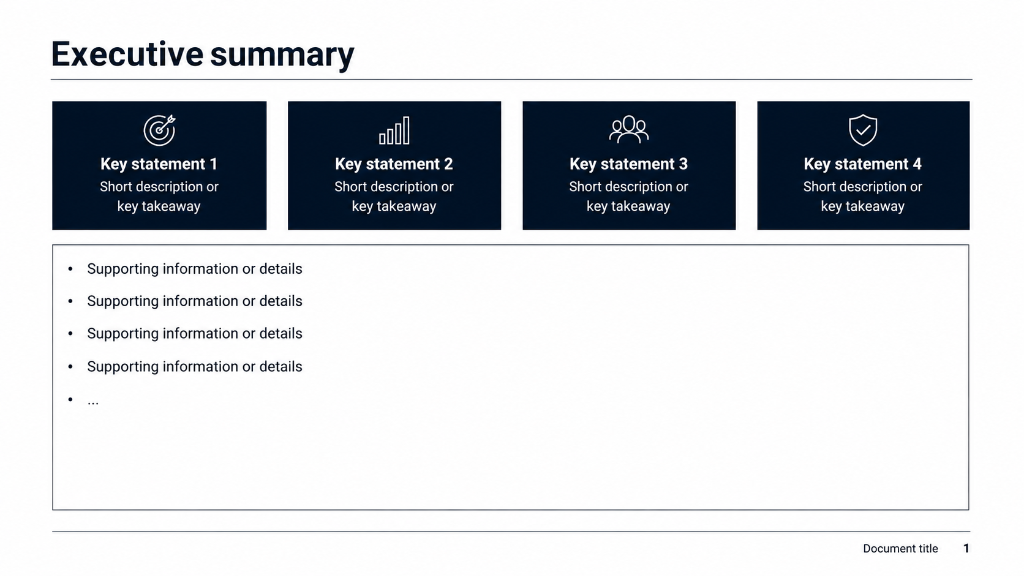
Consulting Deck Vs. Standard Business Deck
Use this comparison to decide whether a page should be treated as an executive decision document.
| Dimension | Standard Business Deck | Consulting-Grade Deck |
|---|---|---|
| Headline | Topic label | Conclusion or recommendation |
| Structure | Narrative order | Answer-first logic |
| Evidence | Selective support | Traceable proof points |
| Audience | Live presentation | Skimmable executive document |
| Design goal | Polish | Clarity under time pressure |
Slide Title Rewrite Matrix
A useful title tells the executive what to conclude, not just what the slide contains.
| Weak Topic Title | Consulting Action Title | Why The Rewrite Works |
|---|---|---|
| Market overview | Enterprise demand is expanding fastest in regulated verticals | It turns a topic into an implication |
| Customer segments | Three segments account for most near-term adoption potential | It tells leadership where to focus |
| Financials | Margin pressure is driven by service delivery complexity, not pricing | It explains the driver behind the metric |
| Risks | Implementation risk is manageable if governance starts before pilot launch | It connects risk to mitigation |
| Roadmap | A 90-day pilot can validate economics before full rollout | It links the plan to the decision threshold |
| Next steps | Leadership needs to approve scope, owner, and success metrics this week | It makes the ask explicit |
How To Build The Storyline Before Designing Slides
The fastest way to improve a management consulting presentation is to separate storyline from slide design. First write the answer in plain language. Then list the three to five arguments needed to support that answer. Only after the logic is clear should the team choose layouts, charts, and page density.
A strong storyline usually follows a situation, complication, recommendation, proof, and action flow. The situation explains the business context. The complication defines what changed or why leadership must act now. The recommendation states the preferred decision. The proof sections support the recommendation with market, customer, financial, operational, and risk evidence. The action section turns the recommendation into ownership, timing, and next steps.
This order keeps the deck from becoming a collection of impressive but disconnected slides. It also makes AI generation more useful. When the prompt contains the decision, hypothesis, evidence, and audience, the generated deck starts closer to a real consulting work product.
Real Executive Summary Layout
Consulting Slide Example
Recommended 12-Slide Consulting Deck Structure
| Slide | Purpose | Executive Question Answered |
|---|---|---|
| Executive summary | State the answer | What should we do? |
| Situation | Set business context | Why now? |
| Complication | Define the problem | What changed? |
| Recommendation | Show preferred path | What is the decision? |
| Market context | Quantify external forces | How large is the opportunity or risk? |
| Customer / segment view | Prioritize demand | Where should we focus? |
| Economics | Explain financial impact | What is the value? |
| Options analysis | Compare alternatives | Why this path? |
| Risks | Surface tradeoffs | What could go wrong? |
| Implementation roadmap | Sequence execution | How do we move? |
| Governance | Assign ownership | Who does what? |
| Appendix | Preserve proof | Where is the detail? |
Three-Column Consulting Logic
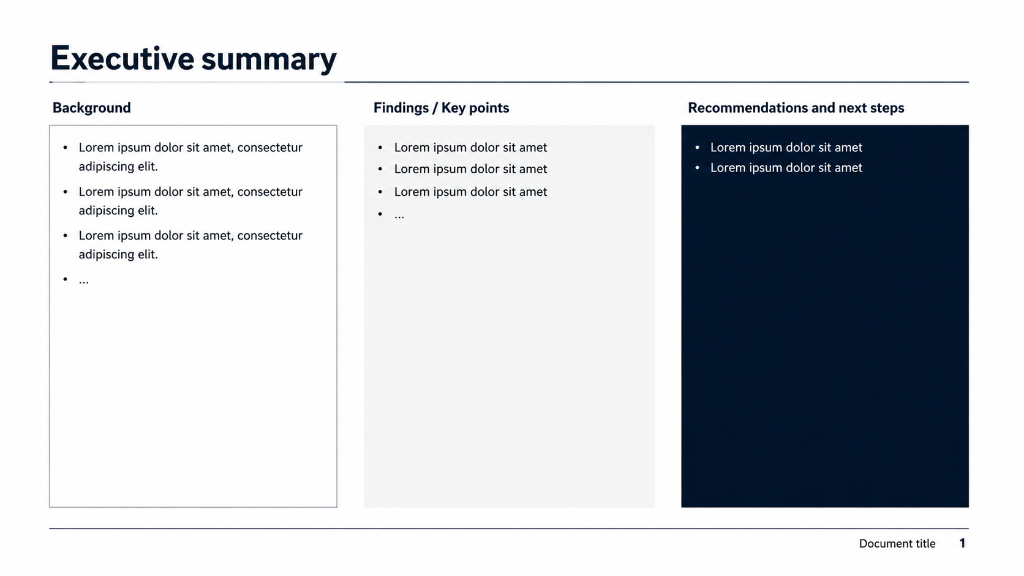
Content Modules To Include
| Module | Why It Helps | Best Page Fit |
|---|---|---|
| Key takeaways | Answers quickly for executives and AI summaries | Every pillar page |
| Framework table | Makes the methodology concrete | Guides and templates |
| Slide structure table | Turns advice into an artifact | Deck generator pages |
| Before / after critique | Shows judgment and quality bar | Design pages |
| Prompt recipe | Connects education to product action | AI workflow pages |
| Checklist | Creates skimmable utility | All executive guides |
Evidence Standards By Slide Type
Consulting slides should make clear what kind of proof supports each claim.
| Slide Type | Evidence Needed | Minimum Source Discipline |
|---|---|---|
| Market sizing | Top-down and bottom-up estimate, assumptions, sensitivity | Show source, formula, and assumption range |
| Benchmarking | Peer set, metric definition, time period | Name peer group and normalize metric definitions |
| Financial impact | Baseline, driver assumptions, bridge or scenario model | Show calculation logic and owner-reviewed assumptions |
| Customer insight | Interview count, survey method, usage data, segment definition | Separate observed evidence from interpretation |
| Options analysis | Decision criteria, scoring logic, tradeoff explanation | Disclose weights or qualitative rationale |
| Implementation roadmap | Milestones, owners, dependencies, risks | Tie timing to real constraints and governance |
What To Automate And What To Keep Human
Automation is valuable when it handles repeatable presentation mechanics: turning a brief into an outline, proposing slide titles, mapping each page to a layout, creating a first-pass executive summary, generating table structures, and converting rough notes into a cleaner storyline. These tasks consume a lot of analyst time but do not require final strategic authority.
Human judgment should stay in the parts that affect credibility: choosing the recommendation, validating source data, deciding what assumptions are acceptable, handling political constraints, and identifying which risks executives will actually challenge. A good pSEO page for this audience should make that boundary explicit because consultants and finance leaders do not trust content that pretends AI can replace judgment.
For XLSlides, this means the product call to action should not promise a finished board-approved deck from one vague prompt. The stronger message is that XLSlides creates a serious editable first draft: a structured deck with action titles, executive-ready sections, chart placeholders, appendix logic, and prompts that help the user move faster while still reviewing the work.
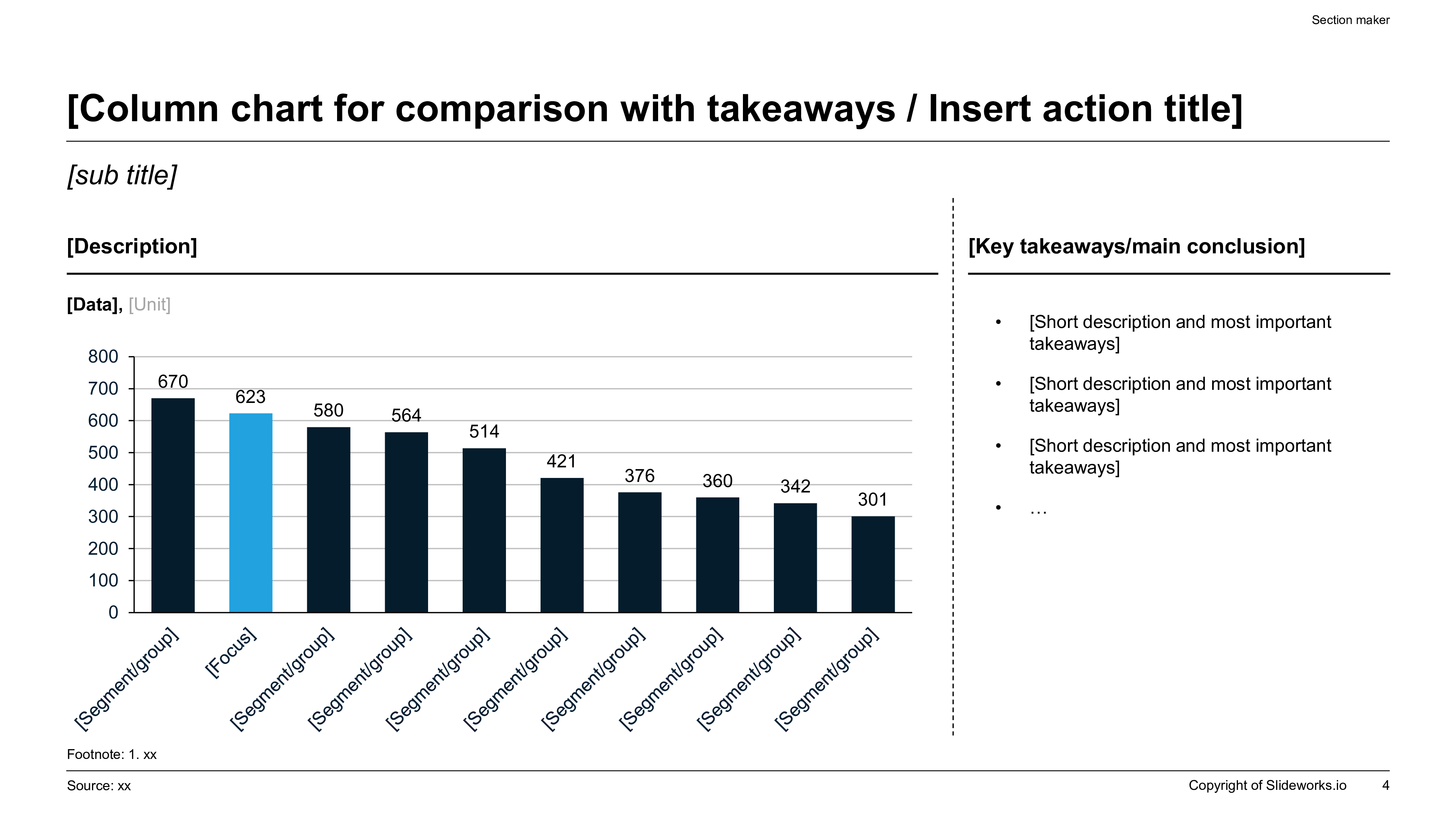
Data Comparison Reference
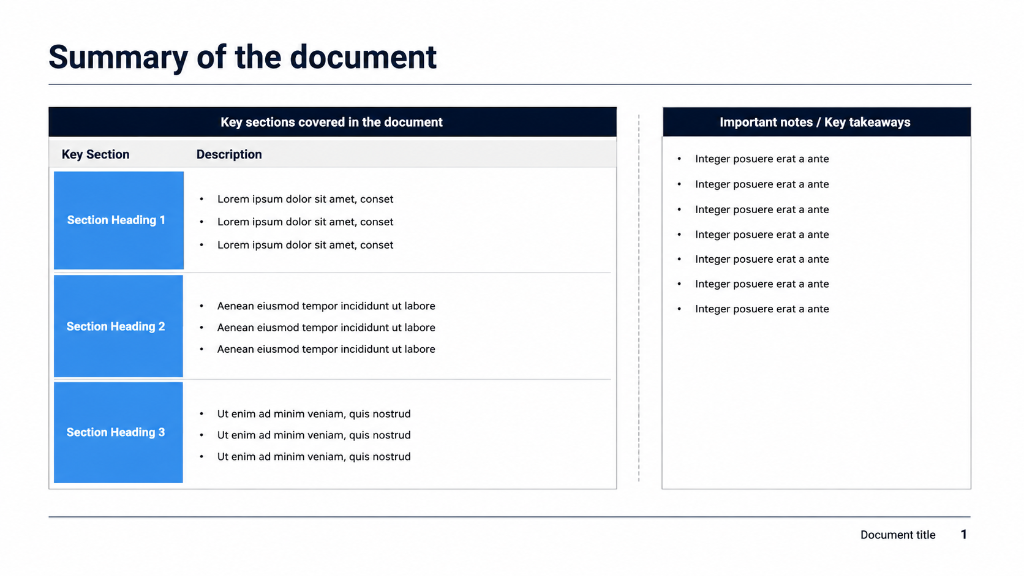
Split-Panel Executive Summary
How To Review A Consulting Deck Like A Partner
A partner-style review starts with the storyline, not the formatting. Read only the slide titles first. If the titles do not form a coherent argument, the deck is not ready for visual polish. The title sequence should make the case: what is happening, why it matters, what the recommendation is, why that recommendation is credible, what risks exist, and what decision is needed.
The second pass is evidence. Every slide should earn its place in the main flow. If a page does not support the recommendation or answer a likely executive objection, move it to the appendix. If a chart does not prove the title, rewrite the title or change the chart. If a number is important enough to influence the decision, add a source note, calculation note, or assumption note.
The final pass is executive usability. Remove repeated points, tighten labels, make the key number visually obvious, and check that the audience can understand the slide in under thirty seconds. This is also where AI output needs the most scrutiny. Generated wording can sound confident even when the logic is generic, so the reviewer should look for unsupported claims, vague recommendations, missing tradeoffs, and action titles that are really just topic labels.
Quality Checklist Before Sending A Consulting Deck
XLSlides Prompt Recipe
Create a 12-slide management consulting presentation for a corporate strategy recommendation. Use an answer-first executive summary, MECE issue tree logic, market sizing, options analysis, financial impact, risk mitigation, and a 90-day implementation roadmap. Use action titles on every slide and make the tone suitable for a C-suite audience.
FAQ
What is the difference between a consulting presentation and a normal business presentation?
A consulting presentation is structured as a decision document. It leads with the answer, uses action titles, supports every recommendation with evidence, and is designed so executives can understand it quickly without a live explanation.
How many slides should a consulting deck have?
Most executive consulting decks work best when the core storyline is 10 to 20 slides, with detailed proof and backup analysis moved into the appendix.
Can AI generate a consulting-grade deck?
AI can create a strong first draft if the prompt specifies the decision, audience, structure, evidence requirements, and slide style. Human review is still needed for logic, sources, and final recommendations.
What should every consulting presentation include?
A serious consulting presentation should include an executive summary, clear recommendation, structured problem logic, evidence pages, financial or operational impact, risks, implementation path, decision ask, and appendix support. The exact sequence changes by use case, but the deck should always make the decision easier.
How do I know if a consulting slide title is strong?
A strong consulting slide title states the conclusion or implication of the page. If the title could appear on any generic deck, it is too weak. Replace topic labels like Market Overview with a sentence that tells the executive what the market evidence means.
Generate A Consulting-Grade First Draft
Start from the same structure described in this guide and let XLSlides create the first editable deck draft.