 XLSlides
A short report enters a much larger story
On October the twentieth, 2018, the New York Times published a story about how Saudi Arabia hunts its critics online. It came eighteen days after the journalist Jamal Khashoggi walked into the Saudi consulate in Istanbul, and never walked out. Deep in the story was a name nobody expected. McKinsey and Company. The Times reported that McKinsey had studied how Saudis felt about cuts to their benefits, on Twitter.
It found three people driving the conversation. And according to the Times, one was later arrested. Two brothers of the second were jailed. The third account was shut down.
A kingdom built on oil
To understand the report, start with the money. For decades, Saudi Arabia ran on oil. Oil paid for public jobs, cheap fuel and generous benefits. About two in every three working Saudis were employed by the state. Then, from mid-2014, the oil price collapsed. In 2015, the government took in six hundred and eight billion riyals. It spent nine hundred and seventy-five billion.
The gap was three hundred and sixty-seven billion riyals. About ninety-eight billion dollars. A record deficit.
Source context: [6]
The Ministry of McKinsey
The kingdom needed a new plan. And consultants were ready. In December 2015, the McKinsey Global Institute published a study called "Moving Saudi Arabia's Economy Beyond Oil." It was not commissioned by the government. Four months later, the young deputy crown prince, Mohammed bin Salman, launched Vision 2030. Analysts at the Brookings Institution noted how closely it echoed McKinsey's study.
The prince had told The Economist: "McKinsey participates with us in many studies." According to the Financial Times, some businessmen took to calling the planning ministry the "McKinsey Ministry."
Source context: [7]
The cuts
In September 2016, the bill arrived for ordinary Saudis. Royal decrees cut ministers' pay by twenty percent. Public employees lost their annual bonus. Overtime pay was capped. And people complained, in public, on Twitter. Saudis were heavy Twitter users. One figure, later quoted in McKinsey's own analysis, put it at more than half a million tweets a day.
Nine pages
Somewhere inside McKinsey, someone was measuring that reaction. A copy of the analysis was later filed in court. It is nine pages long. It covers one month of tweets, from late September to late October 2016. More than twenty thousand tweets, from more than eighty thousand people. The most discussed complaint was a cut to university allowances. Then new highway fees.
Then comes page eight. Its title: "Major influencers in Saudi driving discussion regarding austerity measures." Three accounts. The writer Khalid al-Alkami, with about three hundred and fifty-six thousand followers. Omar Abdulaziz, a young dissident living in Canada. And an anonymous account called "Ahmad." Of Omar, it says he has "a multitude of negative tweets" about austerity and the royal decrees.
Source context: [1]
What happened next
In September 2017, Khalid al-Alkami was arrested, in a wave of arrests of clerics and writers. The free-speech group PEN America says he was held for five years, until December 2022. The account called Ahmad was shut down. Omar Abdulaziz was safe in Montreal. But in the summer of 2018, his phone was infected with Pegasus spyware. Researchers at Citizen Lab linked the operator, with high confidence, to the Saudi government.
That August, two of his brothers were arrested in Saudi Arabia. Omar had been working with a friend on projects to challenge the crown prince online. That friend was Jamal Khashoggi. What no public record shows is whether McKinsey's report played any part in these events.
Public data can create a new exposure
- 01Collect public material
A person’s posts may already be visible individually.
- 02Aggregate and identify
Ranking, context and naming can make a person much easier to target.
- 03Control distribution
Purpose, access and misuse review determine how the analysis should circulate.
Horrified
McKinsey answered the same day. The firm said the report was an internal document, based on public information, and was not prepared for any government entity. It told the Financial Times a junior analyst had written it. "We are horrified," it said, "by the possibility, however remote, that it could have been misused." It said it had seen no evidence of misuse, and was urgently investigating how, and with whom, the document was shared.
Senator Elizabeth Warren wrote to McKinsey's global managing partner, Kevin Sneader, asking, among other things, who had received the report.
The courtroom
In February 2021, Omar Abdulaziz sued McKinsey in New York. His complaint alleged that the firm gave the report to agents of the crown prince, or let them get it. It said his brothers had been tortured. McKinsey called the claim meritless. In September 2021, a federal judge dismissed the case. In July 2022, an appeals court agreed. Under New York law, it said, McKinsey owed Omar no legal duty of care. A risk being foreseeable was not enough.
The courts never decided whether the report reached Saudi officials. The dismissal discussed here did not determine that the report caused the later events or that Saudi officials received it.
Source context: [2]
THE SEQUENCE
A timeline of the case
Social-media analysis
The document examined reactions to austerity measures and named influential accounts. [1]
Spyware findings published
Citizen Lab separately reported on Abdulaziz’s phone. [3]
Public controversy
News reports and oversight questions focused on the analysis and possible misuse. [4]
Lawsuit and dismissal
Abdulaziz filed a claim; the federal court dismissed it. [2]
Appeal resolved
The Second Circuit affirmed the dismissal. [2]
The transformation from public posts to a named list
Information can be public in one form and create a different exposure when it is aggregated. A person may publish individual posts to a general audience. A report can collect those posts, rank the person’s influence, connect the identity to a sensitive topic and make the result easier for another audience to act on. The analytical act changes the usefulness of the information.
That is the research-ethics question in this case. It does not establish that the disputed report caused later events. The litigation and the available reporting leave important factual limits. A responsible article should preserve those limits while examining whether a team ought to assess the risks created by identifying individuals.
Context is essential. A list of prominent contributors to a public discussion may be routine in one setting and sensitive in another. The relevant review considers the topic, the people involved, the possible recipients and the consequences of misuse. A standard social-media template cannot make that judgment automatically.
What the court outcome does and does not answer
Abdulaziz’s complaint alleged that the report reached people who could use it against him and his family. A complaint is the plaintiff’s account of the claim. It is not a factual finding. McKinsey denied wrongdoing and disputed the case. The courts dismissed the claim, with the dismissal affirmed in 2022.
The duty-of-care question should not be replaced with a different conclusion. A dismissal on that basis does not establish that the report caused harm. Nor should the article claim that the court proved every allegation false. The precise outcome matters because legal readers and general readers may otherwise infer opposite things from the same word, dismissed.
The spyware investigation is another separate evidentiary strand. Citizen Lab investigated a device and attributed the operator with stated confidence. That technical evidence does not establish the route by which any consulting document circulated. A timeline can show events together while explicitly declining to draw an unsupported causal arrow between them.
| Evidence category | What it contributes | What it does not establish |
|---|---|---|
| Complaint and exhibit | The plaintiff’s allegations and attached analysis | That every allegation is true |
| Company statement | The firm’s account and denial | Independent verification of that account |
| Technical investigation | Evidence concerning a spyware incident | A causal role for the consulting report |
| Appellate order | The legal outcome and reasoning | A factual trial finding on every event |
A purpose test for naming an individual
Before including a name in a research deliverable, ask what decision requires that identity. If the client needs to understand broad sentiment, aggregated categories may answer the question. If the identity is necessary for a legitimate purpose, the team should document why and consider the minimum information required.
The next question concerns distribution. Who is authorised to receive the report? Could it be forwarded outside that group? Does the material contain information that becomes more sensitive when combined with other data? A statement that the inputs were public does not answer those questions.
Finally, consider the consequence of being wrong. Misidentifying an individual or overstating influence can expose someone without even producing a reliable analysis. The research process should include verification, uncertainty and a route for correcting errors. Those are quality controls as well as ethical safeguards.
An illustrative research redesign
Imagine a fictional team studying public reactions to a benefits-policy change. Its first draft lists the ten most influential critical accounts, with names, locations and a score. The sponsor says the decision is how to improve public communication. The team should test whether that decision actually needs an identifiable list.
A revised deliverable might show themes, frequently misunderstood provisions, the reach of different arguments and examples selected without unnecessary personal details. Where direct engagement with a public organisation is justified, the team could identify that organisation with an explanation of the purpose. It should not add personal location data simply because the data are available.
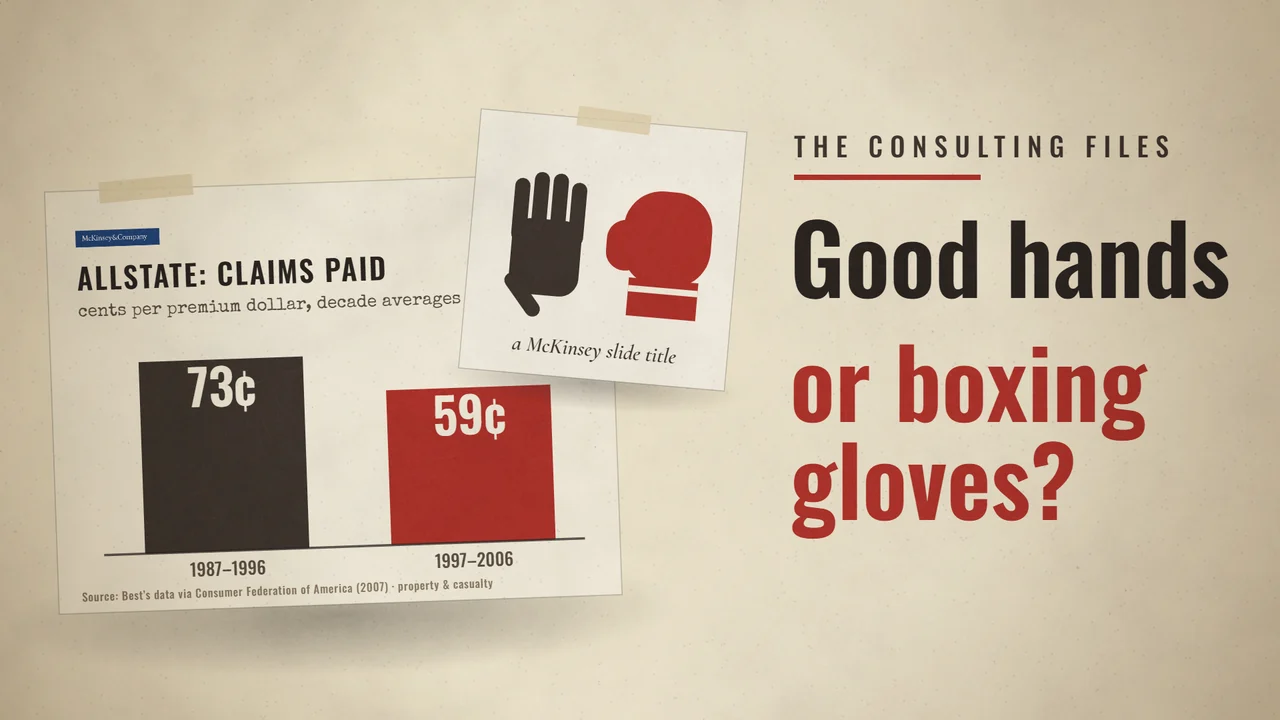
This exercise is illustrative, not a reconstruction of the McKinsey document or a claim that a particular alternative would have prevented harm. It shows how an analyst can preserve useful findings while reducing unnecessary exposure. The Allstate case similarly asks whether the way a problem is framed changes who carries the consequences.
Distribution control is part of research design
A sensitive report should have an accountable owner, a stated audience and an explicit purpose. Access controls can limit circulation, but the team also needs practical rules about export, forwarding and reuse. A document written for one legitimate decision can become problematic if repurposed for another.
Those controls should be designed early. Removing names at the last moment may be difficult if the entire analytical structure relies on ranking individuals. A research brief that begins with the decision and the minimum data required makes a safer and often clearer product. It also makes the final executive summary easier to evaluate.
The Gupta confidentiality case concerns a different information boundary, but the operational lesson overlaps: access and purpose should be explicit. The right to read an input does not create an unlimited right to disclose every derived output.
Keep the surrounding narrative proportionate
The documentary places the report in the wider context of Saudi economic change, public criticism and the treatment of dissidents. Context helps explain why the analysis became controversial. It should not be used to imply that every event in the wider story has the same evidentiary connection to the report.
In particular, no causal link to Khashoggi’s killing is asserted here. Mentioning a shared historical context is different from establishing that link. The visual design should make the difference clear: a sequence of events can use separate lanes, and a disputed relationship should not be drawn as an established money-flow arrow.
An investigative presentation should identify whether a statement is a document fact, a reported allegation, a company response, a court outcome or editorial analysis. That labelling is more useful than a broad disclaimer detached from the page where a reader forms an impression.
The practical standard for an analytical team
The strongest team can explain both why the research is useful and why the chosen form is appropriate. It can justify the inclusion of identifying information, describe its uncertainty, control distribution and show how it considered foreseeable misuse. These questions belong alongside methodological accuracy.
The public procurement case in France asks who owns a recommendation once a public institution uses it. This case asks who may be exposed before a recommendation is even implemented. A well-designed report considers both the decision-maker and the people described in the analysis.
TAKE IT INTO THE NEXT MEETING
Three practical lessons
Review the cost of identification
Ask what naming a person adds to the analysis and what new exposure aggregation creates. Public availability does not make every use ethically equivalent.
Minimise unnecessary personal data
Prefer aggregate findings where individual names are not required for the legitimate question. If names are necessary, document why and restrict distribution.
Separate ethics from legal conclusions
A claim’s dismissal answers a legal question. It does not eliminate the need to assess distribution risks, consent, context and the consequences of misuse.
Questions about the case
Did a court find that McKinsey’s report caused harm?
The outcomes cited here do not establish that causal claim. The lawsuit was dismissed and the dismissal affirmed on duty-of-care grounds. The article distinguishes reported events, allegations and what the courts decided.
What did McKinsey say?
The firm described the report as internal and based on public information, said it was not prepared for a government entity, and said it had no evidence of misuse. That response is essential context.
What should research teams learn?
Assess whether aggregation or naming creates a new risk even where inputs are public. Define the legitimate purpose, minimise identifying information and control who receives sensitive analysis.
THE EVIDENCE TRAIL
Sources & editorial notes
Adapted from the original XLSlides documentary, with additional analysis. Published 29 October 2026. Sources have different roles: primary records, investigative reporting and the positions of affected parties.
- Abdulaziz complaint and report exhibit ↗A plaintiff’s allegations and attached material; not established findings.
- Second Circuit: Abdulaziz v. McKinsey summary order ↗July 2022 dismissal affirmed; legal duty and the limits of the ruling.
- Citizen Lab: The Kingdom Came to Canada ↗Original technical investigation into the separate spyware incident.
- Senator Warren: questions on McKinsey’s Saudi services ↗Contemporaneous oversight questions and quoted firm response.
- PEN America: Khalid al-Alkami ↗The writer’s detention and release history.
- Arab News: Saudi Arabia’s 2015 budget figures ↗Contemporaneous reporting of the fiscal context.
- Brookings: Saudi Arabia’s McKinsey reshuffle ↗Attributed analysis of the economic programme and consulting context.
- NYT report excerpted by the Business & Human Rights Resource Centre ↗The reported controversy and the firm’s contemporaneous response.
Image credits & licences
Original illustrations and typography: XLSlides. Documentary stills have been resized and converted to WebP for this article. Underlying images retain the credits supplied with the episode.
- Mohammed bin Salman: Saudi Press Agency, CC BY-SA 4.0
- Jamal Khashoggi: April Brady / POMED, CC BY 2.0
- Kevin Sneader: World Economic Forum, CC BY 2.0
- McKinsey and New York Times logos, Saudi flag: public domain; Twitter logo: Apache 2.0
- Everything else is drawn. Report pages are redrawn layouts with wording and figures from the court exhibit. The three people named have no free photos and are shown as silhouettes.
FROM EVIDENCE TO A RECOMMENDATION
Make the reasoning visible.
Use clear action titles, sourced exhibits and an explicit decision. XLSlides helps turn your analysis into an editable presentation; the evidence and judgment remain yours to verify.
Build a case-study presentation