XLSlides
Episode premiere: 31 October 2026, 7:30 am IST. The article can be read before the premiere.
A tax question in a Senate hearing
January the eighteenth, 2022. A hearing room in the French Senate, in Paris. A senior partner from McKinsey's French office is under oath. He is asked about tax. His answer: the French firm pays corporate tax in France. Two months later, the senators publish what the tax authorities told them. For ten years, McKinsey's French entities had paid zero euros in corporate tax.
The report landed three weeks before a presidential election. In France, it soon had a name. "The McKinsey Affair."
The client
The client in this story is the French state. Its ministries had been hiring consultants for years. But from 2018 to 2021, their consulting bill more than doubled. From three hundred and seventy-nine million euros, to almost eight hundred and ninety-four million. Add the state's agencies, and the total passed one billion euros in 2021. Strategy and organisation work alone had grown almost fourfold.
The Senate's verdict: hiring consultants had become "a reflex." In the autumn of 2021, at the request of a Communist-led group of senators, the Senate set up a commission of inquiry. For four months it questioned officials and consultants under oath.
The business model
How does a consulting firm earn money from a state? By the day. The Senate found that one consultant-day cost the state about one thousand five hundred euros on average. In the Covid crisis, the average was nearer two thousand two hundred. McKinsey's French business was big. In 2020, it booked three hundred and twenty-nine million euros in revenue, with about six hundred staff.
Only about five percent of that came from the public sector. A small client, in money. But a very visible one.
Behind the scene
Then came Covid. In March 2020, the health ministry turned to consultants to help find masks. Over the crisis, the Senate counted at least sixty-eight orders, worth about forty-one million euros. McKinsey became, in the Senate's words, the "keystone" of the vaccine campaign. Logistics, daily dashboards, a register of about two hundred and fifty key decisions.
Its fees came to about twelve million euros. At the national public health agency, McKinsey ran two briefings a day, at nine and at three. Staff there asked the firm to stop chasing them at three o'clock about tasks set at nine. And it stayed out of sight. McKinsey said it would remain "behind the scene." Its documents carried the ministry's logo, not its own.
The health minister, Olivier Véran, said the firm never made a decision for him.
What the money bought
The Senate also asked: what did the state get? For pension reform, McKinsey was paid about nine hundred and fifty-seven thousand euros. The reform was abandoned. For the education ministry, four hundred and ninety-six thousand eight hundred euros, partly to prepare a conference on the future of teaching. The conference was cancelled. The ministry said it was "not possible to determine the direct consequences" of the work.
And for a new unemployment insurance rule, McKinsey laid out four options. Then wrote that one "seems to be the best solution." The decision belonged to ministers. But the consultants had framed the choice.
Follow the money
Now the tax. The Senate said McKinsey's French entities paid no corporate tax from 2011 to 2020. Its suspicion was transfer pricing: the fees a French branch pays to its parent company abroad. Pay enough of them, and profit at home can turn into a loss. The committee's chair, Arnaud Bazin, said the method itself is allowed under international rules. Whether McKinsey applied it fairly was for the tax authorities to decide.
McKinsey said it respects all applicable French tax rules. It said it had paid four hundred and twenty-two million euros in French taxes and social charges, and that one of its French companies had paid corporate tax for six years.
Make public advice traceable from purchase to decision
- 01Commission the work
State the problem, authority, budget and capability gap.
- 02Attribute the deliverable
Record who produced the advice and the evidence supporting it.
- 03Own the public decision
The administration remains accountable for accepting or rejecting the recommendation.
The campaign
In the middle of an election campaign, the affair exploded. Opponents asked why the state relied so heavily on one firm. Some pointed to Emmanuel Macron's first campaign, in 2017. The news site Mediapart reported that McKinsey consultants had worked for free on that campaign. The partner from the Senate hearing told senators it had been "a mistake" to use his work email to support Macron.
Macron answered on television. If anyone had proof of manipulation, he said, take it to criminal court. On April the twenty-fourth, he was re-elected.
Source context: [4]
The investigations
It went to court. In March 2022, the Senate referred the partner's testimony to prosecutors, as possible perjury. On March the thirty-first, France's financial prosecutors opened an inquiry into aggravated laundering of tax fraud. In May, investigators searched McKinsey's Paris offices. That October, judges opened two more investigations. One into how consultants' work was recorded in Macron's 2017 and 2022 campaign accounts. One into possible favouritism in public contracts.
Macron's office said it was up to the courts, "in full independence." In 2024, the perjury case was dropped. Prosecutors said he had not knowingly lied, because the tax result came from a classic optimisation scheme.
The reckoning
The other cases went on. The health ministry was searched in 2024. McKinsey's offices again in 2025. Then, in September 2026, prosecutors announced that sixty-five million euros had been seized in Belgium. Ninety-six percent of the tax loss they estimate. McKinsey denies wrongdoing, says it is cooperating, and says the seizure is not a court decision. The reported seizure is an investigative measure, not a final conviction.
The vaccine-contract fees and the later tax-investigation seizure refer to different matters. They should not be added or treated as a measure of the same conduct. In January 2022, the government had set a target to reduce strategy and organisation consulting spending. The subsequent debate about regulating consulting work is distinct from the tax and campaign-related investigations.
Source context: [3]
THE SEQUENCE
A timeline of the case
Senate hearings
The inquiry heard evidence about consulting work and tax. [1]
Report published
The Senate documented spending and transparency concerns. [2]
Separate investigations
Tax and campaign-related inquiries asked different questions. [3]
Perjury inquiry dropped
The testimony-related case had a distinct outcome. [4]
Asset seizure reported
Public Sénat reported the PNF’s tax-investigation announcement. [3]
Public expertise can be useful and still require scrutiny
Governments sometimes need specialised skills, temporary capacity or an external perspective. Buying those services is not inherently improper. The governance question is whether the institution can explain the need, choose the supplier appropriately, evaluate the result and retain responsibility for the public decision.
The Senate inquiry made the scale and visibility of consulting work central to a political debate. Its spending figures describe defined categories and institutions, not a single company’s revenue. Presenting the entire total as money paid to McKinsey would misstate the evidence and weaken the value-for-money discussion.
The stronger question is what each category of spending purchased and whether the administration could demonstrate the result. A contract can be expensive and useful, inexpensive and wasteful, or difficult to evaluate because the objective was never sufficiently defined. Cost and value need separate evidence.
Read the spending table before writing the headline
The Senate’s figures for ministries and a sample of operators have different scopes. They can be combined only with a clear explanation of what the combined estimate covers. The time series for ministries also needs consistent definitions before a growth rate is calculated.
A visual comparison should therefore label the year, the institution group and whether the number is an estimate or a complete total. It should not mix expenditure, announced contract ceilings and payments without explanation. A public reader needs to know which of those things the chart represents.
| Number in the debate | What it represents | What it should not be called |
|---|---|---|
| Ministry consulting expenditure | A defined annual spending category | All government spending on every external service |
| Sample of operator expenditure | Additional institutions in the inquiry’s scope | A complete census of every operator |
| One firm’s project fee | A specific contract or service | The entire consulting industry’s revenue |
| Investigative asset seizure | A procedural measure in an inquiry | A final fine or criminal conviction |
This is a reading guide for the evidence. A board-style financial presentation should make these distinctions on the chart itself, rather than relying on the presenter to correct a misleading impression later.
A deliverable is not automatically an outcome
A completed report can establish that work was delivered. It does not establish that the advice was used, that it improved a decision or that the public institution gained a capability. Those are separate evaluation questions. A procurement process should specify which of them the contract is expected to answer.
For a short advisory study, the intended outcome may be a decision with clearer options and evidence. For an implementation project, it may be a functioning process and staff able to operate it. A document count or a number of consultant days is an input measure, not a complete definition of success.
The contract should also define the handover. Source data, assumptions, models, documentation and training materials can be more useful to public staff than a presentation alone. A business-case review should include the cost and benefit of that knowledge transfer, particularly where a recurring assignment could create dependency.
Authorship and decision ownership are different
An external adviser may work behind the scenes to support a ministry. That can be a legitimate service arrangement. It should not make the origin of analysis impossible to trace. The institution needs a record of who produced the material, which evidence was used and how officials evaluated it.
The public decision remains the administration’s responsibility. Attributing a report to a consultancy does not mean the consultancy made every policy choice. Equally, putting a ministry logo on a document does not answer who performed the underlying work. A precise account preserves both forms of authorship.
For an executive summary, distinguish the adviser’s recommendation from the official decision. Record options rejected and the reason for the final choice. That documentation helps later reviewers assess whether advice improved the process without pretending that expertise replaces democratic accountability.
Several investigations require several timelines
The testimony-related inquiry, tax investigation and campaign-related matters ask different questions. A procedural development in one does not decide the others. The perjury inquiry being dropped in 2024 is therefore reported as its own outcome. It should not be used to imply that every question in the wider affair was resolved.
The September 2026 asset-seizure report belongs to the tax-investigation strand. A seizure can preserve assets while an inquiry continues; it is not a final determination of criminal guilt. The amount should not be displayed as though it were a consulting fee, an adjudicated tax bill or a final penalty.
McKinsey’s denial and stated compliance position are part of the account. The article also avoids a broad claim that no court has ever ruled on any related issue. The defensible statement is the particular outcome supported by the source and the date to which it refers.
An illustrative procurement decision
Imagine a fictional ministry purchasing a six-month strategy project. The proposal promises a report and steering-committee support. Before signing, the ministry should specify the decision the report must support, the data it will receive, the public staff involved and the evidence that will establish completion.
It should also decide who will own the model after the consultants leave. Can civil servants update the assumptions? Are the calculation methods documented? Is the institution free to share the work with auditors? If another supplier is needed later, can that supplier understand the original analysis without repurchasing the entire project?
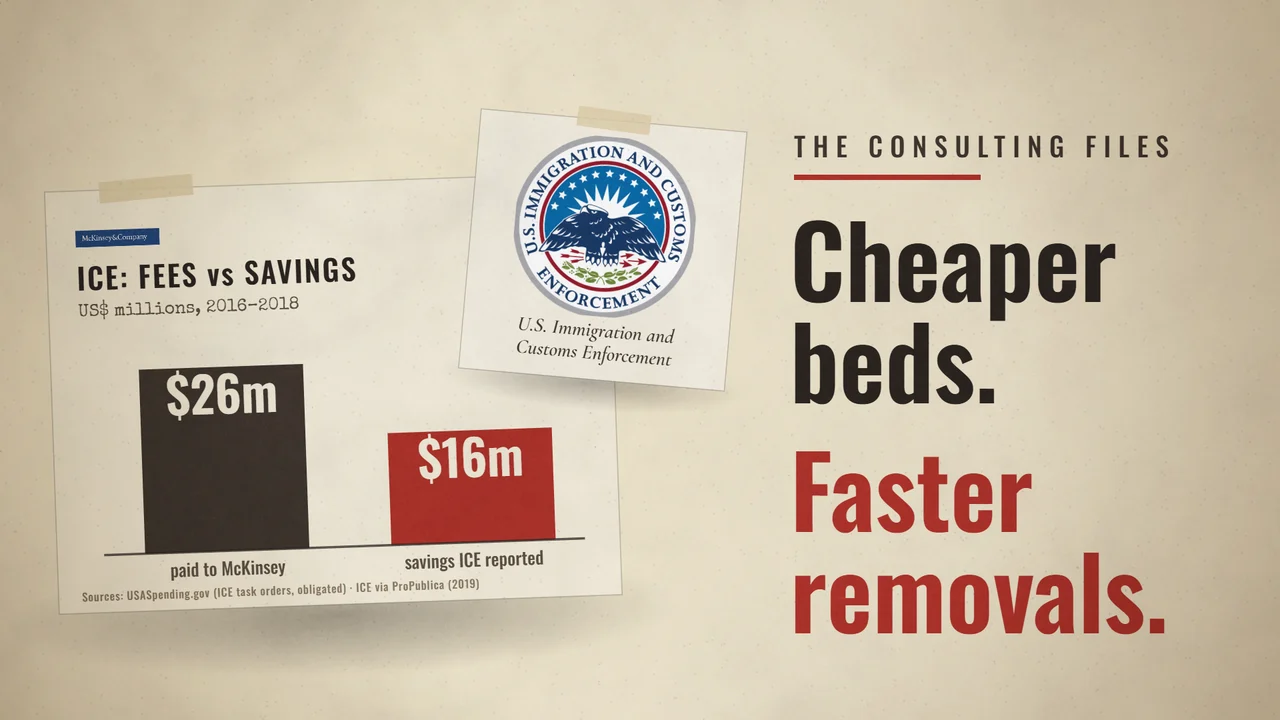
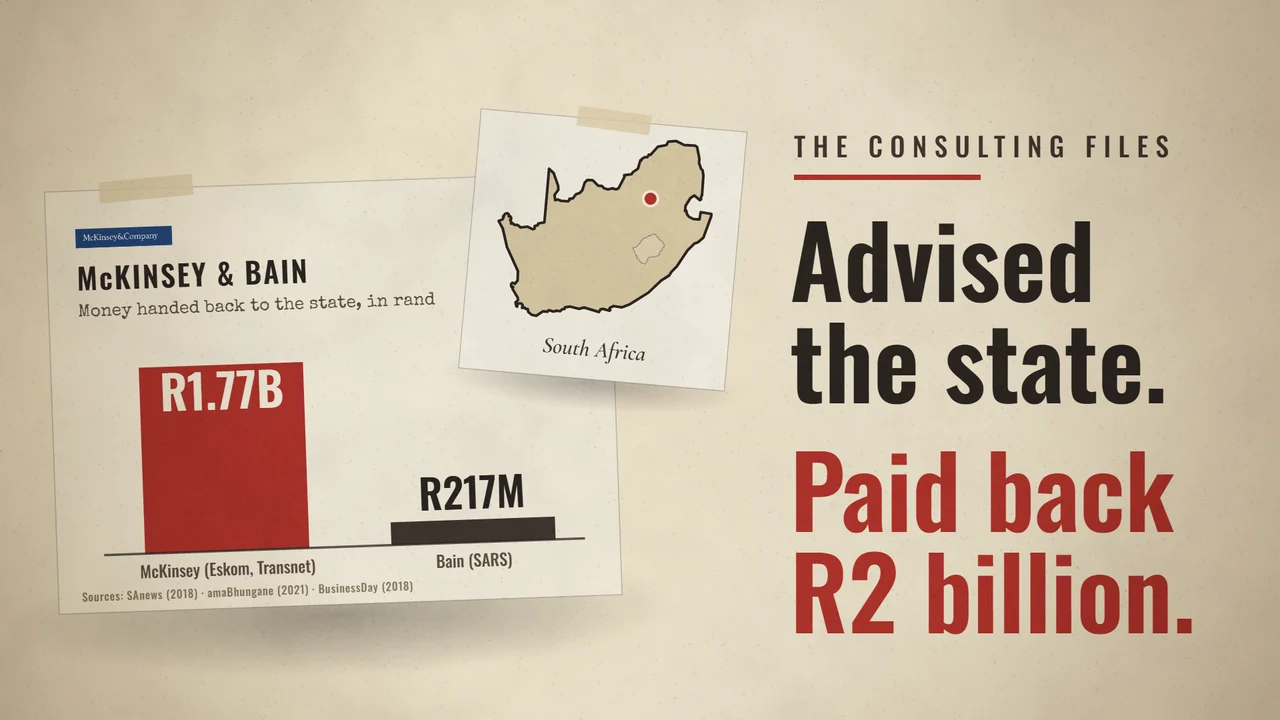
The example is illustrative, not a description of an additional contract in the French inquiry. It shows how to make external advice reviewable. The South Africa cases demonstrate why procurement and institutional challenge matter; the Luanda Leaks case adds the need to understand every entity in the payment route.
The presentation a public buyer should retain
A useful closing deck would show the original problem, the agreed scope, the evidence developed, the recommendation, the official decision and the capability left behind. It would reconcile actual expenditure to the approved budget and identify changes in scope. It would also distinguish realised outcomes from benefits expected in the future.
The authors should be visible. So should the officials accountable for acceptance and implementation. If a major assumption remains uncertain, the deck should name the owner and the evidence needed to resolve it. That is a more durable record than a generic statement that the assignment was completed successfully.
The consulting lesson is practical: public trust depends partly on whether a reasonable outsider can follow the work from the need to the invoice to the decision. A strong project can explain that chain plainly. A strong investigative article should demand the same clarity of its own charts, claims and conclusions.
TAKE IT INTO THE NEXT MEETING
Three practical lessons
Specify the capability being purchased
Document what the administration lacks, why external help is justified and how knowledge will return to public staff. A slide deck alone does not demonstrate transfer.
Attribute advice and decisions separately
Consultants should be identifiable as authors of analysis. Public officials must remain identifiable as owners of policy choices and public accountability.
Keep financial measures distinct
A consulting invoice, an aggregate spending estimate, a tax allegation and an asset seizure answer different questions. Do not combine them into one dramatic total.
Questions about the case
Was the McKinsey affair one legal case?
No. The Senate inquiry, testimony referral, tax investigation and campaign-related inquiries have different scopes and outcomes. Reporting them as one case can make a procedural development look like a finding on unrelated allegations.
What does the €65 million seizure establish?
The September 2026 report describes an investigative asset seizure. It is not a final criminal conviction or a judgment that all seized funds are unlawfully obtained. The firm denies wrongdoing.
What should public-sector buyers learn?
Publish clear scopes, costs, authorship, deliverables and decision ownership. Evaluate whether the work solved a capability problem and left the institution better able to operate without permanent dependence on outside advisers.
THE EVIDENCE TRAIL
Sources & editorial notes
Adapted from the original XLSlides documentary, with additional analysis. Published 29 October 2026. Sources have different roles: primary records, investigative reporting and the positions of affected parties.
- French Senate: March 2022 inquiry report ↗The parliamentary findings and recommendations.
- French Senate: essential findings ↗Ministry spend, operator sample and contract examples; scope matters.
- Public Sénat: September 2026 asset seizure ↗A dated report of the PNF announcement; not a final judgment.
- Consultor: perjury inquiry dropped ↗The distinct July 2024 outcome reported from the prosecutor’s decision.
- Cour des comptes: state use of consulting firms ↗The separate public-auditor examination of state consulting procurement.
Image credits & licences
Original illustrations and typography: XLSlides. Documentary stills have been resized and converted to WebP for this article. Underlying images retain the credits supplied with the episode.
- Emmanuel Macron: Office of the President of Ukraine (president.gov.ua), CC BY 4.0
- Arnaud Bazin: Hugues de Beauchesne, CC BY-SA 4.0
- Éliane Assassi: Micsterm, CC BY-SA 4.0
- Logo of the French Senate: public domain
- McKinsey logo: public domain (text logo)
- Everything else is drawn; documents, emails and headlines are illustrative layouts.
FROM EVIDENCE TO A RECOMMENDATION
Make the reasoning visible.
Use clear action titles, sourced exhibits and an explicit decision. XLSlides helps turn your analysis into an editable presentation; the evidence and judgment remain yours to verify.
Build a case-study presentation