XLSlides
An adviser and an affiliated bondholder
September the twenty-sixth, 2018. Puerto Rico is a year past Hurricane Maria, and deep inside the biggest municipal bankruptcy in American history. A headline appears in The New York Times. "McKinsey Advises Puerto Rico on Debt. It May Profit on the Outcome." McKinsey was the lead strategic adviser to the federal board steering the island's finances and its debt talks.
And McKinsey's own investment arm, the Times reported, owned at least twenty million dollars of the island's bonds. Adviser on the debt. Investor in the debt. This is the story of a wall, and of what regulators found when they looked behind it.
The client
Puerto Rico is a United States territory in the Caribbean. By 2015, its governor called the island's public debt, about seventy-two billion dollars, "unpayable." On top of that sat around fifty-five billion dollars of pension promises with no money set aside. In 2016, Congress passed a law called PROMESA. It created a Financial Oversight and Management Board, with power over the island's budgets and fiscal plans.
In May 2017, the board took Puerto Rico into a court process much like bankruptcy. Months later, Hurricane Maria struck. The board needed a strategist. Its choice was McKinsey.
Source context: [2]
The business model
How does a consulting firm get paid in a debt crisis? Here, by the month. McKinsey worked for a flat fee of about two million dollars a month. Unlike other advisers, it gave no breakdown of the hours it billed. It said that was company policy for government clients. Its consultants led the work on every version of the island's fiscal plan. That plan shapes how much the government can spend, year after year, and so how much might be left for creditors.
By late 2018, Puerto Rico's Center for Investigative Journalism counted roughly fifty million dollars paid to McKinsey by the board. A big client. And a very public one.
Source context: [4]
The other side of the house
But McKinsey has another business. It is called MIO Partners, the McKinsey Investment Office. It invests the pensions and savings of more than thirty thousand current and former McKinsey people. In 2020, it reported thirty-one billion dollars under management. About ninety percent went through outside fund managers. The rest, MIO bought and sold itself. According to the Times, MIO held at least twenty million dollars of a debt called Cofina. These were bonds backed by Puerto Rico's sales tax.
And Cofina's bondholders were in a fight with other creditors over that very same sales tax.
The question
So the question was simple. Can you advise the board that shapes how much creditors get paid, while your own investment arm is one of the creditors? In December 2018, Senator Elizabeth Warren and Representative Nydia Velázquez wrote to McKinsey. They said its bond holdings had not been clearly disclosed before the Times report. The board opened its own investigation, led by its ethics adviser and an outside law firm.
Meanwhile, McKinsey kept working, and kept billing. The board said McKinsey was "a valuable consultant with expertise and experience."
The wall
McKinsey's answer was a wall. It said MIO was separate from its consulting, legally and operationally. "McKinsey consultants cannot direct MIO investments," it said. Its consultants, it said, were not told what MIO invested in. And the twenty million dollars, it argued, was less than zero point one seven percent of MIO's assets. It also argued that the strict disclosure rule of an ordinary bankruptcy did not apply under PROMESA, and that its disclosures fully complied.
In February 2019, a report sponsored by the board found that McKinsey had complied with the legal requirements. But it warned the investments could create the appearance of a conflict.
Test an information barrier at the people and decision level
- 01Map the interests
Identify the client, creditor exposures and affiliated investment roles.
- 02Map the access
Check who sees confidential inputs, holdings and investment oversight.
- 03Document the response
Assign disclosure, recusal, challenge and monitoring to accountable owners.
Follow the money
The restructuring produced different agreements for different obligations. CRS reports that the February 2019 COFINA plan reduced that issuer’s debt by 32%, while preserving an agreed allocation of sales-tax revenue. That is distinct from the central-government plan confirmed in January 2022, which was described as reducing central-government debt from about $34 billion to $7.4 billion.
The fee controversy also involved different reporting periods. Investigative reporting described McKinsey’s monthly fee arrangements and earlier cumulative payments; members of Congress later cited an estimate exceeding $120 million. A fee estimate, a bond holding at face value and the value of a creditor’s recovery are different measures. Placing them on one slide does not establish that one produced the other.
Behind the wall
Then the regulators looked behind the wall. On November the nineteenth, 2021, the US Securities and Exchange Commission issued an order against MIO. It found that from 2015 to 2020, active McKinsey partners sat on MIO's investments committee, while their consulting work gave them confidential information about companies MIO was invested in. One example was Puerto Rico. In January and February 2017, MIO directly held Puerto Rico bonds, while McKinsey was advising the board. The committee was empowered to oversee MIO's sale of nearly one million dollars of them.
The order described the same overlap in two corporate bankruptcies, a coal miner and a solar company. And MIO's own policy, the order said, placed committee members above the protective wall.
Source context: [1]
The reckoning
In November 2021, MIO agreed to an $18 million penalty, a censure and a cease-and-desist order. It neither admitted nor denied the SEC findings. The order addressed policies and procedures for preventing misuse of material nonpublic information; it did not accuse the firm of insider trading. A separate February 2019 U.S. Trustee settlement required $15 million in payments in three corporate bankruptcies to resolve disclosure disputes. It was not a judgment about Puerto Rico’s fiscal plan. In January 2022, Congress enacted PRRADA, adding verified disclosure requirements tied to professional compensation in covered PROMESA proceedings. The documentary’s sources do not establish how the final McKinsey fee application was resolved.
THE SEQUENCE
A timeline of the case
PROMESA establishes the framework
Congress created the oversight board and a restructuring process. [2]
Title III petitions
The oversight board filed petitions for several Puerto Rico debt issuers. [2]
Holdings and fees scrutinised
Investigative reporting raised independence and disclosure questions. [4]
Different reviews and agreements
The COFINA plan, board-sponsored review and separate U.S. Trustee settlement had distinct scopes. [2]
MIO settles with the SEC
The safeguards case ended in an $18m penalty, censure and order. [1]
Plan confirmation and disclosure law
The central-government plan was confirmed; PRRADA was enacted two days later. [3]
A conflict review needs a map of decisions
The useful consulting question is not whether a large organisation can describe itself as independent. It is which people can see which information, which decisions they influence and which interests might benefit. A group can have separate legal entities and separate investment staff while still needing controls over shared oversight roles. Conversely, the existence of affiliated investments does not, by itself, establish that an engagement was improperly influenced.
Begin with a decision map. Identify the client’s decisions, the adviser’s recommendations, the investment office’s decisions and the committees that oversee each. Then mark who participates in more than one part of the map. This makes a review specific enough to test. It avoids both a blanket assumption that every affiliate creates a disqualifying conflict and an equally broad assurance that separate entity names resolve every concern.
The Rajat Gupta case concerns a different legal record, but illustrates why access to confidential information is valuable and why its use must be bounded. Do not import that case’s conviction into this one. Use the comparison to distinguish an information-access risk, an inadequate control and a proved misuse of information.
Look through the structure without presuming the answer
A conflict inventory should distinguish direct holdings, externally managed accounts, pooled investments and a person’s ability to oversee or influence allocations. Visibility and control are different. A person may know a holding without selecting it; an oversight committee may influence a policy without placing a trade. The response should be designed for the actual combination rather than for the most convenient organisational label.
For a hypothetical advisory engagement, prepare a register with columns for the interested party, nature of the connection, information available, decision authority and proposed response. Record uncertainty explicitly. A missing answer should trigger a follow-up owner, not be silently converted into an assurance that there is no connection. The register is an analytical aid; the governing legal assessment belongs with the appropriate qualified reviewers.
This is also a lesson about how a professional-services firm explains itself. The client needs enough information to evaluate independence without receiving irrelevant confidential investment details. Design that disclosure process deliberately. An uncontrolled dump of holdings is not necessarily a better review than a carefully scoped process with independent challenge and documented accountability.
Financial measures need their own labels
Debt face value, investment assets, advisory fees, creditor recoveries and regulatory penalties answer different questions. Each needs an entity, date, scope and measurement basis. A large fee can justify procurement scrutiny without proving biased advice. A small percentage of a portfolio can matter to a control assessment without establishing a material incentive for every employee. Neither conclusion can be reached from a dramatic side-by-side chart alone.
Consider a fictional slide with three boxes: an affiliate’s bond holding at face value, an adviser’s cumulative fees and a penalty imposed years later. An arrow connecting the boxes can make them look like one money flow. Before showing it, ask what each arrow claims. Does it represent an actual payment, ownership, an information link or merely a question? Use different notation and a clear legend for those relationships.
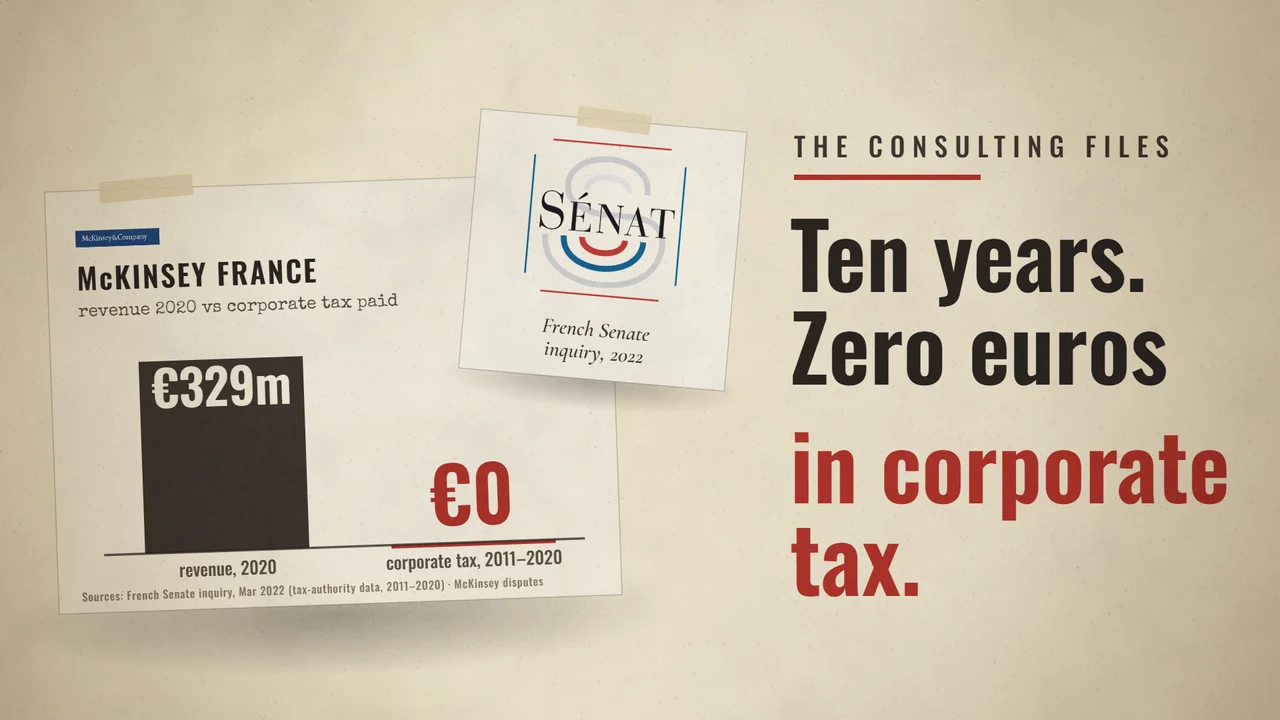
The France procurement case similarly requires aggregate spending, contract fees and investigative measures to stay separate. A useful presentation does not reduce complexity by removing the distinctions that determine what the evidence supports. It reduces complexity by making those distinctions legible.
A fixed fee needs a visible accountability mechanism
A fixed monthly fee is a commercial arrangement, not a verdict on value. It can help a client manage scope and budget, but it can also make effort and deliverables difficult to assess if the agreement does not specify what will be produced. The review should connect the price to outputs, decision support, capability transfer and the procedure for approving changes.
For a public or restructuring engagement, an accountability pack might include a workstream register, named deliverable owners, acceptance criteria, unresolved questions and the basis for any extension. These are proposed management practices, not claims about documents found in this historical engagement. They allow a buyer to ask whether work is useful without assuming that an hourly breakdown is the only possible measure of performance.
The Allstate claims case asks how a performance system can change the behaviour it rewards. Here the analogous question is what the fee and acceptance process makes visible. Define success in terms the client can inspect, including the quality of the decision record, rather than the volume of activity that an adviser reports.
An information barrier must cover exceptions and oversight
An information barrier is a working system of permissions, role restrictions, supervision and escalation. Its weakest point may be an exception made for a senior person or a committee role that does not resemble day-to-day investing. Testing therefore needs to cover both the ordinary workflow and the people who sit above it.
A review can ask how access is granted, how it is removed, how overlapping roles are identified and how exceptions are approved. It can examine whether the same person both benefits from an exception and decides whether that exception is acceptable. None of these questions presumes wrongdoing. They are ways to make a general assurance testable before a problem becomes a disputed historical account.
The Bain–Guinness case provides another setting in which an adviser’s organisational role deserves precision. A secondment, a board role and a consulting assignment can create different duties and reporting lines. The common lesson is to describe authority at the level where the real decision is made, while keeping the legal outcomes of the two cases separate.
Different reviews can answer different questions
A board-sponsored review, an investment-adviser proceeding and a court’s professional-compensation process need not have the same subject, period or test. A reader should be able to see what each examined and what it did not decide. One favourable conclusion does not automatically resolve every broader concern; one adverse finding does not retroactively establish every allegation in a different process.
Build an evidence table with one row per proceeding. State the body, respondent, question, period, outcome and limitation. This is especially helpful when several events share a brand name. It prevents a reader from treating the firm, an affiliate and an individual as interchangeable subjects. The table also makes uncertainty visible without burying it in a general disclaimer.
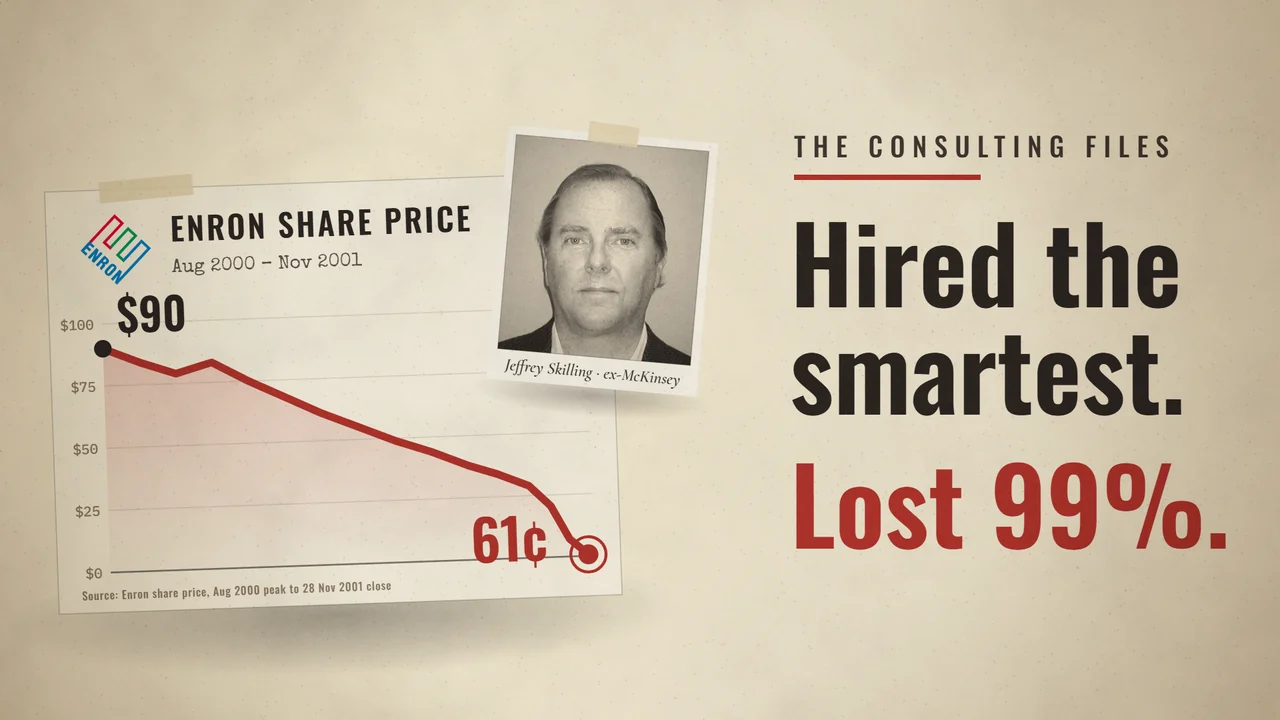
The Enron case shows how easily an admired management narrative can eclipse independent scrutiny. The solution is not to presume the opposite narrative. It is to make the evidence and the decision standard explicit enough that a reviewer can challenge both the reassuring story and the dramatic one.
The useful output is a decision the client can defend
For practitioners, the final product should identify the relevant connection, the risk it creates, the proposed response and the person accountable for maintaining that response. It should distinguish a disclosure issue from a control issue and distinguish both from an established misuse of information. Recommendations need this precision to be operational rather than merely cautionary.
The management consulting presentation guide offers a way to turn that work into an explicit recommendation. Use an action title that states what the client should do, an exhibit that supports the action and a note identifying what remains uncertain. The purpose of the Debt Island case is to improve that reasoning, not to make every organisational overlap look like proof of a corrupt result.
TAKE IT INTO THE NEXT MEETING
Three practical lessons
Test the barrier, not just its name
Document who has information, who oversees investment decisions and who can challenge an exception. A legal-entity chart is only one part of that review.
Separate financial quantities
Date and label advisory fees, face-value holdings, assets under management and creditor recoveries. They cannot be added into a single measure of gain.
Make disclosures maintainable
Build an accountable process for identifying connections, recording the response and revisiting the record as the engagement and interested parties change.
Questions about the case
Did the SEC find insider trading in the Puerto Rico work?
No such finding is made in the 2021 order used here. It concerns MIO’s inadequate safeguards against misuse of material nonpublic information. MIO settled without admitting or denying the findings.
Did the board-sponsored review and SEC order say the same thing?
No. The board review concerned McKinsey’s separation and disclosures in the Puerto Rico engagement. The SEC examined MIO’s policies and organisational risks over a broader period. Keep the questions and scopes distinct.
Were the $15m and $18m settlements one payment?
No. The $15m U.S. Trustee settlement concerned disclosure disputes in three corporate bankruptcies in 2019. The $18m SEC penalty concerned MIO compliance failures in 2021. Neither figure is a measure of Puerto Rico’s creditor recoveries.
THE EVIDENCE TRAIL
Sources & editorial notes
Adapted from the original XLSlides documentary, with additional analysis. Published 2 November 2026. Sources have different roles: primary records, investigative reporting and the positions of affected parties.
- SEC: MIO Partners administrative order, 19 November 2021 ↗Primary findings, organisational structure, information risks, settlement terms and no-admission wording.
- Congressional Research Service: Adjustment of Puerto Rico’s Public Debts ↗CRS’s February 2022 account of the plans, creditor distinctions and the board-sponsored review; hosted by EveryCRSReport.
- GovInfo: Public Law 117-82, PRRADA ↗Primary statute on verified professional disclosures and compensation in covered PROMESA cases.
- Centro de Periodismo Investigativo, via Latino Rebels: adviser and bondholder reporting ↗The owner’s cited December 2018 investigative reporting on fees, holdings and responses; historical reporting rather than a court finding.
- McKinsey: statement on the independent third-party report ↗The firm’s February 2019 response and its account of separation, independence and disclosure compliance.
- U.S. Justice Department: February 2019 disclosure settlement ↗The separate three-case corporate-bankruptcy settlement; not a Puerto Rico adjudication.
- SEC: MIO compliance-failure announcement ↗Plain-language official summary of the 2021 administrative settlement and $18m penalty.
- Representative Velázquez: 2023 letter concerning oversight-board advisers ↗Congressional concerns and the reported cumulative fee estimate; advocacy correspondence is not a judicial determination.
Image credits & licences
Original illustrations and typography: XLSlides. Documentary stills have been resized and converted to WebP for this article. Underlying images retain the credits supplied with the episode.
- Natalie Jaresko: U.S. Embassy Kyiv Ukraine, public domain
- Flag of Puerto Rico: public domain
- Seal of the U.S. Securities and Exchange Commission: public domain (U.S. government)
- Logo of the Financial Oversight and Management Board for Puerto Rico: public domain
- McKinsey and The New York Times logos: public domain (text logos)
- Everything else is drawn; documents, letters, headlines and the island outline are illustrative.
FROM EVIDENCE TO A RECOMMENDATION
Make the reasoning visible.
Use clear action titles, sourced exhibits and an explicit decision. XLSlides helps turn your analysis into an editable presentation; the evidence and judgment remain yours to verify.
Build a case-study presentation