XLSlides
Episode premiere: 2 November 2026 at 7:30 am IST. Read the full case study before the premiere.
An aid brief becomes an institutional question
On 3 June 2025, Boston Consulting Group publicly said it had ended work connected with the Gaza Humanitarian Foundation. The aid system had begun operating in late May amid intense controversy over how people would safely obtain food. The owner’s documentary follows the consultancy’s role rather than treating the wider conflict as one consulting engagement. The central questions are concrete: what work was approved, who understood its scope, which organisation was the client, and what changed when a foundation-establishment brief became operational advice and a separate reconstruction model? BCG’s later reply to British parliamentarians provides a primary account of the firm’s position, while reporting supplies additional context and disputed allegations.
Source context: [3]
The client
The project was called the Gaza Humanitarian Foundation, or G-H-F. It was backed by the United States and Israel, and set up as an alternative to the United Nations for delivering food to Gaza. It began work in late May, after Israel had halted food deliveries for nearly three months. Its stated goal was to stop aid being diverted by Hamas. The United Nations denied that this was happening.
The UN and other aid groups refused to take part. They said the model gave Israel control over food, and could push people to move. And hours before the hubs opened, the foundation's own executive director resigned. The plans, he said, conflicted with humanitarian principles.
The consultant
BCG’s own July reply describes a U.S.-based team supporting the creation of an aid foundation between October 2024 and January 2025. The firm said that phase was pro bono and directed by Orbis Operations. It then distinguished a March operational-and-logistics engagement contracted with McNally Capital. That distinction matters more than a generic statement that BCG worked for GHF. The paying counterparty, the proposed service and the ultimate people affected can differ. The documentary treats the consultant’s size as context; the practical issue is whether the acceptance process accurately captured the nature, location and purpose of each piece of work.
Follow the money
BCG said no fees were collected for the related work. Its parliamentary reply describes an intended for-fee logistics project and an invoice that the firm cancelled after learning more about the scope. Initial pro bono support, intended billing, a cancelled invoice and payments actually received are different financial categories. The owner’s research also records media estimates of contracted work and internal costs. Those reports should not be turned into an asserted cash receipt, particularly where the firm’s position is that no fees were collected. The documentary’s financial question is therefore both about money and about how the work entered the organisation’s approval and accounting systems.
The warning signs
The documentary describes concerns about humanitarian participation and the implications of the operating model. In its July reply, BCG said the project had been presented internally as multilateral and apolitical, but that the information supporting approval was incomplete or misleading. That is the firm’s account of its process failure, rather than an independently published full record of every internal discussion.
The important analytical distinction is between an agreed engagement description and the work actually performed. Changes to counterparties, geography, service type or affected populations can alter an engagement’s risk even if its billing label stays the same. Concerns about safety and participation require their own evidence and decision authority.
The walk-out
On June the third, BCG said it had ended its contract with the foundation. One of the partners was put on leave. Two days later, both partners were fired. BCG said their work was "unauthorised". The foundation carried on. It said it had already delivered more than seven million meals in its first eight days. But witnesses and aid workers told the Associated Press that people had to pass Israeli troops to reach the food, and that soldiers often opened fire. Israel says it fired warning shots, or when its troops were in danger.
Reapprove the actual work when the brief changes
- 01Describe the engagement
Identify counterparty, purpose, population and assumptions.
- 02Test the operating reality
Check whether follow-on work changes geography, consent or risk.
- 03Enforce the decision
Record approvals, stop instructions, escalation and retained evidence.
The apology
BCG publicly expressed regret and said its standards had not been met. Its response to the Business and Trade Committee states that all work was stopped and the two partners leading it left the firm. BCG commissioned WilmerHale to investigate and described steps to strengthen its processes. These statements explain the firm’s position and response. They do not make the underlying investigation fully public, resolve every disputed media account or constitute a court ruling. An apology and personnel action can be relevant evidence of organisational response while remaining distinct from a legal determination about the entire aid operation.
Source context: [1]
The model
Reporting discussed a reconstruction model that included potential relocation scenarios. The owner’s research attributes the numerical scenario to Financial Times reporting cited through other outlets, rather than claiming to have independently audited the spreadsheet. Scenario assumptions and an implemented policy must not be conflated. BCG’s parliamentary response describes reconstruction modelling as separate, specifically unauthorised work, not commissioned by GHF. It said the responsible partner proceeded despite a risk instruction requiring affected-population involvement. The distinction between foundation support, operational advice and reconstruction scenarios is essential to understanding both the criticism and the firm’s response.
The reckoning
The Business and Trade Committee asked BCG to explain its work, clients, approvals and modelling. The firm’s reply described its investigation and the departure of the two responsible partners. It also said its chief risk officer and social impact leader had offered to leave those leadership roles, and those decisions were accepted. The broader humanitarian consequences remain the setting for scrutiny, not proof that the consultancy caused a specific incident. The owner’s cited Associated Press account reports that GHF later closed in November 2025. This article does not present a comprehensive current legal-status search, equate a corporate review with a judgment, or assign individual responsibility for deaths without the necessary evidence.
THE SEQUENCE
A timeline of the case
Foundation-establishment support
BCG describes initial pro bono work through January 2025. [1]
Operational advice and another model
The firm distinguishes a logistics contract and separate reconstruction modelling. [1]
Work stopped and review launched
BCG describes stopping work as its leadership learned the scope. [1]
Public withdrawal and apology
The firm’s response and the departure of two partners become public. [3]
Committee seeks an explanation
British MPs ask about scope, approvals, counterparties and models. [2]
Written response published
BCG sets out its account, fee position and remedial steps. [1]
Aid operation closes
AP reports GHF’s closure; the consultancy’s role remains a separate question. [4]
A humanitarian objective does not complete an engagement review
An engagement can have a stated humanitarian purpose and still require difficult decisions about authority, safety, access and participation. The purpose describes an intended benefit; it does not establish that the operating model delivers it or that the people affected have been adequately considered. Those are separate questions that need evidence and accountable decision-makers.
For consultants, the acceptance brief should identify the service being provided, the actual counterparty, the intended beneficiaries and the institutions whose involvement the plan assumes. Record which facts are confirmed and which are representations made by a sponsor. If the legitimacy of an arrangement depends on multilateral participation, the existence of that participation needs verification rather than repetition in a reassuring project description.
The South Africa state-capture case also asks what a professional-services firm should understand about a client’s institutional setting. The cases have different facts and legal histories. The comparison is useful at the decision-process level: technical competence cannot substitute for an accurate understanding of the engagement’s authority and consequences.
Follow the counterparty as well as the fee
The organisation signing a contract, the sponsor directing work and the people affected by the output can be different. A useful engagement map shows those relationships separately. Otherwise, a team can describe itself as working for one initiative while the contractual route and operational instructions come through several other organisations.
Financial analysis needs the same care. An intended fee, a signed commitment, an invoice, an invoice cancellation, internal labour cost and cash received are different measures. A model that combines them into a single revenue number does not become more informative because the number is prominent. The page retains the firm’s fee position rather than turning reported contract values into an asserted payment.
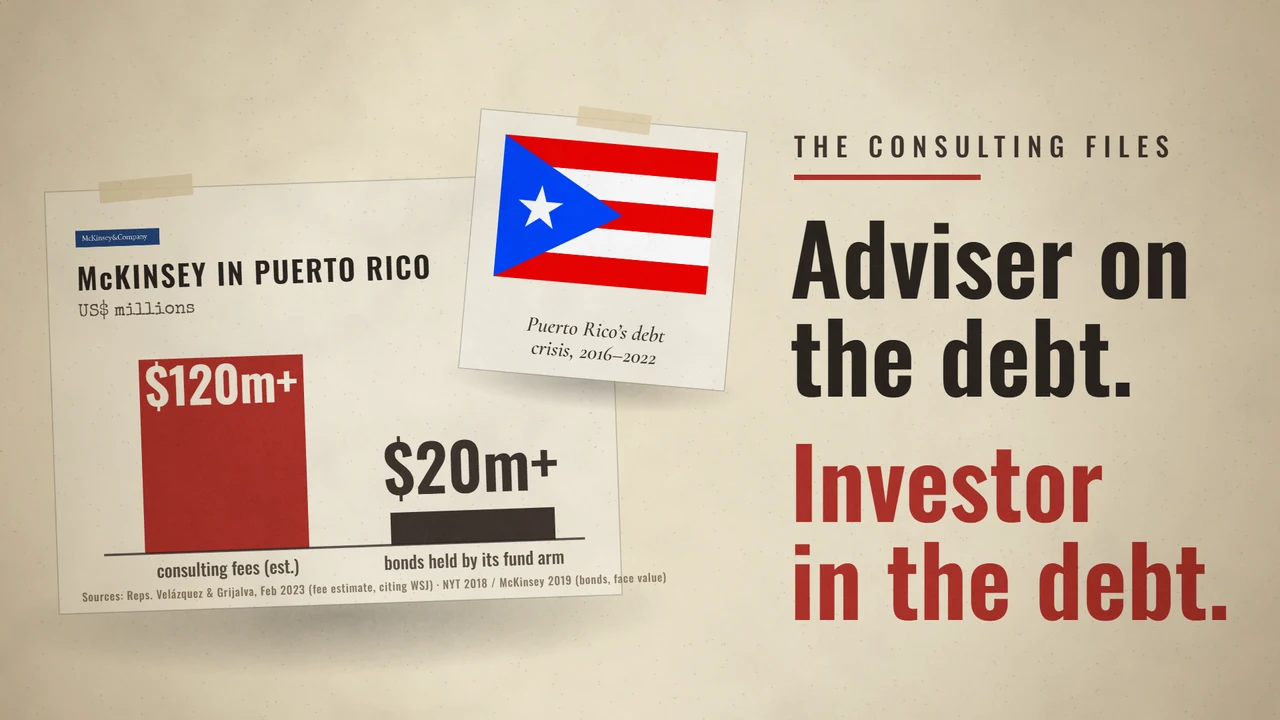
The Puerto Rico case provides a parallel lesson about tracing entities and monetary measures without assuming what the trace will prove. A clear diagram can show several relationships and leave the conclusion proportionate. It should not turn the existence of a commercial chain into an unsupported claim about who controlled every downstream activity.
Pro bono work still uses authority and institutional reputation
No-fee work consumes people, time, management attention and an organisation’s credibility. It can also produce recommendations that a recipient uses to justify decisions. The absence of an invoice therefore cannot be the reason to relax acceptance, evidence retention or escalation. It changes the commercial question, not the fact that an institution is participating.
In a fictional pro bono project, a team might agree to assess the feasibility of a proposed service. Later it is asked to design procurement, develop operating assumptions and prepare a presentation for a sponsor. Each request may sound adjacent to the original brief, but the cumulative change can be substantial. A review process should ask what the team is now doing rather than whether the billing code still says pro bono.
This is a practical matter for staffing and governance. Name the person who can approve follow-on work, identify what changes require reapproval and give junior team members a route for raising a mismatch between the approved brief and the actual tasks. These are proposed controls, not a reconstruction of every internal conversation in this case.
Treat a scenario model as a set of choices
A model is not neutral simply because it uses a spreadsheet. It contains choices about the alternatives considered, costs included, outcomes valued and constraints treated as fixed. A comparison can look precise while leaving the most consequential assumptions outside its boundary. Reviewers need to understand the question the model was permitted to answer before interpreting the numerical result.
For a sensitive population-related scenario, distinguish an assumption about a voluntary choice from evidence that people can make that choice safely and freely. A cost difference does not establish desirability, legitimacy or implementation feasibility. The analyst should record whose perspective defines cost and whose losses may be excluded. These questions apply to model design; they are not findings that a particular published scenario was implemented.
The Saudi report case examines another boundary between an analytical output and the people described by it. The shared question is what a report makes possible and how a team considers foreseeable misuse. That comparison does not establish a causal connection between the cases or resolve disputed facts in either one.
A stop instruction needs an operational record
An instruction not to proceed is effective only if the relevant people receive it, understand its scope and know what to do with work already underway. A robust process identifies which work must stop, which materials must be retained and who can authorise any restart. It should not leave the team to infer whether a narrower task is still permitted.
The record should distinguish refusal, conditional approval and approval of a different service. If an exception is granted, state the conditions and evidence required. If the scope changes again, the exception should not silently expand with it. A decision log allows later reviewers to see what was known at the time rather than reconstructing permission from conflicting recollections.
Communications retention serves that same purpose. The relevant issue is whether instructions, model versions and approvals can be reconstructed when needed. Teams should use the channels and retention arrangements appropriate to their obligations. The case does not justify assuming that every informal message is improper, but it illustrates why an evidence trail cannot be an afterthought.
Keep humanitarian consequences and consultant responsibility distinct
An engagement can deserve scrutiny because it operates in a setting where the stakes are grave. That does not remove the need to establish who did what, what influence an output had and what evidence connects a particular action to a particular outcome. Humanitarian context and causal attribution belong in the same account, but they should not collapse into one assertion.
The ICE detention-budget case similarly asks whether an efficiency objective leaves important consequences outside the model. A consultant should examine the objective and its constraints, while a writer should distinguish a proposal, an adopted measure and a documented outcome. The requirement for evidence becomes more important when the consequences are serious.
A clear article can therefore present company explanations, parliamentary questions and the broader operating context without declaring that a corporate review is a trial. It can explain why a reported scenario attracted criticism without treating the scenario as an implemented policy. This is a standard of attribution and reasoning, not a reason to minimise the subject’s human importance.
Build an acceptance decision that survives a change in the story
The strongest engagement review can be revisited when a new counterparty appears, a service becomes operational or an assumption about participation proves wrong. It gives the team a practical route to pause, escalate or decline work. It also makes clear which conditions are essential, so that losing one of them changes the decision rather than merely changing the wording of a slide.
Use the management consulting presentation guide to make that decision explicit: the proposed scope, the evidence supporting it, the people affected, the unresolved questions and the accountable owner. The useful lesson from The Aid Model is to connect those elements before the organisation’s name, tools and effort become part of a project it does not fully understand.
TAKE IT INTO THE NEXT MEETING
Three practical lessons
Apply acceptance rules to free work
A pro bono label changes billing, not the need to establish purpose, legitimate authority, affected groups and the firm’s ability to perform the work responsibly.
Treat scope drift as a new decision
Changes in clients, location, population effects or delivery arrangements should trigger a recorded reapproval rather than rely on the original engagement description.
Keep the audit trail usable
Preserve instructions, versions and relevant communications. A later explanation is harder to assess when the team cannot reconstruct who approved what and on which information.
Questions about the case
Was all of the work one GHF contract?
BCG’s July reply distinguishes foundation-establishment support, operational/logistics advice contracted through another organisation and a separate reconstruction model. It says the latter was not commissioned by GHF.
Did BCG say it earned fees from the work?
The firm said it collected no fees. It described an intended paid project and a cancelled invoice. Contract estimates, an intended fee, internal cost and cash received are different measures and should remain labelled separately.
Does this case establish criminal responsibility?
No. The article distinguishes corporate statements, committee scrutiny and reporting. It does not treat an internal-review account or a scenario model as a criminal judgment or evidence that BCG caused a particular incident involving aid seekers.
THE EVIDENCE TRAIL
Sources & editorial notes
Adapted from the original XLSlides documentary, with additional analysis. Published 2 November 2026. Sources have different roles: primary records, investigative reporting and the positions of affected parties.
- BCG: 22 July 2025 response to the Business and Trade Committee ↗Primary corporate account distinguishing the three workstreams, fee position, control failures and response; not a published full investigation.
- Business and Trade Committee: July 2025 request to BCG ↗Primary parliamentary questions about clients, scope, authorisation, investigation and relocation modelling.
- Reuters: BCG says staff circumvented controls ↗Reuters reporting of the firm’s July response, including its account of unauthorised work and the investigation.
- Associated Press, via PBS: GHF closes operations ↗The owner’s cited November 2025 account of the aid operation, its closure and the competing accounts of its conduct.
- BCG: April 2025 company announcement ↗The firm’s own 2024 scale figures and corporate context; not evidence about the disputed engagement.
- The New Arab: reporting citing the Financial Times reconstruction investigation ↗The owner’s cited secondary reporting of FT reconstruction scenarios. Thumbnail numbers describe a reported scenario, not an implemented policy or an independently audited spreadsheet.
Image credits & licences
Original illustrations and typography: XLSlides. Documentary stills have been resized and converted to WebP for this article. Underlying images retain the credits supplied with the episode.
- XLSlides logo: XLSlides.
- No photos or third-party logos are used: organisations appear as typeset name cards, people as silhouettes. Maps, documents, letters, slides, the spreadsheet and the chat are drawn illustrations; the Gaza outline is stylised and not to scale.
FROM EVIDENCE TO A RECOMMENDATION
Make the reasoning visible.
Use clear action titles, sourced exhibits and an explicit decision. XLSlides helps turn your analysis into an editable presentation; the evidence and judgment remain yours to verify.
Build a case-study presentation