XLSlides
The email about deleting documents
On July 4th, 2018, a senior partner at McKinsey and Company sent an email to a colleague. A former board member of the drug maker Purdue Pharma, he wrote, was being sued by state attorneys general. Perhaps they should ask the firm's risk committee whether to do anything "other than eliminating all our documents and emails."
Over the following weeks, according to federal prosecutors, he deleted a folder of Purdue files from his laptop. Five years earlier, he had helped McKinsey win a project with a striking name: a plan to "turbocharge" sales of OxyContin.
Source context: [6]
The product
OxyContin was approved in 1995. It was a powerful opioid painkiller, oxycodone, in a pill designed to release slowly over twelve hours. Its maker, Purdue Pharma, was a private company owned by members of the Sackler family. Purdue marketed OxyContin aggressively, to doctors across America. In 1996, OxyContin sales were about forty-eight million dollars. By 2000, they were close to one point one billion.
The business model
How did OxyContin make money? Every prescription was revenue. Higher-strength tablets earned more than lower ones. And longer courses of treatment meant more refills. To drive prescriptions, Purdue relied on an army of sales representatives visiting doctors' offices. And a small group of doctors mattered most. Some high-volume prescribers wrote as many as twenty-five times more OxyContin prescriptions than their lower-volume peers.
For a sales team, they were the most valuable targets of all.
Source context: [4]
The first reckoning
But the drug was being widely misused, and addiction and overdoses were rising. In 2007, Purdue and three of its executives pleaded guilty to misbranding OxyContin, after claiming it was less prone to abuse than other opioids. The company paid about six hundred million dollars. In 2010, Purdue reformulated the pill to make it harder to crush and abuse. OxyContin prescriptions began to fall.
Source context: [9]
Enter McKinsey
McKinsey had been advising Purdue since 2004, both before and after the guilty plea. In May 2013, according to court documents, Purdue hired McKinsey to help recover lost OxyContin sales. The project was called Evolve to Excellence. In August 2013, McKinsey partners met members of the Sackler family, who approved it.
The plan
The plan, according to a lawsuit later filed by New Jersey's attorney general, had several parts. Focus sales calls on the highest-volume prescribers. Remove sales representatives' discretion over which doctors to visit. Increase the number of visits. Emphasize higher, more lucrative doses. And explore new ways to get OxyContin to patients, including through mail-order pharmacies. Prosecutors said McKinsey advised Purdue on how to "turbocharge" its sales pipeline.
The missing constraints in a sales optimisation problem
- 01Define the growth target
Calls, prescriptions and sales become the visible measures.
- 02Concentrate commercial effort
Segmentation and sales-force direction amplify the chosen target.
- 03Apply independent constraints
Product harms, lawful promotion and conflicts must govern the work.
Follow the money
So who earned what? From 2004 to 2019, Purdue paid McKinsey about ninety-three million dollars. Over the same era, OxyContin brought Purdue roughly thirty-five billion dollars in revenue. An audit later found that the Sackler family had withdrawn about ten point seven billion dollars from the company. And the human cost was staggering. From 1999 to 2020, the CDC counted more than two hundred and sixty-three thousand deaths in America from overdoses involving prescription opioids.
The rebate idea
Even as the crisis deepened, the work continued. In 2017, McKinsey proposed that Purdue pay "additional rebates on any new OxyContin related overdose or opioid use disorder diagnosis" to distributors and pharmacy companies. One estimate in McKinsey's materials, later reported in the press, put the rebate at nearly fifteen thousand dollars for each such event.
Both sides of the table
And there was another conflict. A 2022 congressional investigation found that at least twenty-two McKinsey consultants, including senior partners, had worked for both the Food and Drug Administration and opioid makers, on related topics, sometimes at the same time. Thirty-seven FDA contracts were staffed by at least one consultant who was working, or had worked, for Purdue. In 2011, four consultants on an FDA drug-safety contract were simultaneously working for Purdue.
The committee found no evidence that McKinsey had disclosed its opioid work to the FDA. McKinsey said its FDA work focused on administrative and operational topics, not regulatory decisions.
The reckoning
In 2019, McKinsey stopped working for opioid makers. That September, Purdue filed for bankruptcy, and in 2020 it pleaded guilty again, to three federal felonies. In February 2021, McKinsey agreed to pay five hundred and seventy-three million dollars to states and territories across the country. Later settlements followed. And in December 2024, it agreed to pay six hundred and fifty million dollars to resolve federal criminal and civil investigations. That included a criminal penalty of two hundred and thirty-one million dollars, and the forfeiture of every dollar Purdue had ever paid it.
McKinsey agreed to stop doing any work on the marketing or sale of controlled substances. And the senior partner who deleted the files was sentenced to six months in federal prison.
THE SEQUENCE
A timeline of the case
Purdue relationship
The federal resolution covers the consulting relationship over this period. [1]
Sales-growth project
The engagement sought to increase OxyContin sales. [2]
State settlements
McKinsey reached opioid-related settlements with states and territories. [4]
Conflict findings
A House committee examined overlapping FDA and opioid-manufacturer work. [3]
Federal resolution
The firm agreed to payment, restrictions and compliance obligations. [1]
A growth question needs boundaries before an answer
A commercial engagement often begins with a legitimate analytical toolkit: segment customers, identify high-value accounts, allocate sales effort and measure conversion. Those methods do not determine whether the objective is acceptable. The product, the conduct being encouraged and the people exposed to the consequences change the decision.
In this case, treating prescription volume as an isolated business outcome would omit essential context. Medicines have clinical indications, risks and promotion rules. A strategy team needs qualified medical, legal and compliance judgment about those constraints. It cannot infer acceptability merely because a tactic resembles something used successfully in another industry.
That does not mean an article should make unsupported health-impact estimates. The public-health consequences of opioids span many actors and years. Neither a consulting fee nor an industry death total supplies a causal estimate of one project’s impact. The stronger analytical claim is narrower: a project designed to amplify sales must examine foreseeable risks and lawful boundaries before it optimises the commercial target.
Build the risk assessment into the engagement decision
Client acceptance should assess the specific work, not only the client’s name. Advising on an administrative process, a distribution model and a sales campaign can create different exposures. The review needs the real objective, the likely interventions, the data required and the people whose decisions the project seeks to change.
The engagement should then have constraints that survive commercial pressure. If a proposed lever depends on questionable promotion, unsafe targeting or a conflict that cannot be controlled, the team needs an authority capable of rejecting it. A committee that receives a summary after the strategy has been sold has less room to change course than a reviewer involved before the commitment.
| Review stage | Question | Evidence to retain |
|---|---|---|
| Acceptance | Is this objective appropriate for this product and client? | Scope, product-risk assessment and approval |
| Design | Which behaviours will the proposed lever encourage? | Intervention logic and independent review |
| Delivery | What new risks or conflicts have appeared? | Decision log, objections and changes |
| Close | What was recommended and who authorised it? | Final deliverables and retained records |
This is a proposed professional-services framework, not a description of the controls operating in the historical engagement. A business-case presentation should state the constraints beside the financial model so that approval cannot be mistaken for permission to use every commercially effective tactic.
Conflicts must be examined at the level of people and work
The House committee’s FDA investigation raised a separate question from the sales advice itself: what happens when a consultancy works with a regulator and firms in the regulated industry? The committee’s findings and McKinsey’s response should be read together. The firm said its FDA work concerned administrative and operational topics rather than regulatory decisions.
For a risk review, those descriptions are a starting point. The reviewer should establish which people worked on which topics, what information they could access and whether one engagement could influence another. An industry-wide policy does not answer every project-level question. Nor does the mere existence of two clients establish that confidential information crossed a boundary.
The practical control is an evidence-based map of overlap. Identify personnel, timing, deliverables and access rights. Record what must be disclosed to each client and who can approve an exception. If a conflict cannot be explained in a way that both clients could understand, the firm should reconsider whether it can perform the work responsibly.
Do not turn the financial comparison into an impact estimate
The story contains consulting fees, manufacturer revenue, settlement payments and public-health statistics. They refer to different entities, periods and outcomes. Adding them together would produce a dramatic number with no coherent definition. A useful exhibit labels each measure and explains what comparison, if any, is valid.
Likewise, a ratio of settlement payments to consulting revenue is not a complete measure of either social harm or project profitability. It can illustrate the scale of later consequences relative to historical fees. It does not include all costs, establish causation or assign responsibility for the entire opioid crisis.
For an executive presentation, put the period and scope directly under each number. Distinguish an agreed payment from an amount alleged in a complaint and from a public-health estimate. Where a total combines several resolutions, show the components and ensure the agreements do not overlap before displaying the sum.
A practical review exercise for strategy teams
Consider a fictional product with high revenue per repeat user and a known risk of serious harm if used inappropriately. A sales model recommends concentrating effort on the highest-volume purchasers. Before accepting that recommendation, the team should ask what high volume represents: legitimate need, customer concentration, inappropriate use, or some mixture of those factors.
The model alone cannot answer the question. The team needs the relevant specialists, appropriate data and a clear standard for acceptable promotion. A better brief would specify the customer need being served and prohibit growth routes that depend on unsafe or unlawful behaviour. That may change the recommended segment, channel or even the decision to proceed.
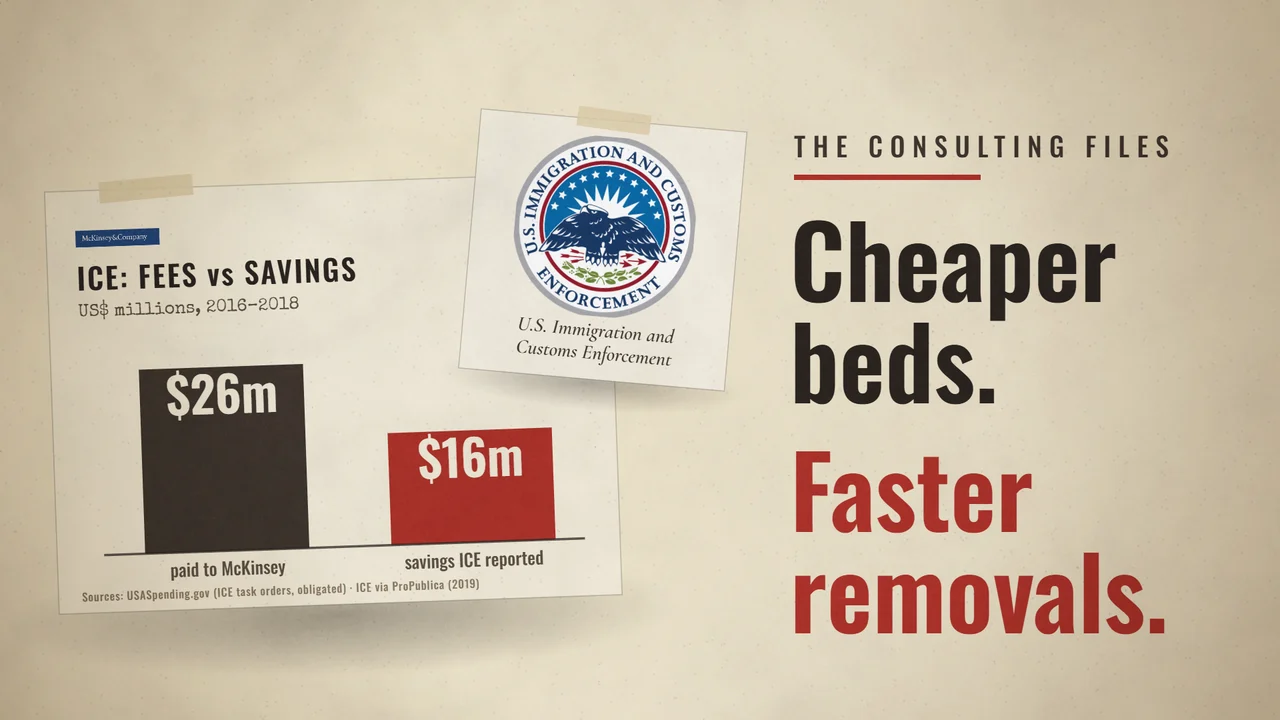
The exercise is illustrative. It is not an allegation about a specific prescriber or a clinical recommendation. Its purpose is to show how a seemingly neutral segmentation rule can encode a value judgment. The ICE cost case asks the corresponding question for efficiency: which standards remain binding when a model recommends a cheaper option?
Records are part of the work product
The former partner’s obstruction proceeding illustrates why records retention is a professional obligation in its own right. The individual case should not be merged with the firm’s deferred prosecution agreement. Both belong in the narrative, but they answer different legal questions.
For a working team, the practical lesson is to preserve the evidence supporting advice, including assumptions and objections. A final polished deck can omit the uncertainty that mattered during development. Version histories, source material and approval records allow later readers to understand what the team knew and why it recommended a course of action.
Retention rules should be supported by actual systems and clear ownership. Staff should know when normal disposal must stop and whom to contact. A presentation workflow that improves charts while losing the underlying decision record creates a different kind of quality failure. The Gupta case explores another boundary around information: the difference between authorised access and personal disclosure.
The question a responsible recommendation should answer
The consulting lesson is not that growth strategy is inherently suspect. It is that a professional recommendation must explain what outcome is being optimised, under which constraints, and with what foreseeable effects. A client’s commercial request does not remove the adviser’s need to assess the work.
An effective decision page therefore contains the proposed action, supporting evidence, product-specific constraints, unresolved risks and the person accountable for approval. The strategy recommendation workflow can organise that argument, but the underlying constraints must be established by the team. If the intervention cannot be defended in those terms, producing a more persuasive chart is not progress. The strategy has not yet met the standard required for a decision.
TAKE IT INTO THE NEXT MEETING
Three practical lessons
Define outcomes beyond sales
Specify the safety, clinical and legal constraints under which growth is acceptable. A commercially effective intervention can still be an unacceptable engagement.
Assess conflicts at project level
Review the actual people, information and topics shared across clients. A broad description such as administrative work does not resolve every potential conflict.
Preserve the decision record
Store assumptions, approvals and objections. Records retention is part of professional accountability, especially once an investigation is foreseeable.
Questions about the case
What was McKinsey’s work for Purdue?
It included sales and marketing advice for OxyContin. Federal documents describe a 2013 engagement intended to increase sales. The article separates that commercial work from the broader history of Purdue and the opioid crisis.
What did the $650 million resolution mean?
The December 2024 agreement resolved federal criminal and civil investigations and included a five-year deferred prosecution agreement and work restrictions. It is distinct from earlier state settlements and from the individual obstruction proceeding.
Can the crisis be reduced to one consulting project?
No. The opioid crisis involved manufacturers, distributors, prescribers, regulation and many other factors. The consulting case is important in its own right, but aggregate deaths or addiction figures cannot be assigned to one engagement.
THE EVIDENCE TRAIL
Sources & editorial notes
Adapted from the original XLSlides documentary, with additional analysis. Published 29 October 2026. Sources have different roles: primary records, investigative reporting and the positions of affected parties.
- US Department of Justice: December 2024 McKinsey resolution ↗Federal resolution, payment, DPA and controlled-substance work restrictions.
- US Department of Justice: deferred prosecution agreement ↗The agreement and accompanying factual statement.
- US House Oversight Committee: The Firm and the FDA ↗The committee’s 2022 findings; read alongside the firm’s response.
- New Jersey Attorney General: McKinsey opioid complaint and settlement ↗Sales strategy allegations and the state resolution.
- McKinsey: statement on opioid-related work ↗The firm’s response and commitments, presented as its position.
- US Department of Justice: Martin Elling sentenced ↗May 2025: the separate obstruction sentence of the former partner.
- GAO: OxyContin abuse and diversion, GAO-04-110 ↗Historical product, marketing and sales context.
- CDC-hosted clinical quality-improvement research ↗The historical 1999–2020 prescription-opioid mortality window; not a causal estimate of this consulting project.
- Purdue Pharma: historical chronology and financial context ↗Secondary background; legal outcomes are sourced separately to federal records.
Image credits & licences
Original illustrations and typography: XLSlides. Documentary stills have been resized and converted to WebP for this article. Underlying images retain the credits supplied with the episode.
- OxyContin 10 mg tablet: Psiĥedelisto, CC0
- One Stamford Forum: John9474, CC BY-SA 4.0
- Purdue Pharma and McKinsey logos: public domain
FROM EVIDENCE TO A RECOMMENDATION
Make the reasoning visible.
Use clear action titles, sourced exhibits and an explicit decision. XLSlides helps turn your analysis into an editable presentation; the evidence and judgment remain yours to verify.
Build a case-study presentation