XLSlides
Hire McKinsey within 24 hours
On 19 March 2020, as the coronavirus shut down much of the United States, an official at the Department of Veterans Affairs made what ProPublica called a highly unusual request: the VA needed to hire McKinsey & Company within 24 hours. “There is no time to spare,” the contracting paperwork said. The contract was signed the next day.
Within four months, ProPublica counted McKinsey’s pandemic work for federal, state and local governments at well over $100 million. This case follows those contracts, what the governments received, and the questions they raised about emergency buying and about dependence on outside advisers.
Source context: [1]
The business
McKinsey sells time: teams of consultants, priced by the week. According to ProPublica, a single junior consultant could cost a client $67,500 a week, about $3.5 million a year. With about $10 billion in annual revenue, the firm was, in ProPublica’s words, as big or bigger than many of its clients. In early 2020, its U.S. federal business was under pressure. That spring, ProPublica reported, the General Services Administration cancelled two government-wide contracts with McKinsey after a long dispute over its prices, having spent nine months negotiating to lower its rates. McKinsey denied wrongdoing. Then came the pandemic.
No time to spare
The VA runs a health system that serves about nine million veterans, and a contract like this would usually take months. This time, according to ProPublica, the contracting officer conducted no market research and only a minimal review of the cost, “as there was no time”. The contract was worth $12 million, and there were no competing bids.
Ten days later, the Defense Health Agency joined the contract, and its value rose to $22.5 million. The Air Force hired McKinsey too, also without bids, and justified its $12 million contract by pointing to the price the VA had agreed. In early May, the Defense Health Agency added up to $6.1 million more. In a matter of weeks, ProPublica reported, $40.6 million in no-bid contracts had flowed from one initial agreement. These are contract values, or ceilings; USAspending.gov lists the VA award at $22,295,000 and the later Defense Health Agency award at $6,100,000.
Follow the money
Within four months, ProPublica counted federal, state and city work worth well over $100 million. The states included California, Illinois, Massachusetts, New Jersey, Tennessee and Virginia, and the cities included Atlanta, Chicago, Los Angeles, New Orleans and St Louis. New York and New Jersey alone accounted for $18 million. McKinsey did cut its prices. Its proposals offered what it called philanthropic pricing, from $125,000 a week for two consultants to $178,000 for five, according to ProPublica. Clients also paid in a second currency: data. The VA’s contracting document said that McKinsey already possessed “an immense amount of both global and community epidemiological data on COVID-19” that the VA did not have, and each new engagement could add more.
The slides
What did the VA receive? More than three weeks into the work, according to ProPublica, a McKinsey slide from mid-April still contained no analysis of VA nursing homes or of its rural facilities, which serve 2.7 million veterans. Where supply data should have been, the slides said: “To be incorporated over the next few days.”
Meanwhile, nurses were warning of shortages of protective equipment. In late April, the VA’s health chief, Richard Stone, told The Washington Post that supplies were at “austerity levels” at some hospitals, as cited by ProPublica. McKinsey said that it ran its analyses as the data became available. The VA said McKinsey was “fully fulfilling the terms of its contract”, and that the department had adhered to all federal contracting laws.
Source context: [1]
The task force
In Washington, a federal supply task force run by FEMA and the Department of Health and Human Services was hunting for masks and ventilators. McKinsey worked there pro bono. A federal official told ProPublica that McKinsey’s consultants had helped vet offers from suppliers, and that career procurement officers ended up rejecting what seemed like every other offer.
FEMA said the task force had vetted hundreds of leads for protective equipment. McKinsey disputed the description: it said it did not vet offers, but helped the client assess the availability of life-saving equipment, and that it made no decisions.
Source context: [1]
Buy fast, but bound it
- 01Cap and date the emergency
Give every no-bid contract a ceiling, an end date and a point at which it must be competed.
- 02Price the deliverable
Agree what will be delivered and when, not only a weekly team rate.
- 03Own the evidence
Keep the right to publish and reuse what you paid for, and build in-house capacity alongside it.
The new normal
In Florida, Miami-Dade County wanted help planning its reopening. McKinsey’s price was $142,000 a week, up to $568,000 in all. “Basically, they are compiling data for us,” the county’s budget director wrote in an email obtained by ProPublica, “and putting it in pretty formats.” McKinsey resisted the county’s attempt to limit the work to four weeks, and when the county objected to a confidentiality clause, a McKinsey partner wrote that removing it would be “a show stopper on our end”. The resulting plan, called The New Normal, ran to 175 pages and was widely criticised as confusing. In a revision on 19 June, McKinsey’s five “archetypes” were removed. “It just strikes me as a colossal waste of money,” said County Commissioner Xavier Suarez.
Source context: [1]
The states
States were paying too. New York gave McKinsey a $9.9 million contract in March 2020, including 18 weeks of leadership counselling at $42,500 a week, later followed by seven weeks at $27,000 a week; as costs were cut, the overall fee was roughly halved, according to The Wall Street Journal. In Massachusetts, BINJ.News reported, a two-month, $1.9 million no-bid contract signed in March 2020 was amended nine times, to more than $20 million.
Maine’s Labor Department paid McKinsey $6.3 million under a no-bid contract from June 2020, to deal with a surge of unemployment claims, its website and fraud, according to Maine Public. By November 2020, the Journal counted at least $182 million in state coronavirus contracts for McKinsey and Deloitte together, a figure it did not split by firm.
The reckoning
Was it worth it? ProPublica described the early results as mixed: after early stumbles, New York state and New Jersey were doing relatively well. No one was charged, and the sources reviewed show no regulator, inspector general or court finding that McKinsey broke the law over its 2020 pandemic contracts. The VA said it had followed all federal contracting laws.
McKinsey said it had reduced its fees to the public sector and made its COVID-19 research freely available. “We are proud of the support we have provided to public sector leaders,” it said. The larger question raised by the reporting was not legality but dependence: whether governments with too few specialists of their own had come to rely on consultants in a crisis.
THE SEQUENCE
A timeline of the case
Massachusetts hires McKinsey
A two-month, $1.9m no-bid contract, later amended nine times. [4]
“No time to spare”
A VA official asks to hire McKinsey within 24 hours; the contract is signed the next day. [1]
Defense Health Agency joins
The VA contract’s value rises to $22.5m. [1]
GSA cancels two contracts
GSA cancels two government-wide contracts with McKinsey after a pricing dispute. [1]
“To be incorporated”
A McKinsey slide still lacks analysis of VA nursing homes and rural facilities. [1]
More defence work
The Defense Health Agency adds up to $6.1m; ProPublica totals $40.6m. [1]
Maine and Miami-Dade
Maine signs a no-bid contract; Miami-Dade revises The New Normal on 19 June. [3]
ProPublica investigation
McKinsey’s pandemic work passes $100m in about four months. [1]
State contracts tallied
The Wall Street Journal counts at least $182m for McKinsey and Deloitte together. [2]
Speed was the product
In March 2020, governments were not buying analysis so much as speed. A VA official asked to hire McKinsey within 24 hours, and the paperwork said there was no time to spare. According to ProPublica, the contracting officer conducted no market research and only a minimal review of the cost. Emergency procurement rules exist for exactly this situation, and using them was not in itself improper. The VA said it adhered to all federal contracting laws, and no official finding has said otherwise.
The difficulty is what happens after the first day. Within weeks, the Defense Health Agency joined the contract, the Air Force signed its own no-bid contract by pointing to the VA’s price, and the Defense Health Agency added more. ProPublica counted $40.6 million in contract values flowing from one initial agreement. An emergency justified the first decision; it is less clear that it justified each of the later ones in the same way. The crisis management and incident response presentation guide is a useful structure for setting out, in advance, which decisions a crisis allows to be fast-tracked and for how long.
A price used as a benchmark
The Air Force’s justification deserves attention. It cited the price the VA had agreed as the basis for its own $12 million contract. That is a natural shortcut under pressure, but it means that a price agreed in 24 hours, without market research, became the benchmark for another agency. Emergency prices tend to travel this way. Buyers who rely on another agency’s emergency contract as evidence of a fair price should check how that price was set.
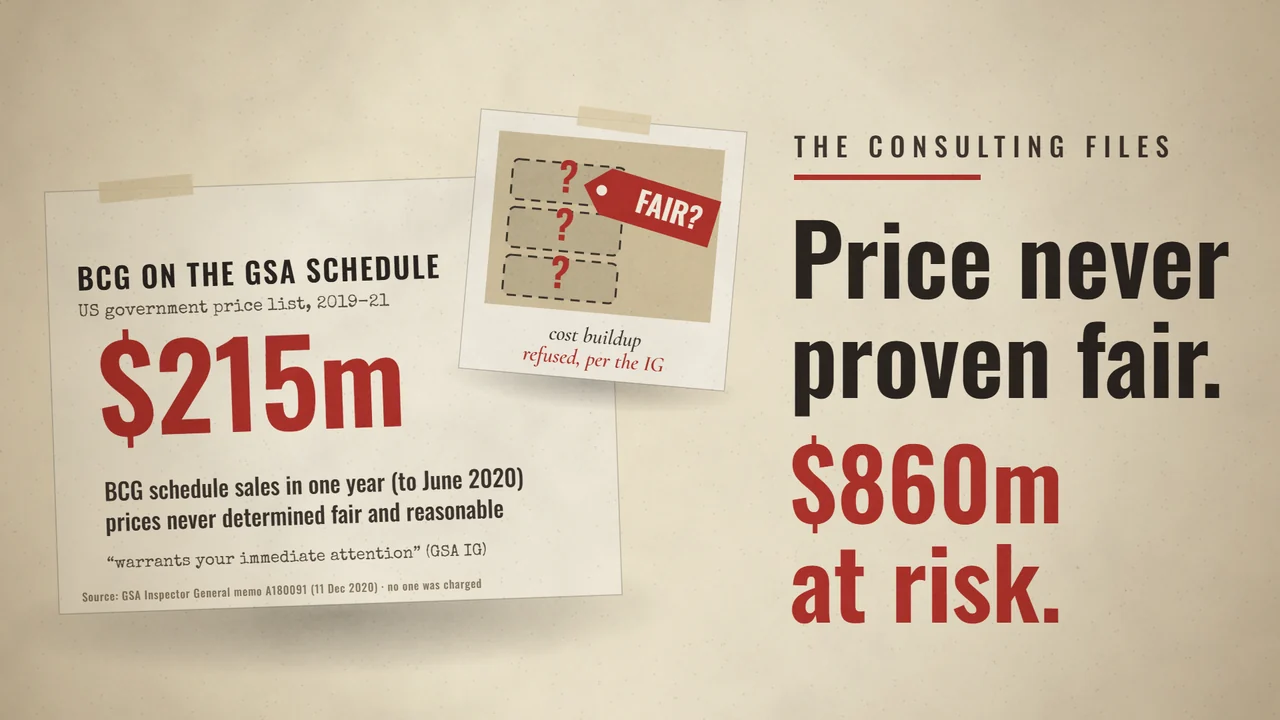
The same issue arose in BCG’s GSA schedule case, where the Inspector General argued that later competitions could not validate a starting price that had never been shown to be fair. ProPublica reported that GSA had cancelled two government-wide contracts with McKinsey shortly before the pandemic, after a long dispute over its prices. Those two stories sit in the background of every no-bid contract in this case.
A discount on a weekly rate is still a weekly rate
McKinsey did reduce its prices. Its proposals offered what it called philanthropic pricing, from $125,000 a week for two consultants to $178,000 for five, according to ProPublica, and the firm says it reduced its fees to the public sector and made its COVID-19 research freely available. Those are real concessions, and they should be acknowledged.
But a lower weekly rate does not answer the question a public buyer most needs to answer: what will be delivered, by when, and how will we know it is useful? Miami-Dade’s experience illustrates the point. The county’s budget director described the work as compiling data and putting it in pretty formats; the 175-page plan was widely criticised as confusing; and McKinsey’s five archetypes were removed in a later revision. A weekly rate rewards time spent. A deliverable-based fee rewards something the client can use. A business case calculator can help a buyer compare the cost of an open-ended weekly team with a fixed-scope alternative.
The client owns the story
Two details from the Miami-Dade contract concern control rather than cost. McKinsey resisted the county’s attempt to limit the work to four weeks, and a McKinsey partner said that removing a confidentiality clause would be a show stopper. For a private client, confidentiality protects commercial information. For a government, the advice it paid for is part of the public record of how decisions were made.
Public buyers should negotiate these terms before the emergency, not during it. A framework that pre-agrees confidentiality, publication rights and data ownership allows a government to move fast without giving up the right to explain its own decisions. That includes data: the VA’s contracting document said McKinsey already had epidemiological data the VA did not, and each new engagement could add more. Who owns what is learned from a government’s data is a question worth settling in writing.
Evidence, not adjectives
This case is easy to tell with adjectives, and harder to tell with evidence. ProPublica described the early results of the response as mixed. A federal official told ProPublica that McKinsey consultants helped vet supplier offers for the federal task force; McKinsey said it did not vet offers and made no decisions, and FEMA said the task force itself vetted hundreds of leads. A mid-April slide lacked analysis of VA nursing homes and rural facilities; McKinsey said it ran its analyses as the data became available, and the VA said McKinsey was fully fulfilling its contract.
Each of these is a disagreement about facts, not a finding. Any presentation should give both sides and say who said what. The executive summary slide generator can help structure a summary that leads with what is established, then sets out what is disputed.
Dependence is the real question
The larger issue raised by the reporting was not legality but dependence. When the pandemic struck, many governments lacked the in-house capacity to model a health crisis, run a supply chain or process millions of unemployment claims. States from New York to Maine bought that capacity from consultants; The Wall Street Journal counted at least $182 million in state contracts for McKinsey and Deloitte together by November 2020.
Buying capacity in a crisis is reasonable. Relying on it for every crisis is a choice. Governments that want to avoid the next round of emergency no-bid contracts need to invest in their own analysts and procurement staff between crises, and to use consultants in ways that transfer skills rather than replace them. The ICE detention-budget case shows a different side of the same dependence in federal work.
Three rules for emergency contracts
First, an emergency is not a blank cheque: every no-bid contract needs a ceiling, an end date and a point at which it must be competed. Second, price the work, not the panic: tie fees to deliverables the client can check. Third, let the client own the story: settle publication, confidentiality and data rights in advance. The management consulting presentation guide is a reminder that the most useful advice is advice a client can explain in public. In a crisis, speed matters. So does knowing what you bought.
TAKE IT INTO THE NEXT MEETING
Three practical lessons
An emergency is not a blank cheque
A no-bid contract can be justified in a crisis. It still needs a ceiling, an end date and a plan to compete what comes next.
Price the work, not the panic
A discount on a weekly rate is still a weekly rate. Tie the fee to defined deliverables that the client can check.
The client owns the story
A government should decide what it can say about the advice it paid for, and keep the data it supplied.
Questions about the case
How much did McKinsey earn from COVID-19 contracts in 2020?
ProPublica counted federal, state and city work worth well over $100 million within about four months, by July 2020. The Wall Street Journal later counted at least $182 million in state contracts for McKinsey and Deloitte together, not split by firm.
Were McKinsey’s COVID contracts illegal?
The sources reviewed show no charge and no official finding that McKinsey broke the law. The VA said it adhered to all federal contracting laws, and McKinsey said it reduced its public-sector fees.
Did McKinsey vet PPE offers for the federal task force?
A federal official told ProPublica that its consultants helped vet supplier offers, and FEMA said the task force vetted hundreds of leads. McKinsey said it did not vet offers, helped assess the availability of equipment and made no decisions.
THE EVIDENCE TRAIL
Sources & editorial notes
Adapted from the original XLSlides documentary, with additional analysis. Published 19 November 2026. Sources have different roles: primary records, investigative reporting and the positions of affected parties.
- ProPublica: How McKinsey is making $100 million (and counting) advising on the government’s bumbling coronavirus response, 15 July 2020 ↗Principal investigation: the VA request, contract growth, pricing, the slides, the task force, Miami-Dade, and the VA’s and McKinsey’s responses.
- The Wall Street Journal: States hire consultants for Covid-19 help, with mixed and expensive results, 2 November 2020 (Dow Jones repost) ↗New York’s contract and fees, and the $182m state total for McKinsey and Deloitte together.
- Maine Public: amid exploding jobless claims, Maine contracted a consulting firm, 12 February 2021 ↗Maine’s $6.3m no-bid Labor Department contract.
- BINJ.News: more multimillion-dollar no-bid COVID contracts for Massachusetts, 5 May 2021 ↗The Massachusetts contract, its nine amendments and its growth past $20m.
- USAspending.gov: VA contract 36E77620C0039, COVID-19 consulting and modelling ↗Official award data: start date and an award amount of $22,295,000.
- USAspending.gov: Defense Health Agency contract HT940220C0002 ↗Official award data: an award amount of $6,100,000.
- ProPublica: coronavirus contracts tracker, McKinsey & Company ↗ProPublica’s database of McKinsey’s federal COVID-19 contracts; context.
- Consulting.us: GSA stops McKinsey’s contract, claims fees were too high, 27 May 2020 ↗Trade report of the GSA cancellation and pricing dispute.
Image credits & licences
Original illustrations and typography: XLSlides. Documentary stills have been resized and converted to WebP for this article. Underlying images retain the credits supplied with the episode.
- McKinsey & Company logo: public domain (text logo), via Wikimedia Commons.
- ProPublica logo: public domain (text logo), via Wikimedia Commons.
- XLSlides logo: XLSlides.
- Government agencies, states and counties are shown as typeset name cards; people are shown as silhouettes; the U.S. map is a stylised hand-placed outline; buildings, documents, slides and charts are drawn. Scenes marked "illustrative" are not to scale.
FROM EVIDENCE TO A RECOMMENDATION
Make the reasoning visible.
Use clear action titles, sourced exhibits and an explicit decision. XLSlides helps turn your analysis into an editable presentation; the evidence and judgment remain yours to verify.
Build a case-study presentation