 XLSlides
Episode premiere: 29 November 2026 at 7:30 am IST. Read the full case study before the premiere.
A retreat from Russia in a week
On Thursday 3 March 2022, a week after Russian troops crossed into Ukraine, McKinsey & Company said it would immediately cease existing work with state-owned entities in Russia and take on no new client work there, Bloomberg reported. Four days earlier, in a LinkedIn post, its global managing partner, Bob Sternfels, had said only that work for Russian government entities would stop. The post did not mention companies that the state owned in full or in part.
The change followed criticism from current and former staff, who said the firm was moving too slowly. Eleven weeks later, NBC News reported on one of McKinsey’s past clients in Russia: companies of Rostec, the state conglomerate whose subsidiaries, according to NBC, make attack helicopters, electronic warfare systems and engines for cruise missiles. At the time, the Pentagon was McKinsey’s largest federal client. This case sets out what was reported, what McKinsey said in reply, and what was not found.
The business
McKinsey sells advice to companies and governments. In 2022 it had about 36,000 employees around the world, NBC News reported, and as a rule it does not disclose who its clients are. Two of those clients matter here. In Washington, the largest federal one was the Department of Defense. In Russia, NBC reported, McKinsey had promoted its work with 21 of the country’s 30 biggest companies.
Court filings shed some light on who they were. According to NBC, a 2020 bankruptcy court filing and documents filed in Puerto Rico’s bankruptcy proceedings showed consulting work for Sberbank and VTB, two of Russia’s largest banks, and for the state energy companies Gazprom and Rosneft. “The value and duration of McKinsey’s consulting work for those firms have not been disclosed,” NBC wrote.
Source context: [1]
The conglomerate
Then there was Rostec. The U.S. Treasury describes it as “a massive Russian state-owned enterprise”, formed to consolidate Russia’s technological, aerospace and military-industrial expertise. More than 800 entities sit under its management umbrella, in sectors including automotive, defence, aviation and metals. In the Treasury’s words, Rostec leads Russia’s domestic defence production and facilitates foreign trade in defence and related materiel.
According to NBC, Rostec’s subsidiaries make attack helicopters, cruise missile engines, systems for naval frigates, electronic warfare systems and night vision goggles. Its chief executive, Sergei Chemezov, served as a KGB officer alongside Vladimir Putin in Dresden during the Soviet era. After Russia’s 2014 invasion of Ukraine, the Treasury had added Rostec to its Sectoral Sanctions Identifications List, a narrower measure than the full blocking sanctions that came later.
The work
What did McKinsey do for Rostec’s companies? Its links to Rostec date to at least 2010, according to several reports in Russian media cited by NBC. In 2015, NBC reported, McKinsey was hired to implement “large-scale reform” at Russian Helicopters, the Rostec subsidiary that builds civilian and military helicopters. The helicopter maker’s own announcement that year describes a narrower role. On 21 May 2015, at the HeliRussia exhibition, its service company signed an agreement under which a consortium led by the Russian consultancy Strategy Partners Group would develop an after-sale service and maintenance strategy to 2030, and McKinsey would carry out the external review. The aim was for after-sale service to provide 35% of Russian Helicopters’ revenue by 2030.
McKinsey’s spokesman, Neil Grace, told NBC that its past work for Rostec subsidiaries “did not concern weapons systems”. One project, he said, concerned buses for public transport; others covered research on the global helicopter market and advice on an engine for commercial aircraft. The work concerned “core commercial and operational topics”, he said.
The other client
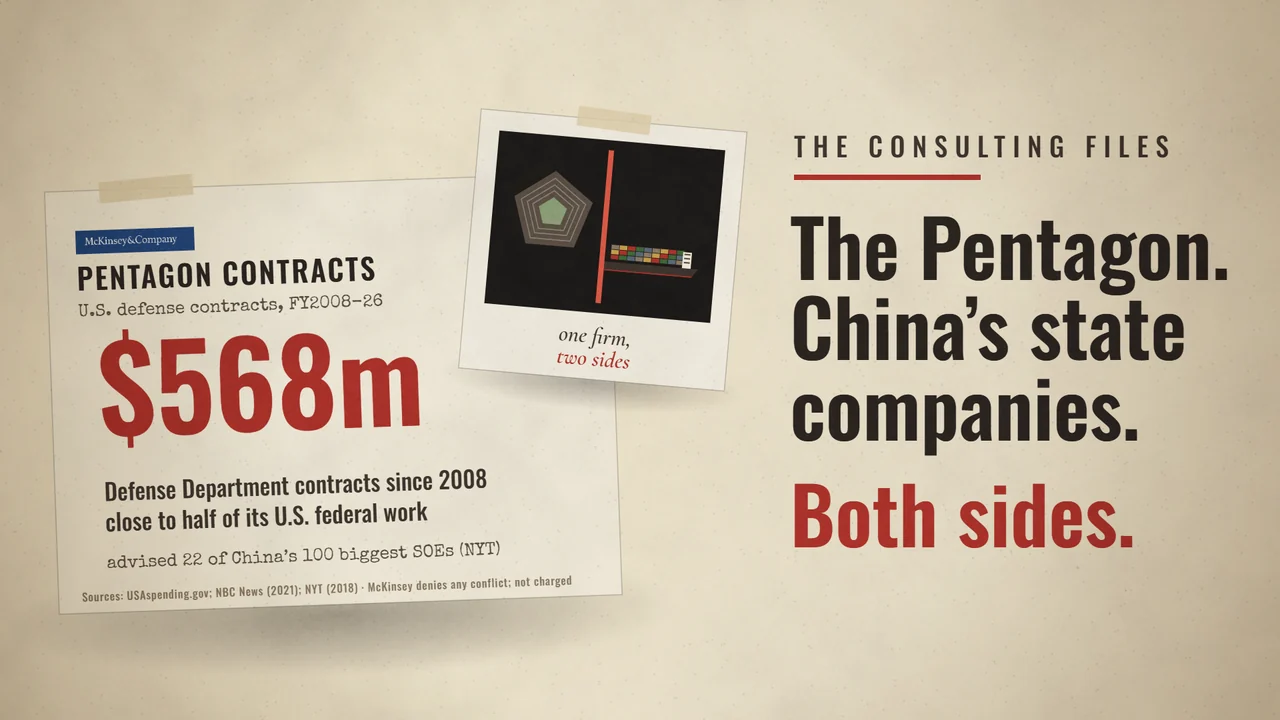
In Washington, the picture was larger and better documented. Citing USAspending.gov, NBC reported that the Defense Department had given McKinsey nearly $875 million of work since 2008, through more than 60 contracts. McKinsey advised senior officials on the Pentagon’s computer network, the F-35 fighter jet programme and weapons budgets. It had also advised the CIA on a sweeping reorganisation under President Barack Obama, and the FBI on building its intelligence-gathering ability after the attacks of 11 September 2001.
In March 2022, the month McKinsey pulled back from Russia, the Army awarded it a $16 million contract to evaluate the country’s ammunition industrial base and the possible risks in its international supply chain, NBC reported.
Source context: [1]
The disclosure
Federal laws require companies to divulge any potential conflict of interest and to show how they plan to address it, NBC noted. It obtained four of McKinsey’s federal contracts, with the Defense Department, the Navy and Customs and Border Protection. None of them noted a possible conflict arising from McKinsey’s work for Russian state-owned companies. The Army told NBC that McKinsey had not flagged any potential conflict of interest: “At this time, the Army is not aware of any acknowledgement by this company of a possible conflict of interest.” Its spokesperson, Lt. Col. Brandon Kelley, added: “The Army followed all applicable contracting laws, policies and procedures.” McKinsey said it complies with all applicable U.S. contracting laws, including those on conflicts of interest, and serves the government through a separate legal entity with separate operational structures and separate information technology where required. It had given a similar answer to questions about its work for Chinese state-owned companies.
Source context: [1]
Name the client, not just the work
- 01Screen the owner
Check who owns the client and what the parent group does, not only the scope of the project.
- 02Disclose to the other side
Where a government contract requires it, state possible conflicts and how they are handled, even when the work looks harmless.
- 03Show the firewall
Describe separate entities, staffing and IT in writing, so that the client can test them.
Follow the money
By our arithmetic, nearly $875 million over 14 years is roughly $60 million a year from the Pentagon. What Rostec’s companies paid McKinsey is not public, and neither is what the Russian banks and energy companies paid. The money was not the only thing of value. “McKinsey puts an enormous stamp of approval on everything,” the investor and Kremlin critic Bill Browder told NBC. After Russia seized Crimea in 2014, McKinsey chose not to withdraw from Russia, NBC reported. When the full-scale invasion came in 2022, the firm said at first that it would keep its Moscow office open to support what Sternfels called its “400-plus local colleagues”, according to Consultancy.eu.
The exit
On Sunday 27 February 2022, Sternfels wrote that the firm was appalled by the Russian government’s actions in its “brutal and senseless invasion” of Ukraine. McKinsey would stop work for the Russian government, but the post did not cover companies the state owned in full or in part, Bloomberg noted. Alumni commenters called it “cowardice” and a “weak PR move”, Consulting.us reported, and the firm’s managing partner in Ukraine publicly urged companies to cut ties with any business in which the Russian state held a stake.
By Thursday, the policy covered every state-owned client: existing work would stop, no new client work would be taken on in Russia, and all client service there would be suspended once the remaining engagements ended. McKinsey also pledged $2 million in cash and $10 million in pro bono support to the humanitarian effort, and matched colleagues’ donations three to one. In the spring of 2022, its Russian business was taken over by local management, Interfax reported. In August it took a new name, Yakov and Partners, with more than 180 employees.
The reckoning
NBC’s report was published on 21 May 2022. Senator Maggie Hassan told NBC that McKinsey had shown a “pattern of behavior” that raised “grave concerns about conflicts of interest”, and that she was “deeply concerned by McKinsey’s choices”. Senator Marco Rubio said in an email that McKinsey was “constantly working against American interests to make a profit”. Those are the senators’ views.
Five weeks later, on 28 June 2022, the Treasury designated Rostec under Executive Order 14024 for operating in Russia’s defence and related materiel sector, blocking it and every entity it owns 50% or more. To be clear about what was not found: U.S. authorities have not charged McKinsey over its work in Russia, and NBC reported that there are no allegations that McKinsey damaged U.S. national security. It was unclear whether McKinsey staff had shared information across the Russian and Washington accounts, NBC wrote, and there was no evidence that happened. McKinsey said it would not be fair or accurate to describe its work for Rostec’s subsidiaries as benefiting the Russian military.
THE SEQUENCE
A timeline of the case
Links to Rostec
Russian media reports cited by NBC date McKinsey’s links to Rostec to at least 2010. [1]
Crimea and a narrower sanction
The Treasury adds Rostec to its Sectoral Sanctions Identifications List; McKinsey does not withdraw from Russia. [2]
Russian Helicopters agreement
A Strategy Partners Group consortium will write an after-sale strategy; McKinsey will carry out the external review. [6]
A first statement
Sternfels says work for the Russian government will stop; state-owned companies are not mentioned. [5]
State-owned clients too
McKinsey says it will stop existing work with Russian state-owned entities and take no new clients there. [4]
An Army contract
$16m to evaluate the U.S. ammunition industrial base and its supply-chain risks. [1]
NBC’s report
Rostec subsidiaries named as past clients while the Pentagon was the top federal client. [1]
Full blocking sanctions
The Treasury designates Rostec under Executive Order 14024. [2]
Yakov and Partners
The former Russian business, under local management since spring, takes a new name. [7]
Harmless work, sensitive client
McKinsey’s defence of its Rostec work is specific, and it deserves to be taken seriously. Its spokesman told NBC News that the work for Rostec subsidiaries “did not concern weapons systems”: one project concerned buses for public transport, others covered research on the global helicopter market and an engine for commercial aircraft. Russian Helicopters’ own 2015 announcement describes a modest role, with McKinsey reviewing an after-sale service strategy written by a Russian consortium. Nothing in the sources reviewed here contradicts that description, and no U.S. authority has charged the firm.
The difficulty is that the scope of a project and the identity of a client are separate questions. The U.S. Treasury describes Rostec as a conglomerate of more than 800 entities that leads Russia’s domestic defence production and facilitates its foreign arms trade. A bus project for such a group is still a relationship with that group: it brings fees, access and, in Bill Browder’s phrase, a stamp of approval. Consultants who screen only the statement of work will miss the question that a government client, a journalist or a senator will ask first, which is who the client is. The enterprise risk management presentation guide shows how to put that kind of exposure on a risk register before it becomes a headline.
The disclosure that was not there
The most consequential finding in NBC’s report is not about Russia at all. It is about four federal contracts, with the Defense Department, the Navy and Customs and Border Protection, that noted no possible conflict from McKinsey’s work for Russian state-owned companies. The Army said it was not aware of any acknowledgement by the firm of a possible conflict, and that it had followed all applicable contracting laws. McKinsey said it complies with all applicable U.S. contracting laws, including those on conflicts of interest.
Those statements can all be true at once. Conflict rules ask a contractor to identify possible conflicts and explain how they will be handled; whether a particular client relationship needed to be listed is a legal judgement that the sources do not resolve, and this article does not attempt it. The practical point is simpler. A disclosure that a firm decides it is not required to make leaves the client to discover the relationship later, from someone else. That is almost always worse for the firm than a line in the contract would have been. A general counsel board presentation is a good model for how to present a judgement call like this one: the facts, the rule, the decision and who made it.
A firewall nobody can see
McKinsey’s answer to the conflict question was structural: it serves the U.S. government through a separate legal entity, with separate operational structures and separate information technology where required. NBC reported that it was unclear whether staff had shared information across the Russian and Washington accounts, and that there was no evidence that happened. That matters, and it should be said plainly whenever the case is discussed.
But a firewall is a promise about what happens inside the firm. The client on the other side cannot inspect it unless the firm describes it, and it cannot weigh a risk it has not been told exists. In a business that sells trust, the client list is part of the product. The same pattern appeared in McKinsey’s work for Chinese state-owned companies, described in the China and the Pentagon case, where the firm gave a similar answer. Two cases do not prove that firewalls fail. They do show that an invisible safeguard persuades nobody once the relationship becomes public.
Concentration and reputation
By our arithmetic, NBC’s figure of nearly $875 million over 14 years is roughly $60 million a year from the Pentagon. What Rostec’s companies paid has not been disclosed, and neither has the value of the work for Russian banks and energy companies. That asymmetry is itself instructive. The cost of the Russian relationships to McKinsey’s American business was never a matter of fees; it was a matter of trust with a client worth tens of millions a year, and with legislators who can influence whether that client keeps buying.
Firms usually measure client concentration in revenue. In sensitive sectors, it is worth measuring it in reputation too: which clients would put other clients at risk if their relationship became public? A simple customer concentration calculator answers the first question. The second needs a partner willing to ask it out loud, ideally before a war answers it for them.
Four days in 2022
McKinsey’s exit from Russia moved quickly once it started. On Sunday 27 February 2022, Bob Sternfels said the firm would stop work for the Russian government. Current and former staff criticised it for moving too slowly, and by Thursday the policy covered every state-owned client. The firm pledged humanitarian support, and by August its former Russian business had become Yakov and Partners under local management.
The speed is to the firm’s credit, and the sequence is a lesson in crisis communication. The first statement drew a line that its own people did not accept, and the second had to correct it within four days. When a crisis forces a decision about clients, the first answer should be the one the firm can defend for years, not the narrowest one available. The crisis management and incident response presentation guide covers how to stage those decisions so that the first public statement does not need a second.
Three rules for sensitive clients
The case suggests three rules for any firm that serves governments and the companies of other governments. First, screen the owner, not just the work: a harmless project for a sanctioned or defence-linked group is still a relationship with that group. Second, disclose early to the client on the other side, even where the firm believes the rules do not strictly require it; explaining a missing line years later costs far more. Third, make the firewall visible, in writing, so that the client can judge it.
None of these rules depends on a finding of wrongdoing, and none was made here. That is the point. The Saudi wealth fund case shows how foreign state clients can create obligations that collide with questions from U.S. lawmakers. In this case, McKinsey pulled back from Russia within a week of the invasion. The harder question, for any firm, is why it took a war to ask who the client really was.
TAKE IT INTO THE NEXT MEETING
Three practical lessons
A conflict follows the client, not only the work
Buses and helicopter-market research can be harmless work for a client whose group makes weapons. Screen the owner and the parent group, not only the statement of work.
Disclose early
A line in a federal contract costs little. Explaining its absence years later, in a newspaper and a senator’s office, costs far more.
Make the firewall visible
Separate entities and separate IT reassure only a client who can see them. Describe the safeguards in writing, and treat the client list as part of what you sell.
Questions about the case
Did McKinsey break the law by working for Rostec’s companies?
U.S. authorities have not charged McKinsey over its work in Russia, and NBC News reported no allegations that it damaged U.S. national security. McKinsey says it complies with all applicable U.S. contracting laws, including those on conflicts of interest.
Did McKinsey work on Russian weapons?
McKinsey says its past work for Rostec subsidiaries “did not concern weapons systems”, citing a bus project, helicopter-market research and a commercial aircraft engine. Russian Helicopters’ 2015 notice describes McKinsey reviewing an after-sale service strategy.
When was Rostec sanctioned?
After Russia’s 2014 invasion of Ukraine, the U.S. Treasury placed Rostec on its Sectoral Sanctions Identifications List, a narrower measure. Full blocking sanctions followed on 28 June 2022. The sources do not give exact dates for all of McKinsey’s Rostec projects.
THE EVIDENCE TRAIL
Sources & editorial notes
Adapted from the original XLSlides documentary, with additional analysis. Published 27 November 2026. Sources have different roles: primary records, investigative reporting and the positions of affected parties.
- NBC News: McKinsey & Co. worked with Russian weapons maker even as it advised Pentagon, 21 May 2022 ↗Primary investigation: Rostec subsidiaries as past clients, Pentagon contract figures, the four federal contracts, the Army’s and McKinsey’s statements, senators’ comments and what was not alleged.
- U.S. Treasury: sanctions on nearly 100 targets in Putin’s war machine, 28 June 2022 ↗Official description of Rostec, its earlier Sectoral Sanctions Identifications listing and its full blocking designation under Executive Order 14024.
- Bloomberg: McKinsey pulls back from Russia after staff, alumni assailed firm’s stance, 3 March 2022 ↗Report of the 3 March decision on state-owned clients and of the narrower Sunday post. Paywalled and blocks automated checks; the opening paragraphs were read in a browser.
- Consultancy.eu: McKinsey & Company’s response to the Russian invasion of Ukraine, 8 March 2022 ↗Sternfels’s wording, the state-owned and new-client decisions, the humanitarian pledge and the Moscow office’s “400-plus local colleagues”.
- Consulting.us: big consultancies move to cut ties with Russia after backlash, 7 March 2022 ↗Trade coverage of the Sunday post, the alumni criticism and the Thursday course correction; corroborates the Bloomberg account.
- Russian Helicopters via HeliHub: after-sale service strategy agreement, 1 June 2015 ↗The company’s own account of the 21 May 2015 agreement: a Strategy Partners Group consortium writes the strategy and McKinsey carries out the external review. The site blocks scripted checks; read through a fetch service.
- Interfax: McKinsey’s former Russian division changes name to Yakov & Partners, 22 August 2022 ↗The local management takeover in spring 2022, the new name and the headcount of more than 180.
- TASS: former partners of McKinsey in Russia change their name to Yakov and Partners, 19 August 2022 ↗Russian state agency report of the renaming and headcount; corroborates Interfax.
- Consulting.us: McKinsey advised Rostec on commercial and operational improvement, 24 May 2022 ↗Trade summary of NBC’s investigation and McKinsey’s “core commercial and operational topics” response.
Image credits & licences
Original illustrations and typography: XLSlides. Documentary stills have been resized and converted to WebP for this article. Underlying images retain the credits supplied with the episode.
- McKinsey & Company logo: public domain, via Wikimedia Commons.
- XLSlides logo: XLSlides.
- Thumbnail: aerial view of the Pentagon, U.S. Navy photo, public domain, via Wikimedia Commons.
- People are shown as silhouettes (no licensed photos on file); Rostec and other organisations are shown as name cards; buildings, aircraft, documents and charts are drawn, and scenes marked "illustrative" are not to scale.
FROM EVIDENCE TO A RECOMMENDATION
Make the reasoning visible.
Use clear action titles, sourced exhibits and an explicit decision. XLSlides helps turn your analysis into an editable presentation; the evidence and judgment remain yours to verify.
Build a case-study presentation