 XLSlides
Episode premiere: 28 November 2026 at 7:30 am IST. Read the full case study before the premiere.
A warning from City Hall
On 22 January 2007, at New York’s City Hall, Mayor Michael Bloomberg and Senator Charles Schumer released a report they had commissioned from McKinsey & Company. It was called Sustaining New York’s and the US’ Global Financial Services Leadership, and its warning was stark. If nothing changed, their cover letter said, within ten years New York would remain a leading regional financial centre but would “no longer be the financial capital of the world”.
The problem, the letter said, was largely America’s own making: a regulatory framework that was “a thicket of complicated rules, rather than a streamlined set of commonly understood principles, as is the case in the United Kingdom”, too many meritless lawsuits and immigration rules that kept talent out. Twenty months later, Lehman Brothers filed for bankruptcy. A month after that, the chairman of Britain’s financial regulator said the age of light-touch regulation was over. This case follows the report from its commission to its reception, and sets out what it said and what it did not.
The clients
This time the clients were politicians. Bloomberg was the mayor of New York; Schumer was one of the state’s two senators. According to the report, they asked McKinsey to work with the New York City Economic Development Corporation to understand what strong financial markets contributed to the economy and how competitive the US sector had become. A legal trade journal, CCBJournal, later reported that McKinsey had been awarded a contract through the corporation. We could not find any public figure for what McKinsey was paid.
What was at stake was Wall Street’s business model: fees for taking companies public, advising on deals and trading securities. The report focused on exactly those businesses, where competition between financial centres was most intense. In New York City, it said, financial services made up 15% of gross city product, contributed over a third of business income tax revenues and accounted for one job in every nine.
The alarm
The McKinsey team interviewed more than 50 financial services chief executives and business leaders, surveyed more than 30 other chief executives and ran an online survey of more than 75 senior executives, the report says. It also spoke to investor, labour and consumer groups. It described itself candidly as “developed within a short timeframe”, not a comprehensive macroeconomic analysis, and as a starting point for debate. The Associated Press reported surveys of more than 300 people; we use the report’s own figures.
The numbers looked alarming. In the first ten months of 2006, the report said, US exchanges attracted barely one third of the share of initial public offerings, by market value, that they had captured in 2001. For offerings over $1 billion, the US share fell from 57% in 2001 to 16%. Between 2002 and 2005, London’s financial services workforce grew to 318,000 while New York’s shrank slightly to 328,400: “almost identical”, in the report’s words.
The diagnosis
Why was this happening? The report named three factors that dominated financial leaders’ views of New York: skilled workers, the legal environment and regulatory balance. On talent, it said caps on H-1B work visas and other immigration rules were pushing skilled people elsewhere. On the law, it noted that 2005 had set a new high for the number and value of securities class-action settlements, while acknowledging that many of those cases addressed the legitimate claims of investors after notable corporate wrongdoing.
On regulation, the cover letter said the 2002 Sarbanes-Oxley Act had suffered a flawed implementation that “produced far heavier costs than expected”. Then came the comparison. Business leaders, the report said, increasingly perceived Britain’s single, principles-based regulator, the Financial Services Authority, as superior to a complex US system of multiple federal and state regulators. The UK’s measured enforcement style was seen as more results-oriented than a US approach sometimes described as punitive.
Source context: [1]
The prescription
The report made eight national recommendations in three groups. The near-term priorities were clearer guidance for implementing Sarbanes-Oxley, securities litigation reform, and a shared vision for financial services with supporting regulatory principles. To level the playing field, it proposed easing restrictions on skilled non-US professionals, including raising the H-1B cap; recognising international accounting standards without reconciliation; and protecting US competitiveness in implementing the Basel II capital accord, where it warned that US proposals “would result in US banks holding higher capital levels than their non-US peers”.
For the longer term, it proposed a bipartisan national commission on financial market competitiveness, which should consider, among other things, the possibility of a single regulator, and modernised financial charters, including an optional federal charter for insurers. To be fair to the report, it did not call for scrapping Sarbanes-Oxley; its first recommendation was clearer guidance on implementing it. And the cover letter said reforms must maintain “strong protections for investors and consumers”.
Source context: [1]
Follow the money
What was the prize? Stopping the loss of market share, the report estimated, would add about $15 billion to $30 billion of financial services revenue to the US in 2011 alone and, assuming revenue and jobs moved together, 30,000 to 60,000 securities jobs. The industry was not short of money at the time: in December 2006, New York State’s comptroller projected record Wall Street bonuses of $23.9 billion for the year, the Associated Press reported.
The report found friends quickly. The day after its release, the American Insurance Association issued a statement applauding its call for an optional federal charter, Insurance Journal reported. Not everyone was convinced. In March 2007, a CFO.com commentary asked whether the report was “just part of a blusterous lobbying campaign on behalf of Wall Street”. It granted that the report made some sensible points, but noted that forces other than regulation, such as very large home-market listings in Russia and China, lay behind the shift in IPOs.
Ask widely, score the risk, write the downside
- 01Widen the evidence base
Balance industry interviews with investors, supervisors and sceptics, and report who was asked.
- 02Use a balanced scoreboard
Pair market-share measures with indicators of leverage, risk and investor protection.
- 03Write the downside
For every rule to loosen, state what could go wrong if the change works as intended.
Not alone
McKinsey’s report was one of several pushing in the same direction, and it said so. On 30 November 2006, the Committee on Capital Markets Regulation, popularly known as the Paulson Committee, had published an interim report. On 12 March 2007, the US Chamber of Commerce released the report of its Commission on the Regulation of US Capital Markets in the 21st Century. The next day, Treasury Secretary Henry Paulson opened a conference on capital markets competitiveness at Georgetown University, where he asked whether it would be possible and beneficial to move toward “a more principles-based regulatory system, as we see working in other parts of the world”.
On 31 March 2008, the Treasury released a blueprint for restructuring America’s financial regulators. The direction of travel across these efforts was broadly similar: simpler, more principles-based and more competitive regulation. That context matters when weighing any one report’s influence. The McKinsey study was a prominent voice in a crowded debate, not its sole author.
The crisis
One passage in the report reads differently today. Describing credit markets, it said that “European lenders are beginning to embrace US-style credit terms, critical to the leveraged lending and sub-prime consumer finance markets”, and expected this to position Europe for “explosive securitization growth” of the kind the US had seen. It was written as a description of a competitive threat, not as a warning about risk.
On 15 September 2008, Lehman Brothers sought Chapter 11 bankruptcy protection, becoming the largest victim of the sub-prime mortgage crisis. According to the New York State comptroller, as reported by The New York Times, the brokerage units of New York financial companies lost more than $35 billion in 2008, and Wall Street bonuses fell 44%, from $32.9 billion in 2007 to $18.4 billion. On 6 October 2008, speaking in the City of London, Bloomberg said the months ahead would be difficult “as we come to terms with a financial system that spun out of control”.
The reckoning
Britain changed course first. In an interview with The Guardian, reported by Risk.net on 17 October 2008, the FSA’s chairman, Lord Turner, said the age of light-touch regulation was over: “There is no doubt the touch will be heavier.” On 12 March 2009, the FSA’s chief executive, Hector Sants, went further: “a principles-based approach does not work with individuals who have no principles”. The regulatory model the report had held up as superior was being rebuilt.
In 2015 the writer Philip Augar summed up the report’s fate: “Within a few months the banking crisis broke, and Messrs Bloomberg and Schumer had more pressing matters to deal with.” To be clear, no one was charged in connection with the report, and McKinsey is not accused of wrongdoing. The report made recommendations; Congress, the Treasury and regulators made the decisions. The sources reviewed do not show that it caused the crisis.
THE SEQUENCE
A timeline of the case
Paulson Committee interim report
The Committee on Capital Markets Regulation publishes its interim findings. [8]
Record bonuses projected
The state comptroller projects $23.9bn in Wall Street bonuses for 2006. [5]
The report is released
Bloomberg and Schumer warn that New York could lose its status within ten years. [2]
Chamber commission reports
The US Chamber of Commerce’s commission publishes its recommendations. [9]
Treasury conference
Paulson raises a move toward more principles-based regulation. [10]
Treasury blueprint
A plan to restructure America’s financial regulators. [11]
Lehman Brothers fails
The largest victim of the sub-prime crisis seeks Chapter 11 protection. [12]
“The touch will be heavier”
The FSA’s chairman says the age of light-touch regulation is over. [15]
“No principles”
Hector Sants says principles-based regulation does not work with people who have none. [16]
A report with a question already in it
The brief for this report contained its conclusion in outline. Two elected officials from New York, worried about the industry that paid a large share of the city’s taxes, asked McKinsey to work with the city’s Economic Development Corporation on how competitive America’s financial markets were. That is a legitimate question, and the report answered it with real data on listings, revenues and jobs. But the framing mattered. The question was how to keep business in New York, not whether the business being competed for was safe, and the recommendations followed that framing.
There is nothing improper in a client commissioning advice on its own priorities. Governments, trade bodies and companies do it all the time, and the report was open about who had asked for it. The practitioner’s lesson is to make the brief visible in the work itself: state the question as the client posed it, say what it leaves out, and flag where a different question would lead to a different answer. The strategy recommendation deck guide shows how to put the governing question on the first page so that readers can judge the answer against it.
Who you ask shapes what you find
The report’s evidence base was described with unusual candour. The team interviewed more than 50 financial services chief executives and business leaders, surveyed more than 30 other chief executives and ran an online survey of more than 75 senior executives. It also spoke to investor, labour and consumer groups, and it said plainly that it had been developed within a short timeframe and was a starting point for debate rather than a comprehensive analysis.
Even so, the centre of gravity was the industry. When the people with the most to gain from lighter rules are the main source of evidence about rules, the findings will tend to describe rules as a cost. That is not bad faith; it is sampling. The remedy is to map who has a stake in the outcome before the interviews begin, and to weight the evidence deliberately: supervisors, investors who had lost money in earlier scandals, academics who studied systemic risk. A stakeholder analysis template makes that map explicit, and it is worth attaching it to the method page of any policy study.
The wrong scoreboard is the easy one
The report’s most striking numbers measured market share. The US share of global listings by value had fallen to barely a third of its 2001 level; the share of offerings over $1 billion had fallen from 57% to 16%; London’s financial workforce had nearly caught up with New York’s. These were real figures, and they were easy to count. A contemporaneous CFO.com commentary pointed out that some of the shift reflected very large listings in Russia and China choosing their home markets, a reminder that a share measure can move for reasons that have nothing to do with regulation.
The deeper problem is what a share measure leaves out. The report itself noted that European lenders were embracing US-style credit terms for leveraged lending and sub-prime consumer finance, and treated the expected growth in securitisation as a competitive threat. Measured by share, that growth looked like success. Measured by risk, it looked very different within two years. Any competitive benchmarking presentation should ask the same question: if we win on this measure, what else rises with it? A scoreboard of competitiveness needs a column for leverage, concentration and investor losses alongside revenue and jobs.
Write the downside next to every recommendation
The report did contain balance. It did not call for scrapping Sarbanes-Oxley; its first recommendation was clearer guidance on implementing it. Its cover letter said reforms must maintain strong protections for investors and consumers, and it quoted Eliot Spitzer, speaking as New York’s Attorney General, on not forgetting the lessons of integrity. What it did not do, recommendation by recommendation, was set out what could go wrong if each change worked exactly as intended.
That is the discipline most worth copying. A recommendation to move toward principles-based regulation should say what happens when firms interpret principles aggressively. A recommendation to limit litigation should say which investor claims might no longer be brought. A recommendation on bank capital should say what a thinner cushion means in a downturn. The FSA’s chief executive put the risk of principles-based regulation in a single sentence in 2009: it does not work with individuals who have no principles. A risk assessment matrix attached to each recommendation, with likelihood, impact and the party that bears the loss, would have made that risk visible in 2007. The enterprise risk management presentation guide covers how to present downside scenarios without burying the main case.
One voice in a crowded room
It would be wrong to present this report as the cause of what followed. It was one of several studies pushing in the same direction, and it said so: the Committee on Capital Markets Regulation had reported two months earlier, the US Chamber of Commerce’s commission reported in March 2007, and the Treasury held its own conference on competitiveness the next day before publishing a blueprint for restructuring the regulators in 2008. Lawmakers and regulators made the decisions. No one was charged in connection with the report, and McKinsey is not accused of wrongdoing.
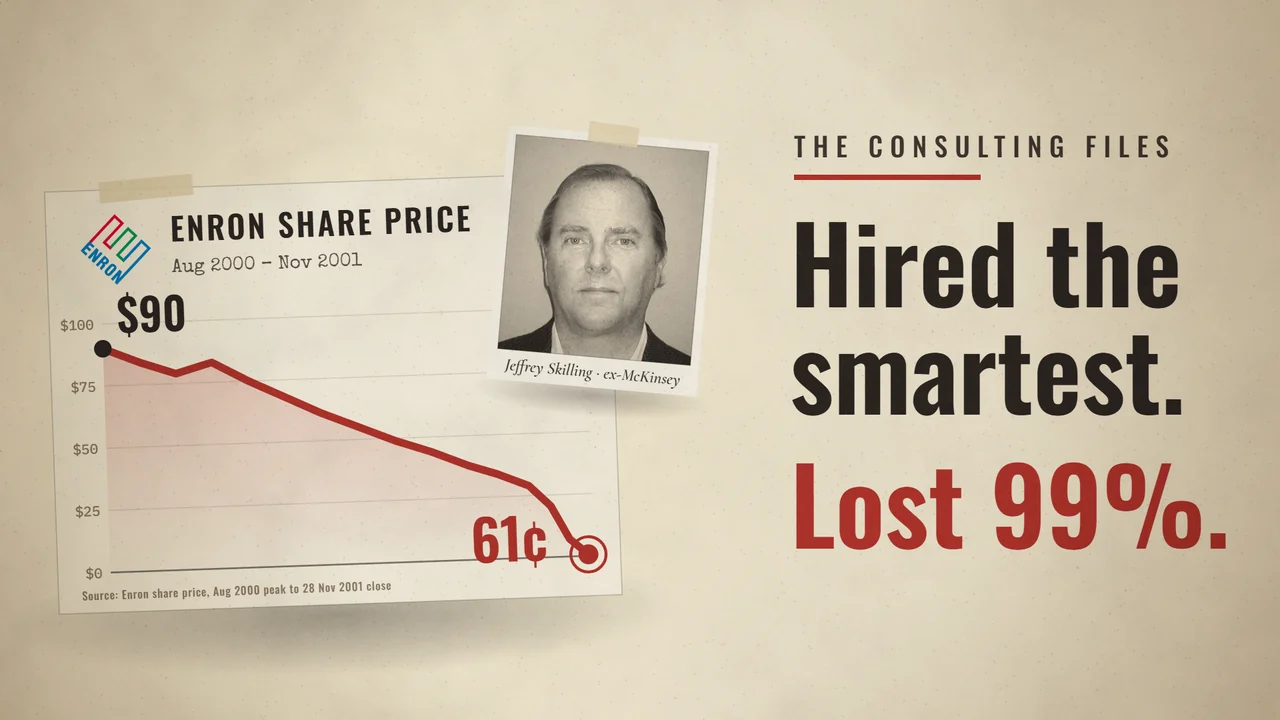
Influence is still worth thinking about, because a consultant’s name lends a policy argument authority it might not otherwise have. When a firm’s brand appears on the cover of a report that two politicians present at City Hall, the analysis becomes part of a campaign. The firm cannot control how its work is used, but it can control how clearly the work states its limits, its sample and its open questions. The Enron case shows how admiring analysis of a business model can look different after a collapse; the lesson in both is to separate description from endorsement.
What a better report would have done
None of this requires hindsight about Lehman Brothers. A better version of the 2007 report would have kept its data on listings and jobs and added three things. First, a method page that named the interview sample by type and weighted it against non-industry voices. Second, a balanced scoreboard that put measures of leverage and risk next to measures of market share, so that growth in sub-prime lending was visible as a risk as well as an opportunity. Third, a downside paragraph for each of the eight recommendations, stating what could go wrong and who would pay.
The report estimated that $15 billion to $30 billion of revenue in 2011 alone was at stake. That is a market sizing exercise, and a useful one. But a prize without a price is half an analysis. In 2007 the question was how to win the race between financial centres. Two years later, the more important question was what the race had cost.
TAKE IT INTO THE NEXT MEETING
Three practical lessons
Who you ask shapes what you find
A study built mainly on interviews with industry leaders will hear industry priorities. Name the sample, balance it with investors, supervisors and critics, and say what the evidence cannot show.
Beware the easy scoreboard
Share of listings is simple to count; risk building up inside the system is not. Put a measure of downside next to every measure of competitiveness.
Write down the downside
Every recommendation to loosen a rule should state what could go wrong if it works, and who would bear the cost.
Questions about the case
Did McKinsey’s report cause the 2008 financial crisis?
No source reviewed here shows that. The report was one of several studies urging simpler, more competitive regulation, alongside the Paulson Committee, the US Chamber of Commerce commission and the Treasury. Lawmakers and regulators made the decisions, and the crisis had many causes.
Did the report call for repealing Sarbanes-Oxley?
No. Its first recommendation was clearer guidance for implementing the Act, particularly the section 404 rules on internal controls, and its cover letter said reforms must keep strong protections for investors and consumers.
How much was McKinsey paid for the report?
We could not find a public figure. The report says Bloomberg and Schumer asked McKinsey to work with the New York City Economic Development Corporation, and a 2007 CCBJournal profile said McKinsey had been awarded a contract through the corporation.
THE EVIDENCE TRAIL
Sources & editorial notes
Adapted from the original XLSlides documentary, with additional analysis. Published 27 November 2026. Sources have different roles: primary records, investigative reporting and the positions of affected parties.
- Sustaining New York’s and the US’ Global Financial Services Leadership, January 2007 (City of New York) ↗Primary source: the cover letter, the commission and method, the figures on listings, jobs and the city economy, the three factors, the eight recommendations and the passage on sub-prime credit terms. The PDF’s text layer drops some characters; figures were read in context.
- City of New York: Bloomberg/Schumer report, press release PR-021-07, 22 January 2007 ↗Official release date and the leaders’ framing of the ten-year warning.
- CBS News (Associated Press): NYC fights to stay world financial capital, 22 January 2007 ↗Contemporaneous coverage of the launch. Its survey count (more than 300) differs from the report’s own; the report’s figures are used.
- CCBJournal: Bloomberg/Schumer report, a focus on talent, 1 June 2007 ↗Trade-journal report that McKinsey had been awarded a contract through the New York City Economic Development Corporation. No fee is given.
- CBS News (Associated Press): Wall St. bonuses trickle through NYC, December 2006 ↗The state comptroller’s projection of a record $23.9bn in 2006 bonuses; a projection, not a final figure.
- Insurance Journal: insurer group applauds report’s call for optional federal charter, 23 January 2007 ↗The American Insurance Association’s statement supporting recommendation 8.
- CFO.com: Bluff and bluster?, 19 March 2007 ↗Contemporaneous sceptical commentary on the report’s data and motives; opinion, attributed as such. The site may block automated checks.
- The D&O Diary: Paulson Committee releases interim report, 30 November 2006 ↗The Committee on Capital Markets Regulation’s parallel interim report.
- The D&O Diary: US Chamber commission reports on capital markets competitiveness, 12 March 2007 ↗The US Chamber of Commerce commission’s parallel report and its date.
- US Treasury: Paulson’s remarks at the Capital Markets Competitiveness Conference, 13 March 2007 ↗Primary record of the Treasury Secretary’s comments on a more principles-based regulatory system.
- US Treasury: Treasury releases Blueprint for stronger regulatory structure, 31 March 2008 ↗Primary record of the 2008 plan to restructure US financial regulators.
- HISTORY.com: Lehman Brothers collapses, 15 September 2008 ↗Date and description of Lehman’s Chapter 11 filing.
- The Bulletin (The New York Times): Wall Street bonuses total $18.4bn, down 44% from 2007, 29 January 2009 ↗The comptroller’s 2008 figures on brokerage losses and bonuses, as reported by The New York Times.
- City of New York: Mayor Bloomberg’s lecture on the financial crisis in the City of London, 6 October 2008 ↗Primary text of the mayor’s remarks, including “a financial system that spun out of control”.
- Risk.net: FSA chairman warns of hard-line regulation, 17 October 2008 ↗Lord Turner’s statements to The Guardian that light-touch regulation was over.
- Katten: FSA chief executive signals regulatory sea change, 16 March 2009 ↗Law-firm summary quoting Hector Sants’s speech of 12 March 2009.
- Philip Augar: The precarious prospects of London finance, 3 May 2015 ↗A later writer’s assessment of the report’s fate; opinion. The site was unavailable during this check and was read in the Internet Archive.
Image credits & licences
Original illustrations and typography: XLSlides. Documentary stills have been resized and converted to WebP for this article. Underlying images retain the credits supplied with the episode.
- McKinsey & Company logo: public domain, via Wikimedia Commons.
- XLSlides logo: XLSlides.
- People are shown as silhouettes (no licensed photos on file); skylines, documents and charts are drawn, and scenes marked "illustrative" are not to scale.
FROM EVIDENCE TO A RECOMMENDATION
Make the reasoning visible.
Use clear action titles, sourced exhibits and an explicit decision. XLSlides helps turn your analysis into an editable presentation; the evidence and judgment remain yours to verify.
Build a case-study presentation