XLSlides
An email after a meeting with the president
On 3 April 2014, Vittorio Massone, the head of Bain & Company’s Johannesburg office, met South Africa’s president, Jacob Zuma. Afterwards he sent an email, quoted in the Nugent Commission’s evidence and reported by Business Day: “Sars is aa go, right after elections!” SARS, the South African Revenue Service, was the country’s tax collector. Months before Tom Moyane was appointed to run it, Bain had drafted a plan for his first 100 days.
Eight years later, the British government excluded Bain from Cabinet Office contracts for what a minister called grave professional misconduct. This case follows the SARS work through two judicial commissions, a repayment, a ten-year restriction at home and a three-year exclusion in Britain that lasted less than eight months. The commissions’ findings are their own. Bain has apologised, but disputes that its people knowingly set out to damage SARS.
The tax collector
SARS was created in 1997 to collect income tax, VAT and customs duties: the money that pays for schools, clinics and police. In the year to March 2015, it collected R986.4 billion, according to its own preliminary revenue outcome. A tax agency sells nothing. It runs on trust, because people pay when they believe the rules are enforced fairly and for everyone.
By 2014, SARS had a strong reputation. The Nugent Commission recorded that a 2014 review using an IMF-backed diagnostic framework had found it world class, and that it had been held up in South Africa as a model public institution. Its engine room was the Large Business Centre, a one-stop service for the biggest taxpayers, which according to the commission brought in about 30% of revenue.
The consultant and the president
Bain’s South African office was led by Vittorio Massone. Between August 2012 and July 2014, he met President Zuma repeatedly. The sources disagree on how often. The Nugent Commission said ten or more times, the Zondo Commission put the number at approximately 17, and Bain says it was 12. According to Nugent, the first meeting concerned a project called Phoenix, aimed at Bain winning work across South Africa’s public institutions. From October 2013, Massone also met Tom Moyane, the man Zuma would later choose to run SARS. Bain has said that those meetings focused on “coaching him for this role”.
The plan
On 26 May 2014, Bain produced a document titled “TM First 100 Days”, which was presented on 2 June. On its face, the Nugent Commission wrote, it was a clear strategy to be followed by Mr Moyane upon his appointment at SARS. At that point he had not been appointed. In September 2014, Zuma appointed Moyane commissioner. The sources give slightly different dates: the Zondo Commission says 23 September, Nugent says with effect from 27 September, and Bain says October. Within about two weeks, the Zondo Commission found, Moyane had disbanded SARS’s executive committee. SARS then needed a consultant to redesign how it worked.
Follow the money
The first phase of that redesign was put out to tender. Bain bid R2.38 million after a 50% discount, which was slightly below the next lowest bidder, according to the Nugent Commission. “We’ll do a 50% discount just for this phase 1,” Massone wrote in an email of 16 December 2014. The second phase was not competed. It was awarded by deviation from normal procurement, at Bain’s ordinary rates less 12%, and earned Bain a further R164 million. A third phase, Nugent said, would have earned about R50 million more. The Zondo Commission said that emails showed “collusion between the consultants and SARS to get around the procurement process”; it described a six-week contract of around R2.6 million followed by 27 months of work worth around R164 million. Bain’s own account is that it was awarded the work on 26 January 2015 and that the engagement ran until March 2017.
What went wrong
Under the new operating model, SARS was rebuilt. The Nugent Commission found that the Large Business Centre was “eviscerated” and that some 200 managerial employees were displaced from their posts. Its overall verdict was “a massive failure of integrity and governance”. On Bain, Nugent was blunt. He described “a premeditated offensive against SARS, strategized by the local office of Bain & Company”, and wrote that Mr Moyane’s interest was to take control of SARS, while Bain’s interest was to make money. He also said he had no evidence that Bain’s parent company was complicit. On 1 November 2018, President Cyril Ramaphosa terminated Moyane’s appointment as commissioner. Moyane has denied any involvement in state capture.
Serve the institution, not the person about to run it
- 01Price the whole engagement
Treat a discounted first phase as a commitment to compete or openly price the phases that follow.
- 02Know who the client is
Work for the organisation and its governance, not for an individual who has not yet been appointed.
- 03Record political access
Log meetings with political principals and test them against the firm’s conflict and procurement rules.
The whistleblower
One former Bain partner spoke publicly. Athol Williams gave evidence to the Zondo Commission in March 2021 about Bain’s dealings with Moyane and Zuma. Bain applied to cross-examine him, then withdrew the application. In its report, the commission thanked Williams and recorded that he had “rejected numerous attempts from Bain & Co to give him large sums of money in return for his silence”. That is the commission’s account, set out in its own report. In November 2021, Williams left South Africa, saying that he feared for his life.
The reckoning at home
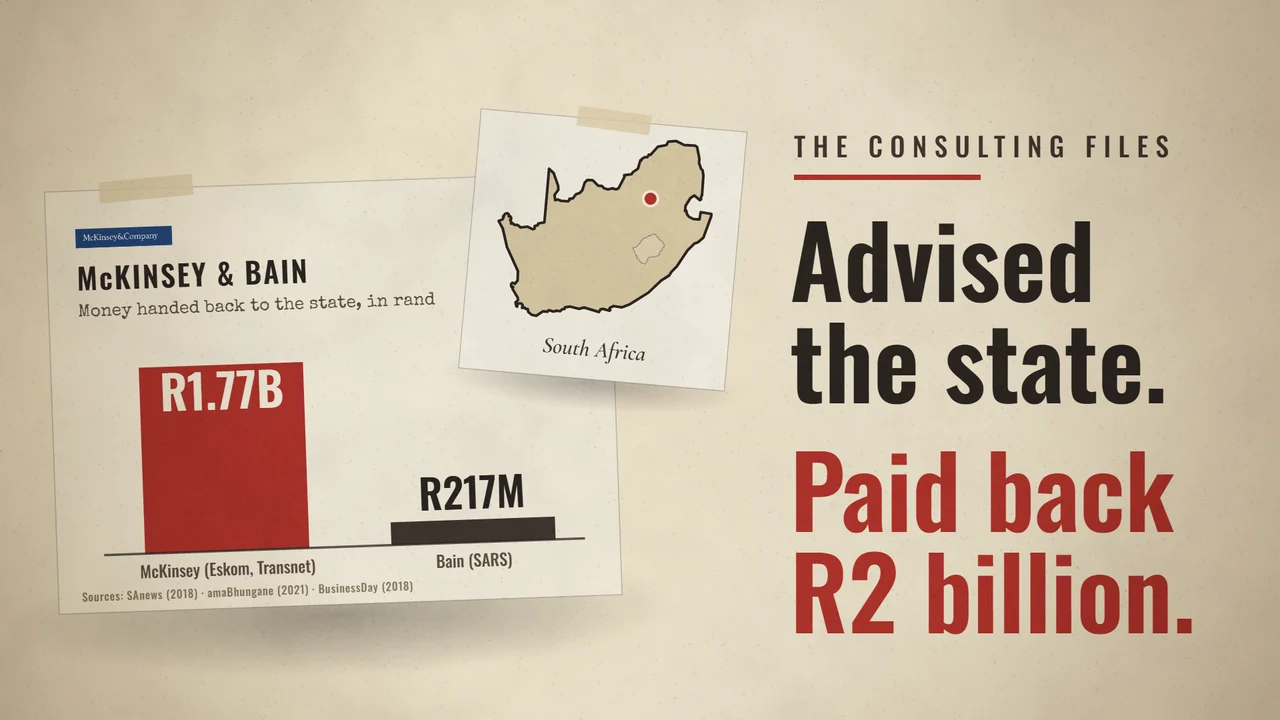
Bain’s reckoning came in stages. In September 2018, its global board set aside the fees from the SARS work and Massone stepped down as head of the South African office, as reported by BizNews; Bain says it separated from him permanently in November. That month, on 16 November 2018, Bain repaid SARS everything it had received, with interest: just short of R217 million, according to the Nugent Commission.
Bain said it was deeply sorry for its involvement and admitted “significant errors of judgement”, but it does not accept that its representatives knowingly participated in an effort to damage SARS. Nugent said the conduct could constitute fraud and recommended that the National Prosecuting Authority consider prosecution. Zondo called SARS “a clear example of state capture” and recommended law enforcement investigations so that prosecutors could decide on the Bain contracts. Bain says neither inquiry recommended charges against it, and the sources reviewed report no charges. In September 2022, National Treasury restricted Bain from public contracts for ten years, until September 2032. Bain challenged the restriction in court; no ruling was found.
The ban
In Britain, Lord Peter Hain, a veteran anti-apartheid campaigner, lobbied the government. On 3 August 2022, the Cabinet Office minister Jacob Rees-Mogg excluded Bain from Cabinet Office contracts for three years for what he called grave professional misconduct, according to City A.M. “I trust that after three years have elapsed Bain & Co will have restored its reputation,” he wrote.
It took less than eight months. On 21 March 2023, in a written ministerial statement, the minister Jeremy Quin lifted the exclusion, citing Bain’s progress and new evidence of its internal controls; only Bain South Africa remained excluded, until January 2025, according to Civil Service World. Hain called the decision “a complete cop-out”. He said Bain had won UK public contracts worth up to £63 million between 2018 and 2022, as reported by Daily Maverick. In October 2024 he asked the new Labour government to reinstate the ban. The reply said that legal advice was that it could not, because there was no new material information. In July 2025, Bain announced that it was winding down its consulting business in South Africa; the Financial Times, as reported by Consultancy.co.za, said it had failed to rebuild its reputation there.
THE SEQUENCE
A timeline of the case
First meeting with Zuma
Massone meets the president; Nugent says the meeting concerned a project called Phoenix. [1]
Meetings with Moyane
Bain later says these meetings focused on coaching him for the role. [3]
“Sars is aa go”
After meeting Zuma, Massone emails that SARS is a go “right after elections”. [6]
“TM First 100 Days”
Bain drafts a plan for Moyane’s first 100 days, months before his appointment. [1]
Moyane appointed
The executive committee is disbanded within about two weeks, per the Zondo Commission. [2]
Phase 2 without competition
After a discounted R2.38m phase 1, phase 2 is awarded by deviation and earns a further R164m. [1]
Moyane removed; Bain repays
Ramaphosa terminates Moyane’s appointment; Bain repays just short of R217m with interest. [10]
Nugent Commission report
“A massive failure of integrity and governance”; prosecutors asked to consider the Bain contracts. [1]
Zondo Commission report
SARS is called “a clear example of state capture”; investigations recommended. [2]
UK exclusion
Rees-Mogg excludes Bain from Cabinet Office contracts for three years. [13]
Treasury restriction
South Africa bars Bain from public contracts until 2032; Bain challenges it in court. [12]
UK exclusion lifted
Jeremy Quin lifts it; Bain South Africa stays excluded until January 2025. [14]
Bain winds down in South Africa
The firm announces it will wind down its South African consulting business. [16]
A discount that opened the door
The commercial pattern in this case is familiar to anyone who has sold consulting work. A firm bids low for a first phase to win a foothold, expecting to earn its margin on what follows. According to the Nugent Commission, Bain bid R2.38 million for the first phase of the SARS operating-model work after a 50% discount, slightly below the next lowest bidder. The second phase was then awarded by deviation from normal procurement, at Bain’s ordinary rates less 12%, and earned a further R164 million.
Discounting a first phase is not wrong in itself. Many firms invest in a client relationship, and many buyers benefit from it. The problem arises when the discounted phase becomes the reason the later, larger phases are never competed. At that point the discount has not lowered the price; it has moved the competition out of the process. Public buyers should treat a deep first-phase discount as a signal to plan how the follow-on work will be priced and tested. Firms should ask themselves the same question before they bid. The strategic sourcing and procurement presentation guide is a useful frame for showing a board how a multi-phase engagement will be competed from the start.
Who was the client?
The most striking document in the Nugent report is not a contract. It is “TM First 100 Days”, a plan prepared in May 2014 for a man who had not yet been appointed. Nugent wrote that on its face it was a clear strategy to be followed by Mr Moyane upon his appointment at SARS. Bain has said that its meetings with Moyane focused on coaching him for the role.
Coaching a future leader can be a legitimate service. But it creates a question that every adviser to a public body must answer: who is the client? A tax agency’s client is ultimately the public, represented by its governance: its board or executive committee, its minister and parliament. A plan written for an individual before he holds office is advice to that individual, not to the institution. When the same firm then wins the institution’s restructuring work, the line between the two engagements becomes very hard to defend. The Eskom and state capture case shows how quickly that line can blur in a period when public institutions are under political pressure.
Access as a business model
The commissions disagreed on the number of meetings between Bain’s office head and President Zuma: Nugent said ten or more, Zondo approximately 17, and Bain says 12. The precise count matters less than the pattern. According to Nugent, the first meeting concerned a project called Phoenix, aimed at Bain winning work across South Africa’s public institutions.
Access to senior decision-makers is part of how consulting firms win business everywhere. The governance question is whether that access is recorded, reviewed and tested against the firm’s own rules. A partner’s private meetings with a head of state should trigger questions inside the firm: what was discussed, what work might follow, and whether any later procurement could be seen as the result. Firms that cannot answer those questions from their own records will find the answers written for them by a commission. Our enterprise risk management presentation guide covers how to bring political-exposure risks of this kind to a board in a structured way.
When a firm repays everything
Bain’s response combined several elements that are worth separating. In September 2018 its global board set aside the fees, and the head of the South African office stepped down. In November 2018 it repaid SARS just short of R217 million with interest, which it describes as everything it received. It apologised, saying it was deeply sorry for its involvement and had made significant errors of judgement. At the same time, it does not accept that its representatives knowingly participated in an effort to damage SARS, and it says neither inquiry recommended charges against it.
A full repayment before the final report is unusual and significant. It removes the argument that the firm kept the proceeds of a disputed engagement. It does not, however, settle the governance questions, and it did not prevent the later sanctions in South Africa and Britain. The comparison with the BCG Angola declination is instructive: there, too, a firm gave up the profit from disputed contracts, but under a formal U.S. legal process with defined terms. Repayment works best as part of a structured remediation that regulators and clients can see and test.
Two countries, two kinds of sanction
South Africa and Britain reached for different tools. National Treasury restricted Bain from public contracts for ten years from September 2022, and Bain challenged the restriction in court. In Britain, the Cabinet Office excluded Bain for three years in August 2022 for what the minister called grave professional misconduct, then lifted the exclusion in March 2023, citing Bain’s progress and new evidence of its internal controls, while keeping Bain South Africa excluded until January 2025.
The British episode shows how much depends on the legal basis of an exclusion. When Lord Hain asked the new government to reinstate the ban in 2024, the reply was that legal advice prevented it without new material information. Exclusion regimes that rest on discretion can be lifted quickly; those that rest on defined grounds and evidence tend to be more durable and more predictable for everyone, including the firms affected. Consultants working across borders should assume that conduct in one country can affect eligibility in another, and should map which of their public clients have exclusion powers.
What the commissions did not find
Careful reading matters here. Nugent said the conduct could constitute fraud and recommended that prosecutors consider it; Zondo recommended law enforcement investigations so that prosecutors could decide on the Bain contracts. Neither is a conviction, and the sources reviewed report no charges. Nugent also said he had no evidence that Bain’s parent company was complicit. Moyane has denied wrongdoing. Any presentation of this case should keep those distinctions, quoting findings as findings and allegations as allegations. The Luanda Leaks case is another example where reported allegations, proceedings and outcomes need to be kept apart.
Rules for public-sector work
Three practical rules follow. First, price the whole engagement in the open: if a first phase is discounted, say how later phases will be competed. Second, contract with the institution, not the individual, and document who in the institution’s governance approved the work. Third, treat political access as a risk to be logged and reviewed, not as an asset to be exploited.
Clear accountability helps with all three. A RACI matrix generator can make explicit who approves each phase, who signs off deviations from procurement and who must be consulted before a partner meets a political principal about future work. In this case, a public tax agency that was widely admired in 2014 became, in the Nugent Commission’s words, the scene of a massive failure of integrity and governance. The real client was South Africa’s taxpayers, and the safeguards that protect them are also the ones that protect the firm.
TAKE IT INTO THE NEXT MEETING
Three practical lessons
The discount is not the deal
A cheap first phase that leads to an uncompetitive second phase should worry everyone, including the consultant. Price the whole engagement in the open.
Know who your client is
A plan for one person’s first 100 days, written before that person has the job, is not advice to an institution. Your client is the organisation and its taxpayers.
Access is not a strategy
Private meetings with a head of state may help win work. They can also become the evidence, and cost a firm its licence to operate in a country.
Questions about the case
Was Bain charged over its SARS work?
The sources reviewed report no charges. The Nugent Commission said the conduct could constitute fraud and recommended that prosecutors consider it, and the Zondo Commission recommended investigations of the Bain contracts. Bain says neither inquiry recommended charges against it, and it challenged South Africa’s ten-year Treasury restriction in court.
How much did Bain repay SARS?
Just short of R217 million, with interest, in November 2018, according to the Nugent Commission. Bain says it repaid everything it had received for the work.
Why did the UK ban on Bain end early?
The Cabinet Office excluded Bain for three years in August 2022. In March 2023, Jeremy Quin lifted the exclusion, citing Bain’s progress and new evidence of internal controls, while Bain South Africa stayed excluded until January 2025. In 2024 the government said legal advice prevented reinstatement without new material information.
THE EVIDENCE TRAIL
Sources & editorial notes
Adapted from the original XLSlides documentary, with additional analysis. Published 19 November 2026. Sources have different roles: primary records, investigative reporting and the positions of affected parties.
- Commission of Inquiry into Tax Administration and Governance by SARS (Nugent Commission): final report, December 2018 ↗Primary report: the 100-day plan, Massone’s meetings and emails, the phase values, the Large Business Centre, the repayment and the referral to prosecutors.
- Judicial Commission of Inquiry into State Capture (Zondo Commission): Report Part I, SARS chapter, January 2022 (copy of the official chapter) ↗Primary findings: meeting count, the disbanded executive committee, “collusion” to get around procurement, Athol Williams’s evidence and the recommendations. The official site blocks automated checks; this is a copy.
- Bain & Company: SARS statement, December 2018 ↗Bain’s apology, its account of the meetings with Moyane and its denial that its people knowingly set out to damage SARS.
- Bain & Company: SARS, misconceptions and realities ↗Bain’s dates and fees, the repayment date and its statement that neither inquiry recommended charges against it.
- Bain & Company: statement on the UK government decision, March 2023 ↗Bain’s response when the Cabinet Office lifted the exclusion.
- Business Day: Jacob Zuma’s role in SARS destruction exposed, 15 December 2018 ↗Reporting of Nugent’s findings, including the “Sars is aa go” email.
- Mail & Guardian: Bain says it made significant errors of judgement in SARS work, 18 December 2018 ↗Bain’s apology after the Nugent report.
- BizNews: Bain to repay SARS fee, Massone resigns, 9 September 2018 ↗The global board’s decision on the fees and Massone stepping down.
- SARS: preliminary outcomes of revenue collection for 2014/15, 1 April 2015 ↗Official revenue figure of R986.4bn.
- South African Government: President Ramaphosa terminates the appointment of Tom Moyane, 1 November 2018 ↗The removal of the commissioner. The site blocks automated checks; read in a browser.
- TimesLive: State capture inquiry witness leaves South Africa, 8 November 2021 ↗Athol Williams’s departure and his stated fears.
- Sowetan: Bain & Co banned from government tenders for a decade, 29 September 2022 ↗National Treasury’s ten-year restriction, September 2022 to September 2032.
- City A.M.: UK government bans Bain from contracts, 3 August 2022 ↗Rees-Mogg’s three-year exclusion, his letter and Lord Hain’s lobbying.
- Civil Service World: consultancy firm ban on bidding for government contracts lifted, 23 March 2023 ↗Jeremy Quin’s written statement, the reasons given and Hain’s reaction.
- Daily Maverick: UK won’t reinstate ban on state capture-implicated Bain & Co, 22 January 2025 ↗Hain’s £63m figure, his 2024 letter, the government’s reply and Williams’s testimony date. The site blocks automated checks; read in a browser.
- Business Report: Bain & Company exits consulting operations in South Africa, 31 July 2025 ↗Bain’s decision to wind down its South African consulting business.
- Consultancy.co.za: Bain exits South African consulting market after failing to rebuild, 1 August 2025 ↗Trade summary of the Financial Times’s report on the exit.
- Bloomberg Law: Bain fights legal battle over decade-long South African ban, February 2025 ↗Bain’s court challenge to the Treasury restriction; partly behind a paywall.
Image credits & licences
Original illustrations and typography: XLSlides. Documentary stills have been resized and converted to WebP for this article. Underlying images retain the credits supplied with the episode.
- XLSlides logo: XLSlides.
- Bain & Company, SARS, the National Treasury and UK government bodies are shown as typeset name cards; all people are shown as silhouettes; buildings, documents, maps and charts are drawn. Scenes marked "illustrative" are not to scale.
FROM EVIDENCE TO A RECOMMENDATION
Make the reasoning visible.
Use clear action titles, sourced exhibits and an explicit decision. XLSlides helps turn your analysis into an editable presentation; the evidence and judgment remain yours to verify.
Build a case-study presentation