XLSlides
A new hospital opens its doors
On 20 November 2016, the first patients moved into Nya Karolinska Solna, Stockholm’s vast new university hospital. The building cost tens of billions of kronor, and it came with a new way of organising care, developed with the help of Boston Consulting Group. About a year later, Dagens Nyheter reported that each BCG consultant working at the hospital had cost, on average, about 700,000 kronor a month, as Läkartidningen reported. This case follows the hospital’s consulting bills through its own internal review, a law firm’s investigation and a government inquiry, and sets out what each of them did and did not find.
The hospital
Karolinska University Hospital is owned by Stockholm’s county council and paid for by taxes. According to its internal review, it has more than 15,000 staff and a turnover of just over 18 billion kronor a year. Every krona it spends is public money. The new building was a public-private partnership. A company formed by Skanska and Innisfree would build it, maintain it and finance it, and the county would pay until 2040. According to the government inquiry SOU 2020:15, construction in the partnership contract came to SEK 14.6 billion, and at signing the whole contract, covering construction, operation, maintenance and financing, was worth SEK 52.2 billion. That was later reduced by SEK 4.1 billion after a 2018 refinancing. An external review for the county, cited by the inquiry, found the construction 53% more expensive than at comparable Scandinavian hospitals.
The consultants arrive
BCG began working at Karolinska in 2011, under the county council’s framework agreements. In 2012, according to the internal review, it lent the hospital two consultants free of charge to help measure the quality of care against its cost. That idea has a name: value-based care, which compares the outcomes that matter to patients with what it costs to achieve them. It shaped the hospital’s new operating model, designed for the move into the new building. The government inquiry later described that model as to a high degree consultant-driven.
The insider
In June 2014, a consultant who had spent six years at BCG left the firm and joined the hospital, where he became production director. In 2015, the hospital ran a competition for more consulting support. The production director sat on the panel that scored the bidders, and in November 2015 the contracts went to BCG and Ernst & Young.
The hospital’s internal auditor later called this “directly inappropriate”, and said the same of the earlier free consultants. The review also noted that the scoring had been documented with adequate arguments, and that the panel’s conflict-of-interest declarations had never been signed. The production director left the hospital in January 2018. He is not named here.
Follow the money
In 2015, a new county framework agreement set BCG’s prices. According to the internal review, the hourly rates for the two consultant levels the hospital used most rose from SEK 1,610 and SEK 1,749 to SEK 2,600 and SEK 2,800, increases of about 61% and 60%. At the old prices, the auditor calculated, the hospital’s 2016 usage, excluding IT, would have cost SEK 14.7 million less.
BCG’s invoice documents showed consultants working 13 hours a day, while the county’s supplier code allowed at most 60 hours a week, including overtime. The review’s own appendix multiplied it out: 13 hours, 20 days and SEK 2,600 an hour come to SEK 676,000 a month for one consultant. In total, Dagens Nyheter reported, BCG billed the hospital SEK 257 million from 2011, including SEK 28 million in 2017.
The invoices
What did that money buy? The invoices did not say. The framework required every invoice to show who had worked, at what level and for how many hours. According to the internal review, BCG’s invoices from 2015 onwards never carried that detail. Dagens Nyheter reported that about 80% of the amount lacked the specification that the contract required.
Each order was treated as a separate purchase, small enough to approve on its own. Taken together, the auditor wrote, the costs became “strikingly large” (our translation). The review also found that the production director had approved eight of the 65 BCG invoices from 2016 and 2017.
Make independence and billing visible
- 01Separate alumni from the award
Keep former employees of a bidder off its evaluation panel, and sign conflict declarations before scoring.
- 02Bill to the contract
Show who worked, at what level and for how many hours on every invoice the framework requires.
- 03Total the call-offs
Report the cumulative value of small orders to someone with authority over the whole.
The newspaper
In late 2017, two Dagens Nyheter reporters, Anna Gustafsson and Lisa Röstlund, published their investigation. The hospital director, Melvin Samsom, at first defended the approach, calling it still a very good model, according to Läkartidningen. When the internal review was presented on 31 January 2018, he said that the report showed the hospital had failed in its routines and processes for buying external consultants. Of the consultants’ cost, he said it might be correct under the contract, “but it is not okay” (our translation).
BCG replied in an opinion piece in Dagens Nyheter. Value-based care, it wrote, had been actively distorted in the Swedish debate, and it was not a BCG product. The move into the new hospital, it said, was a success and a heroic effort by the hospital’s staff. BCG said that it had always acted in accordance with its agreements.
The reckoning
The production director left in January 2018. The government appointed an inquiry, and in the spring the county replaced the hospital’s board. The county also commissioned the law firm Setterwalls to examine Karolinska’s consulting purchases. Its final report, in November 2018, found that the hospital had bought SEK 959 million of consulting services from several firms between 2011 and 2017. BCG’s share was about a fifth, and about SEK 92 million had been awarded directly, against the procurement rules.
Setterwalls found no indications of systematic corruption, no bribery and no established conflict of interest. Its interim report found no sign that the hospital had been billed for work that was not done. No criminal investigation has been reported. In September 2018, Samsom announced that he would step down; no source reviewed links that decision to BCG. In 2018, the hospital ran a deficit of more than SEK 800 million.
Did it work?
In 2020, the government inquiry SOU 2020:15 set out its lessons from the new hospital. It found that the new operating model had not solved the hospital’s problems, and that some of them had become worse. BCG has said that the move into the new hospital was a success. Both statements can be true. A building can open and a move can be carried out well, while the way of working inside it struggles. The inquiry’s task was to draw lessons for future structural change and investment in health care, not to judge any consultant’s legal responsibility.
THE SEQUENCE
A timeline of the case
BCG arrives
BCG starts working at Karolinska under the county’s framework agreements. [8]
Two free consultants
BCG lends two consultants to measure the quality of care against its cost. [1]
From BCG to the hospital
A BCG consultant of six years joins the hospital and becomes production director. [3]
New consulting contracts
After scoring by a panel including the production director, BCG and EY win. [1]
Nya Karolinska opens
The first patients move into the new hospital. [8]
Dagens Nyheter investigation
DN reports SEK 257m billed by BCG since 2011 and invoices lacking detail. [3]
Internal review
The hospital’s auditor calls the panel and the free consultants “directly inappropriate”. [1]
Setterwalls final report
SEK 959m of consulting from several firms; no systematic corruption, bribery or established conflict found. [5]
Government inquiry
SOU 2020:15 finds the new operating model did not solve the hospital’s problems. [2]
A good idea with a weak paper trail
Value-based care is a serious idea. Measuring the outcomes that matter to patients against what it costs to achieve them is a reasonable way to think about a health system, and BCG is right that it is not a BCG product. The controversy at Karolinska was not, at its core, about whether the idea was good. It was about how the hospital bought the help it used to put the idea into practice, and whether anyone could show what that help cost and delivered.
That distinction matters for consultants. An engagement can be intellectually sound and still fail the governance test. The hospital’s internal review found that BCG’s invoices from 2015 onwards never carried the detail the framework required: who worked, at what level and for how many hours. Dagens Nyheter reported that about 80% of the amount lacked the required specification. None of the reviews found billing for work that was not done. But when the paper trail is weak, the firm cannot easily prove the positive either. The consulting proposal deck guide is a reminder that the commercial terms agreed at the start define what a client can later check.
Independence has to be visible
Two findings in the internal review concern independence rather than money. In 2012, BCG lent the hospital two consultants free of charge. In 2015, a former BCG consultant of six years, by then the hospital’s production director, sat on the panel that scored the bids in a competition that BCG and Ernst & Young won. The auditor called both “directly inappropriate”.
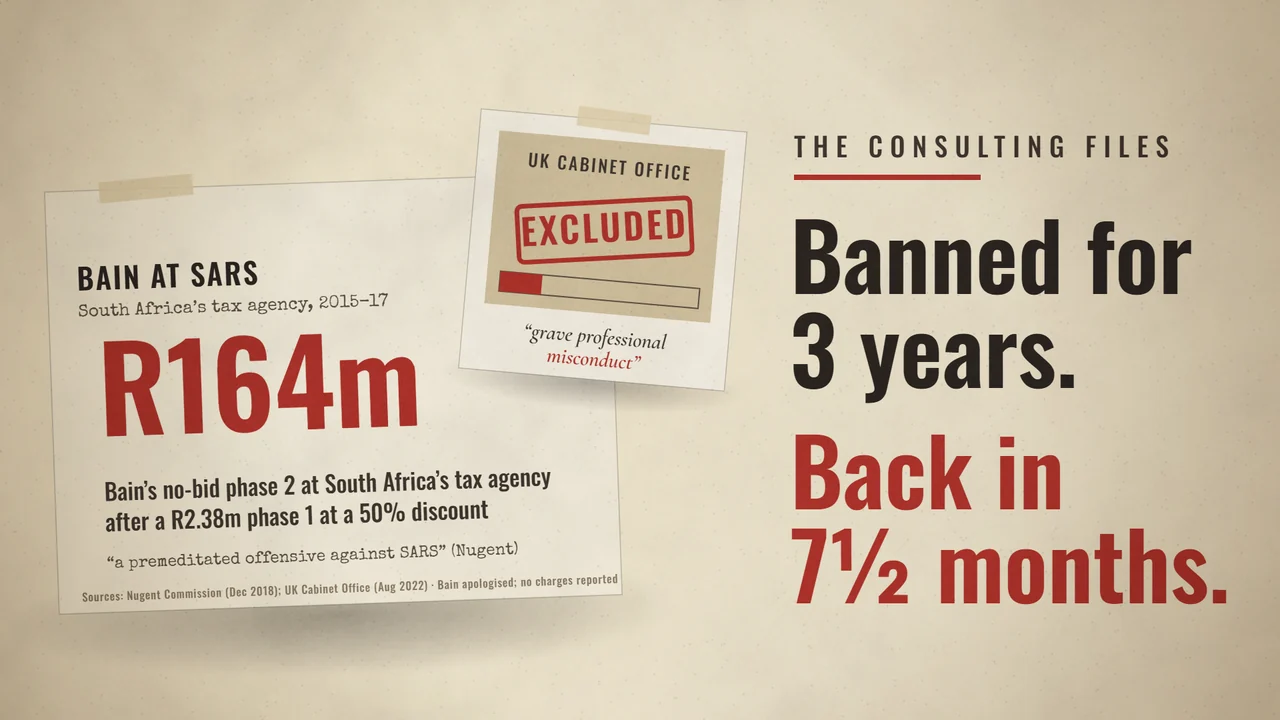
The same review noted that the scoring was documented with adequate arguments, which is an important qualification. It did not find that the result was rigged. But it also noted that the panel’s conflict-of-interest declarations had never been signed. That combination is typical of perception problems: a process that may well have produced a defensible result, but without the safeguards that would allow anyone to demonstrate it. Free work before a tender and alumni on a scoring panel will always look like favours, whatever the intent. The Canadian federal contracts case shows how a Procurement Ombud can reach a “perception of favouritism” finding without any finding of wrongdoing, which is often the more damaging outcome for a firm’s reputation.
The arithmetic of a monthly fee
The figure that made the story was a monthly cost per consultant. Dagens Nyheter reported an average of about 700,000 kronor a month; the internal review’s appendix showed SEK 676,000 for one consultant at 13 hours a day for 20 days at SEK 2,600 an hour. Those numbers are a product of three choices: the hourly rate, which rose about 60% under the 2015 framework; the hours billed, which the review set against a supplier code allowing at most 60 hours a week; and the length of the engagement.
Any one of these can be justified. Together, they produce a number that a newspaper reader can understand in one line, and that a hospital director, as Melvin Samsom put it, can accept might be correct under the contract, but not okay. Consultants should do this arithmetic before the client or the press does. A business case calculator can make the link between fees and expected benefits explicit, so that the monthly figure arrives with its justification rather than alone.
Small orders, one large bill
One of the review’s most useful observations is structural. Each call-off was treated as a separate purchase, small enough to approve on its own, and together the costs became strikingly large. The production director, the review found, approved eight of the 65 BCG invoices from 2016 and 2017.
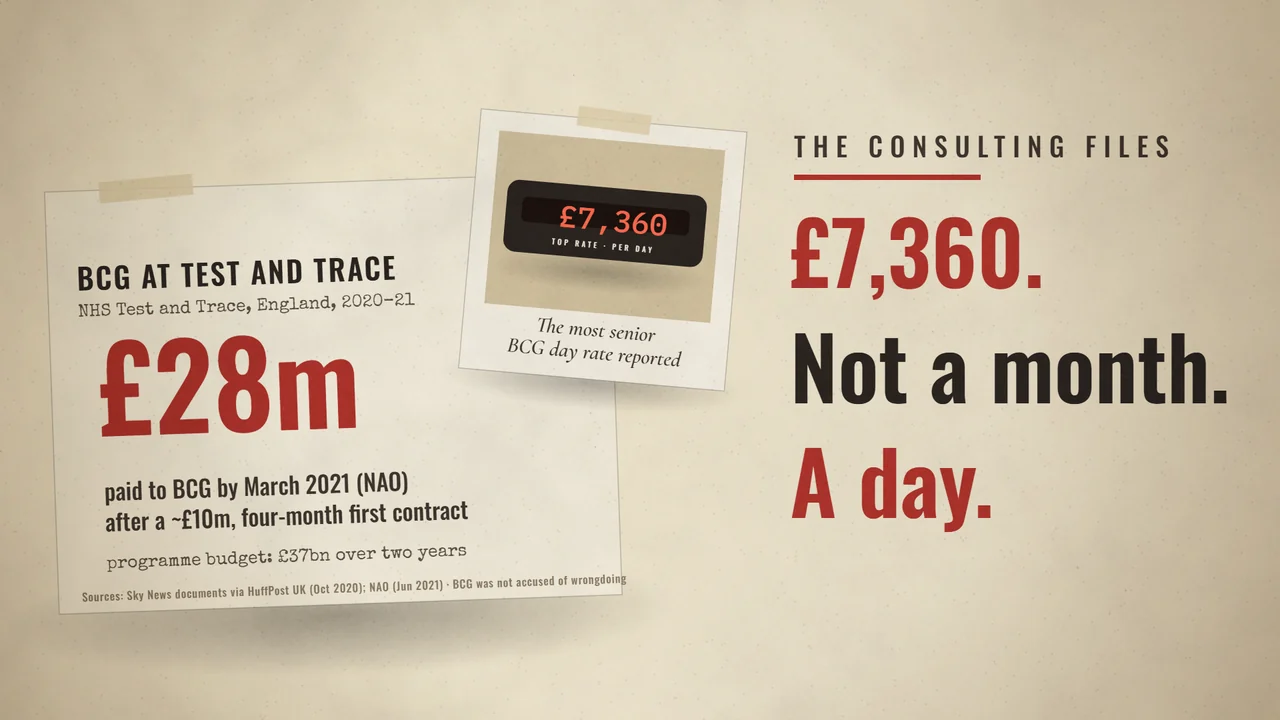
This is a common failure in organisations that buy through framework agreements. Delegated approval limits are designed for individual purchases; they do not show anyone the cumulative total with one supplier. The solution is not more signatures on each invoice, but a regular report of total spend by supplier to someone with authority over the whole. The Test and Trace day-rate case is another example of a public body discovering the size of its consulting bill after the event.
What the reviews did and did not find
Precision protects everyone in a case like this. The Setterwalls review found that Karolinska bought SEK 959 million of consulting from several firms between 2011 and 2017, that BCG’s share was about a fifth, and that about SEK 92 million had been awarded directly against the rules. It also found no indications of systematic corruption, no bribery and no established conflict of interest, and its interim report found no sign of billing for work not performed. No criminal investigation has been reported. The government inquiry, SOU 2020:15, found that the new operating model did not solve the hospital’s problems, and that some got worse; it was drawing lessons, not judging any firm’s legal responsibility.
Anyone presenting this case should keep those layers apart: the newspaper’s figures, the internal auditor’s process findings, the law firm’s review and the government inquiry’s verdict on the model. A board pack that merges them into one charge sheet would be inaccurate. The audit committee presentation guide offers a structure for reporting findings of different weight without overstating any of them.
Building the model with the client
The government inquiry described the hospital’s operating model as to a high degree consultant-driven. That phrase carries a lesson beyond procurement. When an organisation’s new way of working is designed largely by outsiders, the organisation may not own it fully, and may struggle when the outsiders leave or when the model meets reality. The model was introduced alongside a move into a new building, a major public-private partnership and a large organisation of more than 15,000 staff. Separating the effects of each is difficult, and the inquiry does not attribute the hospital’s later problems to one cause.
For consultants, the practical response is to transfer ownership deliberately: build the model with the client’s staff, measure adoption as well as design, and plan the handover from the start. The target operating model presentation guide sets out how to present a new operating model so that the client’s leadership, not the adviser, is visibly accountable for it.
The lesson for advisers
Three practical rules follow from Karolinska. Make independence visible: no free work before a tender and no former colleagues on the panel scoring your bid. Bill as if someone will read every invoice, because someone eventually will. And make sure someone with authority sees the total of many small orders. The money at Karolinska was public, and the patients and taxpayers who funded it deserved to see what it bought.
TAKE IT INTO THE NEXT MEETING
Three practical lessons
Independence has to be visible
A former colleague scoring your bid, or free consultants before a contract, will look like a favour whatever the intent. Ask the client to keep alumni off the panel.
Bill as if someone will read it
Who worked, at what level and for how many hours is not paperwork. It is the evidence that the client received what it paid for.
Small orders add up
Many call-offs, each small enough to approve, can still make one very large bill. Make sure someone with authority sees the total.
Questions about the case
Did BCG overcharge Karolinska?
No review found that BCG billed for work that was not done. The internal review found that its rates rose about 60% under the 2015 framework and that its invoices lacked the required detail. Setterwalls found no systematic corruption, no bribery and no established conflict of interest.
How much did Karolinska pay BCG?
Dagens Nyheter reported SEK 257 million from 2011, including SEK 28 million in 2017. Setterwalls counted SEK 959 million of consulting purchases from several firms in 2011–2017, of which BCG’s share was about a fifth.
Did value-based care fail at Karolinska?
The government inquiry SOU 2020:15 found that the new operating model did not solve the hospital’s problems and that some got worse. BCG says value-based care is not a BCG product and that the move into the new hospital was a success.
THE EVIDENCE TRAIL
Sources & editorial notes
Adapted from the original XLSlides documentary, with additional analysis. Published 19 November 2026. Sources have different roles: primary records, investigative reporting and the positions of affected parties.
- Karolinska University Hospital: internal review of the consultant process (Utredning konsultprocessen), 31 January 2018 ↗Primary review: the free consultants, the evaluation panel, rates, hours, invoice detail, approvals and the “directly inappropriate” finding.
- SOU 2020:15: government inquiry on lessons from Nya Karolinska Solna, 2020 ↗Primary inquiry: the PPP contract values, the 53% construction comparison, the consultant-driven model and its verdict. The site blocks automated checks; read in a browser.
- Läkartidningen: invoices for SEK 28 million cannot be explained, 6 December 2017 ↗Reporting of Dagens Nyheter’s figures, BCG’s history at the hospital and Samsom’s first response.
- Läkartidningen: “Vi har brustit i våra rutiner”, 31 January 2018 ↗The internal review’s presentation, Samsom’s statements and DN’s 700,000-kronor average.
- Läkartidningen: incorrect consultant procurements worth millions at Karolinska, 23 November 2018 ↗Setterwalls’ final report: SEK 959m, BCG’s share, SEK 92m in direct awards and no systematic corruption.
- Läkartidningen: Annika Tibell becomes acting hospital director, 1 October 2018 ↗Samsom’s announced departure.
- Läkartidningen: the region adds SEK 400 million to Karolinska, 25 February 2019 ↗The hospital’s 2018 deficit.
- SVT: NKS timeline, 25 May 2018 ↗Chronology: BCG from 2011, the opening, Dagens Nyheter’s figures, the inquiry and the board.
- SVT: Setterwalls interim report on NKS, 9 May 2018 ↗The interim review’s findings, including no sign of billing for work not done.
- Upphandling24: law firm points to NKS shortcomings, 11 May 2018 ↗Procurement-trade reporting of the interim review.
- Inköpsrådet: one consulting krona in ten bought improperly, 23 November 2018 ↗Procurement-trade reporting of the final review and its breakdown by firm.
- Realtid: after the BCG scandal, a new routine for buying consultants, 1 March 2018 ↗The hospital’s action plan after the internal review.
- Vårdfokus: consultants at Karolinska defend value-based care, 8 January 2018 ↗Report of BCG’s Dagens Nyheter opinion piece and its statements.
Image credits & licences
Original illustrations and typography: XLSlides. Documentary stills have been resized and converted to WebP for this article. Underlying images retain the credits supplied with the episode.
- XLSlides logo: XLSlides.
- BCG, Karolinska University Hospital, Dagens Nyheter, Stockholm County Council, Skanska, Innisfree, Ernst & Young and Setterwalls are shown as typeset name cards; all people are shown as silhouettes; the hospital, documents and charts are drawn. Scenes marked "illustrative" are not to scale.
FROM EVIDENCE TO A RECOMMENDATION
Make the reasoning visible.
Use clear action titles, sourced exhibits and an explicit decision. XLSlides helps turn your analysis into an editable presentation; the evidence and judgment remain yours to verify.
Build a case-study presentation