Direct Answer: What An M&A Due Diligence Presentation Must Do
An M&A due diligence presentation should help a buyer answer one hard question: should we advance, reprice, restructure, or walk away from this deal? That means the deck is not a filing cabinet for every workstream memo. It is a decision document that compresses the most important facts, uncertainties, risks, and value levers into a form that an investment committee, CFO, corp dev lead, or operating partner can absorb quickly.
The best diligence decks open with the red flags, the core underwriting logic, the confirmed strengths, and the few issues that could still change the bid or the integration plan. They show which findings are factual, which are inferred, and which are still open. They also connect diligence to action: what does the finding imply for price, structure, reps and warranties, synergy expectations, Day 1 planning, or the go / no-go call?
For XLSlides, this is a strong product-fit workflow because diligence teams usually have the content but not the clean artifact. They have banker materials, management-call notes, customer findings, financial analyses, legal comments, expert interviews, cyber reviews, and synergy hypotheses. The job is turning that messy evidence into answer-first slides with action titles, clean comparisons, clear source placeholders, and editable PowerPoint-style output that can survive partner and committee review.
Due Diligence Presentation Vs. CIM Vs. Investment Committee Deck Vs. Board Update
These documents are adjacent, but they do different jobs. Confusing them is why many deal decks feel either too promotional or too late-stage.
| Document | Primary Audience | Main Job | Common Failure Mode |
|---|---|---|---|
| Confidential information memorandum (CIM) | Potential buyers | Market the asset and frame the seller narrative | Reads like advocacy, not verification |
| Due diligence presentation | Deal lead, PE partner, corp dev head, CFO, operating partner | Synthesize findings, red flags, and value drivers before final commitment | Becomes a workstream dump with no decision logic |
| Investment committee deck | IC members and senior decision-makers | Ask for approval on the proposed investment and terms | Skips what diligence actually proved or broke |
| Board update on a transaction | Board directors | Summarize strategic rationale, exposure, and approvals needed | Mixes governance reporting with full diligence detail |
Due Diligence Deck Takeaways
- Lead with what changes the deal, not what was easiest to collect.
- Separate confirmed facts, management claims, and team inferences so the committee can see uncertainty clearly.
- Every major finding should connect to valuation, structure, integration, or the go / no-go decision.
- AI is useful when it organizes evidence and drafts the first deck, but the deal team still owns judgment and risk calls.
Opening Findings And Workplan Summary Reference
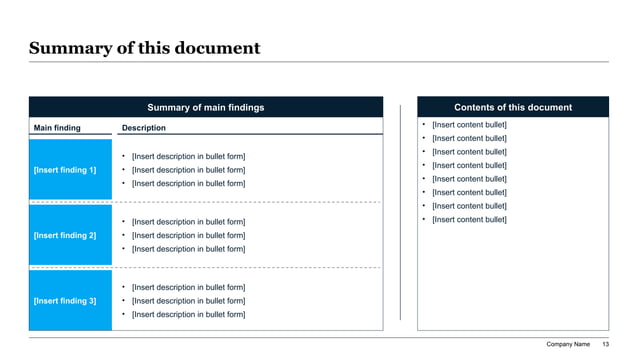
Why Most Diligence Decks Fail Under Senior Review
Most diligence presentations start from the folder structure instead of the decision. Financial diligence has its section. Commercial has its section. Technology, legal, HR, tax, and operations each get their own packet. That feels complete, but it does not necessarily help a senior reader decide. The committee is left to infer which findings matter most, whether the issues connect, and how the workstreams alter price or conviction.
A better approach is to define the deal question first. Is the buyer testing whether the target deserves a premium multiple? Is the buyer trying to confirm recurring revenue quality, customer concentration resilience, synergy reality, carve-out complexity, or cyber exposure? Once the deck is organized around those few decision themes, the workstream evidence becomes much easier to digest because each section exists to answer a live investment question.
This is also where presentation craft matters. Action titles should state the implication, not the topic. A title like Customer diligence is useless. A title like Revenue concentration is acceptable because the top two accounts are contractually sticky and price increases held through renewal is much more helpful. Diligence readers reward compression. They want to understand the point before they inspect the exhibit.
Inputs To Gather Before Drafting The Diligence Deck
Recommended 12-Slide M&A Due Diligence Sequence
| Slide | Purpose | Executive Question Answered |
|---|---|---|
| Executive summary | State the current deal view and the few issues that matter most | Should we still want this asset? |
| Deal thesis and diligence scope | Define what the team set out to prove or disprove | What were we testing? |
| Red flags and gating issues | Surface findings that could reprice or stop the deal | What could break the investment case? |
| Commercial attractiveness | Show category demand, customer behavior, and competitive position | Is the market and revenue story real? |
| Revenue quality | Explain concentration, churn, price realization, and mix | How durable is the top line? |
| Financial quality | Translate accounting and cash findings into valuation implications | What should we normalize or discount? |
| Operational and technology readiness | Assess scalability, systems risk, and execution gaps | Can the business support the plan? |
| Synergy or value-creation logic | Quantify realistic upside and the effort required | Where does additional value come from? |
| Management and organization | Assess leadership quality and critical talent dependencies | Who will deliver the case? |
| Deal structure implications | Tie findings to price, terms, and protections | How should the deal be structured? |
| Day 1 and 100-day priorities | Show what must happen immediately after sign or close | What needs to be managed first? |
| Recommendation and open issues | Make the ask explicit and identify remaining unknowns | Do we proceed, and on what conditions? |
Target Screening And Strategic Rationale Reference
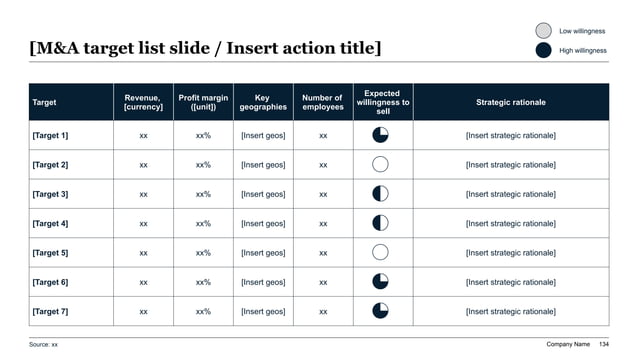
Lead With Red Flags, Value Drivers, And Decision Implications
Senior deal readers do not want suspense. If there is a customer concentration risk, a revenue recognition concern, a cyber exposure, a weak management bench, a key supplier dependency, or a synergy assumption that now looks unrealistic, say it early. Hiding the issue until slide twenty-two does not make the case feel safer. It makes the team look less in control of the process.
The same is true on the positive side. If the target has unusually strong retention, under-monetized pricing, clean working-capital dynamics, or a carve-out complexity that is lower than expected, surface that clearly. A useful diligence deck does not just catalog problems. It shows which findings support conviction and which findings should narrow it.
The discipline is to connect each finding to an implication. A problem with weak contract transferability might change timing or structure. A margin gap might create upside if the buyer has the operating playbook to fix it. A product concentration risk might deserve a higher discount rate, a holdback, or a narrower underwriting case. Diligence earns its keep when the presentation makes those implications hard to miss.
Evidence Standards By Diligence Workstream
The page should make clear what kind of proof supports each claim and what still needs to be validated.
| Workstream | Evidence Needed | What The Slide Should Make Explicit |
|---|---|---|
| Commercial diligence | Customer interviews, win-loss data, market sizing, competitor evidence, pricing behavior | Whether growth and retention claims are observed, inferred, or management-asserted |
| Financial diligence | Quality-of-earnings adjustments, working-capital analysis, cash conversion, debt-like items | Which EBITDA and cash figures are normalized and why |
| Operational diligence | Capacity data, process bottlenecks, vendor dependencies, fulfillment metrics | Whether the operating model can support the base case |
| Technology and cyber diligence | Architecture review, incident history, technical debt, security controls, roadmap feasibility | Which systems create execution or integration risk |
| Legal and compliance diligence | Material contracts, litigation, regulatory exposure, IP ownership, change-of-control terms | What could impair closing, transferability, or post-close economics |
| Management and talent diligence | Leadership interviews, org gaps, incentive alignment, attrition risk, succession depth | Who is essential to preserve value after close |
Target Comparison Matrix Reference
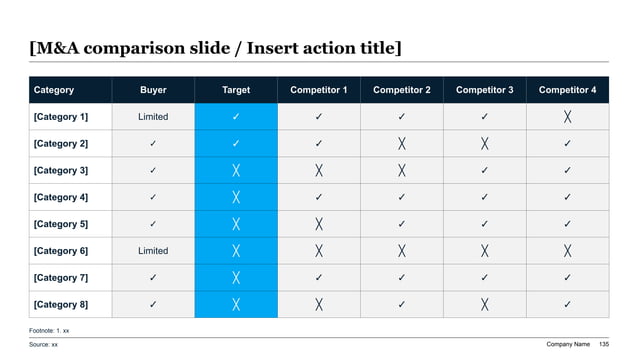
Prompt Recipe For An M&A Due Diligence Presentation
Create a 12-slide M&A due diligence presentation for a private equity deal team, operating partner, CFO, and investment committee. Target: a vertical B2B software company with strong gross retention, mid-tier net retention, founder-heavy sales motion, and uneven international operations. Include an answer-first executive summary, original deal thesis, red flags, commercial findings, revenue-quality analysis, quality-of-earnings implications, technology and cyber risks, management assessment, synergy or value-creation levers, deal-structure implications, 100-day priorities, and explicit proceed / reprice / walk-away recommendation. Use consulting-style action titles, note where evidence is confirmed versus inferred, and keep the output editable in PowerPoint style rather than decorative.
Separate Fact, Inference, And Deal Judgment
One of the fastest ways to lose credibility in diligence is to blend hard evidence with team interpretation. A contract term is a fact. A management explanation for churn is a claim. The deal team's conclusion that churn will moderate after a product fix is an inference. Those should not sit on the slide as if they carry the same certainty.
Sophisticated readers are comfortable with uncertainty if it is labeled honestly. In fact, they often trust the deck more when it says which findings are directional, which analyses depend on limited data, and which assumptions still need management confirmation. A false aura of precision is more dangerous than a transparent range.
This distinction also improves how AI is used. XLSlides can help structure the evidence and produce cleaner slides faster, but the model should be given clear labels such as confirmed finding, management claim, open question, and investment implication. That keeps the generated output from collapsing everything into equally confident prose.
Action Title Rewrite Matrix For Diligence Slides
Strong diligence titles tell the committee what to conclude from the workstream, not what folder the slide came from.
| Weak Topic Title | Stronger Diligence Title | Why The Rewrite Works |
|---|---|---|
| Customer diligence | Top-quartile customer retention supports the case, but two enterprise renewals still drive near-term downside risk | It shows both confirmation and exposure |
| Financials | Normalized EBITDA is lower than management reported because one-time savings and founder under-comp were overstated | It tells the reader what changed in the number |
| Technology review | The product scales, but integration velocity is constrained by one legacy architecture layer | It separates readiness from the key limitation |
| Synergies | Most cross-sell upside is credible only if pricing and CRM discipline improve in the first two quarters | It links upside to execution conditions |
| Management team | The leadership bench is strong in product and finance, but the GTM layer is too founder-dependent today | It explains where talent risk sits |
| Next steps | Proceed if contract transferability is confirmed and the bid reflects the revised cash-conversion case | It turns the conclusion into a conditional decision |
Synergy And Value-Capture Dashboard Reference
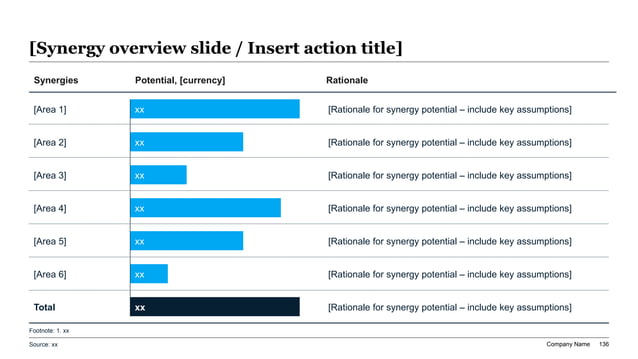
Common Diligence Workstreams And The Executive Question Each One Must Answer
A useful deck integrates the workstreams instead of presenting them as isolated specialist outputs.
| Workstream | Executive Question | Typical Slide Output |
|---|---|---|
| Commercial | Is the market and customer story strong enough to support the case? | Growth drivers, customer evidence, pricing power, competitor view |
| Financial | Are earnings, cash, and liabilities what we thought they were? | QoE bridge, working-capital view, debt-like items, sensitivities |
| Operational | Can the business execute the plan without hidden friction? | Capacity map, process bottlenecks, service model risks |
| Technology and cyber | Will the platform support scale and integration safely? | Architecture summary, technical debt, security gaps, roadmap risk |
| Legal, tax, and compliance | What contractual, regulatory, or structural issues alter the deal? | Change-of-control issues, litigation, tax exposures, reps and warranties implications |
| Management and HR | Who must stay, and where is bench strength thin? | Leadership assessment, dependency map, retention priorities |
Red Flags Sophisticated Buyers Will Challenge Immediately
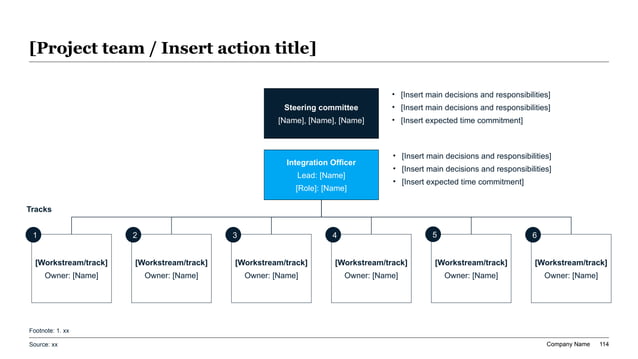
Workstream Governance And Ownership Reference
What AI Should Automate In A Diligence Workflow And What The Deal Team Must Still Own
AI should handle the presentation mechanics that burn time but do not decide the investment. It can draft the slide sequence from the deal thesis, cluster findings by decision theme, propose action titles, convert specialist notes into cleaner summaries, and format repeatable structures such as scorecards, issue trackers, comparison matrices, and workstream overviews. Those are legitimate time savers when the team is working against signing deadlines.
What AI should not own is the truth status of a finding, the weighting of a red flag, the credibility of management, or the negotiation consequence of an issue. It cannot decide whether a quality-of-earnings adjustment should reduce price by three turns, whether a customer interview sample is good enough, or whether a cyber issue is tolerable given the buyer's integration capacity. Those are experienced deal-team calls.
The right promise for XLSlides is therefore pragmatic. It helps the team move from fragmented diligence inputs to a serious first draft faster. The result should be an editable, PowerPoint-ready deck with answer-first structure, clear workstream logic, source-note placeholders, and layouts suited to finance and transaction reviews. Human review is still where investment judgment gets made.
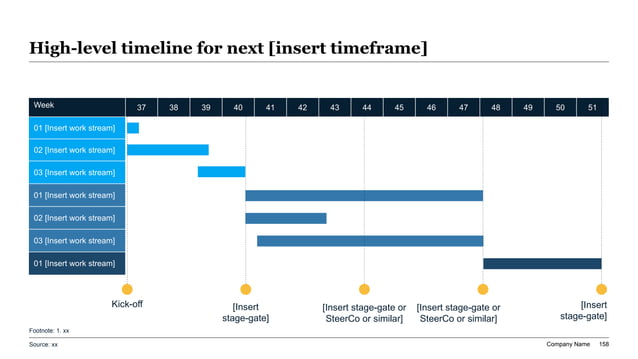
Diligence Timeline And Milestone Reference
Short Answers To Common Due Diligence Presentation Questions
What should be on the first slide of a due diligence presentation?
The first slide should state the current investment view in plain language: whether the deal still works, the two or three findings that matter most, the key unresolved issues, and what those findings imply for price, structure, or timing. Senior readers should not need to wait for the financial section to learn whether the case improved or weakened.
How is a due diligence deck different from an investment committee deck?
A due diligence deck is more diagnostic. It shows what the team tested, what it found, and how those findings changed the investment case. An investment committee deck is the approval artifact that uses that work to recommend a decision. The same slides may overlap, but the diligence deck should be more explicit about evidence quality, open questions, and workstream limitations.
How many diligence workstreams should appear in the main story?
Only the workstreams that materially affect conviction, value, structure, or integration should appear in the main story. Others can live in the appendix. The goal is not to prove that every specialist worked hard. The goal is to help the committee understand what changes the deal.
Can AI create a credible due diligence presentation?
Yes, if the team uses AI as a drafting and structuring layer. XLSlides can turn fragmented workstream notes into a cleaner first draft with action titles, scorecards, issue summaries, and editable layouts. The deal team still needs to validate the evidence, label uncertainty honestly, and decide what each finding means for the transaction.
Create The First Draft In XLSlides
Use XLSlides to turn management notes, QoE findings, customer interviews, workstream summaries, synergy logic, and open-issue trackers into an editable M&A due diligence presentation with action titles, red-flag framing, and PowerPoint-ready structure.