What A Banker-Style Opening Spread Looks Like
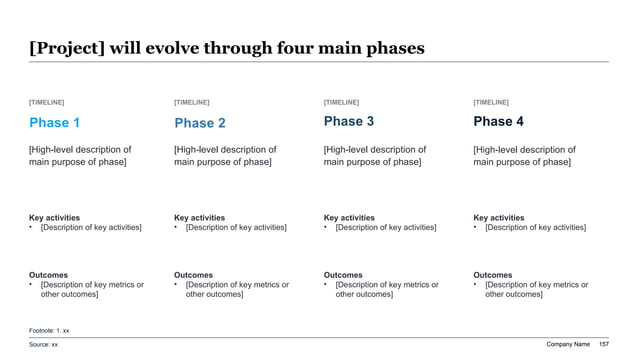
Fast Answer: What An Investment Banking Pitch Book Must Do
An investment banking pitch book is not just a prettier finance deck. It is a sales document, an analytical document, and a process document at the same time. It has to help a banker convince a client, frame a transaction, and move a live process forward without losing control of the logic. In practice that means the book needs to answer a small set of questions quickly: why this deal matters now, how the asset should be positioned, what the likely buyer or investor logic is, what the valuation case looks like, and what the process needs from management next.
The quality standard is higher than in a normal corporate presentation because the audience is more impatient and more technical. Managing directors skim. Clients jump to the valuation pages. Buyers compare one page against another page from a competitor bank. Associates need slides that can survive repeated updates at midnight when numbers move, a buyer list changes, or management wants a different angle. A useful pitch book therefore has to be modular, answer first, and traceable back to real public filings, management inputs, and model outputs.
That is also why generic AI slide generation is usually not enough for banker work. The hard part is not producing ten formatted pages. The hard part is converting model logic, buyer hypotheses, diligence findings, transaction history, and sector context into pages that sound commercially sharp and technically safe. XLSlides fits here as a drafting layer: it can structure the first book, draft the page sequence, rewrite action titles, and turn rough notes into an editable deck, but the banker still owns valuation judgment, disclosure boundaries, and the final message to the client.
Which Investment Banking Book You Are Actually Building
Pitch books are not all the same. The page sequence and evidence burden should change depending on whether the book supports origination, sell-side execution, financing, or board-level transaction review.
| Book Type | Primary Objective | What The Deck Must Prove | Typical Reader |
|---|---|---|---|
| Sell-side pitch book | Win the mandate and shape management's view of buyer interest | The bank understands the asset, knows the buyer universe, and can run a differentiated process | CEO, CFO, board, owner, sponsor |
| Buy-side advisory book | Frame a target landscape and acquisition path | The buyer set, valuation ranges, and strategic fit logic are defensible enough to justify outreach or diligence | Corp-dev lead, CEO, strategy chief, sponsor |
| Financing book | Support a capital raise or refinancing process | The credit or equity story, operating trend, and use of proceeds are coherent and financeable | Lenders, investors, CFO, treasurer |
| Management presentation support deck | Prepare leadership for buyer or investor meetings | The story is consistent, the KPI pages are controlled, and management can answer likely diligence questions | Management team, sponsor, banker |
| Board transaction review | Help directors evaluate a transaction path or offer | The valuation, alternatives, process steps, and risks are explicit enough for directors to challenge and approve | Board, audit chair, special committee |
| CIM support appendix | Back up the information memorandum with more detailed evidence | The deeper operating, market, and financial detail reinforces the headline story instead of contradicting it | Qualified buyers, diligence teams, advisors |
Pitch Book Rules That Matter In Live Deals
- A strong banking pitch book starts with the client decision or buyer question, not with generic sector wallpaper.
- The best banker slides combine one sharp action title, one controlled exhibit, and one explicit implication for the reader.
- Valuation pages need both range logic and assumption discipline; neither a raw output dump nor a vague fairness-style summary is enough.
- AI should accelerate blank-page work, page sequencing, and title rewrites, but final banker judgment still controls numbers, tone, and disclosure.
Why Banker Presentations Feel Different From Board Decks Or Strategy Packs
Investment banking presentations are written under a different pressure profile than most executive decks. A board update may have one central audience and one governance moment. A strategy pack may live inside one company. A banker pitch book often has to perform across multiple moments: internal review with senior bankers, management review with the client, live use during the mandate process, and later reuse inside a board discussion, buyer conversation, or financing dialogue. That forces the pages to be more compact, more reusable, and more sensitive to wording.
The narrative burden is also unusual. A banker does not merely describe a company. The banker has to frame the company in a way that supports a transaction path. That can mean positioning the asset for strategic buyers, emphasizing growth durability for sponsors, clarifying financing headroom, or showing why timing is favorable. The book therefore needs enough analytical substance to feel serious, but it also needs commercial sharpness. A slide that is analytically true but commercially flat is still a weak pitch-book slide.
This is why banker pages often look denser than consulting slides while still demanding strict discipline. Titles have to carry the conclusion. Tables cannot sprawl aimlessly. Public comps, precedent transactions, and financial bridges need visible assumptions. Footnotes and source labels matter because reviewers will ask where the number came from, whether the definition changed, and whether a buyer will see the same thing differently. The deck has to hold up when the presenter is interrupted halfway through the page.
Comparable Companies Page Reference
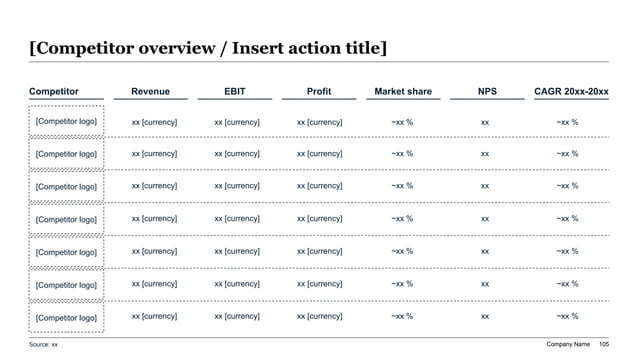
Source Pack Required Before You Draft The First Banker Deck
Recommended 12-Page Investment Banking Pitch Book Flow
This structure works well for a banker-ready first draft because it moves from commercial framing into evidence, valuation, and process without making the client wait for the point.
| Page | Purpose | Reader Question Answered |
|---|---|---|
| 1. Executive summary | State the transaction angle, valuation framing, and ask | Why are we here and what is the central recommendation? |
| 2. Company or asset snapshot | Orient the audience to scale, business mix, and key differentiators | What exactly is the asset and why does it matter? |
| 3. Market and sector context | Show the industry conditions that make the timing credible | Why now? |
| 4. Investment highlights | Translate the story into a small number of buyer-relevant reasons to care | Why would a serious counterparty engage? |
| 5. Historical operating performance | Show growth, margins, and KPI quality cleanly | What does the track record really look like? |
| 6. Peer landscape and positioning | Anchor the asset against relevant public or private peers | Where does the company sit versus alternatives? |
| 7. Public comps valuation | Translate peer trading into a defensible range | What does the market imply today? |
| 8. Precedent transactions | Show how actual deal prices compare with the headline story | What have buyers paid for similar situations? |
| 9. Valuation bridge and range summary | Connect multiple methods into a recommendation band | How do we get from raw analysis to a credible range? |
| 10. Buyer universe or investor targets | Explain who should care and why | Who are the highest-probability counterparties? |
| 11. Process plan | Sequence preparation, outreach, diligence, and management meetings | How would we run the process? |
| 12. Decisions and next steps | Clarify what management or the board must approve now | What needs to happen after this meeting? |
Start With The Buyer Question, Not With The Banker Process
One common weakness in early banker drafts is starting with the process because the team already knows the process. That is the wrong center of gravity. The reader does not primarily care that the bank can run a timeline. The reader cares whether the asset is attractive, which buyer logic matters most, how the valuation case hangs together, and what risks will appear the moment the process goes live. Process matters, but it is downstream of the story.
A stronger drafting habit is to write the book from the outside in. Ask what the most relevant reader would challenge first. A sponsor may ask whether growth is durable and whether add-on logic exists. A strategic buyer may ask whether synergy is real and whether overlap risk is manageable. A board may ask whether the valuation range is grounded and whether alternatives were fully considered. Once that challenge is clear, the page sequence becomes easier: each exhibit exists to remove one obstacle to engagement or approval.
This approach also makes AI more useful. Instead of prompting with 'create a banking pitch book,' prompt with the transaction goal, the company profile, the likely counterparty logic, the available valuation work, and the decision required from the client. Then let the tool produce a first draft with banker-style action titles and exhibit placeholders. That gives the analyst or associate something reviewable before the live model, markups, and footnotes are perfected.
Valuation Bridge Reference
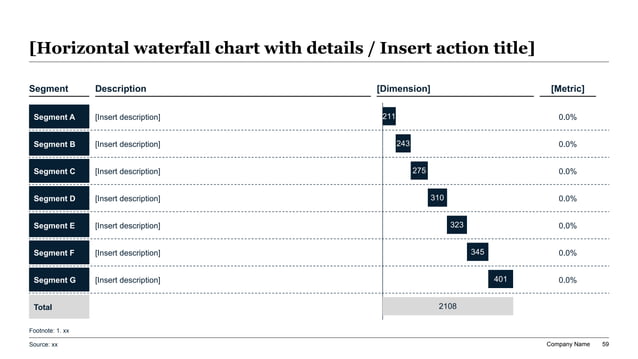
Prompt Recipe For A Banker-Ready Pitch Book Draft
Create a 12-page investment banking pitch book for a CEO, CFO, board, and senior banker audience. Objective: support a sell-side mandate discussion for a mid-market asset. Include an answer-first executive summary, company snapshot, market context, investment highlights, historical operating performance, public comps, precedent transactions, valuation bridge, buyer universe, process plan, and explicit next-step asks. Use banker-style action titles, preserve disclosure discipline, add source-note placeholders for every metric, and optimize for editable PowerPoint-style output rather than decorative web slides.
Action-Title Rewrite Matrix For Banking Slides
A banker title should carry the implication for the client or buyer. Topic labels waste the most valuable real estate in the book.
| Weak Topic Title | Stronger Banker Action Title | Why The Rewrite Works |
|---|---|---|
| Valuation | Current trading and transaction benchmarks support a range above management's last private reference point | It tells the reader the conclusion before they inspect the table |
| Buyer universe | Five buyers have both strategic logic and balance-sheet capacity to engage credibly in the first wave | It turns a logo page into a prioritization statement |
| Financial performance | Margin expansion has been driven by mix and pricing discipline, not one-off cost cuts | It clarifies what is sustainable in the numbers |
| Market overview | Sector consolidation and scarce scaled assets improve the case for running a process this year | It links industry facts to transaction timing |
| Precedent transactions | Relevant precedents indicate buyers pay for recurring growth quality more than headline scale alone | It surfaces the lesson, not just the table |
| Next steps | Management should approve buyer-wave priorities, diligence workstreams, and valuation messaging before outreach begins | It makes the immediate decision path explicit |
Associate-Level Review Questions Before The Book Circulates
How To Show Valuation Without Hiding The Judgment
Banking valuation pages often fail in one of two ways. The first failure mode is dumping too much output on the page: five methods, dense tables, and no indication of which pieces the banker actually trusts. The second failure mode is the opposite: summarizing the conclusion so aggressively that the client cannot see how the range was built. A credible pitch-book page has to sit between those extremes. It should show the methods, make the weighting logic visible, and still communicate a point of view.
The right level of detail depends on the audience and the moment in the process. Early mandate books may emphasize public comps, relevant precedents, and a clear range bridge rather than full DCF plumbing. A board or fairness-style discussion may need more explicit treatment of assumptions, sensitivities, and normalization. Either way, the deck should distinguish between what is market-observable and what is banker judgment. Public multiples, announced deals, and management projections are different evidence classes, and the page should not blur them together.
For XLSlides users, the product opportunity is to structure the valuation story before the final numbers are locked. Feed the system the methods you intend to show, the client context, the likely points of challenge, and the provisional range logic. Then refine the draft once the live model and banker markups are ready. That reduces blank-page time without outsourcing the hard part: deciding what deserves emphasis and what should stay in backup.
Buyer Landscape And Positioning Reference
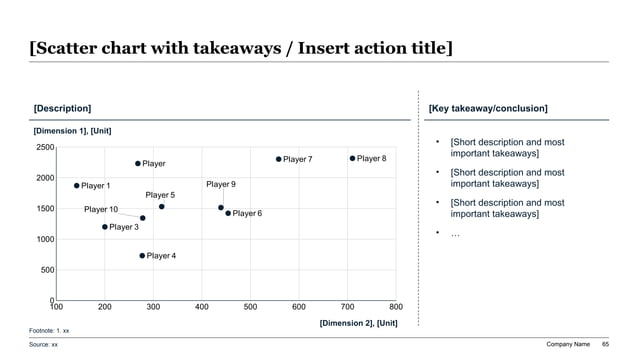
Valuation Exhibits And When To Use Them
The best pitch books use only the exhibits that genuinely move the client decision. More analysis is not automatically a better banker page.
| Exhibit Type | Best Use | What It Clarifies | Common Mistake |
|---|---|---|---|
| Trading comps table | When market pricing of public peers is central to the story | What similar companies imply today on a normalized basis | Using an undisciplined peer set that flatters the answer |
| Precedent transactions table | When actual deal pricing matters more than spot trading | What buyers have paid for similar assets under live-control conditions | Mixing incomparable deal situations without explaining the differences |
| Waterfall or bridge page | When the deck needs to show how the range was built | How assumptions and methods connect to the recommendation | Overloading the bridge with every model tab output |
| Sensitivity matrix | When management or the board will challenge key assumptions | Which variables move the value most and how fragile the range is | Presenting sensitivity without explaining which cases are actually credible |
| Football-field summary | When several methods need one comparable visual frame | How different valuation methods bound the discussion | Turning the field into a false precision exercise |
| Operating KPI dashboard | When quality of earnings and growth durability drive the buyer story | Whether the economics behind the valuation are really improving | Separating the KPI page from the valuation implication |
Process Pages Should Reduce Friction, Not Advertise Ceremony
Clients do want confidence that the bank can run a process, but they do not need a ceremonial timeline with no operational detail. A strong process page reduces friction. It shows what has to happen before outreach, what management will need to prepare, when diligence materials need to be ready, and which decision gates the client cannot miss. The slide should make the process feel controlled and executable.
This is especially important in middle-market situations where management bandwidth is limited. A beautiful process arrow is not enough if the client does not understand what information needs to be assembled, which buyer wave comes first, or how the bank intends to protect momentum if diligence stretches. Good process pages therefore connect stages to concrete workstreams: data room readiness, management presentation preparation, valuation updates, buyer feedback loops, and board decision points.
Pitch books also improve when the process page makes room for downside realities. If the story depends on audited carve-out numbers, separation planning, customer concentration mitigation, or regulatory preparation, the deck should acknowledge that. Senior readers trust process slides more when they show where the real work sits rather than pretending the transaction is just a sequence of colored boxes.
Sell-Side Process Workstream Reference
XLSlides Resources For Finance And Deal Team Work
Short Answers To Common Investment Banking Pitch Book Questions
What should an investment banking pitch book include?
At minimum, include an executive summary, company snapshot, market context, investment highlights, historical financial performance, comp-set analysis, valuation range framing, buyer or investor logic, process plan, and explicit next steps. The exact mix changes by use case, but the deck should always make the transaction point of view obvious.
How is a pitch book different from a CIM or an investment memo?
A pitch book is usually more directional and commercially framed. It helps sell a mandate, shape a process, or guide a client discussion. A CIM is more comprehensive and buyer-facing. An investment memo is usually internal and decision oriented for a committee, sponsor, or board audience.
Can AI create a credible banker deck?
Yes, as a drafting layer. AI is useful for structuring the first narrative, proposing the page sequence, rewriting action titles, and turning rough notes into an editable first book. Bankers still need to validate all numbers, comp choices, valuation logic, and disclosure wording before circulation.
What makes a weak pitch book page?
Weak pages usually label a topic instead of making a point, overload tables without interpretation, hide assumptions behind summary language, or show process graphics that never explain what the client actually needs to do. In live transactions, those weaknesses slow review and reduce confidence.
Build The First Banker-Ready Pitch Book In XLSlides
Use XLSlides to turn model outputs, buyer notes, comp tables, diligence findings, and management comments into an editable investment banking pitch book with sharper action titles, cleaner valuation framing, and a faster path to senior review.
Generate Banking Pitch Book