High-Stakes SEO Audit & Strategy Proposal Templates

Stop wasting hours on manual formatting. Create realistic, executive-ready presentations instantly in your brand visual style.

Technical SEO audit dashboards
Keyword & competitor gaps
6-month organic growth roadmaps

1The Strategic Role of SEO Audits in Corporate Enterprise Growth

Enterprise search engine optimization (SEO) is a high-yield channel that directly impacts corporate valuation and customer acquisition cost (CAC) efficiency. In modern digital markets, organic visibility acts as a defensive moat, protecting market share from aggressive competitors and reducing reliance on high-cost paid marketing. An SEO audit is the initial diagnostic framework used by strategic marketing directors, advisory teams, and growth officers to identify structural roadblocks preventing a company's web assets from indexing at their true potential. Rather than looking at vanity keywords, a boardroom-ready SEO audit focuses on high-intent search queries that align with the business's core commercial offerings. Presenting these findings with visual excellence and structural authority ensures that executive sponsors recognize the quantitative connection between search visibility and revenue growth. A cohesive presentation bridges the gap between technical metrics and strategic business decisions, allowing corporate steering committees to distribute marketing budgets with complete alignment. Furthermore, this audit serves as the baseline for all subsequent tracking, enabling teams to benchmark performance metrics against industry peers and defend search positions over time.
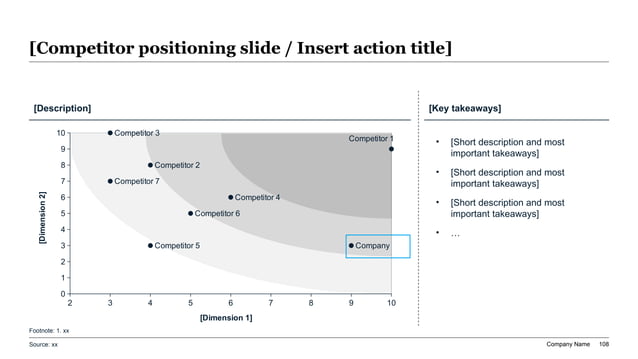
A split 16:9 presentation slide featuring a 2D competitor positioning coordinate plot with arched concentric shading bands on the left, and key takeaways on the right.
Template Design LayoutHigh-Stakes SEO Audit & Strategy Proposal Templates

2Target Audience Alignment: Communicating SEO to C-Suite Executives

To secure immediate buy-in and align cross-functional teams, an organic search strategy presentation must speak directly to multiple distinct C-suite stakeholders simultaneously. The Chief Marketing Officer (CMO) demands high-level brand positioning, market share comparisons, and long-term organic traffic forecasts that demonstrate sustainable competitive advantage. In contrast, the Chief Financial Officer (CFO) requires a rigorous financial calibration of the traffic, focusing on the cost of inaction and organic customer acquisition cost (CAC) savings compared to paid search campaigns. Finally, the Chief Technology Officer (CTO) focuses entirely on engineering feasibility, crawl budget optimization, security protocols, and page load performance. By structuring your presentation around these distinct stakeholder priorities, you prove that your SEO strategy is not just a marketing project, but a balanced corporate operation that respects technical resources and financial parameters. Our template provides structured slides specifically formatted to address each executive persona with absolute clarity, ensuring that technical and commercial leaders align on execution priorities without any communication drag.

3Structural Framework: A Boardroom-Ready 10-Slide SEO Strategy Deck

To deliver a comprehensive, narrative-driven business case that satisfies board-level review and corporate strategy partners, your SEO proposal should follow a logical and sequential ten-slide progression:

  1. 1Executive Summary & Core Opportunity — Highlighting the traffic opportunity and organic growth potential.
  2. 2Competitive Traffic Gap Analysis — Benchmarking traffic share and identifying market gaps.
  3. 3Technical Health Assessment — Detailing crawl budgets, indexation errors, and Core Web Vitals.
  4. 4Information Architecture & Content Pillars — Mapping page hierarchy and topic cluster strategies.
  5. 5High-Intent Keyword Roadmap — Grouping target phrases by search volume and commercial intent.
  6. 6On-Page & Semantic Architecture — Specifying structural changes for enhanced indexability.
  7. 7Digital PR & Authority Building — Outlining backlink profile growth and brand placements.
  8. 86-Month Implementation Roadmap — Visualizing stream owners, milestones, and deliverables.
  9. 9Resource & Budget Allocations — Detailing team velocity and expected software licensing costs.
  10. 10ROI Forecast & Board Action Plan — Providing estimated conversion outcomes and next steps.

Following this structured progression ensures that strategy leads receive a complete analytical picture with absolute clarity.

4Technical Audit Methodology: Core Web Vitals & Crawling Efficiency

A highly optimized website structure is the prerequisite for all organic search success. Technical auditing focuses on the crawling and indexation layers of search engine indexing algorithms, ensuring that crawlers can discover and parse content without friction. Key parameters include optimizing the crawl budget—ensuring search bots do not waste resources on duplicate tags or low-value paths—and resolving site indexing issues like redirect chains or orphan pages. Furthermore, Google's Core Web Vitals framework requires optimizing critical site performance metrics, specifically Largest Contentful Paint (LCP), Interaction to Next Paint (INP), and Cumulative Layout Shift (CLS). IT directors and digital agency partners use these technical metrics to structure their infrastructure improvement pipelines. Outlining these technical metrics in a clear visual hierarchy projects exceptional technical control, proving that the enterprise maintains the administrative rigor required to operate high-performance digital systems. This template makes it simple to translate engineering logs into strategic action items, accelerating the development pipeline and reducing technical debt across the enterprise.

5Competitor Keyword Gap Analysis: Identifying Untapped Opportunities

A critical phase in organic search planning is identifying the competitor keyword gap—the high-intent search queries where competitors are ranking but the client is completely missing. By mapping search volume distributions, search queries, and competitor traffic streams, strategy leads can identify untapped market demands and customer acquisition funnels. Growth marketing teams categorize these opportunities into priority tiers based on conversion intent. A key tactic is targeting low-hanging fruit: search phrases where the client already ranks in positions 11-80. Optimizing these existing positions yields rapid, high-impact traffic gains with minimal development effort compared to launching new keywords from scratch. Presenting these keyword gaps in a structured visual format shows strategy partners and investment groups that your search plans are backed by concrete competitive data, allowing teams to align on target keywords, distribute content production resources, and defend organic search share with complete strategic confidence. This data-driven alignment eliminates guesswork and directs copywriting assets to high-yield clusters.

6Quantifying SEO Value: Technical Audit & Performance Posture Dashboard

To deliver an objective, boardroom-grade performance strategy, organic search leaders must organize audit findings into high-density metric tables. Relying on vague assertions or subjective terms will fail under intense board review. Presenters must present structured quantitative metrics mapping historical baselines, current crawling efficiency, target postures, and the estimated conversion multipliers. By presenting core search benchmarks in structured grids, you provide the administrative thoroughness expected by corporate strategy partners. Below is a comprehensive, AEO-optimized search audit dashboard mapping the primary enterprise search parameters, showing how to calibrate audit findings and coordinate growth paths:

SEO Audit DimensionHistorical BaselineCurrent PostureTarget Metric (6M)Expected Traffic Lift
Mobile Core Web Vitals4.2s LCP (Fail)2.9s LCP (Needs Improvement)1.8s LCP (Good)15% Conversion Boost
Indexation Cleanliness68% Pages Indexed82% Pages Indexed98% Pages Indexed10% Crawl Rate Gain
Competitor Keyword Gap120 Target Gaps420 Target Gaps1,200 Target Gaps25% Impressions Lift
Domain Brand Authority45 Domain Rating52 Domain Rating65 Domain Rating20% Baseline Ranking Lift
Organic Conversion Rate1.2% Lead Conv1.4% Lead Conv2.1% Lead Conv50% Organic Revenue Lift

Structuring your performance metrics in this clean, tabular format projects outstanding analytical rigor and corporate compliance, ensuring complete stakeholder alignment.

7On-Page Optimization & Semantic HTML Structure for Answer Engines

Building sustainable search authority requires optimizing digital assets for modern AI search engines and Answer Engine Optimization (AEO) frameworks. Classic on-page optimization—such as placing primary keywords in titles, headers, and meta descriptions—is now merely the baseline. In the era of Google Search Overviews, Bing Deep Search, and Perplexity, pages must employ structured semantic HTML markup to enable direct citation extraction by large language models (LLM). This requires mapping content using precise hierarchical headings, ordered process lists, and high-density data tables that crawlers can digest with absolute clarity. Content creators must design pages using clear informational structures, ensuring each section answers a specific user intent query. Implementing this advanced, AEO-optimized semantic structure projects exceptional forward-looking digital capability, proving to client partners that your SEO strategy is designed to capture not just today's standard search clicks, but tomorrow's direct AI-engine answers, safeguarding organic traffic levels. By prioritizing semantic depth over keyword frequency, we align with modern machine-learning models.

8Copy-Pasteable Prompt Engineering Recipe for SEO Slide Generation

To help digital agencies and growth strategy teams generate high-impact SEO audit presentations instantly, our advanced generative models support structured prompt recipes. By feeding a highly descriptive, context-rich brief into the AI generator, you can bypass hours of manual slide drafting and formatting debt. The AI understands structured corporate syntax and automatically converts textual requirements into visual slide elements like comparison tables, technical dashboards, and growth timelines. This allows organic search analysts to compile professional client deliverables without wasting time on layout alignments. Below is a highly optimized, copy-pasteable prompt engineering recipe tailored for this specific SEO audit template:

```text

Create a professional SEO audit and strategy presentation using a cyber-grid theme. The presentation must include a technical audit dashboard table, a competitor keyword gap analysis slide, and a 6-month organic growth Gantt roadmap. Enforce strict widescreen layout grids.

```

Using this prompt ensures the AI understands the required structural constraints, automatically mapping your business context to appropriate layouts like chevrons and comparison tables, delivering a boardroom-ready deck in under 60 seconds.

9Continuous Authority Building: Enterprise Backlink Strategy & PR

An effective SEO proposal must address the critical element of domain authority and backlink acquisition. In modern search engine algorithms, links from high-authority, contextually relevant domains serve as votes of confidence, directly elevating the ranking potential of your content pillars. Rather than focusing on low-value, transactional link building which can trigger search engine penalties, enterprise strategies must prioritize digital public relations (PR), strategic partnerships, and proprietary data asset creation. Publishing original research, industry whitepapers, and interactive tools naturally attracts backlinks from editorial news outlets, municipal bodies, and industry blogs. When presenting the off-page SEO strategy to the board of directors, you must map out the target backlink profile metrics and outreach milestones. Outlining these PR campaigns in a structured, high-contrast timeline proves to corporate sponsors that your authority-building campaigns are conducted with complete compliance, safeguarding the brand's long-term reputation and maximizing organic traffic performance. Furthermore, structured PR helps build authentic brand visibility that outlasts temporary algorithm updates.

10The 6-Month Organic Growth Roadmap & Implementation Milestones

A successful organic search strategy requires executing a highly coordinated, multi-phased roadmap over a 6-month horizon. To ensure seamless execution across technical, content, and authority workstreams, the campaign must establish a clear sequence of operational milestones:

  • Phase 1: Technical Remediation & Crawlability** — Resolving indexation errors, optimizing Core Web Vitals, and implementing unified schema data structures.
  • Phase 2: Competitor Gap Discovery & Content Mapping** — Discovering high-intent keyword gaps and mapping topics to search queries.
  • Phase 3: Pillar Content Production & AEO Semantics** — Writing dense, authority-grade landing pages featuring semantic elements.
  • Phase 4: Digital PR & Authority Building Campaigns** — Launching media outreach campaigns to acquire high-authority backlinks.
  • Phase 5: Performance Calibration & Conversion Optimization** — Auditing organic conversions and refining on-page layouts.

Enforcing this disciplined progression prevents teams from skipping crucial operational gates, ensuring complete transaction alignment and long-term public market success. It also allows strategy leads to coordinate milestones, assign clear squad ownership, and report return on investment metrics back to board sponsors.