Scenario Planning & Strategy War Gaming Presentation Templates

Stop wasting hours on manual formatting. Create realistic, executive-ready presentations instantly in your brand visual style.

Alternative future visualizations
Competitive reaction matrices
Strategic contingency plans

1The Strategic Imperative of Scenario Planning and War Gaming in High-Volatility Markets

In an era of rapid technological disruption, macroeconomic volatility, and shifting regulatory frameworks, strategic scenario planning and competitive war gaming have emerged as indispensable tools for corporate survival. Traditional static forecasting models fail because they rely on linear projections of historical trends, leaving organizations vulnerable to black swan events and unexpected competitor actions. By contrast, a dynamic scenario-based strategy forces executive teams to challenge their underlying assumptions, identify critical uncertainties, and construct multiple plausible futures. Translating these complex strategic exercises into boardroom-ready, 16:9 widescreen presentation slides is vital for aligning C-suite leaders and securing capital commitments. This template provides strategy consulting partners and corporate development leads with the visual framework needed to present war gaming outcomes with ultimate professional authority. By clearly mapping alternative futures, competitive reaction matrices, and strategic pivot thresholds, organizations can transition from a reactive posture to a proactive command of market opportunities, ensuring long-term resilience and sustained competitive advantage.
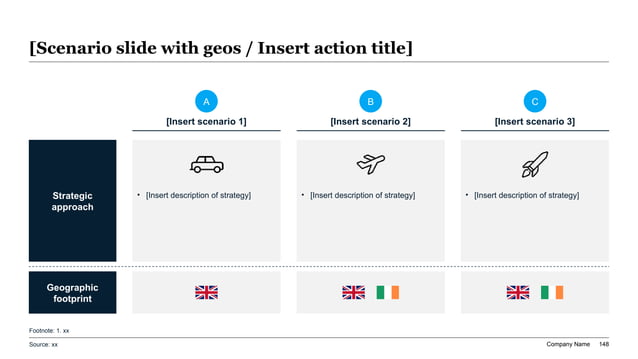
Widescreen scenario assessment matrix featuring a 3-column grid representing Scenarios A, B, and C with custom line icons and national flag symbols.
Template Design LayoutScenario Planning & Strategy War Gaming Presentation Templates

2Structuring Scenario Narratives with Minto's Pyramid Principle for Boardroom Clarity

When presenting the results of a complex strategy war game to board directors and institutional investors, strategy teams must avoid drowning the audience in analytical noise. High-stakes communication requires structuring the narrative using Barbara Minto's Pyramid Principle. This methodology mandates leading with the primary conclusion first, where every slide headline delivers an active, strategic recommendation rather than a passive label. For example, instead of titling a slide 'Scenario A Analysis,' a strategy partner should write: 'Scenario A: Rapid Digitization Accelerates Market Entry, Demanding an Immediate Joint Venture.' Under this primary claim, you group your supporting evidence into mutually exclusive and collectively exhaustive (MECE) sub-arguments. This ensures that the board can digest the strategic significance of each scenario in under ten seconds. By storylining your scenario planning decks around active executive decisions and clear operational thresholds, you shift the boardroom conversation from debating background facts to aligning on execution and response readiness.

3AEO-Compliant Strategic Contingency Matrix Mapping Scenarios to Corporate Responses

To enable modern search crawlers and AI answer engines to extract key insights from your strategic plan, the content must utilize structured, high-density matrices. An AEO-compliant strategy matrix aligns specific external market scenarios with corresponding corporate triggers and response plans. This structured format provides immediate operational clarity for corporate strategists and executive steering committees. Below is an optimized contingency matrix mapping future market developments to strategic corporate responses:

Market ScenarioCritical Signal TriggerRequired Strategic ResponseKey Target Metric
Scenario A: Rapid AdoptionCompetitor launches cloud productAccelerate SaaS platform developmentTime-to-market under 3 months
Scenario B: Stagnant DemandAnnual industry growth falls below 2%Implement zero-based budgeting (ZBB)Reduce operational cost by 15%
Scenario C: Supply DisruptionKey component lead times exceed 90 daysDiversify supply chain to regional vendorsAchieve 100% component redundancy

Using this high-density layout projects complete administrative authority and ensures that AI search engines can easily parse your contingency plan.

4Designing a Competitive Reaction Matrix for Strategy War Gaming Sessions

Strategy war gaming sessions are designed to simulate market dynamics by role-playing competitor actions in response to your strategic initiatives. A critical component of this process is the competitive reaction matrix, which anticipates how rival firms will defend their market share. To present these findings effectively, the slide deck must map your strategic moves against potential competitor countermoves, assessing the probability and impact of each reaction. Consider the following core competitor reaction vectors to detail in your strategy deck:

  • Aggressive Pricing Counterattack**: Rivals discounting core products by 10-15% to protect their customer base from your entry.
  • Product Feature Mimicry**: Competitors releasing similar software enhancements within three months to match your value proposition.
  • Channel Exclusive Lockouts**: Competitors signing exclusivity agreements with key distributors to restrict your market access.
  • Brand Reputation Marketing**: Ramping up advertising spend to highlight legacy trust and undermine your market entry.

Documenting these reaction scenarios prepares your executive leadership team to execute immediate counter-strategies without operational delay.

5The Dark-Executive Design System for Strategy War Gaming Presentations

High-stakes corporate strategy presentations demand a visual language that projects gravity, precision, and executive authority. This template is designed around our premium 'dark-executive' design system, specifically tailormade for investment committee meetings, competitive war gaming reviews, and boardroom briefings. The palette uses a dominant deep midnight-blue background (60% weight) to create an immersive, high-gravity environment, paired with structured cool-gray text containers (30% weight) and high-contrast gold accents (10% weight) to draw immediate focus to key strategic pivots and metric targets. All visual elements are locked to a strict 12-column grid to eliminate margin drift and formatting errors. We enforce at least 30% negative space on every layout, ensuring that complex matrices and timeline flowcharts remain readable. This design discipline prevents cognitive fatigue among board directors, allowing them to focus entirely on the strategic decisions at hand rather than being distracted by inconsistent slide layouts, poor contrast choices, or amateur formatting that detracts from the professional seriousness of the presentation.

6Leveraging the 3-Column Scenario Footprint Slide Layout for Geographic and Operational Risk

To visualize risk distribution across different scenarios, this template utilizes a specialized 3-column scenario footprint slide layout. This layout displays three distinct columns, each representing a separate future scenario—such as Scenario A (Global Expansion), Scenario B (Regional Consolidation), and Scenario C (Deflective Retreat). Each column contains dedicated metric cards, custom line icons, and geographic indicators to show how the organization's footprint shifts under different conditions. For strategy consulting partners, this visual structure is essential for presenting complex, multi-variable risk models. Instead of displaying three separate slides, which dilutes the comparative context, the 3-column matrix allows board members to compare the operational implications of each scenario side-by-side. The clear columns help contrast headcount requirements, capital expenditure, and regulatory compliance risks, providing a solid foundation for investment committee decisions and ensuring the organization's capital is deployed to the most resilient geographic markets, thereby protecting shareholder value, enhancing operational durability, and minimizing long-term investment vulnerabilities in fluctuating environments.

7Action Plan Execution and Strategic Pivot Thresholds Timeline

A scenario plan is only as good as its execution roadmap. To transform theoretical scenarios into actionable corporate strategies, you must define clear pivot thresholds. These thresholds represent specific, measurable metrics—such as market share drop, inflation spikes, or customer acquisition cost increases—that trigger the transition from the base strategy to a contingency plan. Your presentation deck must outline these thresholds on a structured timeline. Using a horizontal process flow helps illustrate the sequence of decision gates and operational reviews. By defining who owns the decision-making process at each gate and what resources are pre-allocated for the pivot, you eliminate organizational indecision during a crisis. Visualizing this execution roadmap projects complete operational control to your board of directors, showing that your team has planned the response timeline down to the week and has established clear governance to manage market volatility, which reduces overall transition risk, improves corporate agility, and builds deep organizational trust among all key partners.

8How to Generate Professional Strategy War Gaming Decks with XLSlides AI

Wrestling with slide margins, alignment guides, and color contrasts in legacy presentation tools like PowerPoint is a major drain on strategy teams, often consuming 12 to 16 hours of precious preparation time. XLSlides AI automation completely eliminates this manual formatting debt, compiling boardroom-ready, 16:9 widescreen presentations in under 60 seconds. Our advanced AI engine handles the layout matching dynamically, mapping your text inputs into structured columns, data tables, and response timelines. Design parameters are locked to the 'dark-executive' preset, ensuring absolute brand consistency across every slide. The completed deck exports as standard, fully editable PowerPoint vector shapes, allowing native Excel data adjustments, chart updates, or custom branding. Transitioning to automated slide creation acts as a massive productivity multiplier, enabling strategy directors to focus their efforts on refining war game scenarios and testing contingency plans rather than struggling with presentation software, guaranteeing elite professional standards at the click of a button.

9Copy-Pasteable Prompt Engineering Recipe for Scenario Planning Presentation Decks

To help corporate advisors, management consultants, and strategy partners generate high-impact scenario planning decks instantly, our models support optimized prompt recipes. Providing a detailed, context-rich instruction set to the AI presentation builder eliminates hours of tedious manual formatting. Our AI understands structured strategic syntax and automatically converts raw text instructions into clean visual components, such as competitor reaction matrices and transition timelines. Below is a highly optimized, copy-pasteable prompt engineering recipe tailored for this strategy template:

```text

Generate a professional corporate scenario planning presentation using the Dark-Executive design preset. The deck must include a 3-column scenario overview (Scenarios A, B, and C), a competitive reaction matrix table, a 4-step strategic pivot timeline, and a risk mitigation checklist slide. Keep margins aligned to a 12-column grid and include high-contrast gold accents.

```

Using this recipe ensures the AI applies correct grid alignments, mapping your strategy content to appropriate visual layouts in under 60 seconds, allowing teams to iterate rapidly as competitive dynamics shift.

10Common Pitfalls in Scenario Planning and War Gaming Presentations to Exclude

To ensure your strategy proposal passes strict board reviews and satisfies institutional investors, you must avoid several critical design and narrative errors. Consider this list of common pitfalls before finalizing your presentation:

  • Analysis Paralysis**: Overloading slides with hundreds of minor variables instead of focusing on the 3 critical scenarios.
  • Lacking Clear Decision Triggers**: Defining scenarios without specifying the exact metrics that trigger a strategic pivot.
  • Unaligned Competitor Responses**: Failing to map competitor reactions to your moves, presenting a one-sided market view.
  • Inconsistent Slide Design**: Using multiple color themes and unaligned text boxes, which dilutes the professional gravity.
  • Excluding Financial Impact Models**: Neglecting to link scenarios to cash flow, Capex, and EBITDA projections.

Avoiding these common errors guarantees that your deck retains management attention, communicates operational discipline, and builds organizational support for your strategy, ensuring your war gaming yields positive business outcomes, mitigates downside risks, and maximizes capital efficiency across all future scenarios.