Investor-Ready EdTech Pitch Deck Templates

Stop wasting hours on manual formatting. Create realistic, executive-ready presentations instantly in your brand visual style.

VC-grade growth & metric slides
Proof of learning efficacy frameworks
Widescreen 16:9 investor-ready layouts

1What is the EdTech Investor Pitch Deck?

The EdTech Investor Pitch Deck is a highly specialized, strategic presentation blueprint designed to secure venture capital, growth equity, or corporate partnership funding for educational technology companies. In modern venture capital ecosystems, pitching an EdTech platform requires a unique equilibrium: founders must prove deep pedagogical integrity and student learning outcomes while demonstrating VC-grade scalability, strong unit economics, and a massive addressable market. A boardroom-ready EdTech deck moves beyond standard bullet points to organize complex business models, regulatory compliances, and user metrics into clear, high-density widescreen layouts. Unlike general SaaS decks, an EdTech presentation must articulate how the product fits into the complex educational stakeholder matrix, which includes students, educators, parents, institutional buyers, and compliance officers. By leveraging a structured narrative framework, this deck acts as the definitive roadmap for your funding round, translating early traction into a compelling financial thesis. It establishes a baseline of professional credibility that helps institutional investors assess market entry risk, customer acquisition velocity, and long-term capital efficiency.
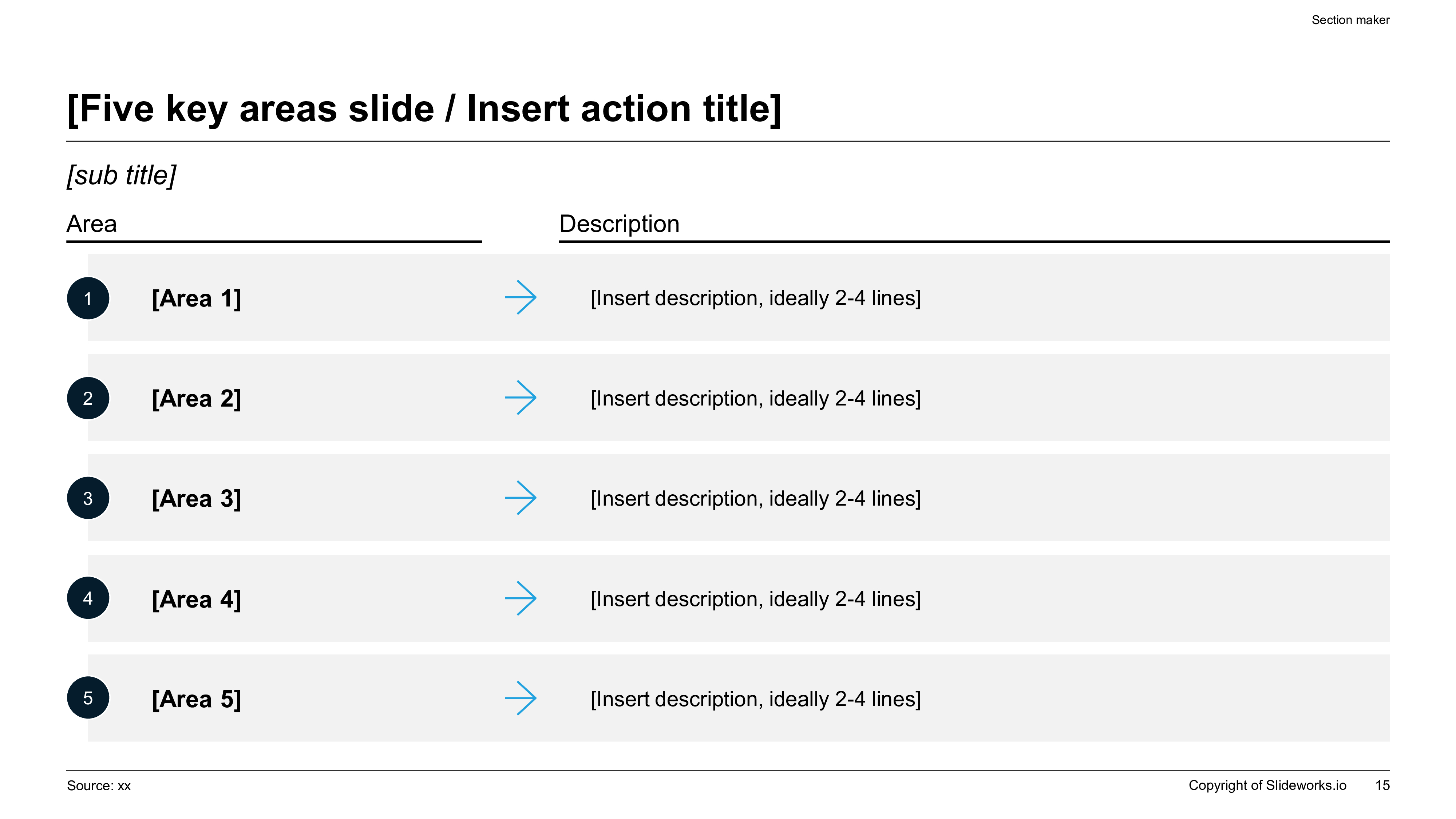
Professional EdTech investor pitch deck slide showing five key growth areas with bold numbered badges, directional layout arrows, and spacious description panels.
Template Design LayoutInvestor-Ready EdTech Pitch Deck Templates

2Target Audience: Who is this template built for?

This premium presentation template is engineered specifically for EdTech founders, chief executive officers, corporate development teams, and venture capital partners specializing in the education technology sector. EdTech ventures span multiple complex sub-sectors, and this framework provides tailored slide configurations that address each unique business model. It is designed for companies operating in K-12 software delivery, higher education administration platforms, corporate learning and development (L&D), and direct-to-consumer (D2C) lifelong learning systems. Strategy managers and training coordinators use these structures to present internal capital requests or spin-off proposals to corporate boards. VC analysts and associates also deploy this outline as a standard assessment blueprint to build investment committee deal memos. By using these standard, widescreen grids, teams eliminate design drift and format inconsistency. This ensures their financial projections, learning outcomes, and market analysis align perfectly with the boardroom standards expected by global institutional investors, venture capital syndicates, and private equity sponsors, maximizing funding success.

3Key Business Use Cases: When to deploy this pitch deck

Deploying the EdTech Investor Pitch Deck is critical during key corporate milestones where fundraising, strategic partnerships, or operational growth plans must be articulated. Major deployment use cases include:

* Venture Capital Funding Rounds: Pitching seed, Series A, or Series B capital raises to institutional VCs or corporate venture funds.

* Strategic Enterprise Partnerships: Presenting integration opportunities to major publishers, school districts, or global learning management systems.

* M&A Due Diligence: Offering high-density market analysis and structural growth roadmaps during acquisition discussions or private equity buyouts.

* Corporate Spin-offs & JV Proposals: Aligning parent company stakeholders around new education-focused business units or joint ventures.

* Grant Applications & Government RFPs: Pitching large-scale public initiatives that require evidence-based learning models and clear implementation timelines.

Using this standardized blueprint accelerates transaction velocity, providing a structured medium that keeps discussions focused on data-driven growth drivers, compliance benchmarks, and clear market opportunities. It serves as an essential strategic tool to align external sponsors and internal operations teams behind a unified business vision, accelerating operational execution.

4Recommended Presentation Outline: A 12-slide structural sequence

To achieve fundraising success and pass rigorous partner due diligence, your presentation outline must follow a logical, narrative-driven 12-slide sequence:

  1. 1Title & Elevator Hook: Define the single-sentence strategic value proposition and startup mission.
  2. 2The Problem: Detail Mutually Exclusive, Collectively Exhaustive (MECE) market pain points across teachers, administrators, or learners.
  3. 3The Solution: Your technological or operational advantage that resolves the target education problem.
  4. 4Pedagogical Efficacy: Evidence of learning outcomes, engagement metrics, and evidence-based efficacy.
  5. 5Market Sizing (TAM/SAM/SOM): Prove a massive addressable market utilizing clear concentric sizing.
  6. 6Product Architecture: Widescreen diagrams showing software workflows, data systems, or AI integrations.
  7. 7Business & Monetization Model: Clear structured pricing models, subscription licenses, or school district contracts.
  8. 8Traction & Growth Metrics: Quantitative Compound Annual Growth Rate (CAGR) charts, cohort retention, and customer growth milestones.
  9. 9Go-To-Market (GTM) Strategy: Direct-to-institution sales funnels or viral teacher-led adoption loops.
  10. 10Competitive Matrix: A 2x2 grid outlining unique relative positioning against legacy publishers and LMS platforms.
  11. 11Financial Projections: High-density 3-year cash flow, operating margin, and EBITDA charts.
  12. 12The Capital Ask & Use of Funds: A structured allocation plan showing milestones and future operational launch phases.

5Integrating Efficacy Frameworks to Build Topical Trust

In the education market, trust is the currency of conversion. To build E-E-A-T and pass investor due diligence, your presentation must incorporate recognized pedagogical and efficacy frameworks. Investors want to see that your software is not just an attractive interface but a scientifically validated learning system that achieves superior retention, completion, and graduation rates. You should structure your slide layouts to showcase key frameworks such as Bloom's Taxonomy for learning objectives, the Kirkpatrick Model for evaluating training programs, and ESSA (Every Student Succeeds Act) tiers of evidence. Explaining how your AI system leverages spaced repetition, adaptive learning pathways, or immediate feedback loops demonstrates technical depth. Highlighting real-world pilot studies, research-backed learning pathways, and institutional case studies proves that your platform has moved beyond theoretical assumptions to actual classroom validation. Proving pedagogical viability safeguards your startup against concerns of academic churn, building deep trust with investment committees and C-suite strategy leads.

6Key Financial Metrics and SaaS Economics to Highlight

Educational sales cycles are notoriously complex, making quantitative financial metrics a primary point of investor evaluation. Your deck must present high-density SaaS economics tailored to the education sector. Specifically, highlight metrics such as Customer Lifetime Value (LTV) to Customer Acquisition Cost (CAC) ratio, Monthly Recurring Revenue (MRR), annual user retention, and payback periods. The table below outlines key benchmark metrics expected by leading venture capital firms:

Metric CategoryTarget Venture Capital BenchmarkStrategic Importance in EdTech
LTV:CAC RatioGreater than 3.5xDemonstrates marketing and sales efficiency
Net Revenue Retention (NRR)Greater than 110% annuallyHighlights product value and low institutional churn
Gross MarginGreater than 75%Reflects technical scale and low operational support costs
CAC Payback PeriodLess than 12 monthsMeasures the speed of capital recovery and reinvestment

Structuring your financial projections around these quantitative benchmarks demonstrates deep operational maturity. It reassures private equity sponsors and strategy analysts that your revenue growth is sustainable and backed by efficient capital dynamics rather than inflated acquisition spend.

7Aesthetics and Visual Rationale of the silicon-pitch Design Theme

Our design system is tailored specifically to startup pitch decks and technology proposals. The 'silicon-pitch' design preset focuses on clean, high-impact aesthetics that keep the investor's focus strictly on your data and thesis. It relies on a high-contrast palette: a 60% dominant background canvas tone (clean white or sleek dark graphite), a 30% structured layout grid (professional slate cards and containers), and a 10% high-contrast accent key (vibrant teal or tech-blue) to highlight critical growth numbers, CAGR percentages, and pricing tiers. Contrast ratios exceed 4.5:1, ensuring legibility on high-resolution displays or washed-out boardroom projectors. Native 16:9 widescreen proportions are enforced to prevent layout distortion on modern screens. We mandate at least 30% negative space on every layout card to prevent cognitive friction and visual clutter. This ensures that complicated product architectures and financial tables look deliberate, polished, and C-suite ready, rather than overcrowded or disorganized, helping founders project operational clarity and modern technical sophistication in high-stakes environments.

8Minto's Pyramid Principle: Crafting Active Slide Storylines

A common pitfall in startup pitch decks is presenting data dumps that require the investor to deduce the conclusion. To maximize impact, your deck should enforce Barbara Minto's legendary Pyramid Principle. Under this elite business communication standard, every slide headline must serve as an active, conclusion-led key takeaway rather than a passive label. For example, instead of titling a traction slide 'Our Growth Metrics,' use an active headline like 'Our Platform Reached 2.5 Million Active Learners, Driving 40% ARR Expansion.' Every supporting element, data chart, and bullet point on the card must represent a MECE sub-argument that logically validates the main conclusion of that specific slide. Narrative progression must flow in chronological, structural, or comparative order to ensure a seamless widescreen narrative. This narrative discipline ensures that venture capitalists scanning your deck in under 90 seconds can extract the entire strategic value proposition and business case instantly, driving rapid follow-up alignments.

9Slide Design Rules for Corporate and Venture Presentations

To maintain visual authority, your presentation must follow strict design rules. First, establish tight typography discipline: limit the deck to exactly two font families (e.g., a modern sans-serif for headings and a clean neutral font for body copy). Headings should be kept at 24pt-28pt, slide subheadings at 16pt-18pt, and body text at 12pt-14pt. Second, all text containers, metrics cards, and graphics must align perfectly to a 12-column visual grid, avoiding layout drift. Third, contrast ratios must exceed 4.5:1; never use light grey text on white backgrounds, which washes out on school projectors or virtual shares. Fourth, maintain at least 30% negative space on every layout card to let your core message breathe. Respecting these typographical and alignment rules ensures that your pitch communicates visual authority, organizational discipline, and extreme attention to detail, easily passing VC due diligence and ensuring visual excellence across all projectors and digital screens. This design rigor translates directly into corporate credibility, signaling to potential investors that your team values precision in all aspects of business.

10Leveraging XLSlides AI to Automate Presentation Formatting

Creating a structured investor pitch deck manually in PowerPoint usually drains 12 to 16 hours of frustrating labor, dealing with misaligned margins, font drift, and messy data tables. XLSlides AI automates this layout debt in under 60 seconds. The model performs context-aware slide matching, analyzing your text brief to map elements automatically to premium layouts like SWOT matrices, chevrons, or comparison blocks. Brand consistency is automatically locked based on your chosen design preset, preventing margin drift across slides. Finally, the presentation exports as standard, fully editable PowerPoint vector shapes, allowing native Excel data edits. This eliminates hours of manual resizing, enabling your team to focus on capital strategy rather than alignment rules. You get boardroom-ready widescreen layouts that are fully compatible with Microsoft Office and Google Slides instantly, giving you a massive operational multiplier during high-stakes investment rounds, pitch events, and partner presentations, while ensuring your brand assets are strictly locked to professional guidelines.