Edge AI Implementation Strategy Presentation Template

Stop wasting hours on manual formatting. Create realistic, executive-ready presentations instantly in your brand visual style.

Latency, workload, and edge-device prioritization slides
Model deployment, monitoring, and hardware architecture visuals
Security, operating model, cost economics, KPI, and rollout roadmap layouts

1What an Edge AI Implementation Deck Needs to Prove

An edge AI implementation presentation should prove that moving inference closer to devices creates measurable operational value. Leaders need to understand which workloads require lower latency, offline resiliency, bandwidth reduction, privacy protection, or local decision-making, and why those needs cannot be handled adequately through a cloud-only architecture. The deck should also show whether edge AI is technically feasible with available devices, data pipelines, connectivity, security controls, and support capacity. A strong narrative avoids generic AI language and instead connects deployment architecture to specific decisions such as faster inspection, safer operations, lower cloud cost, or reduced service interruption. This gives CIOs, CTOs, AI leaders, IoT teams, device engineers, cloud architects, data scientists, security stakeholders, operations leaders, PMOs, and consultants enough evidence to assess workload fit, latency value, hardware readiness, model reliability, cyber risk, operating complexity, and rollout sequencing. The narrative should also define workload owners, device tiers, latency targets, security controls, and deployment checkpoints for each rollout wave.
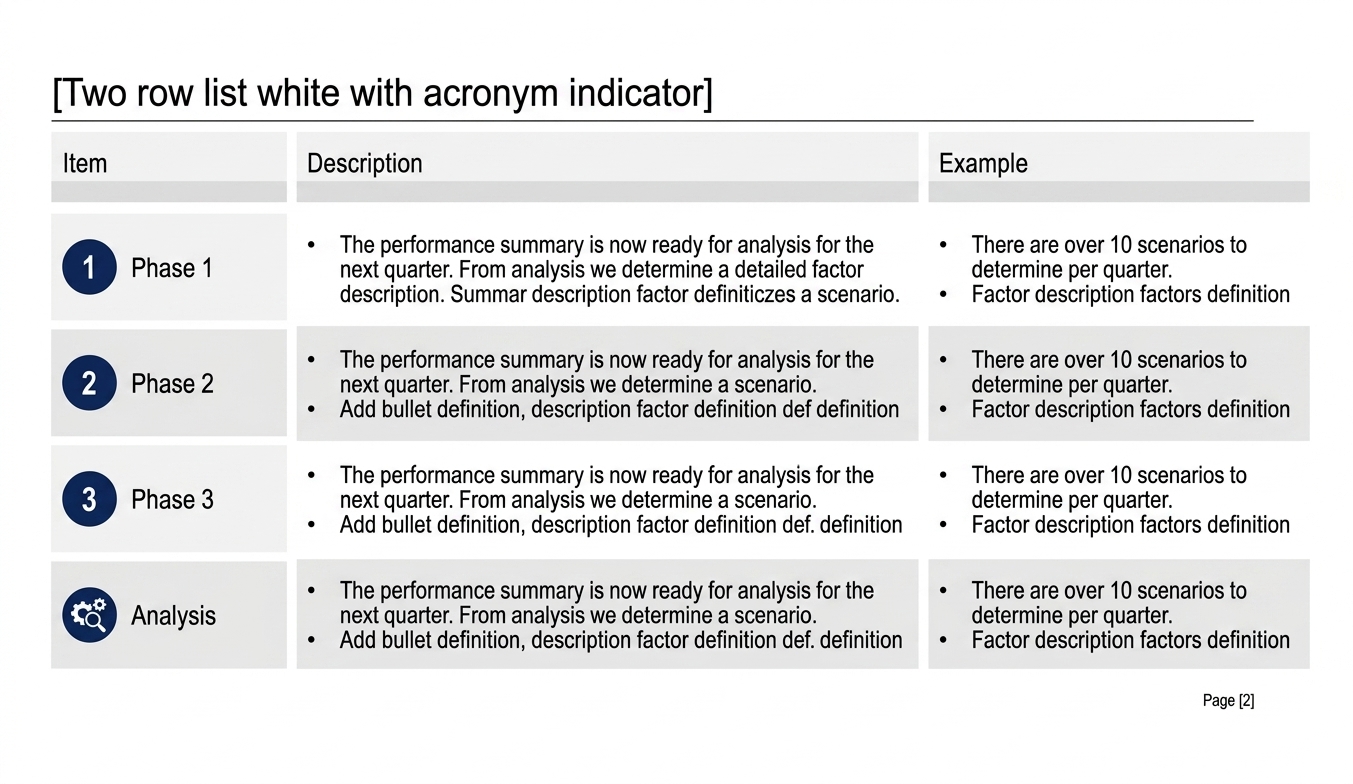
Edge AI implementation slide with a phased details table, numbered indicators, and structured deployment steps for distributed model rollout planning.
Template Design LayoutEdge AI Implementation Strategy Presentation Template

2Who This Template Is Built For

This template is built for teams that need to explain edge AI as an implementation program, not a futuristic concept. Typical users include CIOs, CTOs, AI transformation leaders, IoT platform owners, device engineering teams, cloud architects, data science teams, MLOps teams, cybersecurity leaders, privacy stakeholders, operations executives, and consultants supporting digital transformation. It is useful for computer vision deployments, industrial analytics, smart stores, connected vehicles, logistics automation, autonomous equipment, healthcare monitoring, field-service intelligence, and distributed infrastructure use cases. These audiences usually need a deck that balances model performance with hardware, networking, governance, cost, and frontline adoption realities. This gives CIOs, CTOs, AI leaders, IoT teams, device engineers, cloud architects, data scientists, security stakeholders, operations leaders, PMOs, and consultants enough evidence to assess workload fit, latency value, hardware readiness, model reliability, cyber risk, operating complexity, and rollout sequencing. The narrative should also define workload owners, device tiers, latency targets, security controls, and deployment checkpoints for each rollout wave.

3Workload Prioritization and Edge Fit

The workload section should distinguish use cases that truly need edge deployment from those that can remain in cloud or batch analytics environments. A practical prioritization page scores workloads by latency sensitivity, bandwidth cost, offline requirement, privacy exposure, operational criticality, model size, device constraints, data volume, and expected business value. It should also identify whether inference happens on cameras, sensors, gateways, machines, vehicles, mobile devices, or local servers. Not every AI use case becomes better at the edge, so the deck should make tradeoffs visible before investment decisions are made. This gives CIOs, CTOs, AI leaders, IoT teams, device engineers, cloud architects, data scientists, security stakeholders, operations leaders, PMOs, and consultants enough evidence to assess workload fit, latency value, hardware readiness, model reliability, cyber risk, operating complexity, and rollout sequencing. The narrative should also define workload owners, device tiers, latency targets, security controls, and deployment checkpoints for each rollout wave.

4Latency, Resilience, and Connectivity Requirements

Edge AI business cases often depend on latency and resiliency, so those assumptions need to be shown clearly. The deck should define acceptable response time, network availability, data transfer limits, offline behavior, failover expectations, synchronization cadence, and degradation rules when connectivity is weak. It should compare current cloud or manual decision latency against target edge inference latency and show which decisions benefit from local execution. Connectivity pages can cover Wi-Fi, private 5G, wired industrial networks, satellite links, local gateways, and site-to-cloud synchronization. The goal is to prove that architecture choices are tied to operational requirements rather than technology preference. This gives CIOs, CTOs, AI leaders, IoT teams, device engineers, cloud architects, data scientists, security stakeholders, operations leaders, PMOs, and consultants enough evidence to assess workload fit, latency value, hardware readiness, model reliability, cyber risk, operating complexity, and rollout sequencing. The narrative should also define workload owners, device tiers, latency targets, security controls, and deployment checkpoints for each rollout wave.

5Device, Hardware, and Runtime Architecture

The architecture section should show where models will run and what technical constraints matter. It should compare edge cameras, embedded processors, mobile devices, industrial PCs, gateways, accelerators, local servers, and hybrid cloud patterns against workload requirements. Useful details include compute capacity, memory, power consumption, thermal constraints, physical environment, device lifecycle, firmware management, operating system support, model runtime, containerization, observability, and remote management. The deck should also explain how data flows between devices, local gateways, cloud services, enterprise systems, and monitoring tools. This helps leadership see whether edge AI can be supported at scale across real sites, assets, and field conditions. This gives CIOs, CTOs, AI leaders, IoT teams, device engineers, cloud architects, data scientists, security stakeholders, operations leaders, PMOs, and consultants enough evidence to assess workload fit, latency value, hardware readiness, model reliability, cyber risk, operating complexity, and rollout sequencing. The narrative should also define workload owners, device tiers, latency targets, security controls, and deployment checkpoints for each rollout wave.

6Model Deployment, Monitoring, and MLOps

Edge AI requires a clear model lifecycle because distributed devices make updates, monitoring, and rollback more complex than centralized cloud inference. The deck should describe model packaging, version control, testing, deployment approval, canary rollout, remote update process, monitoring signals, drift detection, retraining triggers, fallback rules, and rollback paths. It should also show how labeled data returns from edge environments to improve future model versions. MLOps pages should clarify ownership between data science teams, platform engineers, device teams, and operations. Without that clarity, models may work in pilots but fail once devices are spread across facilities, stores, vehicles, or field assets. This gives CIOs, CTOs, AI leaders, IoT teams, device engineers, cloud architects, data scientists, security stakeholders, operations leaders, PMOs, and consultants enough evidence to assess workload fit, latency value, hardware readiness, model reliability, cyber risk, operating complexity, and rollout sequencing. The narrative should also define workload owners, device tiers, latency targets, security controls, and deployment checkpoints for each rollout wave.

7Security, Privacy, and Compliance Controls

Security sections should address the risks created when AI workloads run outside centralized cloud environments. The deck should cover device identity, secure boot, patching, encryption, local data retention, access control, network segmentation, vulnerability management, physical tamper risk, remote administration, audit logging, and incident response. Privacy controls may be especially important for video, biometric, location, customer, workforce, or health-related workloads. Compliance pages should show which data remains local, which metadata is transmitted, who can view outputs, and how retention or consent rules are enforced. Edge AI can reduce some data exposure, but it also increases the number of endpoints that need disciplined management. This gives CIOs, CTOs, AI leaders, IoT teams, device engineers, cloud architects, data scientists, security stakeholders, operations leaders, PMOs, and consultants enough evidence to assess workload fit, latency value, hardware readiness, model reliability, cyber risk, operating complexity, and rollout sequencing. The narrative should also define workload owners, device tiers, latency targets, security controls, and deployment checkpoints for each rollout wave.

8Operating Model and Site Adoption

The operating model should define how edge AI will be supported once devices are live. It should identify who owns hardware installation, model updates, alert review, incident response, site training, device replacement, performance monitoring, and user feedback. Site adoption matters because frontline teams must trust model outputs and know what actions to take when inference generates an alert, recommendation, or control signal. The deck should show role responsibilities across central AI teams, IT infrastructure, OT or device teams, security, business operations, and site leadership. It should also define escalation paths when a model underperforms or a device becomes unavailable. This gives CIOs, CTOs, AI leaders, IoT teams, device engineers, cloud architects, data scientists, security stakeholders, operations leaders, PMOs, and consultants enough evidence to assess workload fit, latency value, hardware readiness, model reliability, cyber risk, operating complexity, and rollout sequencing. The narrative should also define workload owners, device tiers, latency targets, security controls, and deployment checkpoints for each rollout wave.

9Business Case, Cost Model, and KPI Dashboard

The business case should compare the full cost and value of edge AI against current operations and cloud-only alternatives. Costs may include devices, sensors, accelerators, installation, network upgrades, platform software, cloud synchronization, cybersecurity, support capacity, model development, and lifecycle replacement. Benefits may include faster decisions, lower bandwidth cost, reduced cloud inference spend, improved safety, higher quality, better equipment uptime, labor productivity, lower shrink, or improved customer experience. KPI dashboards should track latency, model accuracy, device availability, alert response, inference volume, bandwidth reduction, operational outcome improvement, support tickets, security exceptions, and benefit realization. This gives CIOs, CTOs, AI leaders, IoT teams, device engineers, cloud architects, data scientists, security stakeholders, operations leaders, PMOs, and consultants enough evidence to assess workload fit, latency value, hardware readiness, model reliability, cyber risk, operating complexity, and rollout sequencing. The narrative should also define workload owners, device tiers, latency targets, security controls, and deployment checkpoints for each rollout wave.

10Rollout Roadmap and XLSlides Workflow

The rollout roadmap should sequence edge AI implementation through workload selection, site readiness, architecture design, pilot deployment, operational validation, security review, scaled rollout, and continuous monitoring. Early waves should focus on a narrow set of use cases where latency, bandwidth, or offline value is obvious and site conditions are manageable. Later waves can expand device types, add model variants, improve remote operations, and standardize governance across facilities or regions. XLSlides helps teams convert workload notes, architecture diagrams, device assumptions, model requirements, security decisions, cost estimates, and rollout milestones into a structured implementation deck. The output gives teams a clear draft storyline that can be refined with technical details, economics, and named owners. This gives CIOs, CTOs, AI leaders, IoT teams, device engineers, cloud architects, data scientists, security stakeholders, operations leaders, PMOs, and consultants enough evidence to assess workload fit, latency value, hardware readiness, model reliability, cyber risk, operating complexity, and rollout sequencing. The narrative should also define workload owners, device tiers, latency targets, security controls, and deployment checkpoints for each rollout wave.