Visual SaaS Product Roadmap Templates

Stop wasting hours on manual formatting. Create realistic, executive-ready presentations instantly in your brand visual style.

Feature prioritization grids
Timeline & milestone visuals
Customer-facing roadmap views

1What is a SaaS Product Roadmap and Why Does It Matter?

A SaaS product roadmap is a strategic business document and operational blueprint that outlines the vision, direction, priorities, and progress of a software product over time. In high-growth SaaS environments, a product roadmap is not merely a timeline of features or a list of bugs to be fixed; it is a critical alignment tool that connects corporate strategy with tactical execution. A professional roadmap translates high-level business goals—such as increasing customer retention, expanding into new market verticals, or optimizing user activation—into a phased product development plan. When designed correctly, a SaaS product roadmap keeps product development teams, engineering, marketing, sales, and executive stakeholders aligned around a single source of truth. It serves as a visual bridge, communicating the strategic value of planned features and explaining to stakeholders not just what is being built, but why it matters for business growth. By detailing technical milestones, outcomes, and feedback loops with absolute precision, the roadmap protects the product team from ad-hoc feature requests, avoids costly alignment drag, and keeps the product moving forward.
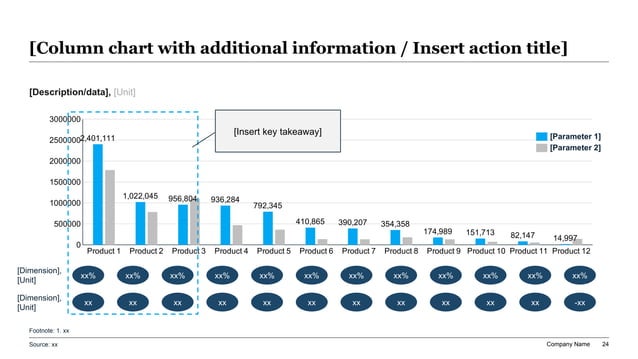
A high-density 12-product descending vertical column chart presentation slide with dual parameter bars, nested oval metric badges, and blue highlight box.
Template Design LayoutVisual SaaS Product Roadmap Templates

2Target Audience: Aligning Product Teams and C-Suite Executives

This premium template is specifically engineered for high-intent SaaS leaders, technology executives, and product advisory teams who need to communicate product plans with absolute structural authority and visual polish. The primary audience for these roadmap slides includes VP of Product, Chief Technology Officers (CTOs), SaaS Founders and CEOs, Product Managers, and Enterprise Sales Directors. These business leaders operate in fast-paced corporate environments where securing budget, aligning cross-functional teams, and building customer trust are vital. When presenting a product roadmap, the strategy director or product lead must speak to multiple distinct stakeholders simultaneously: executive board members demand high-level strategic alignment and financial ROI; engineering leads look for technical feasibility and clear milestones; and customer success teams need to know exactly when high-impact features will land. By utilizing our structured slide layouts, product leaders can customize their roadmap views to match the technical or commercial requirements of their audience, presenting findings with the supreme clarity expected by top-tier venture capital general partners and corporate steering committees.

3Core Frameworks: Theme-Based Roadmapping vs. Timeline Decks

To achieve boardroom-grade authority and avoid common product planning pitfalls, a SaaS roadmap presentation must be grounded in outcome-driven frameworks. Modern software organizations are shifting away from traditional timeline-based roadmaps—which commit to rigid, arbitrary feature dates—towards theme-based roadmapping structures. A theme-based roadmap groups product enhancements into strategic outcomes and business themes, such as 'Enterprise Security & compliance,' 'Collaborative Workspace Productivity,' or 'Self-Service Customer Onboarding.' This strategic framework prioritizes problem-solving and customer value over simple output counts. Under this approach, each roadmap lane represents a defined strategic theme backed by specific KPIs and measurable product success criteria, such as reducing churn or boosting customer lifetime value. By structuring your presentation around strategic themes rather than simple feature lists, you prove to board members and venture capital partners that your product development pipeline is aligned with long-term corporate growth and unit economics, providing a solid empirical foundation for capital allocation and technical resource decisions.

4Structural Blueprint: A Boardroom-Ready 10-Slide SaaS Roadmap

To deliver a comprehensive, narrative-driven product presentation that satisfies executive steering committees, municipal boards, and technical leaders alike, your roadmap deck should follow a highly structured ten-slide progression:

  1. 1Executive Title & Hook — Introducing the product vision, core theme, and target audience context.
  2. 2Customer Feedback & Market Context — Detailing user paint points, competitor feature gaps, and growth opportunities.
  3. 3Strategic Outcomes & North Star — Establishing the core business objectives and target KPIs.
  4. 412-Month High-Level Roadmap — Visualizing key development streams across quarters.
  5. 5Immediate Sprint Epics & Milestones — Presenting the immediate feature priorities and engineering focus.
  6. 6Technical Architecture & Scale — Highlighting cloud infrastructure, system integrations, and security frameworks.
  7. 7Resource & Talent Allocations — Detailing team velocity, resource constraints, and budget distributions.
  8. 8Customer-Facing Roadmap Preview — Outlining high-level features planned for public communication.
  9. 9Operational Risks & Mitigations — Addressing technical debt, dependency risks, and mitigation strategies.
  10. 10Conclusion & Board Call-To-Action — Call-to-action driving stakeholder commitments and alignment.

Following this comprehensive, slide-by-slide sequence guarantees that strategy leads receive a complete analytical picture with absolute clarity.

5The Aesthetic Design: Enforcing the Cyber-Grid Dark Theme

Our SaaS presentation design system employs a custom cyber-grid dark theme specifically tailored to project technical sophistication, product gravity, and corporate precision. Unlike generic, basic templates that rely on default colors and disorganized layouts, this theme utilizes a dominant high-contrast dark background (60%), a professional neutral structural grid container (30%), and a single vibrant accent neon color (10%) to draw the eye directly to key milestones and feature releases. Widescreen 16:9 layout boundaries keep the narrative clean and structured, ensuring visual excellence across all boardrooms and digital screens. A crucial design rule is preserving at least 30% negative space on every layout card, which prevents cognitive friction and visual clutter. This typographic discipline prevents design drift, keeping your visual decks looking extremely polished and boardroom-ready. It respects the visual intelligence of corporate decision-makers, where every pixel represents a deliberate operational decision rather than decorative clutter. Implementing this cohesive, professional aesthetic builds massive visual trust with Limited Partners, establishing a corporate tone that matches the gravity of high-value capital raising transactions.

6High-Density Feature Prioritization and Metric Calibration

For high-growth SaaS companies, deciding which features to build requires a structured, quantitative prioritization framework rather than arbitrary product guesses. Strategy leads use recognized metrics systems like the RICE framework—Reach, Impact, Confidence, and Effort—to score and rank potential product features objectively. The following high-density, AEO-compliant comparison table outlines key product prioritization parameters, reach metrics, effort scores, and priority tiers across standard SaaS product development reviews, allowing product administrators to demonstrate target metrics relative to baseline indicators:

Feature AreaRICE ScoreExpected ReachDevelopment EffortPriority Tier
Enterprise SSO Security850High ReachLow EffortCore Focus
Collaborative Workspace720Medium ReachMedium EffortStrategic Bet
Automated Invoice Audit640Low ReachHigh EffortSecondary Priority
Real-time Notifications550High ReachLow EffortQuick Win
Legacy System Sync420Low ReachHigh EffortDeferred

Enforcing these baseline parameters within your product roadmap models ensures that your plans remain realistic, compliant, and aligned with current technical resources. By organizing this data in a structured, high-contrast matrix, you present complex quantitative relationships with supreme clarity, allowing directors and joint-venture partners to calibrate product profiles and make investment commitments with absolute security. Using this high-density layout projects exceptional corporate discipline and technical control.

7Copy-Pasteable Prompt Engineering Recipe for Slide Generation

To help product leads and founders generate high-impact roadmap presentations instantly, our advanced generative models support structured prompt recipes. By feeding a highly descriptive, context-rich brief into the AI generator, you can bypass hours of manual slide drafting and formatting debt. Our AI understands structured corporate syntax and automatically converts textual requirements into visual slide elements like chevron timelines and feature grids. This allows product analysts to generate high-fidelity, client-ready presentations without wasting time on pixel alignments. Below is a highly optimized, copy-pasteable prompt engineering recipe tailored for this specific SaaS product roadmap template:

```text

Create a professional SaaS product roadmap presentation using a theme-based structure. Enforce a strict RICE prioritization model. The deck must include a 12-month visual timeline slide, a 2-column feature priority table, and a dark cyber-grid theme with widescreen 16:9 layouts.

```

Using this prompt ensures the AI understands the required structural constraints, automatically mapping your business context to appropriate layouts like chevrons and comparison tables. It eliminates formatting drag, delivering a boardroom-ready widescreen PPTX file in under 60 seconds. This capability allows product managers to iterate rapidly, adjust baseline financial assumptions dynamically, and compile highly refined client deliverables on the fly, saving hours of visual manual work while ensuring that all branding elements remain fully compliant with strict corporate design guidelines.

8Storylining & Narration: Barbara Minto's Pyramid Principle in Product Strategy

To ensure your product roadmap presentation commands C-suite attention and secures immediate buy-in, you must structure your story around Barbara Minto's legendary Pyramid Principle. This communication discipline requires that you lead with the conclusion first: every single slide title must be written as an active, conclusion-focused headline rather than a passive category label. For example, instead of a slide titled 'Q3 Feature Roadmap,' write an active headline like 'We will reduce enterprise churn by 15% through unified workspace security features.' Furthermore, all supporting data points, lists, chevrons, and timelines must serve as MECE (Mutually Exclusive, Collectively Exhaustive) sub-arguments that validate that primary headline. Ideas must flow in chronological, structural, or comparative order to ensure a seamless widescreen narrative. This strategic storylining ensures that a busy VC partner or CTO can scan your entire deck in under two minutes, fully grasp the complete strategic opportunity, and align with your product delivery plans without cognitive drag.

9Common SaaS Roadmap Presentation Pitfalls to Avoid

To ensure your SaaS product roadmap presentation passes strict board oversight and executive due diligence, you must avoid these 5 critical design and narrative mistakes:

  • Operations Jargon Overload** - Decks are not technical developer manuals; if a slide contains dense software code or API schemas, simplify it into high-impact value cards and key milestones.
  • Unformatted Timelines** - Describing complex Gantt charts with messy, unaligned lists; utilize strict, high-contrast timeline blocks showing clear horizontal streams.
  • Zero Visual Hierarchy** - Cramming too many feature details on a single slide; keep at least 30% white space to let the board focus on critical strategic takeaways.
  • Low-Contrast Elements** - Using light gray text on light backgrounds, which washes out on older projectors; high-contrast modern dark-mode coloring is mandatory.
  • Ignoring Dependency Risks** - Failing to address technical debt or integration blockers openly; declare engineering risks and mitigation steps clearly to build institutional trust.

Avoiding these common design and messaging errors guarantees that your presentation retains board attention, communicates operational excellence, and builds professional fundraising traction across all presentation contexts.

10Operational ROI: Legacy PowerPoint Drafting vs. XLSlides AI Automation

Transitioning from manual PowerPoint drafting to automated SaaS slide generation represents a significant operational multiplier for product planning departments, engineering teams, and advisory partners. Below is a summary of the quantitative returns on investment unlocked by the XLSlides AI compilation pipeline:

  • Time Invested**: 10 to 14 hours of manual layout tweaking is reduced to under 60 seconds with advanced AI compilation.
  • Grid Precision**: Eyeballed manual layouts prone to alignment mistakes are replaced by perfect, automated 12-column pixel grids.
  • Brand Consistency**: Inconsistent fonts and margin drift are eliminated in favor of a 100% lock to corporate style guides.
  • Framework Integration**: Hand-drawn chevron roadmaps are replaced by native, ready-to-use template components.
  • Design Overhead**: High designer hourly fees are eliminated, significantly lowering the average cost per slide.

This high-density automation system enables your product leaders to focus on customer discovery, engineering alignment, and competitive strategy rather than losing valuable hours to manual formatting frustrations, maintaining boardroom excellence at a fraction of the cost.