Robotics and Warehouse Automation Solution Presentation Template

Stop wasting hours on manual formatting. Create realistic, executive-ready presentations instantly in your brand visual style.

Turn warehouse constraints, robotics use cases, throughput targets, and labor economics into an executive-ready automation deck.
Explain AMRs, AGVs, picking robots, sortation, WMS integration, safety controls, staffing impact, and ROI.
Build slides for logistics operators, ecommerce teams, robotics vendors, consultants, investors, and supply chain leaders.

1What Is a Robotics Warehouse Automation Deck?

A robotics warehouse automation deck explains how a logistics operator, retailer, ecommerce company, manufacturer, or robotics vendor will improve warehouse performance through automation. It should connect operational challenges to practical solutions: labor shortages, picking inefficiency, high travel time, order variability, space constraints, safety incidents, service-level pressure, and rising fulfillment cost. The deck usually covers baseline operations, challenge-to-solution mapping, robotics use cases, facility fit, systems integration, safety controls, labor model, ROI, implementation roadmap, KPIs, and risks. The strongest version avoids presenting robots as a plug-and-play answer. It shows how processes, software, layout, people, and equipment must work together. This gives supply chain leaders, warehouse managers, robotics vendors, IT teams, safety reviewers, finance leaders, and investors enough evidence to assess throughput improvement, labor impact, integration complexity, operational risk, payback, and rollout readiness. It also keeps the recommendation anchored in order profile, facility constraints, worker adoption, exception handling, uptime, maintenance support, and peak-season resilience before capital approval.
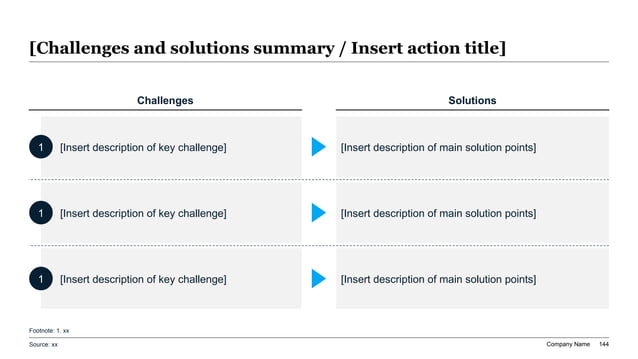
Robotics warehouse automation slide with three challenge-to-solution rows, numbered badges, grey cards, and blue transition arrows.
Template Design LayoutRobotics and Warehouse Automation Solution Presentation Template

2When to Use This Warehouse Robotics Template

Use this template when you need to present a robotics-enabled warehouse automation initiative to stakeholders who care about operations and economics. It works for capital committee reviews, vendor sales decks, fulfillment network planning, warehouse design workshops, ecommerce peak-readiness plans, consulting recommendations, investor presentations, and transformation roadmaps. A logistics operator can use it to compare automation options, a robotics vendor can use it to explain solution fit, and a consultant can use it to structure the business case. The template is especially useful when audiences need to understand why robotics is the right answer for a specific facility, order profile, and labor environment. This gives supply chain leaders, warehouse managers, robotics vendors, IT teams, safety reviewers, finance leaders, and investors enough evidence to assess throughput improvement, labor impact, integration complexity, operational risk, payback, and rollout readiness. It also keeps the recommendation anchored in order profile, facility constraints, worker adoption, exception handling, uptime, maintenance support, and peak-season resilience before capital approval.

3Recommended Robotics Automation Deck Structure

A strong robotics warehouse automation deck should begin with the current-state baseline: order volume, SKU mix, pick rate, travel distance, labor hours, overtime, error rate, inventory accuracy, congestion, and service level. The next section should define the main operational challenges and map each one to a solution option such as AMRs, AGVs, goods-to-person systems, robotic picking, automated sortation, conveyors, palletizing, or vision-guided quality checks. Then the deck should explain facility layout, process redesign, WMS or WES integration, safety requirements, labor transition, ROI, and implementation stages. Close with KPIs, risks, governance, and the executive ask. This gives supply chain leaders, warehouse managers, robotics vendors, IT teams, safety reviewers, finance leaders, and investors enough evidence to assess throughput improvement, labor impact, integration complexity, operational risk, payback, and rollout readiness. It also keeps the recommendation anchored in order profile, facility constraints, worker adoption, exception handling, uptime, maintenance support, and peak-season resilience before capital approval.

4Baseline Operations, Bottlenecks, and Automation Fit

The baseline section should make the warehouse opportunity specific. Show where throughput is constrained, which process steps create excessive labor time, where travel distance is highest, which zones create congestion, and how order variability affects productivity. Useful metrics include lines picked per hour, orders per shift, dock-to-stock time, pick accuracy, replenishment delays, inventory accuracy, labor cost per order, capacity utilization, and overtime. The deck should separate problems that robots can solve from problems that require process redesign, slotting changes, staffing changes, or software cleanup. Automation fit depends on SKU profile, order mix, aisle width, floor condition, peak demand, and integration readiness. This gives supply chain leaders, warehouse managers, robotics vendors, IT teams, safety reviewers, finance leaders, and investors enough evidence to assess throughput improvement, labor impact, integration complexity, operational risk, payback, and rollout readiness. It also keeps the recommendation anchored in order profile, facility constraints, worker adoption, exception handling, uptime, maintenance support, and peak-season resilience before capital approval.

5AMRs, AGVs, Picking Robots, and Sortation Use Cases

The use-case section should compare robotics options against actual warehouse workflows. Autonomous mobile robots may reduce walking distance and support flexible picking. Automated guided vehicles may move pallets or carts on predictable routes. Robotic picking may help with repetitive item handling when SKU variability is manageable. Automated sortation can improve parcel flow, returns processing, and outbound staging. The deck should clarify which use cases are near-term, which require pilots, and which need facility redesign. It should also show dependencies such as WMS tasks, barcode quality, charging strategy, traffic management, exception handling, and maintenance support. This prevents robotics from being oversold without operational proof. This gives supply chain leaders, warehouse managers, robotics vendors, IT teams, safety reviewers, finance leaders, and investors enough evidence to assess throughput improvement, labor impact, integration complexity, operational risk, payback, and rollout readiness. It also keeps the recommendation anchored in order profile, facility constraints, worker adoption, exception handling, uptime, maintenance support, and peak-season resilience before capital approval.

6WMS Integration, Data Flow, and Operating Model

Warehouse robotics value depends heavily on software integration and operating model design. The deck should explain how robots receive tasks, update inventory, handle exceptions, coordinate with workers, and report performance. Integration may involve WMS, WES, ERP, labor management, slotting tools, scanners, conveyors, and dashboards. A clear data-flow slide should show order release, task assignment, robot execution, worker interaction, exception handling, and performance reporting. The operating model should define who monitors robots, who resolves jams or exceptions, who maintains equipment, and how supervisors manage mixed human-robot workflows. Without this clarity, robotics pilots can stall after the demo stage. This gives supply chain leaders, warehouse managers, robotics vendors, IT teams, safety reviewers, finance leaders, and investors enough evidence to assess throughput improvement, labor impact, integration complexity, operational risk, payback, and rollout readiness. It also keeps the recommendation anchored in order profile, facility constraints, worker adoption, exception handling, uptime, maintenance support, and peak-season resilience before capital approval.

7Safety, Workforce Change, and Adoption Planning

Robotics deployment changes how people move, pick, replenish, and supervise work. The deck should explain safety controls, traffic rules, training, restricted zones, emergency stops, maintenance procedures, and incident escalation. It should also address workforce change: role redesign, supervisor coaching, worker acceptance, productivity expectations, redeployment, and communication. Automation may reduce travel or repetitive tasks, but workers need to understand how the new process affects their day. Safety reviewers will want evidence that robots can operate around people, equipment, pallets, forklifts, and changing floor conditions. A strong adoption plan includes pilot feedback, standard operating procedures, training cadence, and shift-level support. This gives supply chain leaders, warehouse managers, robotics vendors, IT teams, safety reviewers, finance leaders, and investors enough evidence to assess throughput improvement, labor impact, integration complexity, operational risk, payback, and rollout readiness. It also keeps the recommendation anchored in order profile, facility constraints, worker adoption, exception handling, uptime, maintenance support, and peak-season resilience before capital approval.

8ROI, Labor Model, and Capacity Economics

A robotics warehouse automation deck needs a disciplined business case. The ROI section should compare labor savings, throughput gains, reduced overtime, improved accuracy, lower injury risk, better space utilization, service-level improvement, and peak capacity against robot cost, software fees, integration, facility changes, maintenance, support, and training. It should show sensitivity to volume, labor rate, shift pattern, utilization, seasonality, and adoption speed. Finance leaders need to know whether benefits come from headcount avoidance, productivity improvement, capacity deferral, improved customer experience, or risk reduction. The best ROI slide separates proven pilot performance from assumptions and assigns owners to each benefit. This gives supply chain leaders, warehouse managers, robotics vendors, IT teams, safety reviewers, finance leaders, and investors enough evidence to assess throughput improvement, labor impact, integration complexity, operational risk, payback, and rollout readiness. It also keeps the recommendation anchored in order profile, facility constraints, worker adoption, exception handling, uptime, maintenance support, and peak-season resilience before capital approval.

9Implementation Roadmap, Pilot Design, and Scaling

The implementation roadmap should sequence automation in practical stages. Stage one may include current-state analysis, facility assessment, order profile review, vendor shortlist, integration design, safety review, and pilot scope. Stage two may deploy robots in one process area, measure productivity, train supervisors, refine exception handling, and validate system integration. Stage three may expand across zones, shifts, sites, or additional use cases while standardizing support and governance. Each stage should include milestones, owners, dependencies, risks, and decision gates. The deck should define what proof is required before scaling, such as pick-rate improvement, labor productivity, uptime, safety performance, worker adoption, and payback confidence. This gives supply chain leaders, warehouse managers, robotics vendors, IT teams, safety reviewers, finance leaders, and investors enough evidence to assess throughput improvement, labor impact, integration complexity, operational risk, payback, and rollout readiness. It also keeps the recommendation anchored in order profile, facility constraints, worker adoption, exception handling, uptime, maintenance support, and peak-season resilience before capital approval.

10How XLSlides Speeds Up Robotics Warehouse Planning

XLSlides helps warehouse teams turn operations notes, process maps, vendor research, KPI exports, facility constraints, labor assumptions, and investment logic into a structured robotics automation presentation faster. The AI workflow can organize the story into baseline, challenges, solution options, use cases, integration model, safety plan, workforce change, ROI, implementation roadmap, KPIs, risks, and executive ask. This is useful when operations teams or vendors have the substance but need a polished deck for leadership, capital committees, customers, or investors. The generated output is not a substitute for engineering design, safety assessment, vendor diligence, or financial modeling, but it gives teams a stronger working draft. This gives supply chain leaders, warehouse managers, robotics vendors, IT teams, safety reviewers, finance leaders, and investors enough evidence to assess throughput improvement, labor impact, integration complexity, operational risk, payback, and rollout readiness. It also keeps the recommendation anchored in order profile, facility constraints, worker adoption, exception handling, uptime, maintenance support, and peak-season resilience before capital approval.