Renewable Energy Investment Strategy & Project Finance Presentation Template

Stop wasting hours on manual formatting. Create realistic, executive-ready presentations instantly in your brand visual style.

Portfolio screening, market-entry, and asset-prioritization layouts
Project finance, power-price, IRR, and DSCR economics slides
Development gating, risk, governance, and capital-allocation roadmap visuals

1What a Renewable Energy Investment Deck Needs to Prove

A renewable energy investment deck is not a generic climate narrative. It is a capital allocation document that must prove where returns are attractive, how risk is being underwritten, and why the chosen asset mix deserves scarce development and financing capacity. Senior stakeholders usually want four answers quickly: which markets and technologies should be prioritized, what project economics look like under realistic assumptions, where the critical development and financing risks sit, and what milestones justify additional capital. The strongest decks therefore lead with answer-first headlines such as 'Prioritize contracted solar-plus-storage assets in constrained nodes where interconnection and offtake certainty support target returns' instead of passive labels like 'Renewables overview.' When the story is structured properly, it links market opportunity to IRR, payback, downside protection, and portfolio construction logic.

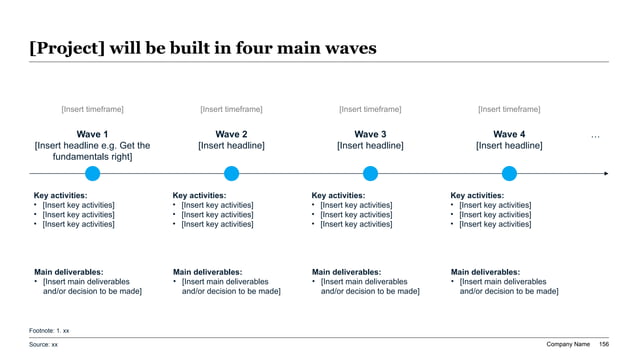
Executive renewable energy investment roadmap slide with four investment waves, milestone nodes, and workstream activities across a 16:9 board-style layout.
Template Design LayoutRenewable Energy Investment Strategy & Project Finance Presentation Template

2Who This Renewable Energy Investment Template Is Built For

This template is designed for senior business users who need renewable investment cases to survive board, investor, and lender scrutiny. Typical users include infrastructure funds, project-finance teams, independent power producers, utilities, renewable platform founders, corporate development groups, and consultants advising growth or energy transition strategy. It is especially useful when the audience needs more than enthusiasm about decarbonization. Investment committees want to see resource quality, interconnection timelines, EPC and supply-chain assumptions, commercial structure, leverage capacity, and downside cases. Operators want to understand which asset classes improve portfolio resilience and where execution bandwidth should concentrate. Lenders and co-investors want evidence that the project pipeline is sequenced, de-risked, and economically credible.

3Practical Use Cases for an Executive Renewable Investment Deck

Use this page when real decisions must be made on technology mix, market focus, and capital sequencing. Common use cases include investment committee reviews for utility-scale solar or wind platforms, board updates on storage expansion, lender presentations for project finance, acquisition memos for operating or development-stage assets, fundraising materials for clean-infrastructure funds, and corporate strategy reviews for large energy users or utilities building renewable portfolios. The template also works well for comparing contracted versus merchant strategies, greenfield versus M&A entry, single-technology versus hybrid buildouts, and regional pipeline choices. If the conversation involves tax credits, PPA strategy, merchant curves, congestion, or staged capital deployment, this is the right presentation format.

4Recommended Slide Outline for a Decision-Ready Investment Review

A strong renewable energy investment presentation usually follows a ten-slide narrative:

- Slide 1: Executive recommendation stating where to invest, why now, and what return profile is targeted.

- Slide 2: Market context covering demand growth, policy support, power-market dynamics, and competitive intensity.

- Slide 3: Portfolio screening by technology, geography, development stage, and strategic fit.

- Slide 4: Project economics bridge covering capex, capacity factor, merchant assumptions, PPA pricing, incentives, and opex.

- Slide 5: Commercial model with offtake structure, revenue stack, hedge logic, and customer pipeline where relevant.

- Slide 6: Development and delivery blueprint covering interconnection, permitting, land, EPC, procurement, and commissioning.

- Slide 7: Financing structure with leverage, tax equity or subsidy considerations, DSCR, and capital sources.

- Slide 8: KPI and value-creation dashboard covering IRR, NPV, payback, build schedule, availability, and emissions impact.

- Slide 9: Risk, governance, and milestone gates for releasing the next capex tranche.

- Slide 10: Decisions required on market entry, capital allocation, partnerships, and next-stage diligence.

This structure works because it answers the investment thesis first, then shows economics and execution, then closes with financing, governance, and explicit decisions.

5Frameworks That Keep Renewable Investment Analysis MECE

Renewable investment pages become noisy when macro market trends, project economics, and delivery tasks are mixed on the same slide. Keep the analysis MECE by separating four layers. First, define the market and asset-screening logic: technology, geography, node, stage, and strategic fit. Second, define the economic engine: capex, resource yield, curtailment, degradation, opex, financing cost, and incentive support. Third, define commercialization and portfolio logic: PPA versus merchant exposure, customer concentration, balancing needs, storage pairing, and portfolio diversification. Fourth, define execution readiness: interconnection, permitting, EPC, procurement, community engagement, and governance. A simple attractiveness-versus-executability matrix works well for prioritization, especially when comparing development-stage assets with different return profiles and permitting risk. The Minto Pyramid Principle remains the right storylining standard: lead with the recommended asset strategy, group support into a few strategic arguments, and keep evidence under those arguments.

6Economics, KPIs, and Underwriting Metrics Leadership Expects

A renewable investment deck only becomes credible when it shows which assumptions drive returns and where downside sits. Executives and investors typically expect to see capex per megawatt, expected COD timing, net capacity factor, merchant and contracted pricing assumptions, curtailment exposure, opex, leverage ratio, interest coverage, DSCR, tax-credit or incentive contribution, unlevered and levered IRR, NPV, payback, and sensitivity ranges for power prices, capex inflation, and construction delays. Portfolio operators may also want availability, forced outage rate, storage duration, round-trip efficiency, land or interconnection queue status, and carbon-abatement metrics. If the case relies on tax equity, subsidies, or hedging, show the assumptions explicitly so the economics remain testable rather than aspirational.

7Project Finance, Risk, and Governance Decisions That Matter

Many renewable strategies fail not because the market is wrong, but because the deck underplays risk ownership and gating. A decision-ready page should specify which milestones must be proven before land spend, notice-to-proceed, debt close, or portfolio expansion occurs. It should clarify decision rights across development, finance, commercial, legal, EPC, procurement, and operating teams. Typical risk categories include interconnection delay, permitting challenge, supply-chain inflation, contractor concentration, basis risk, merchant-price downside, offtaker credit, weather volatility, and policy or tax-credit change. Governance should show the cadence for investment committee reviews, lender updates, risk escalation, and drawdown approvals. When the deck makes those controls visible, the opportunity starts to read like an institutionally governable investment program rather than a speculative growth story.

8Design Guidance for Premium Energy Investment Slides

Renewable energy pages often drift into sustainability-report aesthetics or overloaded engineering diagrams. Avoid both. Use action-title headlines that state the investment implication on every slide. In the `bcg-emerald` theme, keep a restrained 60-30-10 color ratio: clean background, neutral containers for analytical structure, and one green accent for economics, milestones, or risk flags. Use a twelve-column grid so economics bridges, project maps, financing tables, and phased roadmaps stay aligned. Keep one analytical job per slide: screening, economics, commercial model, financing, or risk. For maps, label only the nodes and regions that matter to the decision. For KPI tables, highlight only the few assumptions that move the return case. The visual goal is to make an energy-transition investment look governed, underwritten, and capital efficient.

9Common Pitfalls in Renewable Energy Investment Presentations

The first mistake is presenting demand growth or decarbonization tailwinds without proving why the chosen assets win on economics. The second is hiding key sensitivities such as power-price downside, capex inflation, or COD delay behind a single base case. Third, many teams ignore commercial structure; if the deck does not explain PPA tenor, merchant exposure, counterparty quality, or hedge logic, underwriting will look incomplete. Fourth, some pages jump from a long project list to a capital ask without showing development readiness or management bandwidth. Finally, teams often overstate ESG value while understating execution friction around interconnection, permitting, and community acceptance. A credible deck should show staged capital release, explicit milestone evidence, and a realistic downside case.

10Prompt Recipe for Better Renewable Investment Outputs

High-quality XLSlides outputs depend on prompts that specify the asset mix, market, economics, and audience. A strong recipe is: `Build an executive renewable energy investment deck for an infrastructure investment committee reviewing a pipeline of utility-scale solar, onshore wind, and storage projects. Show market attractiveness by region, project screening criteria, capex and financing assumptions, PPA versus merchant exposure, IRR and DSCR targets, interconnection and EPC risks, and a phased capital deployment roadmap.` You can improve results further by requesting the exact layouts you need, such as an asset-screening matrix, an economics waterfall, a revenue-stack page, a financing scorecard, and a stage-gate roadmap. The more specific the market and investment decision, the stronger the draft becomes.

11How to Use XLSlides to Build the Deck Faster

Start by defining the investment decision before collecting every engineering detail. Assemble the minimum evidence pack: target technologies and geographies, expected build or acquisition strategy, power-price and capex assumptions, commercial structure, financing plan, key execution constraints, and the approval the audience must make. Generate the first draft in XLSlides, then tighten the story by rewriting each headline into a conclusion and deleting any page that does not support a capital or governance decision. Use XLSlides for hard-to-format visuals such as portfolio screening matrices, economics bridges, financing dashboards, risk heatmaps, and phased deployment roadmaps, then refine the exact figures and ownership in PowerPoint. This workflow lets strategy and investment teams move from scattered pipeline notes to a lender- and board-ready renewable investment narrative much faster without giving up rigor.