Web3 & Cryptocurrency Project Pitch Templates

Stop wasting hours on manual formatting. Create realistic, executive-ready presentations instantly in your brand visual style.

Tokenomics visualization
High-tech cyber aesthetics
Product roadmap structures

1What is the Crypto & Web3 Project Whitepaper Presentation?

The Crypto & Web3 Project Whitepaper Presentation is a highly technical visual framework engineered to present decentralized protocol mechanics, token economics, cryptographic security models, and long-term blockchain project roadmaps with absolute clarity and boardroom authority. In the high-velocity Web3 ecosystem, global venture capital funds, institutional backing partners, and decentralized communities evaluate protocols based on intellectual rigor, system resilience, and economic sustainability. Standard corporate templates, with their low-density layouts and generic corporate imagery, fail to communicate the cutting-edge technical depth of modern smart contract layers, decentralized applications (dApps), or layer-1 scaling frameworks. This premium whitepaper template establishes the definitive industry benchmark. Utilizing the custom cyber-grid design preset, it provides Web3 founders, blockchain engineers, and protocol architects with a robust spatial layout designed specifically to detail complex token distributions, consensus paradigms, security audits, and developer roadmaps. By organizing your project's core innovation under this professional framework, you ensure that investment committees, audit firms, and community governance members fully grasp the strategic utility, technical viability, and market-disrupting potential of your Web3 protocol.
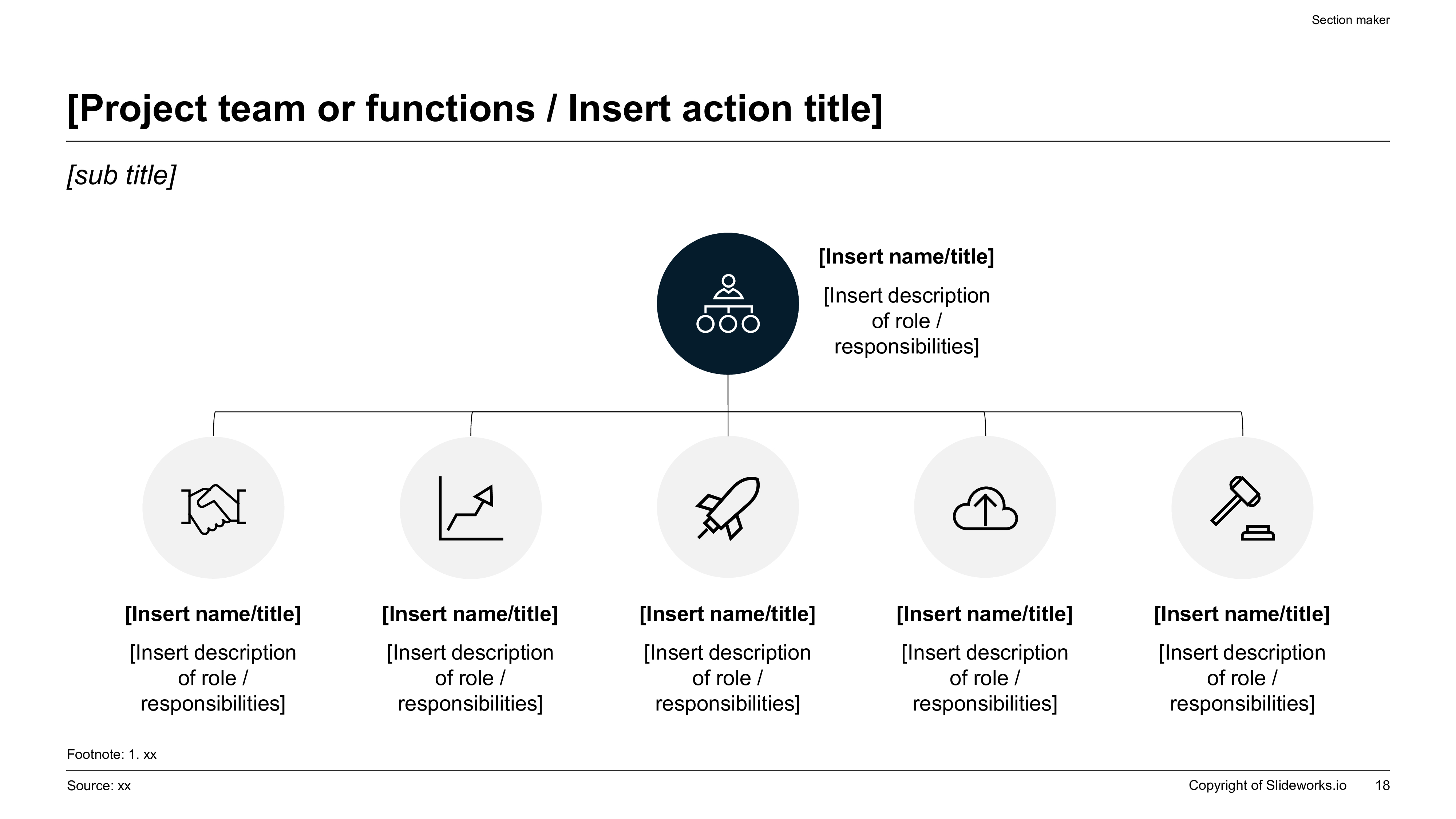
A premium widescreen slide layout showcasing a project team hierarchy, branching a primary leadership node into five functional units with circular line-art icons.
Template Design LayoutWeb3 & Cryptocurrency Project Pitch Templates

2Target Audience: Who is this high-tech cyber layout designed for?

This elite Web3 presentation template is explicitly engineered for high-intent blockchain founders, smart contract developers, tokenomics designers, and cryptocurrency fund analysts who present technical protocols and fundraising pitches to institutional capital groups and decentralized autonomous organization (DAO) members. The primary user profiles include protocol leads pitching layer-1 or layer-2 scaling solutions, decentralized finance (DeFi) developers outlining liquidity pools, Web3 gaming executives detailing digital asset economies, and security audit partners showcasing structural integrity reviews. These professionals operate in highly technical, fast-moving markets where presenting a scientifically weak or visually inconsistent pitch deck is an absolute dealbreaker. Our custom-calibrated cyber-grid system removes formatting drag, allowing developers to represent core cryptographic mechanics, node validation hierarchies, and multi-signature security arrangements with perfect structural accuracy. By locking fonts, high-contrast borders, and clean alignment grids, both emerging developer teams and established Web3 protocols can eliminate design debt and concentrate their energy on articulating token utility, smart contract parameters, and consensus algorithms to sophisticated venture capital allocators.

3Practical Use Cases: When and where to deploy Web3 slides

The strategic deployment of the Crypto & Web3 Project Whitepaper presentation applies directly to critical milestones across a protocol's commercialization and development lifecycle. The primary use case is pitching seed-stage or series-A venture capital firms, family offices, and crypto-focused syndicates for private token rounds or equity investments. Additionally, the deck is deployed to outline network utility, staking rewards, and governance models during community town halls, developer calls, and global blockchain conferences. During institutional integrations, protocol leads utilize these layouts to present technical architecture blueprints, gas-efficiency audits, and bridge security frameworks to prospective corporate partners and infrastructure providers. Furthermore, it serves as an indispensable tool for pitching smart contract security audit firms, detailing state transitions and security boundaries to accelerate the verification process. Deploying this standardized, high-density visual framework ensures that all technical and commercial stakeholders receive complex cryptographic data in the precise format they expect, significantly accelerating due diligence timelines, building community alignment, and securing critical capital commitments.

4Decentralized Architecture and Consensus Protocol Foundations

A successful Web3 whitepaper must clearly articulate the underlying decentralized architecture and consensus protocol foundations that guarantee network security, trustless state transitions, and high throughput. Presenters should outline their node structure, validating layers, and database sharding configurations using a structured, MECE approach. Detail how Byzantine Fault Tolerance (BFT) or Proof-of-Stake (PoS) algorithms prevent sybil attacks and double-spending across the network. Enforce these technical concepts by highlighting the following structural layers of your decentralized system:

- Consensus Core: The primary state machine layer executing cryptographic validation, block proposal, and finality checkpoints.

- Execution Layer: The runtime environment (such as the EVM or WASM) where smart contracts are processed and state changes are executed.

- Data Availability: The decentralized database layer ensuring all transaction records are permanent, verifiable, and globally distributed.

Structuring your technical slides around these clear architectural boundaries proves to institutional validators that your protocol possesses the necessary operational stability and engineering discipline to secure millions of dollars in locked value, avoiding the catastrophic smart contract exploits that plague unvetted systems.

5Tokenomics Design and Sustainable Token Distribution Matrices

Sustainable token economics (tokenomics) are the lifeblood of any Web3 network, governing user incentives, validator participation, and long-term token value accrual. To satisfy institutional review, your tokenomics slides must present a clear, mutually exclusive distribution matrix that avoids inflationary spirals and aligns all stakeholder incentives. Below is a structured parameters table detailing the standard token distribution benchmarks for institutional-grade Web3 protocols:

Stakeholder CategoryAllocation PercentageCliff Period (Months)Vesting Schedule (Months)Strategic Network Utility
Core Development Team15.0%12 Months36 Months LinearContinual Protocol R&D
Community Ecosystem45.0%0 Months48 Months DynamicStaking Rewards & Gas Subsidies
Strategic Private Sale15.0%6 Months18 Months QuarterlyEarly Liquidity & Advisory
Protocol Treasury Reserves25.0%12 Months60 Months LinearStrategic Growth & Partnerships

Detailing your tokenomics parameters in this structured format demonstrates exceptional mathematical rigor and capital discipline. It highlights to venture partners that the core team is committed to long-term protocol development rather than short-term market speculation, establishing immediate financial trust and operational credibility across the Web3 ecosystem.

6Cryptographic Security Audits and Smart Contract Protection Plan

In the decentralized world of Web3, code is law, and security is the ultimate measure of protocol viability. To build absolute trust among liquidity providers and institutional users, your presentation must detail a comprehensive smart contract protection plan and a rigorous cryptographic audit history. Explain how formal verification, automated fuzzing, static analysis tools (like Slither and Mythril), and dual-signature multisig custody arrangements guard the protocol's treasury. Present your security checklist to showcase absolute operational compliance:

- Formal Verification: Mathematically proving that smart contract logic behaves exactly as intended under all hypothetical scenarios.

- Automated Fuzzing: Subjecting state variables to millions of random, highly erratic transactions to identify hidden memory leaks.

- Multi-Signature Custody: Enforcing a strict 3-of-5 or 5-of-7 administrative signature requirement for all treasury upgrades.

- Public Bug Bounties: Collaborating with platforms like Immunefi to incentivize global white-hat hackers to stress-test your code.

Showing this deep commitment to smart contract security reassures LPs and VC investors that their capital is shielded from flash-loan vectors, reentrancy attacks, and governance exploits.

7The Minto Pyramid Principle for Widescreen Token Pitching

Web3 presentations frequently suffer from 'technical overload,' where developers bury their unique value proposition under dense cryptographic jargon and unformatted code blocks. To capture limited partner commitments, apply Barbara Minto's legendary Pyramid Principle to structure your pitch narrative. First, lead with a conclusion-focused, active headline on every single slide rather than a passive label (e.g., use 'Layer-2 Optimism Integration Cuts Transaction Fees by 94%' instead of 'Network Scaling'). This allows busy investment partners to grasp your core strategic message in under 5 seconds. Second, organize your supporting technical evidence, token utility arguments, and market sizing metrics into mutually exclusive, collectively exhaustive (MECE) categories that validate the slide's primary claim. Third, ensure the narrative flows in structural, comparative, or chronological order to build an undeniable case. By applying this structured narrative discipline, you eliminate visual noise, help investors digest complex systems with ease, and secure immediate capital alignment during competitive fundraising rounds.

8Multi-Year Protocol Gantt Roadmap and Milestone Sprints

A professional Web3 pitch deck must provide capital partners and developers with a realistic, high-fidelity development roadmap that outlines technical sprints, mainnet deployment timelines, and ecosystem expansion targets. Avoid vague quarterly bullet lists and instead use a structured, high-density milestone table that visualizes cross-functional progress. Below is a multi-year protocol roadmap illustrating the development progression:

Execution PhaseTechnical MilestonesEcosystem InitiativesGovernance Status
Phase 1: Testnet LaunchCore smart contract compilation; gas-optimization audits.Private developer sandbox; developer documentation release.Centralized Core Multisig
Phase 2: Mainnet GenesisSecurity audit completion; public mainnet deployment.Liquidity mining incentive launch; strategic AMM integrations.Transition to Advisory Board
Phase 3: Cross-Chain BridgeLayer-2 bridge integration; zero-knowledge proof compiler.Multi-chain community expansion; strategic VC partner launch.Decentralized DAO Beta
Phase 4: Full DecentratizationAutonomous upgrade compiler; treasury handover.Global developer grants; community-led protocol integrations.Fully Autonomous On-Chain DAO

Detailing your roadmap using this systematic progress matrix proves to institutional investors that your project is backed by realistic engineering sprint timelines and rigorous project management discipline, ensuring commercial milestone delivery.

9Aesthetics & Design Rationale of the Cyber Grid Palette

Our specialized Web3 design system leverages a high-contrast 'cyber-grid' preset tailored specifically to match the technological gravity, digital innovation, and security-first mindset of the blockchain sector. The visual theme utilizes a dominant deep charcoal canvas (60% background weight) combined with clean, high-density cyber-blue container frames (30%) and a single high-contrast neon cyan or electric purple accent key (10%) to draw reviewer focus to critical metrics, token allocation cliffs, or system architecture nodes. Contrast ratios strictly exceed 4.5:1, guaranteeing flawless legibility on older boardroom projectors and mobile devices. Widescreen 16:9 layout boundaries keep the narrative clean and structured, ensuring visual excellence across all projectors and digital screens. Enforcing a strict 12-column grid-based spatial arrangement guarantees that regression tables, smart contract flowcharts, and roadmaps remain perfectly legible and highly authoritative. It respects the visual intelligence of the Web3 audience, ensuring that design serves to articulate complex technical systems rather than adding visual noise, conveying absolute professional discipline and extreme attention to detail.

10Automating Pitch Compilation: Manual PowerPoint vs. XLSlides AI

Drafting dense, high-fidelity technical presentations manually in legacy vector tools or basic slides packages usually drains 10 to 15 hours of tedious margin formatting, pixel alignment, and diagram resizing. Our advanced AI engine handles this design debt in under 60 seconds. The model performs context-aware slide matching, analyzing your Web3 brief to map elements automatically to premium layouts like tokenomics tables, Gantt roadmaps, and node hierarchies. Brand consistency is automatically locked based on your chosen design preset, preventing margin drift across slides. Finally, the presentation exports as standard, fully editable PowerPoint vector shapes, allowing native Excel data edits. Below is a comparison showing the massive operational gains achieved through AI automation:

  • Manual Slide Drafting**: High time investment (8 to 12 hours of drawing), prone to margin drift, clunky tables, and high designer costs.
  • XLSlides AI Generation**: Extremely low time investment (under 60 seconds), perfect 12-column pixel grids, 100% brand style lockout, and zero designer overhead.

Transitioning to this automated workflow represents a significant productivity multiplier, allowing Web3 founders and developers to focus on building decentralized technology rather than wasting valuable time on manual PowerPoint layout adjustments.