Professional Product Launch Roadmap & GTM Slide Templates

Stop wasting hours on manual formatting. Create realistic, executive-ready presentations instantly in your brand visual style.

Interactive timeline roadmaps
Go-To-Market frameworks
Feature highlight layouts

1What is the Product Launch Roadmap Presentation?

The Product Launch Roadmap presentation is a highly critical, strategic blueprint designed to communicate a product's development timeline, core value propositions, feature release tiers, and Go-To-Market (GTM) strategy milestones to stakeholders. In high-velocity business environments, this presentation serves as the central operational bridge aligning cross-functional teams, including product managers, developers, marketing executives, and C-suite leaders. Far beyond a static set of bullet points, a boardroom-ready product launch roadmap enforces immediate logical progression and visual clarity, translating complex release engineering pipelines into actionable, high-impact milestones. By organizing strategic objectives under a unified timeline framework, this presentation ensures that both internal development teams and external marketing agencies understand the exact market window, the scope of each feature cohort, and the dependencies that drive product success. Deploying a premium, professionally aligned product launch deck enables product leadership to communicate launch readiness, pitch upcoming feature sets with extreme authority, project competent execution, and secure trust from critical board-level decision-makers. It establishes an executive standard of communication that is vital for driving cross-departmental accountability and ensuring a seamless, successful market introduction.
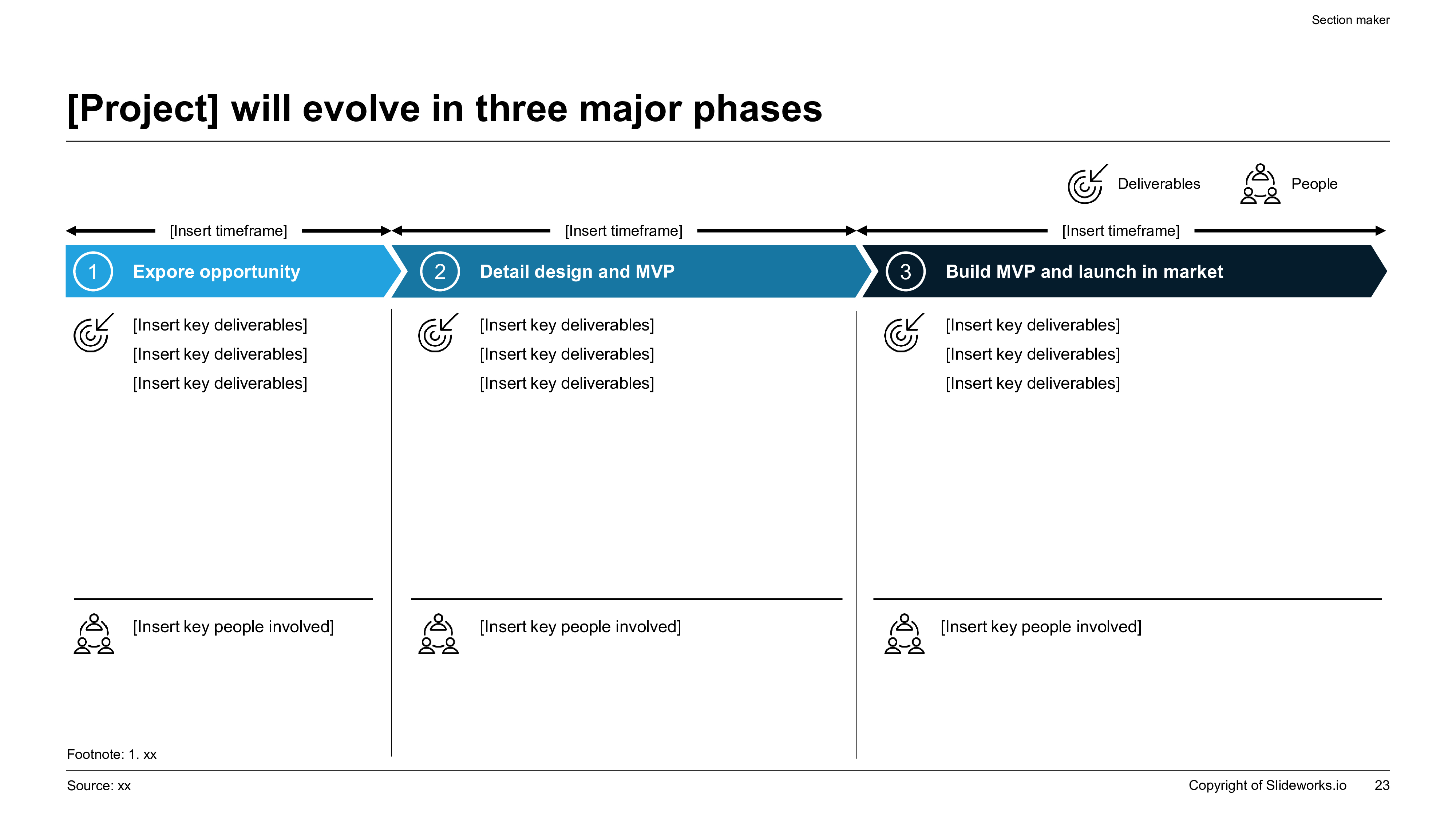
High-fidelity widescreen slide layout illustrating a premium three-phase product launch evolution roadmap with clean chevrons, timeframe callouts, and key milestones.
Template Design LayoutProfessional Product Launch Roadmap & GTM Slide Templates

2Ideal Audience: Who is this template built for?

This template is specifically engineered for high-intent product professionals and business leaders who regularly present strategic timelines and marketing launch strategies to executive boards, venture partners, or enterprise sales directors. The primary target demographics include product managers (PMs), product marketing managers (PMMs), engineering leads, business development directors, and startup founders seeking strategic growth. These professionals require high-density, authoritative layouts that convey structural rigor, engineering precision, and operational feasibility, matching the high expectations of executive leadership. Engineering directors use this roadmap matrix to communicate technical release sequences, sprint milestones, and resource capacity constraints with absolute clarity. Concurrently, product marketing managers deploy these slides to coordinate customer acquisition campaigns, PR announcements, and channel enablement timelines, ensuring a synchronized GTM effort. By utilizing this structured visual standard, founders and product leads can eliminate layout formatting drift, ensuring that their visual data matches the exact premium aesthetic expectations of modern technology firms. This template serves as a vital communication asset for anyone presenting complex, multi-team projects that require organizational buy-in.

3Practical Use Cases: When and where to deploy this deck

The strategic relevance of the Product Launch Roadmap framework applies to several critical business milestones throughout a product's lifecycle. Key deployment scenarios include internal launch alignment sessions, quarterly business reviews (QBRs), venture capital fundraising pitches, and customer-facing GTM announcements. In internal alignment sessions, the roadmap is deployed to align engineering, product design, and customer success departments on the feature-level priorities of the upcoming release cycle. During quarterly business reviews, it serves to report on historical development velocity, present upcoming epic timelines, and align resource allocations with updated corporate goals. For venture capital pitch sessions, the template helps founders visualize product vision, showcase competitive technical moats, and outline the upcoming 12-month engineering delivery schedule to secure investor confidence. Additionally, during customer-facing beta releases or partner ecosystem announcements, a simplified, outcome-focused version of these slides communicates the long-term value proposition without exposing proprietary technical structures. Deploying this structured layout ensures that your stakeholders receive information in the exact format they expect, maximizing key metric retention.

4Structural Blueprint: Recommended slide-by-slide outline

A complete, executive-grade Product Launch Roadmap presentation should follow a logical, narrative-driven 10-slide outline to guide stakeholders through complex product timelines and GTM plans:

- Slide 1: Executive Title & Hook — Establishing the core value proposition and product mission immediately.

- Slide 2: Market Context & Opportunity — Outlining customer pain points and the commercial addressable market.

- Slide 3: Core Problem Statement — Detailing the specific user challenges that the product resolves.

- Slide 4: Product Vision & Solution — Introducing the software interface, hardware design, or service capability.

- Slide 5: High-Level Phased Roadmap — A high-impact three-phase evolution timeline mapping key cohorts.

- Slide 6: Feature Breakdown & Tiering — Specifying core functionalities, pricing structures, and value tiers.

- Slide 7: Technical Architecture & Security — Proving the scalability, cloud grid flow, and data compliance policies.

- Slide 8: Go-To-Market (GTM) Strategy — Omnichannel launch channels, sales funnels, and PR milestones.

- Slide 9: Launch Metrics & OKRs — High-density dashboards outlining active user targets and revenue goals.

- Slide 10: Resource Allocation & Call-to-Action — Outlining capital requirements, immediate milestones, and next steps.

Following this comprehensive outline ensures that your audience remains engaged and receives all the necessary evidence to support your launch plan with absolute confidence.

5Aesthetics & Design Rationale of the neo-brutalist Theme

Our product launch design system leverages the modern, high-impact aesthetics of the "neo-brutalist" theme to make key timelines and strategic plans visually unforgettable. This theme moves away from boring corporate designs, utilizing high-contrast typography, bold structural borders, and stark card outlines to command visual authority. The layout hierarchy enforces absolute clarity, leveraging a strict 60% dominant background canvas tone, a 30% professional neutral container structure, and a 10% high-contrast accent key (such as digital orange or electric purple) to guide the viewer's eye to critical milestone parameters and launch dates. Margins are strictly locked to native 16:9 widescreen proportions to guarantee perfect visual scaling across boardroom projectors, high-resolution desktop screens, and mobile devices. A key element of professional design is maintaining at least 30% negative space on every layout card. This prevents cognitive friction and visual clutter, allowing complex multi-phase roadmaps and feature grids to remain highly readable and impactful. The neo-brutalist aesthetic respects the visual intelligence of the audience, ensuring that design always serves the strategic content, making every roadmap slide look deliberate and polished.

6Strategic Frameworks to Integrate with this Template

To build credible topical authority and pass rigorous board scrutiny, your product launch presentation must be built upon recognized, academically validated business frameworks. We recommend integrating several key models: the GTM Launch Funnel to align sales and marketing efforts, the Feature Prioritization Matrix (such as the Eisenhower or RICE score models) to justify timeline decisions, and the TAM/SAM/SOM Concentric Sizing model to outline target market penetration. Additionally, utilizing the ICP (Ideal Customer Profile) Persona matrix helps categorize target demographics, while the Agile Epic Sprint timeline maps immediate operational milestones against future product horizons. Finally, integrating Minto's Pyramid Principle structures the narrative, ensuring you lead with the core launch outcome first before presenting detailed feature lists. Leveraging these established frameworks proves to your executive board and corporate advisors that your roadmap is backed by rigorous quantitative logic and proven methodologies rather than optimistic assumptions, maximizing structural rigor, operational trust, and decision-making speed during high-stakes corporate launches.

7Storylining & Narration: Lead with Outcomes, Not Features

Busy executives and venture capitalists have a high "bullshit detector" and very limited time. To maximize the impact of your product launch deck, structure your storyline using the legendary Minto Pyramid Principle, leading with business outcomes first rather than deep feature technicalities. Under this communication standard, every single slide's headline must serve as an active, key conclusion rather than a passive label. For example, instead of titling a roadmap slide "Upcoming Roadmap," write an active headline like "Phase 1 launch will target enterprise SaaS customers to secure $500K ARR." Every supporting detail, bullet point, or chevron description must represent a MECE sub-argument that logically validates the main conclusion of that specific card. Ideas must flow in chronological, structural, or comparative order to ensure a seamless widescreen narrative. This strategic narrative discipline prevents data dumping, allowing busy stakeholders to grasp your entire product value proposition in under 2 minutes. It transforms a standard presentation into a compelling business case that demonstrates clarity, deep analytical rigor, and executive presence.

8Professional Design and Typography Rules to Follow

To keep your product launch presentation looking like it was custom-made by a professional design agency rather than an amateur compiler, you must enforce strict typographical rules throughout your slides. Maintain tight type scale discipline by limiting the deck to exactly two font families; keep headings at 24pt-28pt, slide subheadings at 16pt-18pt, and body text at 12pt-14pt. Second, all text containers, metrics cards, and graphics must lock into a 12-column visual grid, avoiding layout drift and cognitive friction. Third, contrast ratios must exceed 4.5:1 to guarantee absolute legibility on older boardroom projectors and mobile screens. Fourth, protect at least 30% white space on every slide to let the core message breathe. Respecting these typographical and alignment rules ensures that your product launch presentation communicates visual authority, organizational discipline, and extreme attention to detail, passing rigorous board standards easily. It guarantees that the visual system supports the narrative logic, making every slide look highly professional, balanced, and authoritative across all channels.

9XLSlides AI Capability: Customizing the Product Launch Roadmap

Manually formatting complex product roadmaps and GTM slides in PowerPoint usually drains 8 to 12 hours of frustrating labor, dealing with misaligned margins, font drift, and messy timeline tables. Our advanced AI engine handles this design debt in under 60 seconds. The model performs context-aware slide matching, analyzing your text brief to map elements automatically to premium layouts like SWOT matrices, chevron timelines, or comparison blocks. Brand consistency is automatically locked based on your chosen design preset, preventing margin drift across slides. Finally, the presentation exports as standard, fully editable PowerPoint (.pptx) vector shapes, allowing native Excel data edits. This eliminates hours of manual resizing, enabling your product team to focus on launch strategy rather than alignment rules. You get boardroom-ready widescreen layouts that are fully compatible with Microsoft Office and Google Slides instantly, giving you a massive operational multiplier during high-stakes investment rounds, pitch events, and partner presentations, while ensuring your brand assets are strictly locked to professional guidelines.

10Visual Workspace: Editing in the AI Visual Studio Canvas

This premium template integrates directly with the premium AI Visual Studio Canvas, our drag-and-drop reference workspace. To draft custom visual layouts, product leads can click and drag anywhere on the 16:9 canvas area to draw custom text container placeholders, making layout drafting exceptionally visual. You can assign structural tags (such as metrics grid, column table, process timeline, or visual quote) to each drafted card to define the AI's rendering constraints. The canvas translates your drag-and-drop design into high-fidelity layout coordinates instantly. This visual workspace bridges the gap between raw text ideas and structured spatial design, giving you ultimate creative control while maintaining the rigorous alignment guardrails of professional presentations. To try it now, click the Open Interactive Canvas button in the sidebar or mobile stream to map out your slide layouts in real time, making custom presentation drafting exceptionally responsive, clear, highly visual, and perfectly aligned to your corporate goals. This spatial control ensures that your product launch roadmap has direct visual impact when presenting to institutional stakeholders.

11Common Presentation Pitfalls to Avoid

To ensure your product launch deck passes executive scrutiny and builds professional credibility, you must avoid these 5 critical design mistakes: First, the "Wall of Text"—slides are not documents. If a slide contains long paragraphs, convert them into clean, horizontal column blocks or card summaries. Second, "Feature Stuffing"—cramming every minor software function onto a single slide. Highlight only the primary value drivers and save technical specs for an appendix. Third, "Weak Contrast"—using light gray text on white backgrounds, which washes out on older projectors; high-contrast, accessibility-compliant coloring is mandatory. Fourth, "Inconsistent Typography"—mixing multiple font families and sizes, which creates visual noise and destroys professional authority. Fifth, "Outdated Margins"—outdated 4:3 layouts stretch poorly on modern displays; always build on locked 16:9 margins with at least 30% white space. Avoiding these common design pitfalls guarantees that your presentation retains investor attention, communicates operational excellence, and builds professional fundraising traction across all presentation contexts.