Enterprise Property Management Proposal Templates

Stop wasting hours on manual formatting. Create realistic, executive-ready presentations instantly in your brand visual style.

Enterprise asset-level fee structures
4-phase operational transition roadmaps
Boardroom-ready investor reporting models

1The Strategic Value of Enterprise Property Management Proposals

In the high-stakes commercial real estate sector, securing property management contracts for multi-family complexes, retail centers, and office parks requires more than simple pricing lists and generic capability statements. Asset managers, REIT executives, and institutional investors expect rigorous operational plans and absolute financial transparency. A boardroom-grade property management proposal deck serves as the primary tool to align stakeholders, justify management fee structures, and outline risk-mitigation strategies. By standardizing on professional widescreen 16:9 presentation layouts, management firms can communicate operational authority and executive-level readiness. This document acts as the definitive roadmap for the transition phase, ensuring that property transition processes, maintenance programs, tenant relations, and compliance governance are aligned with the owner's investment objectives. Grounding your proposal in structured management consulting frameworks prevents layout drift and establishes an immediate baseline of operational excellence, helping teams secure approval from investment committees, commercial real estate developers, and corporate board directors who demand absolute clarity and strategic depth before signing multi-year agreements.
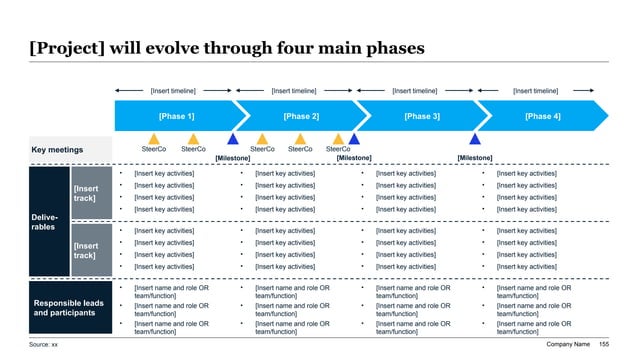
Professional property management proposal timeline slide showing a 4-phase program management matrix with multi-track phase arrows, key milestones, and deliverables.
Template Design LayoutEnterprise Property Management Proposal Templates

2Structuring Property Proposals via Minto's Pyramid Principle

Many real estate proposals fail to win contracts because they bury key value propositions under a sea of operational jargon and administrative details. To maximize impact, corporate strategy teams structure their proposals using Barbara Minto's Pyramid Principle. This communication standard dictates that slides must lead with the conclusion first: every slide headline must state a clear, active recommendation or commercial outcome rather than a passive label. For example, instead of titling a slide 'Transition Schedule,' write 'Our 4-Phase Transition Plan Minimizes Tenant Churn and Secures Operational Stability within 60 Days.' The supporting details, timeline flowcharts, and resource allocation grids must represent mutually exclusive, collectively exhaustive (MECE) sub-arguments that validate the slide's main claim. This narrative discipline ensures that busy board directors, REIT managers, and financial analysts reviewing your deck in under two minutes can extract the complete business case instantly, driving faster decisions and approvals while demonstrating exceptional corporate alignment and visual presentation authority.

3Aligning Operational Strategies with Owner Investment Theses

To win corporate and institutional property management mandates, proposals must demonstrate a clear understanding of the owner's financial objectives and investment thesis. Different owners require different management approaches, and your deck must show how your operational strategy aligns with their specific goals. For instance, a private equity sponsor focused on a value-add strategy requires aggressive lease-up programs, capital improvement execution, and product repositioning to boost Net Operating Income (NOI) for exit. Conversely, a core REIT focusing on long-term capital preservation requires high-touch tenant retention services, preventive maintenance roadmaps, and steady yield preservation. By tailoring your proposal to the owner's investment strategy, you prove that your management firm is a strategic partner rather than a simple service vendor. Outlining this alignment in a structured slide format reassures owners that their assets are managed to maximize cash flow, asset valuation, and long-term equity growth, giving them a clear path to yield stabilization.

4Transitioning Operations via a 4-Phase Management Timeline

The transition of property management control from an incumbent operator to a new management team is a critical phase fraught with operational risks, tenant anxiety, and potential data loss. To mitigate these risks, your proposal must outline a detailed, structured transition roadmap. An advanced multi-track project delivery engine stacks high-level phase arrows, key steering milestones, and workstream deliverables across a timeline. The 4-phase transition matrix covers pre-transition planning, operational takeover, tenant communication, and system integration. During pre-transition, teams audit lease files and vendor contracts. The operational takeover focuses on cash collection and maintenance transitions. Tenant communication mitigates churn, while system integration migrates data to property management software. Visualizing this progression on a structured timeline slide proves to owners that your team possesses the operational discipline required to manage the transition smoothly, preventing administrative delays, safeguarding cash flow from day one, and maintaining absolute operational continuity across all building systems so that there is zero friction for residents and commercial clients. This transition matrix acts as a governance framework, clarifying roles, responsibilities, and key deliverables for all parties involved during this critical operational handoff.

5Securing Income Stability through Strict Tenant Service Standards

Tenant retention is the primary driver of stable cash flow and asset valuation in commercial real estate. To minimize lease churn and maintain high occupancy rates, property management firms must establish strict Service Level Agreements (SLAs) for tenant requests, maintenance, and emergency response. Your proposal deck should outline these service standards clearly to prove operational responsiveness. By defining clear response windows for different categories of issues, you demonstrate a disciplined approach to customer service. The following table outlines standard service level targets that show owners how your team handles maintenance operations:

Service CategoryTarget Response WindowTarget Resolution WindowKey Operational Goal
Emergency MaintenanceLess than 15 MinutesLess than 2 HoursPrevent property damage and ensure safety
Routine Work OrdersLess than 12 HoursLess than 48 HoursMaintain high tenant satisfaction metrics
Tenant Billing InquiriesLess than 24 HoursLess than 3 Business DaysEnsure rent collection and database accuracy
Lease Renewal RequestsLess than 48 HoursLess than 5 Business DaysSecure occupancy stability and lease execution

Presenting these operational metrics in a structured grid signals professional accountability and gives owners peace of mind.

6Preserving Asset Value with Preventive Maintenance Programs

A well-structured property management proposal must detail a proactive approach to preventive maintenance and capital expenditure (CapEx) planning. Deferred maintenance is a major threat to long-term property valuation, leading to emergency repair costs and tenant dissatisfaction. Your presentation should demonstrate how your team audits building systems, schedules routine inspections, and manages vendor relationships to optimize operating costs. By structuring your maintenance roadmap into distinct tracks—such as HVAC servicing, structural inspections, and landscaping—you show owners that you actively protect their physical asset. Furthermore, the proposal should outline how your team assists in planning CapEx budgets, helping owners allocate capital efficiently to maximize property yield. Using clean visual grids to present maintenance schedules proves that your operations are driven by systematic planning rather than reactive fire-fighting, keeping operating expenses predictable, tenant spaces safe, and ensuring the physical plant operates at peak thermodynamic and structural efficiency for many years. Additionally, this proactive model reduces unexpected equipment failure rates by up to thirty percent, significantly extending the lifecycle of major building assets and improving overall property evaluation metrics.

7Maximizing Net Operating Income with Diligent Lease Management

Effective property management relies heavily on rigorous financial administration and timely reporting. Owners must receive accurate monthly statements to monitor cash flow, track operating expenses (OpEx), and evaluate property performance against budgets. Your proposal must outline how your team manages rent collection, lease administration, and financial reporting. Detail your accounts receivable procedures, including automatic late fee enforcement and delinquency management. Furthermore, explain how your team handles annual budget preparation, CAM reconciliations, and property tax audits. Presenting this financial capability to the board shows that you treat the property as a business entity. The list below highlights the core financial reports your team delivers to owners monthly:

  • Monthly Profit & Loss (P&L) Statement** - Detailed breakdown of rental revenue, miscellaneous income, and operational expenses.
  • Rent Roll & Delinquency Report** - Current occupancy status, tenant lease terms, and outstanding balances.
  • Budget vs. Actual Variance Analysis** - Evaluation of monthly and year-to-date performance against the approved business plan.
  • Aged Accounts Payable Ledger** - Summary of outstanding vendor invoices and operating cash distributions.

This financial transparency helps owners make informed asset management decisions, ensuring complete trust.

8Mitigating Operational Risks through Rigorous Regulatory Compliance

Operating commercial real estate involves navigating a complex web of local zoning ordinances, building codes, environmental regulations, and safety standards. A failure in regulatory compliance can lead to costly fines, legal liabilities, or property closures that destroy asset value. Your property management proposal must outline a robust risk management framework. Detail how your team conducts regular safety audits, maintains emergency evacuation plans, and ensures ADA compliance. Furthermore, explain your vendor screening process, requiring all contractors to carry adequate insurance and licensing. Outlining these risk controls in a clean, visual format proves to owners and their legal counsel that your firm prioritizes asset protection. It shows that you have the corporate governance structures in place to handle emergencies, manage insurance claims, and resolve tenant disputes, shielding the property owner from unnecessary liability, preserving corporate reputation, and maintaining full alignment with municipal policies and regulatory steering groups. Having these processes formalized ensures that your properties remain compliant with fire safety, occupational health, and municipal development laws, safeguarding both your capital investment and community goodwill.

9Design Standards for Boardroom-Grade Real Estate Presentations

To maintain a premium, boardroom-grade aesthetic that commands visual authority, your presentation must follow strict design rules. Avoid the common pitfall of crowded layouts by maintaining a 60% dominant background canvas (such as a clean white or light grey), a 30% structured layout grid (using professional slate cards or containers), and a 10% high-contrast accent key (such as a deep corporate blue or warm slate) to highlight key performance metrics, timeline milestones, and fee percentages. Enforce a strict 12-column grid to align all text boxes, charts, and table columns perfectly, avoiding layout drift. Furthermore, keep typography disciplined: slide headings should be 24pt-28pt, subheadings 16pt-18pt, and body text 12pt-14pt, utilizing no more than two professional font families. Protecting at least 30% negative space on every slide lets the content breathe, reducing cognitive load and helping board directors focus on your operational strategy rather than formatting details, ensuring visual excellence across all projectors and digital screens.

10Accelerating Proposal Workflows and Eliminating Design Debt with AI

Drafting property management proposals manually in PowerPoint is a slow, tedious chore, often taking management teams 8 to 12 hours of formatting, grid alignments, and font adjustments. XLSlides AI automates this design process, allowing strategy leads to build premium, widescreen decks in under 60 seconds. The AI performs context-aware layout matching, interpreting your operational brief and automatically mapping text to visual timelines, fee comparison tables, or process flowcharts. Brand consistency is strictly maintained based on your chosen design preset, preventing font or margin drift. The final presentation exports as standard, editable PowerPoint vector shapes, allowing you to easily adjust fee schedules, update timelines, or import custom corporate branding. This design automation frees up property management strategy and leasing teams to focus on tenant acquisition and asset operations rather than wasting hourly resources on layout checks, providing a major efficiency boost to real estate firms and allowing strategy teams to concentrate on commercial scaling.