Public Health Outreach Plan Presentation Template

Stop wasting hours on manual formatting. Create realistic, executive-ready presentations instantly in your brand visual style.

Audience segmentation, priority community, and message strategy layouts
Channel mix, partner activation, resource allocation, and outreach roadmap slides
KPI dashboard, risk controls, equity considerations, and implementation sections

1What Is a Public Health Outreach Plan?

A public health outreach plan explains how a team will reach priority populations, change awareness or behavior, reduce access barriers, and measure health impact. It should connect the health issue, community context, target audience, message strategy, trusted channels, partner roles, field resources, and implementation timeline into one practical campaign story. The deck should not be a generic awareness plan. It should show which communities are prioritized, why they are hard to reach, what action the campaign wants people to take, and how the team will know whether outreach is working. This gives public health leaders, program managers, communications teams, community partners, healthcare providers, funders, policy stakeholders, and field coordinators enough evidence to assess audience fit, equity impact, resource needs, channel effectiveness, behavioral outcomes, implementation risk, partner accountability, and measurement cadence. It keeps decisions grounded in community evidence, health goals, cultural context, operational feasibility, and accountable next actions. The narrative should also define outreach owners, local feedback loops, approval gates, language needs, and adaptation triggers for each community segment.
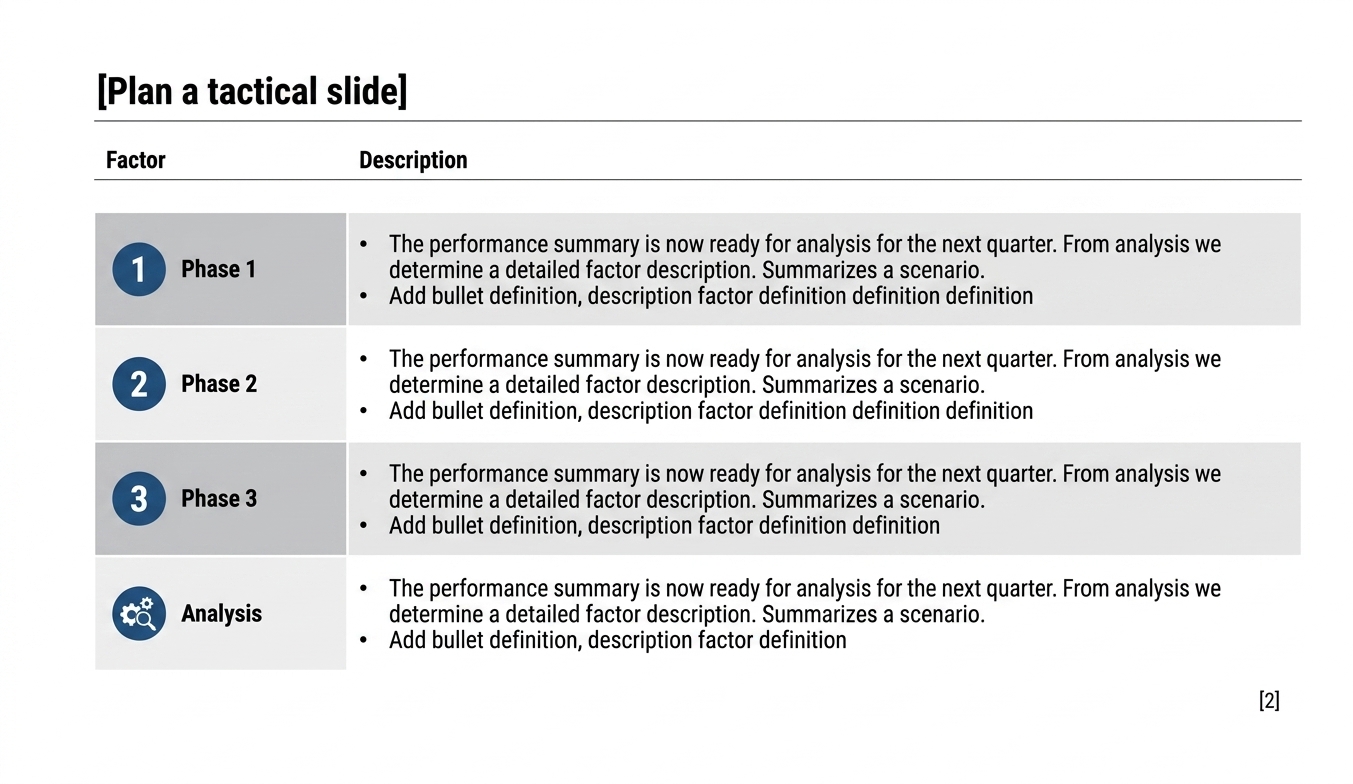
Public health outreach plan slide with banded phase-planning table for community strategy, execution steps, and analysis phase.
Template Design LayoutPublic Health Outreach Plan Presentation Template

2When to Use This Public Health Outreach Template

Use this template when a team needs to plan or present a campaign for vaccination, screening, prevention, maternal health, chronic disease management, mental health awareness, nutrition, sanitation, emergency preparedness, infectious disease response, harm reduction, or community health education. It is useful for agency briefings, grant proposals, partner coordination meetings, hospital community-benefit planning, NGO programs, and field-team implementation reviews. The presentation helps stakeholders understand how outreach activities connect to real behavior and service access, not only impressions or media reach. It should make the target population, barriers, intervention logic, and delivery model explicit. This gives public health leaders, program managers, communications teams, community partners, healthcare providers, funders, policy stakeholders, and field coordinators enough evidence to assess audience fit, equity impact, resource needs, channel effectiveness, behavioral outcomes, implementation risk, partner accountability, and measurement cadence. It keeps decisions grounded in community evidence, health goals, cultural context, operational feasibility, and accountable next actions. The narrative should also define outreach owners, local feedback loops, approval gates, language needs, and adaptation triggers for each community segment.

3Recommended Public Health Outreach Deck Structure

A strong public health outreach deck usually starts with the health problem, target outcome, priority audience, and executive recommendation. It then moves into community segmentation, barriers and motivators, message strategy, channel plan, trusted messengers, partner roles, field operations, resource allocation, risk controls, equity considerations, KPI framework, and rollout roadmap. The structure should help decision makers see the logic from need to action to measurement. Technical epidemiological detail can support the appendix, while the core deck should remain practical enough for campaign teams and partners to execute. This gives public health leaders, program managers, communications teams, community partners, healthcare providers, funders, policy stakeholders, and field coordinators enough evidence to assess audience fit, equity impact, resource needs, channel effectiveness, behavioral outcomes, implementation risk, partner accountability, and measurement cadence. It keeps decisions grounded in community evidence, health goals, cultural context, operational feasibility, and accountable next actions. The narrative should also define outreach owners, local feedback loops, approval gates, language needs, and adaptation triggers for each community segment.

4Audience Segmentation, Barriers, and Community Insight

The audience section should define who the campaign needs to reach and why. Segmentation may consider age, geography, language, income, health status, risk exposure, care access, trust level, digital access, cultural context, and prior engagement with health services. The deck should identify barriers such as misinformation, transportation, cost, stigma, work schedules, fear, low literacy, language mismatch, or lack of trusted providers. It should also show motivators, influencers, and community assets. A strong slide avoids treating the public as one audience and instead shows which groups require different messages and channels. This gives public health leaders, program managers, communications teams, community partners, healthcare providers, funders, policy stakeholders, and field coordinators enough evidence to assess audience fit, equity impact, resource needs, channel effectiveness, behavioral outcomes, implementation risk, partner accountability, and measurement cadence. It keeps decisions grounded in community evidence, health goals, cultural context, operational feasibility, and accountable next actions. The narrative should also define outreach owners, local feedback loops, approval gates, language needs, and adaptation triggers for each community segment.

5Message Strategy, Creative Approach, and Trust Building

The message section should explain what the campaign wants people to understand, feel, and do. Public health messages need to be accurate, culturally relevant, plain-language, and specific to the intended action. The deck should define message pillars, proof points, call to action, tone, language adaptation, creative formats, and review process. It should also identify who the audience trusts, because the messenger can matter as much as the message. Healthcare providers, community leaders, faith organizations, schools, employers, peers, and local advocates may each play different roles. This gives public health leaders, program managers, communications teams, community partners, healthcare providers, funders, policy stakeholders, and field coordinators enough evidence to assess audience fit, equity impact, resource needs, channel effectiveness, behavioral outcomes, implementation risk, partner accountability, and measurement cadence. It keeps decisions grounded in community evidence, health goals, cultural context, operational feasibility, and accountable next actions. The narrative should also define outreach owners, local feedback loops, approval gates, language needs, and adaptation triggers for each community segment.

6Channel Mix, Partner Activation, and Field Operations

The channel section should show how outreach will actually reach people. Options may include community events, clinics, schools, SMS, social media, radio, local newspapers, door-to-door canvassing, workplace sessions, pharmacies, faith-based networks, call centers, mobile units, or partner newsletters. Each channel should have a role, audience fit, cost implication, owner, and expected contribution. Field operations should cover staffing, training, materials, translation, scheduling, referral pathways, data capture, and escalation process. Partner activation should clarify who is responsible for introductions, venue access, credibility, follow-up, and local feedback. This gives public health leaders, program managers, communications teams, community partners, healthcare providers, funders, policy stakeholders, and field coordinators enough evidence to assess audience fit, equity impact, resource needs, channel effectiveness, behavioral outcomes, implementation risk, partner accountability, and measurement cadence. It keeps decisions grounded in community evidence, health goals, cultural context, operational feasibility, and accountable next actions. The narrative should also define outreach owners, local feedback loops, approval gates, language needs, and adaptation triggers for each community segment.

7Resource Allocation, Budget, and Implementation Roadmap

The implementation section should translate outreach strategy into people, budget, materials, partners, and timing. The deck should show which activities happen first, which communities are prioritized, which partners need funding or training, and how resources shift as the campaign learns. Budget categories may include creative development, translation, media, field staff, community grants, events, transport, incentives, data systems, evaluation, and contingency. A phased roadmap helps stakeholders see preparation, launch, expansion, optimization, and closeout activities. It should also show dependencies such as procurement, approvals, partner agreements, staffing, and public health guidance. This gives public health leaders, program managers, communications teams, community partners, healthcare providers, funders, policy stakeholders, and field coordinators enough evidence to assess audience fit, equity impact, resource needs, channel effectiveness, behavioral outcomes, implementation risk, partner accountability, and measurement cadence. It keeps decisions grounded in community evidence, health goals, cultural context, operational feasibility, and accountable next actions. The narrative should also define outreach owners, local feedback loops, approval gates, language needs, and adaptation triggers for each community segment.

8KPIs, Evaluation Design, and Learning Loops

The measurement section should define how the team will track outreach performance and health outcomes. Useful metrics may include reach, frequency, engagement, event attendance, hotline calls, website visits, appointment bookings, screening uptake, vaccination completion, referral follow-through, knowledge change, behavior change, service utilization, and equity of access by segment. The deck should distinguish activity metrics from outcome metrics and define what data will be collected, by whom, and how often. Evaluation should also include qualitative feedback from community partners and field teams. Learning loops are important because outreach plans often need rapid adjustment. This gives public health leaders, program managers, communications teams, community partners, healthcare providers, funders, policy stakeholders, and field coordinators enough evidence to assess audience fit, equity impact, resource needs, channel effectiveness, behavioral outcomes, implementation risk, partner accountability, and measurement cadence. It keeps decisions grounded in community evidence, health goals, cultural context, operational feasibility, and accountable next actions. The narrative should also define outreach owners, local feedback loops, approval gates, language needs, and adaptation triggers for each community segment.

9Risk Management, Equity, and Ethical Considerations

Public health outreach can create risk if it overlooks trust, privacy, stigma, misinformation, or unequal access. The deck should identify risks related to data handling, consent, language access, cultural fit, message misinterpretation, political sensitivity, partner capacity, safety, and service availability. Equity should be treated as an operating requirement, not a statement of intent. The plan should show how outreach will reach underserved groups, remove participation barriers, adapt materials, and monitor whether benefits are distributed fairly. Ethical review may be needed when collecting sensitive information or targeting vulnerable populations. This gives public health leaders, program managers, communications teams, community partners, healthcare providers, funders, policy stakeholders, and field coordinators enough evidence to assess audience fit, equity impact, resource needs, channel effectiveness, behavioral outcomes, implementation risk, partner accountability, and measurement cadence. It keeps decisions grounded in community evidence, health goals, cultural context, operational feasibility, and accountable next actions. The narrative should also define outreach owners, local feedback loops, approval gates, language needs, and adaptation triggers for each community segment.

10How XLSlides Speeds Up Public Health Outreach Planning

XLSlides helps teams convert needs assessments, community research, campaign briefs, partner notes, audience segments, budget assumptions, channel plans, KPI lists, and rollout timelines into a structured public health outreach presentation. The AI workflow can organize the story into health problem, priority audience, barriers, message strategy, channel mix, partner roles, resources, roadmap, risks, equity safeguards, KPIs, and executive decisions. This is useful when health teams have strong program inputs but need a polished deck for agencies, funders, hospitals, community partners, or leadership. The generated output is not a substitute for epidemiological review, community consultation, clinical guidance, or ethics review, but it gives teams a strong working draft. This gives public health leaders, program managers, communications teams, community partners, healthcare providers, funders, policy stakeholders, and field coordinators enough evidence to assess audience fit, equity impact, resource needs, channel effectiveness, behavioral outcomes, implementation risk, partner accountability, and measurement cadence. It keeps decisions grounded in community evidence, health goals, cultural context, operational feasibility, and accountable next actions.