Quantum Computing Industry Impact Presentation Template

Stop wasting hours on manual formatting. Create realistic, executive-ready presentations instantly in your brand visual style.

Quantum use-case prioritization and impact matrix slides
Cryptography, security, and post-quantum transition roadmap visuals
Investment case, ecosystem, and capability readiness layouts for leadership review

1What Is a Quantum Computing Industry Impact Deck?

A quantum computing industry impact deck explains how quantum technologies could change markets, operating models, security assumptions, R&D productivity, and competitive advantage. It should not be a physics lecture or a vendor brochure. The purpose is to help leadership understand which applications matter, when they may become relevant, what risks need preparation now, and where the organization should invest time, partnerships, data, talent, and governance. A strong deck translates technical concepts such as quantum simulation, optimization, sensing, and cryptography into business questions that executives can act on. For example, it may show how route optimization, material discovery, portfolio risk modeling, or post-quantum encryption migration could affect an industry. The best pages are structured around decisions: monitor, experiment, partner, invest, mitigate, or defer. This template helps teams build that decision narrative with clear opportunity sizing, timing assumptions, risk framing, and roadmap logic. This framing keeps the discussion grounded in business decisions, evidence quality, capability gaps, and the next practical action.
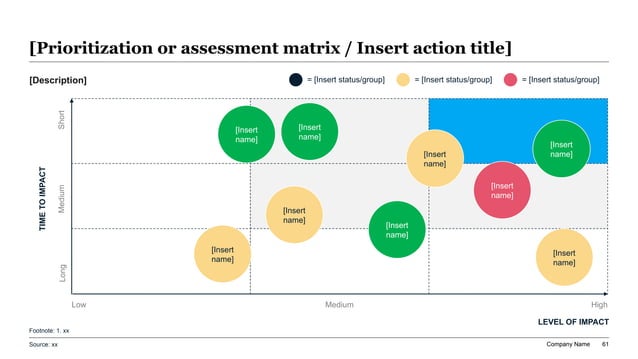
Quantum computing industry impact slide with 3x3 time-to-impact versus level-of-impact matrix and color-coded initiative circles.
Template Design LayoutQuantum Computing Industry Impact Presentation Template

2When to Use This Quantum Strategy Template

Use this template when the audience needs a practical point of view on quantum computing but does not need a deep technical tutorial. Common moments include annual strategy planning, innovation portfolio reviews, board technology briefings, enterprise risk updates, cybersecurity planning, R&D acceleration discussions, and market-entry assessments. It is especially useful when stakeholders are asking whether quantum computing is hype, a near-term priority, or a long-term disruption that still requires preparation today. The deck can also support consulting work where clients need an industry-specific scan of use cases, capability gaps, vendor options, and investment implications. For security leaders, the template frames post-quantum cryptography as a business continuity and data protection issue. For strategy teams, it shows how to compare use cases by value, feasibility, time to impact, and readiness. For investors, it can summarize ecosystem maturity, commercial traction, and adoption risks across the value chain. This framing keeps the discussion grounded in business decisions, evidence quality, capability gaps, and the next practical action.

3Recommended Quantum Industry Impact Deck Structure

A board-ready quantum impact deck works best when it moves from context to choices. Start with an executive summary that states the headline view: which areas are worth action now, which should be monitored, and which remain too early. Follow with a market and technology context page that explains why quantum matters without overloading the audience with science. Then include industry use-case pages grouped by value pool, such as optimization, simulation, cryptography, machine learning acceleration, sensing, or secure communications. Add a prioritization matrix that compares use cases by time to impact and level of impact. Include a readiness assessment covering data, algorithms, workflows, infrastructure, partners, talent, and governance. Add risk pages for post-quantum cryptography, vendor dependency, regulatory uncertainty, and unrealistic timelines. Close with a roadmap that defines experiments, decision gates, partnership moves, budget ranges, and accountabilities. This structure keeps the presentation executive, practical, and action oriented. This framing keeps the discussion grounded in business decisions, evidence quality, capability gaps, and the next practical action.

4Prioritizing Quantum Use Cases by Time and Impact

The most important slide in many quantum strategy decks is the prioritization matrix. It forces the team to move beyond broad excitement and rank use cases by commercial relevance, technical feasibility, and timing. A useful matrix plots potential initiatives against time to impact and level of impact. Near-term high-impact items may include post-quantum cryptography assessment, data inventory, security migration planning, and limited optimization experiments using quantum-inspired methods. Longer-term high-impact items may include materials simulation, drug discovery acceleration, complex supply chain optimization, or financial portfolio modeling. Low-impact or distant use cases should be shown transparently so leadership understands why they are not immediate priorities. Each circle on the matrix should have a clear rationale, not just a label. Include assumptions about hardware maturity, algorithm readiness, integration complexity, and business value. This turns the slide into a decision tool rather than a decorative technology landscape. This framing keeps the discussion grounded in business decisions, evidence quality, capability gaps, and the next practical action.

5Industry Use Cases: Optimization, Simulation, Cryptography, and AI

Quantum computing impact varies sharply by industry, so use-case pages should be specific. In logistics, energy, manufacturing, and telecom, the strongest narratives often involve combinatorial optimization, such as scheduling, network design, fleet routing, or asset utilization. In pharmaceuticals, chemicals, batteries, and advanced materials, quantum simulation may eventually help model molecular interactions that are hard for classical computers. In financial services, potential applications include portfolio optimization, risk analytics, derivatives pricing, and fraud detection, although many remain early. In cybersecurity, post-quantum cryptography is already a practical planning issue because encrypted data captured today may be vulnerable later. AI-related use cases should be framed carefully, distinguishing quantum machine learning research from deployable business tools. The deck should show which use cases are commercially plausible for the target industry, what evidence supports them, and what enterprise capabilities are required before pilots can produce credible learning. This framing keeps the discussion grounded in business decisions, evidence quality, capability gaps, and the next practical action.

6Assessing Readiness Across Hardware, Algorithms, Data, and Talent

Quantum readiness is not only about buying access to a quantum computer. A realistic readiness slide should assess multiple layers: hardware maturity, algorithm availability, data quality, workflow integration, security posture, talent, vendor relationships, and governance. Many organizations can begin useful work before fault-tolerant quantum systems are widely available by mapping cryptographic exposure, training key technical leaders, monitoring standards, and testing quantum-inspired optimization approaches. Other use cases require stronger prerequisites, such as specialized data pipelines, domain scientists, algorithm engineers, and partnerships with cloud or hardware providers. The assessment should clearly separate current capability from required capability. A traffic-light or maturity model can help executives see where gaps are material. The goal is not to claim the organization is quantum-ready today. The goal is to define which actions create optionality, reduce risk, and prepare the enterprise without overcommitting capital too early. This framing keeps the discussion grounded in business decisions, evidence quality, capability gaps, and the next practical action.

7Business Value, KPIs, and Investment Case

Executives will usually ask how quantum computing creates measurable business value. This template helps frame the investment case without pretending certainty is higher than it is. Each priority use case should connect to a value driver, such as lower logistics cost, faster R&D cycles, improved risk modeling, stronger encryption resilience, better asset utilization, or new product capabilities. Where direct financial estimates are uncertain, use ranges and scenarios rather than point forecasts. KPIs can include pilot learning milestones, percent of cryptographic assets inventoried, number of priority workflows assessed, vendor proof-of-concept outcomes, talent trained, standards readiness, and decision gates completed. The business case should also account for opportunity cost. Some activities justify immediate spending because they reduce future migration risk, while others should remain low-cost monitoring items. A disciplined investment slide helps leadership fund the right level of exploration without presenting quantum computing as either instant transformation or irrelevant science. This framing keeps the discussion grounded in business decisions, evidence quality, capability gaps, and the next practical action.

8Risk, Security, and Post-Quantum Cryptography Transition

Post-quantum security deserves its own section because it is one of the clearest enterprise planning needs. Even if broad commercial quantum advantage takes time, cryptographically relevant quantum computers could threaten current public-key encryption in the future. Organizations with long-lived sensitive data, regulated infrastructure, customer trust obligations, or critical systems should understand their exposure now. A strong risk slide maps where encryption is used, which data has long confidentiality life, which vendors and systems depend on vulnerable algorithms, and what migration path is required. It should also explain harvest-now-decrypt-later risk in business terms. The deck can include a phased transition plan: inventory assets, classify data, track standards, update procurement requirements, test post-quantum algorithms, and coordinate with vendors. This makes the security narrative practical. It also prevents the broader quantum strategy from focusing only on upside while ignoring resilience and compliance obligations. This framing keeps the discussion grounded in business decisions, evidence quality, capability gaps, and the next practical action.

9Ecosystem, Partnerships, and Vendor Strategy

Quantum computing is developing through an ecosystem of hardware providers, cloud platforms, software vendors, academic labs, standards bodies, startups, industry consortia, and government programs. A useful ecosystem slide helps leadership decide where to build, partner, monitor, or avoid dependency. For most companies, the right early posture is not to create a large internal quantum lab. It is to identify the few partners that can provide learning access, domain-specific expertise, security guidance, or pilot infrastructure. The deck should compare vendors by maturity, industry relevance, integration model, roadmap credibility, and commercial fit. It should also highlight lock-in risks, data-sharing concerns, intellectual property considerations, and the danger of pilots that demonstrate technology without connecting to an operational decision. A strong partnership strategy defines what the organization wants to learn, which assets it will protect, and what evidence is needed before expanding investment. This framing keeps the discussion grounded in business decisions, evidence quality, capability gaps, and the next practical action.

10Roadmap, Governance, and Decision Gates

A quantum roadmap should be staged because the technology will mature unevenly. The first phase often includes education, opportunity scanning, cryptographic inventory, ecosystem monitoring, and selection of a small number of use cases. The second phase may include targeted proofs of concept, vendor partnerships, security transition planning, and capability building for data, algorithms, and architecture. Later phases can scale validated use cases, integrate new workflows, and make larger capital or operating commitments when evidence improves. Governance matters because quantum activity can otherwise fragment across innovation, security, data science, and business units. A practical roadmap names owners, committees, funding envelopes, and decision gates. Each gate should specify what evidence is required to continue, pivot, or stop. This prevents the program from drifting into endless experimentation and gives leadership a disciplined way to manage uncertainty while preserving strategic optionality. This framing keeps the discussion grounded in business decisions, evidence quality, capability gaps, and the next practical action.

11Prompt Recipe for Better Quantum Strategy Outputs

A strong AI prompt makes the generated deck more useful by giving the model a business problem, audience, scope, and expected slide logic. For this template, start by naming the industry, strategic objective, and leadership audience. Then ask for a quantum computing impact deck that covers market context, priority use cases, time-to-impact mapping, post-quantum cryptography risk, readiness gaps, ecosystem options, investment scenarios, and a phased roadmap. Include the desired tone, such as executive, practical, evidence-led, and non-technical. Specify that the deck should separate near-term actions from long-term opportunities and should avoid overstating certainty. Add any company-specific facts, such as current cybersecurity posture, R&D priorities, supply chain complexity, data sensitivity, or innovation budget constraints. A good prompt turns the output into a strategic working draft instead of a generic quantum overview. It also helps the AI choose slide structures that match executive decision making. This framing keeps the discussion grounded in business decisions, evidence quality, capability gaps, and the next practical action.

12How XLSlides Speeds Up Quantum Impact Planning

XLSlides helps teams move from messy research notes to a structured executive presentation faster. Quantum strategy work often begins with scattered inputs: analyst reports, vendor claims, academic references, cybersecurity concerns, internal innovation ideas, and leadership questions. The AI presentation workflow organizes those inputs into pages that follow a clear decision sequence. It can draft use-case matrices, roadmap slides, readiness assessments, ecosystem comparisons, and risk summaries in a consistent visual system. The result is not a substitute for expert judgment, but it gives strategy teams, consultants, security leaders, and innovation groups a strong starting point for discussion. Users can refine assumptions, replace generic use cases with industry-specific examples, and add evidence from internal teams. This reduces time spent formatting and structuring the deck, allowing more effort to go into the hard questions: what matters, what is credible, and what action is justified now. This framing keeps the discussion grounded in business decisions, evidence quality, capability gaps, and the next practical action.