Nanotechnology Industrial Application Presentation Template

Stop wasting hours on manual formatting. Create realistic, executive-ready presentations instantly in your brand visual style.

Material performance, manufacturing readiness, and application prioritization layouts
IP, regulatory, safety, partnership, and commercialization strategy slides
Scale-up roadmap, economics, KPI, and executive investment decision sections

1What Is a Nanotechnology Industrial Application Deck?

A nanotechnology industrial application deck explains how nano-enabled materials, coatings, particles, films, membranes, additives, sensors, or manufacturing techniques can create measurable industrial value. It should translate scientific capability into business language: what the material does, which performance problem it solves, where it fits in a production environment, and what evidence proves it can scale. The deck should not stop at describing nanotechnology in general. It should connect a specific application to customer pain points, qualification requirements, production constraints, safety controls, intellectual property, and economics. This gives R&D leaders, manufacturing executives, product teams, industrial customers, investors, safety reviewers, and commercialization partners enough evidence to assess technical readiness, market fit, scale-up risk, regulatory exposure, unit economics, IP defensibility, partnership needs, and roadmap sequencing. It keeps decisions grounded in measured performance data, manufacturability, customer validation, operating constraints, and responsible deployment. The narrative should also define evidence owners, qualification gates, partner commitments, risk mitigations, and next experiments before larger funding decisions.
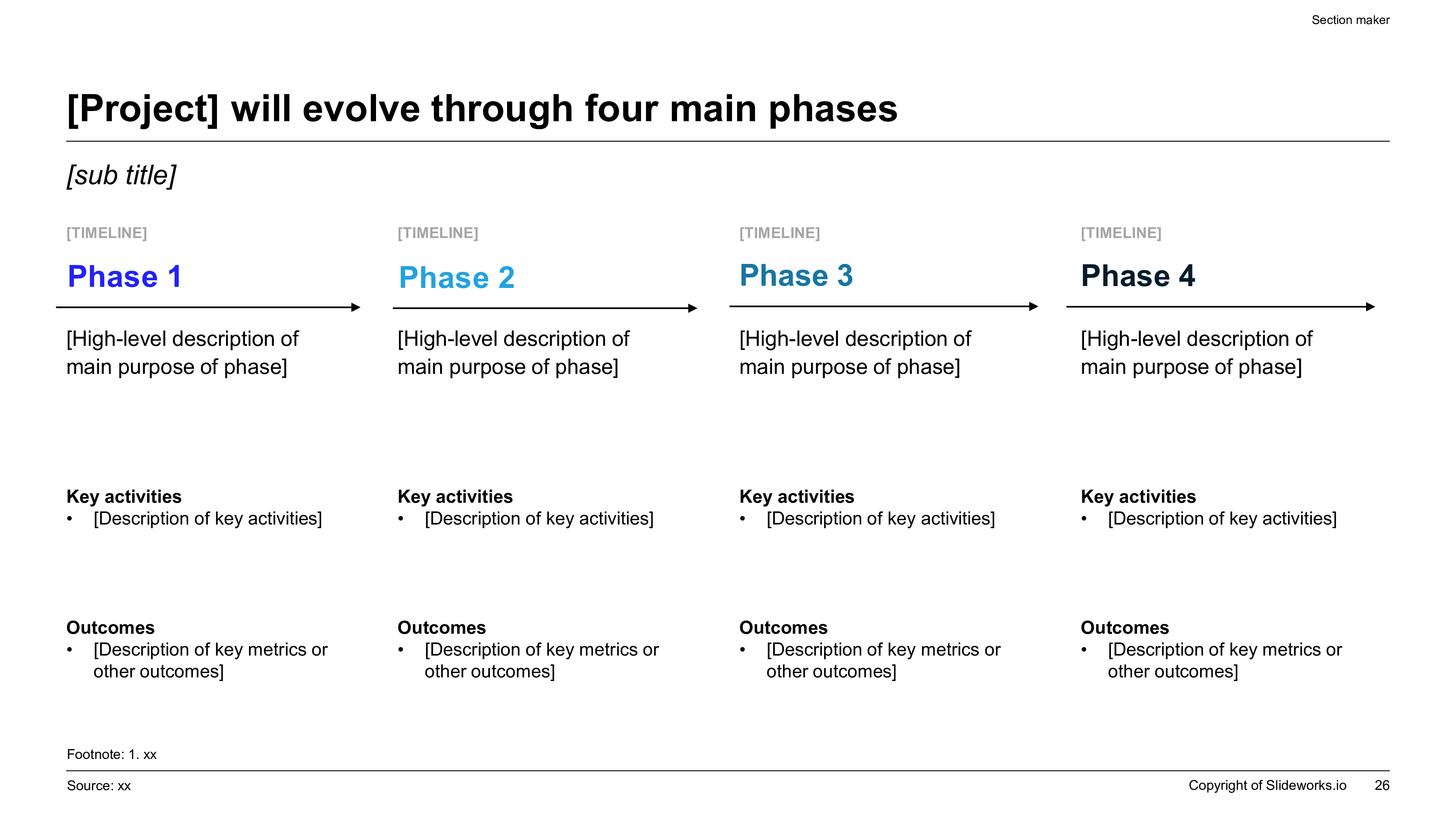
Nanotechnology industrial application slide with four horizontal process phases showing descriptions, key activities, and expected outcomes.
Template Design LayoutNanotechnology Industrial Application Presentation Template

2When to Use This Industrial Nanotechnology Template

Use this template when a team needs to present a nano-enabled technology to executives, manufacturing partners, customers, investors, grant reviewers, or strategic collaborators. It works for applications such as advanced coatings, lightweight composites, conductive films, filtration membranes, nano-additives, antimicrobial surfaces, energy storage materials, medical device coatings, industrial sensors, packaging materials, or high-performance catalysts. The page is especially useful when stakeholders need to compare technical promise against practical adoption barriers. A strong deck should show where the application improves durability, strength, conductivity, corrosion resistance, thermal management, filtration, precision, yield, or cost. This gives R&D leaders, manufacturing executives, product teams, industrial customers, investors, safety reviewers, and commercialization partners enough evidence to assess technical readiness, market fit, scale-up risk, regulatory exposure, unit economics, IP defensibility, partnership needs, and roadmap sequencing. It keeps decisions grounded in measured performance data, manufacturability, customer validation, operating constraints, and responsible deployment. The narrative should also define evidence owners, qualification gates, partner commitments, risk mitigations, and next experiments before larger funding decisions.

3Recommended Nanotechnology Application Deck Structure

A decision-ready nanotechnology deck usually starts with the industrial problem, target application, material mechanism, and proof of performance. It then moves into customer use cases, benchmark comparison, manufacturing process, quality controls, safety and environmental considerations, IP position, partner ecosystem, economics, scale-up roadmap, and executive ask. This structure helps prevent the story from sounding like a science overview without a commercialization path. The best slide flow makes it clear which assumptions are already supported by evidence and which need further validation. Technical details can sit in appendix slides, while the main narrative should stay focused on adoption and investment decisions. This gives R&D leaders, manufacturing executives, product teams, industrial customers, investors, safety reviewers, and commercialization partners enough evidence to assess technical readiness, market fit, scale-up risk, regulatory exposure, unit economics, IP defensibility, partnership needs, and roadmap sequencing. It keeps decisions grounded in measured performance data, manufacturability, customer validation, operating constraints, and responsible deployment.

4Material Performance, Benchmarks, and Proof Points

The performance section should define the nano-enabled property improvement and compare it with incumbent materials or processes. Depending on the application, useful metrics may include tensile strength, hardness, conductivity, thermal stability, surface area, corrosion resistance, permeability, particle dispersion, adhesion, optical behavior, energy density, catalytic activity, or contamination reduction. The deck should explain testing conditions, sample size, repeatability, failure modes, and relevance to real operating environments. A strong slide separates lab performance from customer-ready performance and highlights which benchmarks are still pending. This gives R&D leaders, manufacturing executives, product teams, industrial customers, investors, safety reviewers, and commercialization partners enough evidence to assess technical readiness, market fit, scale-up risk, regulatory exposure, unit economics, IP defensibility, partnership needs, and roadmap sequencing. It keeps decisions grounded in measured performance data, manufacturability, customer validation, operating constraints, and responsible deployment. The narrative should also define evidence owners, qualification gates, partner commitments, risk mitigations, and next experiments before larger funding decisions.

5Target Applications, Customers, and Value Proposition

The application section should prioritize where the technology creates the strongest industrial value. A nano-enabled material may be scientifically impressive, but the deck must show which customer segments care enough to adopt it. Prioritization should consider pain-point severity, willingness to pay, switching cost, qualification burden, production compatibility, competitive alternatives, and time to revenue. The value proposition should connect material properties to business outcomes such as longer asset life, lower weight, better yield, faster processing, improved safety, reduced maintenance, lower energy use, or new product functionality. This gives R&D leaders, manufacturing executives, product teams, industrial customers, investors, safety reviewers, and commercialization partners enough evidence to assess technical readiness, market fit, scale-up risk, regulatory exposure, unit economics, IP defensibility, partnership needs, and roadmap sequencing. It keeps decisions grounded in measured performance data, manufacturability, customer validation, operating constraints, and responsible deployment. The narrative should also define evidence owners, qualification gates, partner commitments, risk mitigations, and next experiments before larger funding decisions.

6Manufacturing Scale-Up and Quality Control

Nanotechnology commercialization often depends on manufacturing repeatability rather than discovery alone. The deck should explain the production route, input materials, equipment needs, process windows, yield assumptions, batch consistency, contamination controls, metrology, and quality assurance steps. It should identify which parameters are sensitive at scale, such as particle size distribution, surface functionalization, dispersion quality, coating uniformity, temperature, humidity, or mixing conditions. Manufacturing leaders will want to understand whether the process can fit existing lines or requires new equipment and supplier relationships. This gives R&D leaders, manufacturing executives, product teams, industrial customers, investors, safety reviewers, and commercialization partners enough evidence to assess technical readiness, market fit, scale-up risk, regulatory exposure, unit economics, IP defensibility, partnership needs, and roadmap sequencing. It keeps decisions grounded in measured performance data, manufacturability, customer validation, operating constraints, and responsible deployment. The narrative should also define evidence owners, qualification gates, partner commitments, risk mitigations, and next experiments before larger funding decisions.

7Safety, Regulatory, and Environmental Considerations

A credible industrial nanotechnology presentation should address safety and environmental questions directly. The deck should summarize handling requirements, worker exposure controls, material stability, lifecycle considerations, waste streams, potential toxicity, regulatory classification, documentation needs, and customer compliance expectations. These topics should be presented as design constraints rather than afterthoughts. Depending on geography and sector, stakeholders may need evidence related to occupational safety, chemical registration, medical device requirements, food-contact rules, environmental release, or product stewardship. A strong slide also explains how safety testing and governance will evolve as production scales. This gives R&D leaders, manufacturing executives, product teams, industrial customers, investors, safety reviewers, and commercialization partners enough evidence to assess technical readiness, market fit, scale-up risk, regulatory exposure, unit economics, IP defensibility, partnership needs, and roadmap sequencing. It keeps decisions grounded in measured performance data, manufacturability, customer validation, operating constraints, and responsible deployment. The narrative should also define evidence owners, qualification gates, partner commitments, risk mitigations, and next experiments before larger funding decisions.

8IP Strategy, Partnerships, and Competitive Position

The IP and ecosystem section should explain what is defensible and what support is required to commercialize. Useful slides may cover patent families, trade secrets, know-how, freedom-to-operate review, licensing options, university or lab relationships, supplier dependencies, contract manufacturing partners, customer co-development, and channel partnerships. Industrial nanotechnology often needs partners for testing, qualification, production, distribution, or regulatory support. The deck should also compare competing materials, substitute technologies, incumbent suppliers, and likely responses from established players. This gives R&D leaders, manufacturing executives, product teams, industrial customers, investors, safety reviewers, and commercialization partners enough evidence to assess technical readiness, market fit, scale-up risk, regulatory exposure, unit economics, IP defensibility, partnership needs, and roadmap sequencing. It keeps decisions grounded in measured performance data, manufacturability, customer validation, operating constraints, and responsible deployment. The narrative should also define evidence owners, qualification gates, partner commitments, risk mitigations, licensing boundaries, ownership, and next experiments before larger funding decisions.

9Economics, Commercialization Roadmap, and KPIs

The economics section should connect technical progress to adoption and financial outcomes. Useful metrics include target unit cost, gross margin, yield, production capacity, qualification cycle time, customer conversion, pilot success rate, durability improvement, maintenance savings, material substitution value, and payback period. The roadmap should show proof-of-concept, prototype validation, customer trials, regulatory or safety review, pilot manufacturing, qualification, launch, and scale-up milestones. Each phase should have clear decision gates and evidence thresholds. Executives need to know what must be true before additional capital, headcount, or partnership commitments are approved. This gives R&D leaders, manufacturing executives, product teams, industrial customers, investors, safety reviewers, and commercialization partners enough evidence to assess technical readiness, market fit, scale-up risk, regulatory exposure, unit economics, IP defensibility, partnership needs, and roadmap sequencing. It keeps decisions grounded in measured performance data, manufacturability, customer validation, operating constraints, and responsible deployment. The narrative should also define evidence owners, qualification gates, partner commitments, risk mitigations, and next experiments before larger funding decisions.

10How XLSlides Speeds Up Nanotechnology Commercialization Planning

XLSlides helps teams convert lab summaries, material specifications, test results, patent notes, customer interviews, manufacturing assumptions, safety considerations, and commercialization plans into a structured nanotechnology application presentation. The AI workflow can organize the story into problem definition, material mechanism, benchmark evidence, target applications, manufacturing readiness, safety and regulatory needs, IP strategy, economics, roadmap, KPIs, risks, and executive ask. This is useful when technical teams have strong evidence but need a polished deck for leadership, investors, customers, or partners. The generated output is not a substitute for lab validation, legal IP review, regulatory assessment, or process engineering, but it gives teams a strong working draft. This gives R&D leaders, manufacturing executives, product teams, industrial customers, investors, safety reviewers, and commercialization partners enough evidence to assess technical readiness, market fit, scale-up risk, regulatory exposure, unit economics, IP defensibility, partnership needs, and roadmap sequencing. It keeps decisions grounded in measured performance data, manufacturability, customer validation, operating constraints, and responsible deployment.