Mining Automation and Operational Efficiency Presentation Template

Stop wasting hours on manual formatting. Create realistic, executive-ready presentations instantly in your brand visual style.

Turn mine operations data, automation use cases, safety priorities, and productivity targets into an executive-ready roadmap.
Explain autonomous haulage, remote operations, predictive maintenance, fleet dispatch, ore flow, and worker safety improvements.
Build slides for mining executives, operations leaders, technology vendors, consultants, investors, and transformation teams.

1What Is a Mining Automation Efficiency Deck?

A mining automation efficiency deck explains how a mine operator, technology vendor, consultant, or investor will improve productivity, safety, and cost performance through automation and digital operations. It should connect operational problems to practical levers: autonomous haulage, fleet dispatch, drill and blast optimization, remote operations, predictive maintenance, sensor coverage, ore flow analytics, safety monitoring, and workforce enablement. The deck usually covers the current operating baseline, pain points, automation use cases, expected benefits, capital requirements, implementation roadmap, operating model, KPIs, risks, and decision gates. The strongest version avoids treating automation as a standalone technology purchase. It shows how process redesign, data quality, equipment readiness, and frontline adoption create measurable value. This gives mine executives, site leaders, technology teams, safety managers, finance reviewers, vendors, and investors enough evidence to assess productivity upside, safety impact, implementation risk, ROI, workforce readiness, and the next approval gate. It also keeps recommendations grounded in mine-plan constraints, shift routines, equipment availability, network coverage, maintenance discipline, and operator adoption before major capital is committed.
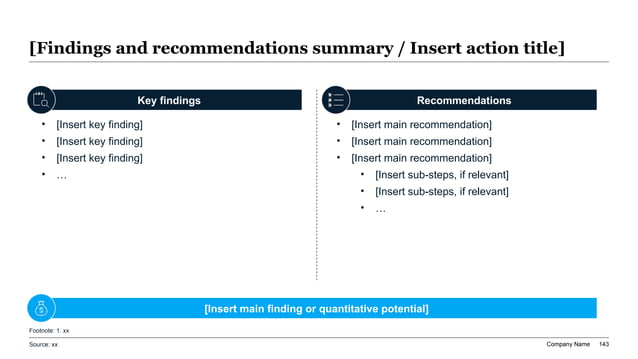
Mining automation efficiency slide with two-column findings and recommendations summary, line icons, and bottom executive callout banner.
Template Design LayoutMining Automation and Operational Efficiency Presentation Template

2When to Use This Mining Automation Template

Use this template when you need to present a mining automation initiative to senior stakeholders who care about both operational impact and execution risk. It works for board updates, mine-site transformation plans, capital committee reviews, vendor sales decks, consulting recommendations, investor presentations, and operations improvement workshops. A mining company can use it to prioritize automation use cases, a vendor can use it to explain its value proposition, and a consultant can use it to structure findings and recommendations. The template is especially useful when audiences need a clear link between technology, mine performance, safety outcomes, and economics. It creates a practical narrative across baseline, bottlenecks, solution options, implementation sequencing, and measurable results. This gives mine executives, site leaders, technology teams, safety managers, finance reviewers, vendors, and investors enough evidence to assess productivity upside, safety impact, implementation risk, ROI, workforce readiness, and the next approval gate. It also keeps recommendations grounded in mine-plan constraints, shift routines, equipment availability, network coverage, maintenance discipline, and operator adoption before major capital is committed.

3Recommended Mining Automation Deck Structure

A strong mining automation deck should begin with the operating baseline: production volume, equipment availability, utilization, cycle time, maintenance downtime, safety incidents, labor constraints, energy use, and unit cost. The next section should identify bottlenecks by value chain step, such as drilling, loading, hauling, crushing, processing, stockpile management, and dispatch. Then the deck should compare automation and analytics use cases, including autonomous haulage, remote operation centers, predictive maintenance, computer vision safety monitoring, fleet optimization, and digital work management. The roadmap should sequence pilots, technology integration, workforce training, governance, and capital decisions. Close with KPI targets, economics, risks, and the executive ask. This gives mine executives, site leaders, technology teams, safety managers, finance reviewers, vendors, and investors enough evidence to assess productivity upside, safety impact, implementation risk, ROI, workforce readiness, and the next approval gate. It also keeps recommendations grounded in mine-plan constraints, shift routines, equipment availability, network coverage, maintenance discipline, and operator adoption before major capital is committed.

4Baseline Performance, Bottlenecks, and Value Drivers

The baseline section should make the performance opportunity specific. Show where production losses occur, which assets constrain throughput, how often equipment is unavailable, where safety risks are highest, and how operating variability affects cost. Useful metrics include tons moved, payload compliance, truck cycle time, queue time, shovel productivity, drill utilization, maintenance backlog, mean time between failures, fuel use, incident rates, and overtime. The deck should separate structural constraints from execution gaps. Automation may not solve poor maintenance discipline, weak dispatch rules, incomplete sensor coverage, or unclear accountability unless those issues are addressed. A clear value-driver tree helps leadership see where automation can actually move the needle. This gives mine executives, site leaders, technology teams, safety managers, finance reviewers, vendors, and investors enough evidence to assess productivity upside, safety impact, implementation risk, ROI, workforce readiness, and the next approval gate. It also keeps recommendations grounded in mine-plan constraints, shift routines, equipment availability, network coverage, maintenance discipline, and operator adoption before major capital is committed.

5Autonomous Haulage, Dispatch, and Remote Operations

Autonomous haulage and remote operations are often central to mining automation strategy. The deck should explain which fleets or areas are candidates, what infrastructure is required, and how dispatch logic will change. Autonomous haulage may improve safety, utilization, fuel efficiency, and consistency, but it also requires road design, communications coverage, maintenance readiness, exclusion zones, operating discipline, and workforce transition planning. Remote operations may improve access to specialist talent and reduce exposure to hazardous environments, but it depends on reliable connectivity, control-room processes, and clear escalation protocols. The deck should show expected benefits, dependencies, and implementation risks by workstream. This gives mine executives, site leaders, technology teams, safety managers, finance reviewers, vendors, and investors enough evidence to assess productivity upside, safety impact, implementation risk, ROI, workforce readiness, and the next approval gate. It also keeps recommendations grounded in mine-plan constraints, shift routines, equipment availability, network coverage, maintenance discipline, and operator adoption before major capital is committed.

6Predictive Maintenance, Sensors, and Equipment Reliability

Equipment reliability is a major source of mining efficiency. The maintenance section should explain how sensors, telematics, condition monitoring, maintenance history, and analytics will reduce unplanned downtime. Predictive maintenance may support earlier failure detection, better component planning, improved parts availability, and more disciplined maintenance windows. The deck should identify which assets matter most, such as haul trucks, shovels, drills, crushers, conveyors, pumps, and processing equipment. It should also explain the data foundation: sensor coverage, alert logic, work-order integration, maintenance accountability, and feedback loops. A credible slide shows how analytics move from signal detection to actual maintenance action. This gives mine executives, site leaders, technology teams, safety managers, finance reviewers, vendors, and investors enough evidence to assess productivity upside, safety impact, implementation risk, ROI, workforce readiness, and the next approval gate. It also keeps recommendations grounded in mine-plan constraints, shift routines, equipment availability, network coverage, maintenance discipline, and operator adoption before major capital is committed.

7Safety Automation, Computer Vision, and Risk Controls

Automation can improve safety only when it is paired with operational controls. The deck should explain how technology will reduce exposure to high-risk work, improve hazard visibility, and strengthen compliance. Use cases may include collision avoidance, fatigue monitoring, restricted-zone detection, proximity alerts, computer vision inspections, geofencing, remote equipment operation, and automated permit workflows. The slide should also discuss false positives, privacy concerns, field adoption, incident escalation, and ownership of corrective actions. Safety managers need confidence that automation will support, not weaken, existing controls. A strong safety section links each use case to a specific risk, control, metric, and operating behavior. This gives mine executives, site leaders, technology teams, safety managers, finance reviewers, vendors, and investors enough evidence to assess productivity upside, safety impact, implementation risk, ROI, workforce readiness, and the next approval gate. It also keeps recommendations grounded in mine-plan constraints, shift routines, equipment availability, network coverage, maintenance discipline, and operator adoption before major capital is committed.

8ROI, Capital Plan, and Operating Economics

A mining automation deck needs a disciplined economics section because capital requirements can be significant. The business case should compare expected productivity gains, labor redeployment, equipment utilization, maintenance savings, fuel savings, safety improvements, and cost per ton against technology investment, infrastructure upgrades, training, integration, and ongoing support. It should separate proven benefits from assumptions and show sensitivity to utilization, commodity price, mine plan, equipment age, and adoption speed. Finance reviewers will want to know which benefits hit EBITDA, which reduce risk, and which require multi-year investment before payback. A clear ROI slide includes baseline, target, investment, benefit owner, timing, and confidence level. This gives mine executives, site leaders, technology teams, safety managers, finance reviewers, vendors, and investors enough evidence to assess productivity upside, safety impact, implementation risk, ROI, workforce readiness, and the next approval gate. It also keeps recommendations grounded in mine-plan constraints, shift routines, equipment availability, network coverage, maintenance discipline, and operator adoption before major capital is committed.

9Implementation Roadmap, Governance, and Workforce Change

The implementation roadmap should sequence automation in realistic waves. Wave one may include site assessment, data cleanup, connectivity review, use-case prioritization, vendor selection, and pilot design. Wave two may deploy pilots for haulage, dispatch, maintenance, or safety monitoring while measuring adoption and operational impact. Wave three may scale across pits, fleets, shifts, or sites with standardized governance and support. Workforce change needs explicit attention: operators, maintainers, supervisors, control-room staff, and safety teams all need training and new roles. The roadmap should show owners, milestones, risks, dependencies, and decision gates. This prevents automation from becoming a technology rollout without operating model change. This gives mine executives, site leaders, technology teams, safety managers, finance reviewers, vendors, and investors enough evidence to assess productivity upside, safety impact, implementation risk, ROI, workforce readiness, and the next approval gate. It also keeps recommendations grounded in mine-plan constraints, shift routines, equipment availability, network coverage, maintenance discipline, and operator adoption before major capital is committed.

10How XLSlides Speeds Up Mining Automation Planning

XLSlides helps mining teams turn site performance data, automation ideas, maintenance metrics, safety priorities, vendor notes, capital assumptions, and transformation plans into a structured executive presentation faster. The AI workflow can organize the story into baseline, bottlenecks, findings, recommendations, use cases, operating model, safety controls, ROI, implementation roadmap, KPIs, risks, and executive ask. This is useful when mine teams have operational substance but need a polished deck for leadership, capital committees, investors, or technology partners. The generated output is not a substitute for engineering design, safety review, vendor diligence, or financial modeling, but it gives teams a strong working draft. This gives mine executives, site leaders, technology teams, safety managers, finance reviewers, vendors, and investors enough evidence to assess productivity upside, safety impact, implementation risk, ROI, workforce readiness, and the next approval gate. It also keeps recommendations grounded in mine-plan constraints, shift routines, equipment availability, network coverage, maintenance discipline, and operator adoption before major capital is committed.