Carbon Capture and Storage Pitch Presentation Template

Stop wasting hours on manual formatting. Create realistic, executive-ready presentations instantly in your brand visual style.

Capture technology, storage site, transport, and value-chain strategy layouts
CO2 economics, policy incentives, project finance, and partner slides
Risk controls, MRV plan, KPI dashboard, and commercialization roadmap sections

1What Is a Carbon Capture and Storage Pitch Deck?

A carbon capture and storage pitch deck explains how a CCS project or technology will capture carbon dioxide, transport it, store it safely, and create economic or climate value. It should connect emissions sources, capture technology, storage geology, infrastructure requirements, policy incentives, customer demand, project finance, monitoring, and risk controls into one credible investment story. The deck should avoid treating CCS as a generic climate solution. It should show why this specific project is technically feasible, commercially attractive, and responsibly governed. This gives investors, industrial emitters, energy developers, infrastructure partners, policy stakeholders, sustainability leaders, project finance teams, and technical advisors enough evidence to assess capture efficiency, storage readiness, permitting risk, unit economics, incentive exposure, partner requirements, MRV credibility, and commercialization sequencing. It keeps decisions grounded in emissions data, technical proof, regulatory context, financing assumptions, and accountable project milestones. The narrative should also define evidence owners, permitting dependencies, partner commitments, financing gates, and verification triggers for each project phase.
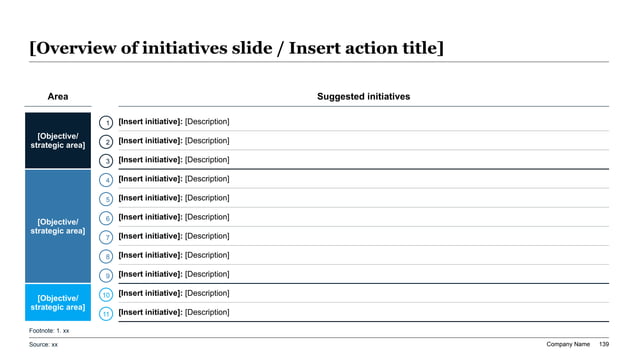
Carbon capture and storage pitch slide with three strategic objective cards and numbered initiatives for CCS project planning.
Template Design LayoutCarbon Capture and Storage Pitch Presentation Template

2When to Use This CCS Pitch Template

Use this template when pitching a carbon capture startup, industrial decarbonization project, hub development, storage asset, capture equipment platform, utilization pathway, grant proposal, infrastructure partnership, or project finance opportunity. It works for cement, steel, chemicals, refining, power, hydrogen, waste-to-energy, direct air capture, and multi-emitter clusters. The presentation is especially useful when stakeholders need to compare technical ambition with real infrastructure constraints. Investors and customers will want to understand capture cost, storage capacity, transport access, permitting path, offtake demand, policy support, and monitoring obligations. This gives investors, industrial emitters, energy developers, infrastructure partners, policy stakeholders, sustainability leaders, project finance teams, and technical advisors enough evidence to assess capture efficiency, storage readiness, permitting risk, unit economics, incentive exposure, partner requirements, MRV credibility, and commercialization sequencing. It keeps decisions grounded in emissions data, technical proof, regulatory context, financing assumptions, and accountable project milestones. The narrative should also define evidence owners, permitting dependencies, partner commitments, financing gates, and verification triggers for each project phase.

3Recommended Carbon Capture Pitch Deck Structure

A strong CCS pitch deck usually starts with the emissions problem, target customer or asset, executive investment thesis, and project recommendation. It then moves into capture technology, source profile, transport and storage model, site readiness, monitoring and verification, policy incentives, customer economics, partner ecosystem, project finance, risk register, roadmap, and funding ask. The structure should make the full value chain visible because CCS success depends on more than capture equipment. Each section should clarify what is proven, what is assumed, and what requires further engineering, permitting, or commercial validation. This gives investors, industrial emitters, energy developers, infrastructure partners, policy stakeholders, sustainability leaders, project finance teams, and technical advisors enough evidence to assess capture efficiency, storage readiness, permitting risk, unit economics, incentive exposure, partner requirements, MRV credibility, and commercialization sequencing. It keeps decisions grounded in emissions data, technical proof, regulatory context, financing assumptions, and accountable project milestones. The narrative should also define evidence owners, permitting dependencies, partner commitments, financing gates, and verification triggers for each project phase.

4Capture Technology, Source Profile, and Performance Proof

The technology section should explain how CO2 is captured, what source stream it targets, and which evidence supports performance. Useful details may include capture rate, purity, energy penalty, solvent or sorbent requirements, modularity, uptime, operating conditions, integration needs, and degradation risk. The deck should compare the technology with incumbent alternatives and identify where performance has been proven in lab, pilot, demonstration, or commercial settings. Source profile matters because CO2 concentration, contaminants, heat integration, and plant operations can materially affect cost and reliability. This gives investors, industrial emitters, energy developers, infrastructure partners, policy stakeholders, sustainability leaders, project finance teams, and technical advisors enough evidence to assess capture efficiency, storage readiness, permitting risk, unit economics, incentive exposure, partner requirements, MRV credibility, and commercialization sequencing. It keeps decisions grounded in emissions data, technical proof, regulatory context, financing assumptions, and accountable project milestones. The narrative should also define evidence owners, permitting dependencies, partner commitments, financing gates, and verification triggers for each project phase.

5Transport, Storage Site Readiness, and MRV Plan

The storage section should explain where captured CO2 will go and how long-term containment will be proven. It should cover pipeline, trucking, shipping, or hub transport options; storage capacity; injectivity; geology; permitting; pore-space rights; well design; operating responsibilities; and liability considerations. Monitoring, reporting, and verification must be visible because buyers, regulators, and investors need confidence that captured carbon is permanently stored or responsibly utilized. The deck should also identify site development milestones, third-party studies, seismic data, baseline measurements, and monitoring technologies. This gives investors, industrial emitters, energy developers, infrastructure partners, policy stakeholders, sustainability leaders, project finance teams, and technical advisors enough evidence to assess capture efficiency, storage readiness, permitting risk, unit economics, incentive exposure, partner requirements, MRV credibility, and commercialization sequencing. It keeps decisions grounded in emissions data, technical proof, regulatory context, financing assumptions, and accountable project milestones. The narrative should also define evidence owners, permitting dependencies, partner commitments, financing gates, and verification triggers for each project phase.

6Customer Economics, Policy Incentives, and Revenue Model

The economics section should connect carbon capture cost to revenue, avoided penalties, credits, offtake agreements, tax incentives, carbon prices, low-carbon product premiums, or corporate decarbonization commitments. The deck should show cost per ton, capex, opex, energy cost, utilization, storage fees, transport cost, incentive eligibility, and sensitivity to uptime or policy changes. For project finance audiences, it should separate contracted revenue from speculative upside. A strong slide explains why a customer or partner would pay now and what policy or market conditions make the project bankable. This gives investors, industrial emitters, energy developers, infrastructure partners, policy stakeholders, sustainability leaders, project finance teams, and technical advisors enough evidence to assess capture efficiency, storage readiness, permitting risk, unit economics, incentive exposure, partner requirements, MRV credibility, and commercialization sequencing. It keeps decisions grounded in emissions data, technical proof, regulatory context, financing assumptions, and accountable project milestones. The narrative should also define evidence owners, permitting dependencies, partner commitments, financing gates, and verification triggers for each project phase.

7Partner Ecosystem, Permitting, and Delivery Model

CCS projects require coordinated partners across emitters, technology providers, EPC firms, transport operators, storage developers, regulators, financiers, insurers, and carbon-credit or offtake buyers. The deck should show which partners are secured, which are under discussion, and which capabilities remain open. Permitting and delivery model slides should clarify approvals, environmental review, interconnection, safety cases, land access, community engagement, procurement, construction, commissioning, and operating handoff. A credible pitch makes dependencies explicit rather than assuming every part of the value chain will be available on schedule. This gives investors, industrial emitters, energy developers, infrastructure partners, policy stakeholders, sustainability leaders, project finance teams, and technical advisors enough evidence to assess capture efficiency, storage readiness, permitting risk, unit economics, incentive exposure, partner requirements, MRV credibility, and commercialization sequencing. It keeps decisions grounded in emissions data, technical proof, regulatory context, financing assumptions, and accountable project milestones. The narrative should also define evidence owners, permitting dependencies, partner commitments, financing gates, and verification triggers for each project phase.

8Risks, Climate Integrity, and Community Considerations

The risk section should address technical, commercial, regulatory, environmental, safety, and reputational issues. Risks may include capture underperformance, higher energy use, storage uncertainty, leakage concern, permitting delay, community opposition, incentive changes, carbon-accounting disputes, construction cost escalation, and offtake weakness. Climate integrity is central because stakeholders need confidence that the project reduces emissions rather than only shifting accounting. The deck should explain residual emissions, lifecycle impact, monitoring controls, safety response, community engagement, and independent verification where relevant. This gives investors, industrial emitters, energy developers, infrastructure partners, policy stakeholders, sustainability leaders, project finance teams, and technical advisors enough evidence to assess capture efficiency, storage readiness, permitting risk, unit economics, incentive exposure, partner requirements, MRV credibility, and commercialization sequencing. It keeps decisions grounded in emissions data, technical proof, regulatory context, financing assumptions, and accountable project milestones. The narrative should also define evidence owners, permitting dependencies, partner commitments, financing gates, and verification triggers for each project phase.

9Commercial Roadmap, KPIs, and Funding Ask

The roadmap should translate the CCS pitch into concrete milestones. It may include feasibility study, pilot operations, source agreements, storage characterization, permits, front-end engineering design, financing, final investment decision, construction, commissioning, injection start, MRV reporting, and scale-up. KPIs should cover capture rate, tons captured, uptime, cost per ton, energy penalty, storage availability, incentive qualification, permits secured, customer contracts, partner commitments, and safety incidents. The funding ask should be tied to specific evidence gaps and value-creating milestones rather than a broad climate ambition. This gives investors, industrial emitters, energy developers, infrastructure partners, policy stakeholders, sustainability leaders, project finance teams, and technical advisors enough evidence to assess capture efficiency, storage readiness, permitting risk, unit economics, incentive exposure, partner requirements, MRV credibility, and commercialization sequencing. It keeps decisions grounded in emissions data, technical proof, regulatory context, financing assumptions, and accountable project milestones. The narrative should also define evidence owners, permitting dependencies, partner commitments, financing gates, and verification triggers for each project phase.

10How XLSlides Speeds Up CCS Pitch Development

XLSlides helps teams convert technical notes, emissions profiles, pilot data, storage studies, policy research, cost models, partner updates, risk registers, and roadmap assumptions into a structured carbon capture and storage pitch deck. The AI workflow can organize the story into emissions problem, capture technology, source profile, transport and storage model, MRV plan, customer economics, policy incentives, partner ecosystem, risks, roadmap, KPIs, and funding ask. This is useful when climate and energy teams have strong inputs but need a polished deck for investors, industrial customers, grant reviewers, or infrastructure partners. The generated output is not a substitute for engineering, legal, permitting, or financial diligence, but it gives teams a strong working draft. This gives investors, industrial emitters, energy developers, infrastructure partners, policy stakeholders, sustainability leaders, project finance teams, and technical advisors enough evidence to assess capture efficiency, storage readiness, permitting risk, unit economics, incentive exposure, partner requirements, MRV credibility, and commercialization sequencing. It keeps decisions grounded in emissions data, technical proof, regulatory context, financing assumptions, and accountable project milestones.