Change Management Communications Plan Presentation Templates

Stop wasting hours on manual formatting. Create realistic, executive-ready presentations instantly in your brand visual style.

Stakeholder impact mapping
Communication timeline roadmaps
Resistance mitigation frameworks

1The Strategic Role of Change Management Communications in Corporate Transformations

In the modern corporate landscape, organizational change is constant, driven by digital transformation, mergers and acquisitions, or strategic pivots. However, the majority of corporate transformations fail to achieve their target objectives, primarily due to employee resistance and communication breakdown. A structured Change Management Communications Plan is not merely an administrative task; it is a critical strategic instrument that translates executive vision into daily operational reality. For management consultants, strategy partners, and corporate HR leaders, this plan serves as the primary mechanism to align stakeholders and minimize productivity loss during transitions. By establishing clear, consistent, and transparent communication channels, organizations can alleviate employee anxiety, build trust, and foster a culture of active participation. When presenting these change strategies to the board of directors or private equity sponsors, utilizing boardroom-ready widescreen slides ensures that your communications roadmap is perceived as rigorous and well-engineered, laying the groundwork for successful execution and sustainable growth.
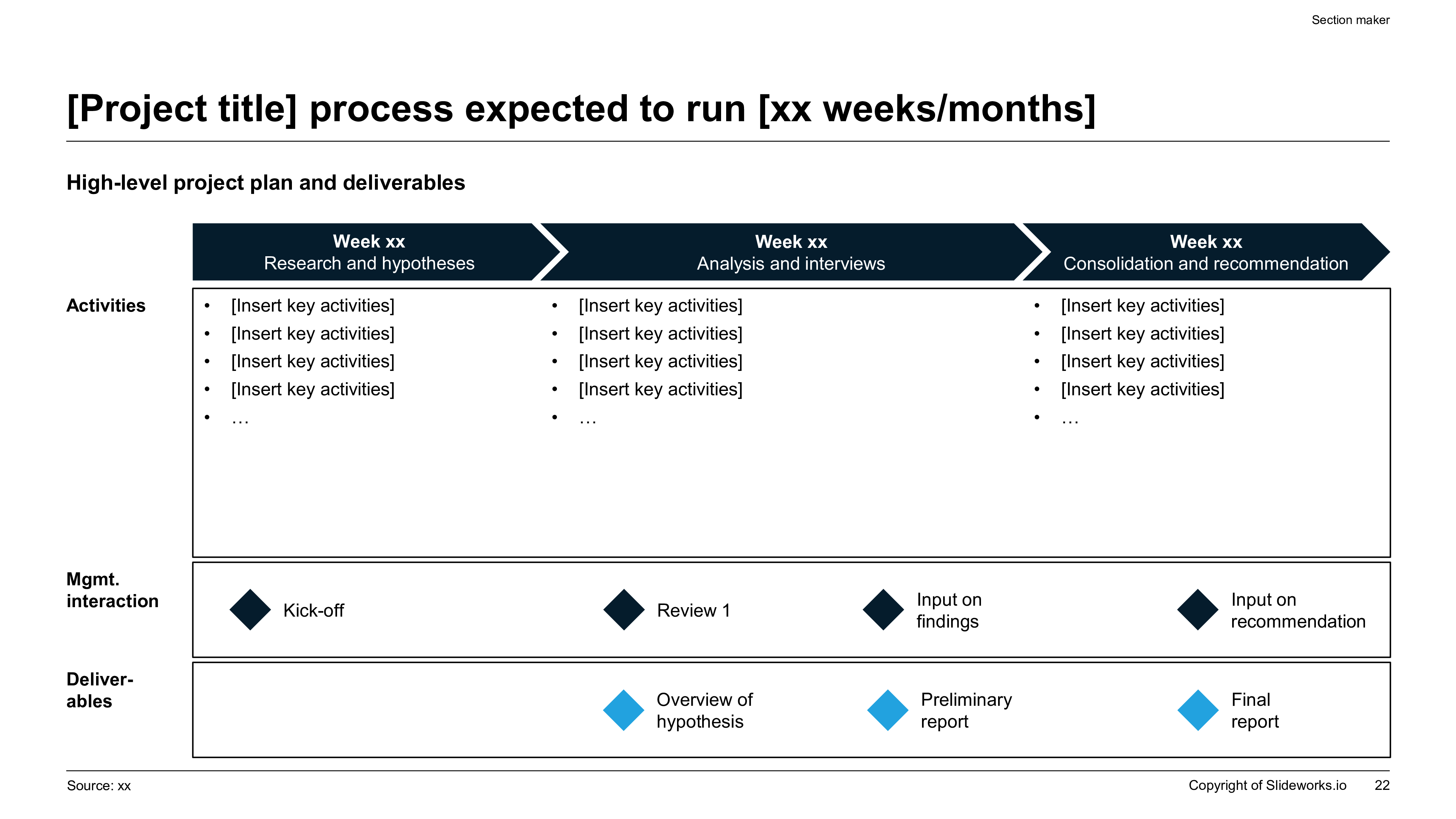
Widescreen change management timeline slide showing a 3-chevron phase-based project plan with weekly lanes mapping key communication milestones and activities.
Template Design LayoutChange Management Communications Plan Presentation Templates

2Applying Barbara Minto's Pyramid Principle to Change Communication Stories

When communicating major organizational changes, strategy teams frequently overwhelm employees with dry, administrative timelines and complex spreadsheets. This approach fails to engage the workforce and increases resistance to change. To create alignment and inspire action, change management consultants should structure their communication deck using Barbara Minto’s Pyramid Principle. This professional communication framework dictates that every slide must lead with the conclusion first: the slide headline must state a clear, active takeaway rather than a passive label. For example, instead of titling a slide "Transition Timeline," use an active headline like "Our 3-Phase Communication Plan Aligns Frontline Teams and Restores Operations in 30 Days." The supporting arguments, stakeholder maps, and channel strategies must represent mutually exclusive, collectively exhaustive (MECE) sub-elements that validate the slide’s main message. This narrative discipline ensures that busy board directors, managers, and employees can digest the key strategic takeaways of your presentation in under ten seconds, accelerating alignment and driving faster consensus across the entire enterprise.

3Mapping Stakeholder Segments Using a MECE Stakeholder Impact Matrix

A successful change communication plan must recognize that different stakeholder groups experience organizational transition in different ways. A one-size-fits-all communication approach inevitably leads to misunderstandings, misalignment, and active resistance. To ensure comprehensive coverage, change leaders must construct a Mutually Exclusive and Collectively Exhaustive (MECE) stakeholder impact matrix. This matrix maps the organization's divisions, assessing each group's level of influence, interest, and the specific impact of the change. By categorizing stakeholders into distinct segments, communication teams can tailor their messages, timing, and channels to address specific concerns. This prevents message fatigue and ensures that critical updates reach the right audience at the right time. For example, while executives require high-level financial and strategic justifications, frontline workers need practical explanations of how their daily tasks will evolve. The following table summarizes a typical stakeholder communication matrix designed for corporate transformations:

Stakeholder SegmentImpact LevelPrimary ChannelCore Message
Executive SponsorsHigh1-on-1 BriefingsStrategic alignment, ROI validation, and milestone updates
Middle ManagersHighInteractive WorkshopsOperational transition plans, role adjustments, and team coaching
Frontline EmployeesMediumTown Halls & EmailsDaily workflow changes, system training, and benefits mapping
External PartnersLowMonthly NewslettersService continuity, contract updates, and integration timelines

By systematizing this process, managers can prevent gaps in alignment and ensure that all resources are directed to the highest-impact areas of the organization, thereby maximizing communication efficiency and minimizing operational friction.

4Designing a Phased Change Communications Timeline Roadmap

Visualizing the transition schedule is crucial for establishing expectations and maintaining organizational discipline during a major change initiative. To present this roadmap clearly to the executive committee, this template utilizes our suggested slide asset, which features a premium widescreen project plan timeline. This layout is structured around three sequential chevron phases representing weekly or monthly stages, mapping out specific activities, management checkpoints, and key milestones. The three phases are:

  1. 1Prepare and Align: Focuses on initial stakeholder briefings, leadership alignment, and drafting core change narratives.
  2. 2Launch and Educate: Covers the official announcement, wide-scale training sessions, and launching feedback loops.
  3. 3Sustain and Embed: Involves monitoring compliance, celebrating quick wins, and embedding new behaviors into corporate culture.

Mapping your communications plan to this structured 3-chevron framework demonstrates operational rigor and provides the board with an intuitive, visual summary of the transformation journey, ensuring complete strategic clarity and reducing layout confusion during high-stakes presentations.

5Developing the Core Narrative for Executive-Level Stakeholder Alignment

C-suite executives, board trustees, and private equity sponsors demand a specific communication style that prioritizes business outcomes over operational details. When presenting a change management communications plan to this group, the core narrative must tie the transformation directly to financial viability, competitive advantage, and strategic growth. Leaders do not want to hear about minor scheduling updates; they want to know how the change communication plan will mitigate operational risks, protect key revenue streams, and accelerate the realization of the investment thesis. The narrative should highlight key metrics like transition budgets, forecasted cost savings, and risk indicators. Frame the communication strategy as an insurance policy that safeguards the organization's human capital and guarantees business continuity. Using clear, data-driven slides and maintaining a professional, analytical tone helps secure quick executive alignment and ensures the necessary budget and resources are approved without delay, paving the way for a successful corporate launch and long-term organizational health.

6Establishing Clear Feedback Channels and Feedback Loops

Communication during a corporate transformation must never be a one-way broadcast; it must be a two-way dialogue that allows employee feedback to flow back to the transition steering committee. Without active feedback loops, leadership remains blind to emerging operational bottlenecks, rising resistance, and communication gaps that can derail the entire project. This change management template guides teams to design and implement structured feedback channels at every stage of the transition roadmap. These channels include anonymous survey tools, Q&A sessions during town halls, and dedicated digital feedback mailboxes. Managers must review these inputs weekly, categorizing comments by department and concern type to identify systemic issues. Presenting a structured summary of employee feedback and the corresponding action plans to the steering board demonstrates proactive leadership and operational control. By actively listening to employee concerns and adjusting communication tactics accordingly, organizations can defuse resistance early, improve employee morale, and build a collaborative transition environment.

7Deploying a Resistance Mitigation Framework for Mid-Level Managers

Middle managers are the critical linchpin of any corporate transformation, serving as the bridge between executive strategy and frontline execution. However, they are also the group most likely to resist change, as they often burden implementing new systems while maintaining daily productivity. A robust change communications plan must dedicate specific resources to support middle managers, turning them from potential blockers into active change advocates. This template outlines a structured resistance mitigation framework that helps HR leaders and department heads identify the root causes of manager resistance, such as fear of job loss, lack of training, or misaligned incentives. By providing managers with tailored toolkits, FAQs, and peer-coaching workshops, you equip them with the skills and confidence to lead their teams through the transition. Visualizing this manager-enablement track on your strategy slides proves to stakeholders that you have addressed the human element of change, ensuring a smoother rollout and higher long-term adoption rates.

8Selecting Key Performance Indicators (KPIs) to Measure Communication Effectiveness

To prove the value of your change communications plan to corporate controllers and private equity investors, you must track and report quantitative performance metrics. Qualitative claims like "employees feel better about the transition" will not satisfy rigorous board reviews. You must measure the reach, engagement, and impact of your communication initiatives using objective Key Performance Indicators (KPIs). These metrics should be tracked weekly and compiled into an operational dashboard slide. For instance, monitoring intranet read rates, training completion percentages, and town hall attendance provides a clear picture of audience engagement. Additionally, regular pulse surveys can track alignment and sentiment trends. The following list highlights the core KPIs that strategy teams should track to measure change communication success:

  • Intranet and Email Read Rates** - Measures the reach and visibility of core change announcements.
  • Pulse Survey Alignment Scores** - Tracks employee understanding of the change's strategic rationale.
  • Training Module Completion Rates** - Measures readiness and skill acquisition for new workflows.
  • Two-Way Feedback Submissions** - Monitors the volume and sentiment of employee questions and concerns.

9Aesthetic and Layout Guidelines for Minimal-Modern Change Presentations

The visual execution of your presentation slides plays a silent but critical role in how your change communications plan is received by the board and employees. This template is designed around our "minimal-modern" style, which projects professionalism, clarity, and modern design principles. The layout follows a strict 60-30-10 color rule: a dominant 60% clean white canvas prevents visual clutter, a 30% slate-grey grid structures content blocks and data tables, and a 10% high-contrast accent key highlights critical milestones and timeline phases. Enforce a strict 12-column grid alignment to prevent layout drift, keeping text boxes, icons, and diagrams perfectly structured. Furthermore, protect at least 30% negative space on every slide to let the design breathe and prevent cognitive fatigue. By maintaining a clean, professional aesthetic, you project competence, ensure readability across all digital screens and projectors, and keep the audience focused on your strategic roadmap rather than design inconsistencies, ensuring your message is delivered with maximum impact.

10Leveraging AI to Automate Presentation Design and Eliminate Formatting Overhead

Designing change management presentations manually in PowerPoint is a notoriously slow, tedious process that often costs strategy teams and HR executives 10 to 14 hours of formatting work. Adjusting text box margins, aligning timeline chevrons, and styling tables manually is an inefficient use of valuable resources. XLSlides AI automates this layout design process, allowing strategy partners to generate premium, boardroom-ready change decks in under 60 seconds. The AI engine performs intelligent, context-aware layout mapping, translating your change narrative and stakeholder tables into structured column cards, chevron timelines, and comparison matrices. Design parameters are automatically locked to your chosen style preset, preventing font or margin drift. The completed presentation exports as fully editable PowerPoint vector shapes, allowing you to easily adjust schedules, customize copy, or import company-specific branding. This automation acts as a massive productivity booster, allowing change leaders to focus on guiding people and managing communication feedback loops rather than wasting hours on formatting slides, ensuring professional excellence at the click of a button.