Account-Based Marketing Plan Presentation Template

Stop wasting hours on manual formatting. Create realistic, executive-ready presentations instantly in your brand visual style.

Tiered account selection and scoring visuals
Buying committee, persona, and message-map layouts
Pipeline, coverage, engagement, and sales alignment dashboards

1What an Account-Based Marketing Plan Needs to Prove

An ABM plan is not a list of target logos or a set of personalized email ideas. It is a revenue operating document that proves why a specific account universe deserves concentrated marketing and sales investment. Executives need to see the logic behind target selection, the buying committee hypothesis, the commercial value of each tier, the engagement model, and the expected pipeline contribution. The deck should make the tradeoff explicit: ABM sacrifices broad reach for higher relevance, stronger account coverage, and deeper sales coordination. A strong opening page states the target segment, expected pipeline impact, account tiering method, investment required, and decisions needed from leadership. This prevents the discussion from drifting into channel tactics before leaders agree on the strategic account focus. The plan should also clarify what the company will stop doing or deprioritize so ABM does not become an unfunded overlay on top of every existing demand program.
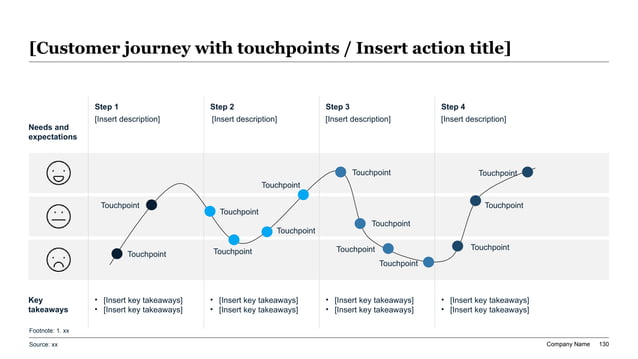
Four-step customer experience matrix slide with sentiment indicators, touchpoint curve, and bottom-row takeaways for ABM journey planning.
Template Design LayoutAccount-Based Marketing Plan Presentation Template

2Who This ABM Template Is Built For

This template is built for B2B teams that need account-based growth plans to survive executive scrutiny. Typical users include CMOs, VP Demand Generation, ABM program owners, revenue operations leaders, enterprise sales heads, account executives, partner marketers, founders, and strategy consultants supporting go-to-market work. It is especially useful when the sales cycle is complex, average contract value is high, buying committees include several roles, and generic inbound marketing does not create enough qualified pipeline. The audience is usually a revenue leadership team or board that wants to know whether marketing spend will produce named-account engagement, pipeline acceleration, expansion opportunity, or improved win rates. The deck should therefore connect every campaign choice to account economics. It should also give sales leaders enough operational detail to commit account ownership, executive sponsorship, and follow-up capacity. When the plan is used in an operating review, it should help each function understand the exact support expected during launch.

3Recommended Slide Flow for an Executive ABM Deck

A decision-ready ABM presentation usually follows a ten-slide structure:

- Slide 1: Executive recommendation with target segment, investment ask, and pipeline ambition.

- Slide 2: ICP definition showing firmographic, technographic, behavioral, and strategic fit criteria.

- Slide 3: Target-account tiering model with account counts, value pools, and coverage logic.

- Slide 4: Buying committee map covering economic buyers, champions, users, blockers, and influencers.

- Slide 5: Account journey and touchpoint plan across awareness, engagement, opportunity creation, and expansion.

- Slide 6: Campaign playbook by tier, including executive events, content, ads, SDR orchestration, and sales plays.

- Slide 7: Sales and marketing operating model with ownership, handoff rules, and governance cadence.

- Slide 8: KPI dashboard tracking coverage, engagement, meetings, pipeline, velocity, win rate, and expansion.

- Slide 9: Budget, capacity, and technology requirements.

- Slide 10: 90-day launch roadmap, risks, decisions required, and next steps.

This sequence keeps the plan commercial, operational, and measurable.

4Target Account Tiering and ICP Scoring Logic

The quality of an ABM plan depends on the quality of account selection. A credible deck should show how accounts are scored and why each tier deserves a different level of investment. Tier 1 accounts might receive one-to-one executive outreach, custom content, and high-touch sales coordination. Tier 2 accounts may receive cluster-based plays by industry, use case, or growth trigger. Tier 3 accounts can receive lighter one-to-many nurture with intent-based routing. The scoring model should combine fit and timing: company size, industry, revenue, technology environment, hiring signals, funding events, product usage, intent data, relationship strength, and account expansion potential. Presenting this logic as a matrix reassures leadership that ABM is not based on wish-list accounts alone. It also helps sales teams trust the program because account inclusion is transparent. The slide should show the cutoff rules for each tier so account swaps do not become political during quarterly planning. It should also name the data owner responsible for refreshing scores.

5Buying Committee Mapping and Message Strategy

Enterprise ABM fails when teams target an account but do not understand the people inside it. The deck should map the buying committee by role, influence, pain point, decision criteria, and likely objection. Common roles include economic buyer, technical evaluator, business sponsor, procurement, legal, finance, end users, and internal champions. Each role needs a message that connects the product to their specific job. For example, a CFO may care about payback and risk, while an operations leader cares about implementation effort and process impact. A strong message map shows role, problem, proof point, content asset, and sales action. This prevents marketing from producing generic thought leadership and helps sales deliver relevant follow-up. The goal is coordinated account progression, not isolated campaign activity. Include trigger events and proof requirements by persona so outreach feels relevant to the account's current business context. This section should also identify where customer stories, ROI proof, or technical validation assets are missing.

6Campaign Plays and Channel Orchestration

ABM campaign planning should show how touchpoints work together across the account journey. A strong executive page distinguishes one-to-one plays, one-to-few plays, and one-to-many plays. It also defines how paid media, direct mail, webinars, executive dinners, thought leadership, SDR outreach, partner co-marketing, and sales-led account planning interact. The orchestration view should answer who receives which touchpoint, in what sequence, with what trigger, and how sales responds. For high-value accounts, the playbook may start with account research, then executive insight content, then tailored outreach, then a workshop or diagnostic offer. For scaled accounts, intent signals may trigger ads, email nurture, and SDR tasks. The deck should make the system visible so leadership can see that ABM is a coordinated motion rather than a collection of disconnected campaigns. It should also identify which plays are reusable and which require custom work. Clear sequencing helps prevent teams from launching channels before sales has the account context needed for follow-up.

7Sales and Marketing Operating Model

ABM only works when marketing and sales share ownership of account outcomes. The operating model page should define planning cadence, account selection rights, campaign ownership, SDR responsibilities, handoff rules, feedback loops, and escalation paths. A useful structure is a RACI table that shows who is responsible, accountable, consulted, and informed for each part of the motion. Marketing may own audience strategy, content, media, and engagement reporting, while sales owns account strategy, relationship mapping, opportunity creation, and follow-up discipline. Revenue operations should own data hygiene, scoring rules, attribution, and dashboard consistency. Without this governance, ABM programs often produce engagement without pipeline. A clear operating model turns the plan into an executable revenue system with visible accountability. The slide should name the weekly and monthly forums where account progress is reviewed and decisions are made. It should also state what happens when sales follow-up or data quality falls below the agreed standard.

8ABM Metrics and Pipeline Economics

Executives will judge the ABM plan by whether it can produce measurable revenue impact. The KPI dashboard should show both leading and lagging indicators. Useful leading indicators include account coverage, contact coverage by buying role, engagement score, intent signals, meeting creation, content interaction, and sales follow-up SLA. Mid-funnel indicators include opportunity creation, pipeline value, stage progression, account penetration, multi-threading depth, and deal velocity. Lagging indicators include win rate, average contract value, sales cycle length, expansion pipeline, retention, and revenue influenced or sourced by the program. Attribution rules should be stated clearly because ABM often influences deals that sales also sources. The economic page should translate activity into pipeline targets, budget assumptions, and expected payback so leadership can evaluate whether the investment is credible. If data quality is weak, the deck should state how reporting will improve during launch. This makes the program measurable before leadership is asked for additional budget.

9Common Pitfalls in ABM Strategy Presentations

The most common mistake is presenting ABM as a campaign tactic instead of a revenue strategy. If the deck does not explain why the selected accounts matter economically, leadership will not trust the plan. The second mistake is targeting too many accounts with too little personalization, which creates the cost of ABM without the relevance advantage. Third, teams often ignore buying committee complexity and produce content for a single persona even though enterprise deals require consensus. Fourth, sales alignment is frequently asserted but not operationalized with cadences, handoff rules, and follow-up standards. Fifth, many ABM decks report engagement without showing pipeline movement. A credible presentation should show account selection logic, orchestration, ownership, and commercial measurement with enough specificity that the revenue team can execute immediately. It should also clarify risks such as low sales adoption, poor CRM hygiene, and insufficient content capacity. Strong plans convert those risks into owners, mitigations, and launch checkpoints.

10Prompt Recipe for Better ABM Plan Outputs

High-quality XLSlides outputs depend on prompts that specify the account universe, buyer roles, commercial objective, and operating model. A strong recipe is: `Build an executive account-based marketing plan deck for a cybersecurity SaaS company targeting 150 enterprise financial services accounts. Segment accounts into Tier 1, Tier 2, and Tier 3 based on revenue potential, technology fit, intent signals, and relationship strength. Map the buying committee across CISO, CIO, procurement, risk, finance, and security operations. Include campaign plays by tier, SDR and AE handoff rules, pipeline KPI dashboard, budget assumptions, and a 90-day launch roadmap for revenue leadership review.` Add any data sources, target segments, or campaign constraints so the first draft matches the actual GTM motion. You can also request specific layouts such as a tiering matrix, buying committee map, journey orchestration view, or pipeline dashboard. Naming the executive audience helps the generated slides emphasize decisions rather than generic marketing education.

11How XLSlides Helps Build ABM Decks Faster

ABM decks are hard to build manually because the content spans strategy, sales operations, campaign planning, account research, budget logic, and performance measurement. Teams often have the data in several places: CRM exports, intent platforms, sales account plans, campaign calendars, website engagement reports, and revenue dashboards. XLSlides helps convert that scattered input into a structured first draft with account tiering pages, journey maps, KPI scorecards, campaign play tables, and operating model slides. The team can then replace placeholders with verified account lists, approved budget numbers, and company-specific sales process details. This approach keeps human judgment in account selection and commercial assumptions while reducing the formatting work that slows GTM planning. It gives revenue leaders a clean PowerPoint-ready starting point for alignment meetings. The result is faster executive alignment without hiding the strategic choices behind generic marketing slides. Teams can reuse the structure every quarter as account tiers, campaigns, and pipeline targets evolve.