5G and 6G Telecom Infrastructure Plan Presentation Template

Stop wasting hours on manual formatting. Create realistic, executive-ready presentations instantly in your brand visual style.

Turn network rollout priorities, spectrum choices, fiber backhaul, and monetization use cases into an executive-ready telecom plan.
Explain 5G densification, private networks, edge integration, 6G readiness, capex tradeoffs, and deployment governance.
Build slides for telecom operators, tower companies, infrastructure investors, enterprise connectivity teams, and strategy consultants.

1What Is a 5G and 6G Telecom Infrastructure Plan?

A 5G and 6G telecom infrastructure plan explains how a carrier, tower company, fiber provider, enterprise, or investor will build the network foundation for next-generation connectivity. It should connect coverage, capacity, latency, spectrum, backhaul, core network, edge infrastructure, and monetization choices into a sequenced plan. The deck usually covers the current network baseline, demand forecast, coverage gaps, spectrum strategy, fiber backhaul, small cell rollout, tower upgrades, private networks, enterprise use cases, capex, operating model, KPIs, and risks. The strongest version avoids treating 5G or 6G as a slogan. It shows what infrastructure must be built, funded, integrated, and commercialized. This gives telecom executives, network planners, enterprise customers, regulators, infrastructure investors, and technology partners enough evidence to assess coverage impact, capex priorities, deployment risk, monetization potential, service quality, and next approval gates. It also keeps decisions grounded in geography, spectrum depth, fiber availability, site permitting, vendor readiness, enterprise demand, regulatory obligations, and measurable rollout economics.
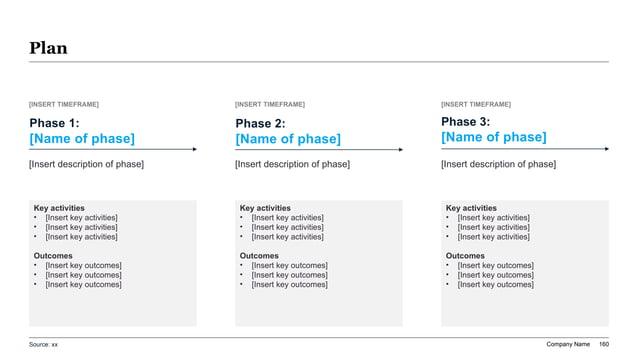
5G and 6G telecom infrastructure plan slide with three-phase horizontal process arrows and dense activity and outcome blocks.
Template Design Layout5G and 6G Telecom Infrastructure Plan Presentation Template

2When to Use This Telecom Infrastructure Template

Use this template when you need to present a network rollout or modernization plan to senior stakeholders. It works for 5G densification updates, standalone core planning, 6G readiness studies, fiber backhaul investment cases, private network proposals, smart-city connectivity plans, tower strategy reviews, enterprise low-latency use cases, and infrastructure investor presentations. A telecom operator can use it to sequence coverage expansion, a tower company can use it to explain site upgrades, and a consultant can use it to structure network transformation recommendations. The template is especially useful when audiences need a clear bridge between technical infrastructure and commercial outcomes. This gives telecom executives, network planners, enterprise customers, regulators, infrastructure investors, and technology partners enough evidence to assess coverage impact, capex priorities, deployment risk, monetization potential, service quality, and next approval gates. It also keeps decisions grounded in geography, spectrum depth, fiber availability, site permitting, vendor readiness, enterprise demand, regulatory obligations, and measurable rollout economics.

3Recommended 5G and 6G Plan Structure

A strong telecom infrastructure deck should begin with the current network baseline: coverage, capacity, latency, traffic growth, spectrum utilization, fiber availability, site density, reliability, and customer experience. The next section should identify gaps by geography, segment, and use case. Then the deck should explain infrastructure levers such as spectrum refarming, radio upgrades, small cells, fiber backhaul, transport modernization, edge nodes, cloud-native core, network slicing, private networks, and automation. The roadmap should sequence phases, capex, owners, dependencies, vendor choices, regulatory approvals, and monetization experiments. Close with KPIs, risks, governance, and the executive ask. This gives telecom executives, network planners, enterprise customers, regulators, infrastructure investors, and technology partners enough evidence to assess coverage impact, capex priorities, deployment risk, monetization potential, service quality, and next approval gates. It also keeps decisions grounded in geography, spectrum depth, fiber availability, site permitting, vendor readiness, enterprise demand, regulatory obligations, competitive pressure, service assurance, and measurable rollout economics.

4Coverage, Capacity, Latency, and Demand Forecasting

The demand section should make the network problem specific. Show where traffic is growing, where coverage gaps persist, where latency limits use cases, and where capacity investments will matter most. Useful dimensions include urban density, suburban expansion, rural coverage, enterprise campuses, transport corridors, venues, industrial sites, ports, hospitals, and public safety areas. Demand forecasting should include consumer data growth, fixed wireless access, enterprise IoT, video, AI workloads, private networks, and emerging 6G scenarios. The deck should separate immediate 5G needs from longer-term readiness bets. It should also identify where customer willingness to pay supports investment. This gives telecom executives, network planners, enterprise customers, regulators, infrastructure investors, and technology partners enough evidence to assess coverage impact, capex priorities, deployment risk, monetization potential, service quality, and next approval gates. It also keeps decisions grounded in geography, spectrum depth, fiber availability, site permitting, vendor readiness, enterprise demand, regulatory obligations, and measurable rollout economics.

5Spectrum Strategy, Radio Access, and Site Deployment

Spectrum and site strategy are central to 5G and 6G infrastructure planning. The deck should explain available spectrum bands, coverage characteristics, capacity tradeoffs, refarming opportunities, auction exposure, and deployment constraints. Low-band, mid-band, and millimeter-wave assets support different coverage and capacity goals. Site deployment may involve macro towers, small cells, indoor systems, distributed antenna systems, neutral host models, and shared infrastructure. The plan should show where permitting, power, backhaul, landlord access, or equipment lead times can slow deployment. It should also explain how radio upgrades and site densification support specific service targets. This gives telecom executives, network planners, enterprise customers, regulators, infrastructure investors, and technology partners enough evidence to assess coverage impact, capex priorities, deployment risk, monetization potential, service quality, and next approval gates. It also keeps decisions grounded in geography, spectrum depth, fiber availability, site permitting, vendor readiness, enterprise demand, regulatory obligations, competitive pressure, service assurance, and measurable rollout economics.

6Fiber Backhaul, Edge Infrastructure, and Core Modernization

Next-generation connectivity depends on transport and core infrastructure, not only radio upgrades. The deck should explain fiber backhaul readiness, fronthaul requirements, transport capacity, edge node placement, data center dependencies, cloud-native core modernization, network slicing, automation, and observability. Low-latency applications need coordinated design across radio, transport, compute, and application layers. The plan should identify where fiber gaps create bottlenecks and where edge infrastructure enables enterprise, industrial, gaming, public safety, or AI-enabled services. It should also show integration risks between legacy systems and new cloud-native platforms. This gives telecom executives, network planners, enterprise customers, regulators, infrastructure investors, and technology partners enough evidence to assess coverage impact, capex priorities, deployment risk, monetization potential, service quality, and next approval gates. It also keeps decisions grounded in geography, spectrum depth, fiber availability, site permitting, vendor readiness, enterprise demand, regulatory obligations, competitive pressure, service assurance, technical resilience, operating readiness, migration sequencing, capacity assurance, and measurable rollout economics.

7Private Networks, Enterprise Use Cases, and Monetization

The monetization section should explain how infrastructure investments create revenue beyond generic connectivity. Use cases may include private 5G for manufacturing, ports, mines, logistics hubs, hospitals, campuses, utilities, smart cities, public safety, autonomous systems, and immersive venues. The deck should define target customers, value proposition, service model, pricing, partnership requirements, and proof points. Enterprise connectivity often needs service-level guarantees, security, edge compute, integration with operational technology, and support models. The plan should separate near-term commercial offers from exploratory 6G scenarios. A strong slide maps infrastructure capabilities to revenue pools and adoption barriers. This gives telecom executives, network planners, enterprise customers, regulators, infrastructure investors, and technology partners enough evidence to assess coverage impact, capex priorities, deployment risk, monetization potential, service quality, and next approval gates. It also keeps decisions grounded in geography, spectrum depth, fiber availability, site permitting, vendor readiness, enterprise demand, regulatory obligations, competitive pressure, service assurance, and measurable rollout economics.

8Capex, Business Case, and Investment Prioritization

A telecom infrastructure plan needs a disciplined capex story. The deck should compare investment needs for spectrum, radio equipment, site acquisition, tower upgrades, small cells, fiber, edge compute, core modernization, software, automation, and operations support. It should show which investments are coverage-driven, which are capacity-driven, and which are tied to enterprise or wholesale monetization. Finance leaders will want sensitivity to traffic growth, customer adoption, regulatory obligations, equipment cost, vendor terms, and competitive response. The business case should connect capex to revenue, churn reduction, service quality, compliance, and long-term option value. This gives telecom executives, network planners, enterprise customers, regulators, infrastructure investors, and technology partners enough evidence to assess coverage impact, capex priorities, deployment risk, monetization potential, service quality, and next approval gates. It also keeps decisions grounded in geography, spectrum depth, fiber availability, site permitting, vendor readiness, enterprise demand, regulatory obligations, competitive pressure, service assurance, funding timing, and measurable rollout economics.

9Implementation Roadmap, Governance, and KPIs

The roadmap should sequence the infrastructure plan in phases. Phase one may include baseline assessment, priority geography selection, spectrum and backhaul review, vendor planning, permitting, and business case approval. Phase two may execute radio upgrades, site densification, fiber builds, edge pilots, private network deployments, and core modernization workstreams. Phase three may scale enterprise services, network slicing, automation, 6G research partnerships, and advanced monetization models. Each phase should define owners, milestones, dependencies, risks, and decision gates. KPIs should include coverage, capacity, latency, uptime, traffic growth, capex efficiency, deployment velocity, enterprise pipeline, service revenue, and customer experience. This gives telecom executives, network planners, enterprise customers, regulators, infrastructure investors, and technology partners enough evidence to assess coverage impact, capex priorities, deployment risk, monetization potential, service quality, and next approval gates. It also keeps decisions grounded in geography, spectrum depth, fiber availability, site permitting, vendor readiness, enterprise demand, regulatory obligations, and measurable rollout economics.

10How XLSlides Speeds Up Telecom Infrastructure Planning

XLSlides helps telecom teams turn network data, rollout notes, spectrum assumptions, capex models, vendor research, enterprise use cases, and strategy inputs into a structured infrastructure presentation faster. The AI workflow can organize the story into baseline, demand forecast, coverage gaps, spectrum strategy, radio rollout, fiber backhaul, edge infrastructure, enterprise monetization, capex, roadmap, KPIs, risks, and executive ask. This is useful when network teams have detailed technical inputs but need a polished deck for leadership, investors, regulators, or enterprise customers. The generated output is not a substitute for radio planning, engineering design, regulatory review, or financial modeling, but it gives teams a strong working draft. This gives telecom executives, network planners, enterprise customers, regulators, infrastructure investors, and technology partners enough evidence to assess coverage impact, capex priorities, deployment risk, monetization potential, service quality, and next approval gates. It also keeps decisions grounded in geography, spectrum depth, fiber availability, site permitting, vendor readiness, enterprise demand, regulatory obligations, and measurable rollout economics.