Legal Tech and AI Automation Roadmap Presentation Template

Stop wasting hours on manual formatting. Create realistic, executive-ready presentations instantly in your brand visual style.

Contract lifecycle, matter intake, and legal operations workflow slides
AI review, knowledge management, and risk-control framework layouts
Vendor strategy, adoption KPIs, governance, and phased rollout roadmap visuals

1What Is a Legal Tech Automation Roadmap Deck?

A legal tech automation roadmap deck explains how a legal function will modernize work intake, contracts, research, document review, knowledge management, compliance workflows, and service delivery. It should connect technology choices to legal quality, attorney adoption, risk controls, and measurable operating improvement. A strong deck avoids treating automation as a generic productivity promise. It shows which legal workflows are repetitive enough to automate, which require attorney judgment, what data and documents are in scope, and how outputs will be reviewed. Common use cases include matter intake, contract lifecycle management, NDA review, obligation tracking, e-discovery, legal research, playbook automation, policy review, and self-service legal support. This discipline keeps the roadmap grounded in legal risk, privilege, workflow complexity, attorney adoption, vendor accountability, measurable cycle-time improvement, and the next approval gate before automation expands across practice groups. That added evidence helps the page stand up in general counsel, legal operations, IT security, procurement, and partner reviews where confidentiality, quality control, user adoption, and budget ownership are scrutinized.
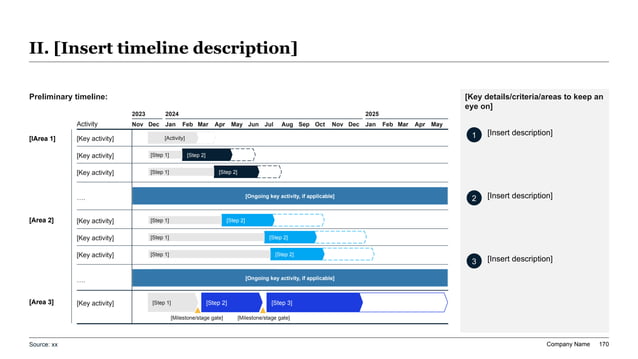
Legal tech automation roadmap slide with layered three-year timeline, workstream bars, milestone markers, and takeaway sidebar.
Template Design LayoutLegal Tech and AI Automation Roadmap Presentation Template

2When to Use This Legal Automation Template

Use this template when a corporate legal team, law firm, legal operations group, compliance function, vendor, or consultant needs to present an automation plan. It is useful for general counsel strategy reviews, legal operations roadmaps, contract lifecycle modernization, AI governance planning, matter intake redesign, law firm innovation programs, vendor selection, and private equity portfolio value creation. The deck is especially helpful when legal leaders know automation is needed but need a structured way to prioritize workflows, manage risk, and secure adoption. Corporate teams can use it to reduce cycle time and outside counsel dependency. Law firms can use it to improve knowledge reuse and delivery consistency. Vendors can use it to explain implementation logic. This discipline keeps the roadmap grounded in legal risk, privilege, workflow complexity, attorney adoption, vendor accountability, measurable cycle-time improvement, and the next approval gate before automation expands across practice groups. That added evidence helps the page stand up in general counsel, legal operations, IT security, procurement, and partner reviews where confidentiality, quality control, user adoption, and budget ownership are scrutinized.

3Recommended Legal Tech Roadmap Structure

A useful legal automation deck starts with the case for change: volume, cycle time, cost, inconsistent intake, contract bottlenecks, knowledge fragmentation, or rising compliance burden. Then map priority workflows by frequency, risk, manual effort, document standardization, stakeholder pain, and automation feasibility. Add a technology section covering CLM, matter management, AI research, document review, e-billing, knowledge systems, workflow tools, and integrations with procurement, finance, HR, CRM, or document repositories. Include AI governance, privilege, confidentiality, human review, and quality controls because legal teams cannot automate without trust. Follow with operating model, vendor strategy, adoption plan, KPIs, and phased rollout. Close with milestones, decision gates, budget, and risks. This discipline keeps the roadmap grounded in legal risk, privilege, workflow complexity, attorney adoption, vendor accountability, measurable cycle-time improvement, and the next approval gate before automation expands across practice groups. That added evidence helps the page stand up in general counsel, legal operations, IT security, procurement, and partner reviews where confidentiality, quality control, user adoption, and budget ownership are scrutinized.

4Prioritizing Contract and Matter Workflows

The roadmap should prioritize workflows where automation produces meaningful value without unacceptable legal risk. Contract workflows may include request intake, NDA generation, clause review, redlining support, approval routing, obligation extraction, renewal alerts, and repository cleanup. Matter workflows may include triage, assignment, status tracking, budget review, outside counsel coordination, and reporting. A prioritization matrix should score workflows by volume, cycle-time pain, risk level, standardization, data availability, stakeholder adoption, and expected benefit. Low-risk high-volume workflows often make the best starting point because they build confidence and generate early savings. High-risk workflows may still be valuable but require stronger review, governance, and attorney oversight. This discipline keeps the roadmap grounded in legal risk, privilege, workflow complexity, attorney adoption, vendor accountability, measurable cycle-time improvement, and the next approval gate before automation expands across practice groups. That added evidence helps the page stand up in general counsel, legal operations, IT security, procurement, and partner reviews where confidentiality, quality control, user adoption, and budget ownership are scrutinized.

5AI Review, Research, and Knowledge Management

AI can support legal work, but the deck should make clear where AI assists rather than replaces legal judgment. Use cases may include first-pass contract review, issue spotting, legal research summaries, matter history search, policy comparison, deposition or discovery review support, playbook guidance, and knowledge retrieval. The roadmap should define approved tools, data boundaries, prompt guidance, output review, citation checking, privilege handling, confidentiality controls, and escalation paths. Knowledge management is often a prerequisite because AI output improves when source material, templates, clause libraries, policies, matter data, and precedent documents are organized. A strong slide should show how AI review connects to attorney workflows and quality standards. This discipline keeps the roadmap grounded in legal risk, privilege, workflow complexity, attorney adoption, vendor accountability, measurable cycle-time improvement, and the next approval gate before automation expands across practice groups. That added evidence helps the page stand up in general counsel, legal operations, IT security, procurement, and partner reviews where confidentiality, quality control, user adoption, and budget ownership are scrutinized.

6Governance, Privilege, Confidentiality, and Risk Controls

Legal automation requires governance that protects privilege, confidentiality, data security, and professional responsibility. The deck should explain which documents and data can be used in each tool, which workflows require attorney review, how outputs are stored, and how access is controlled. Risk controls may include approved vendor lists, data-processing terms, retention rules, audit logs, human review thresholds, model-use restrictions, conflict checks, citation validation, and escalation procedures. For AI tools, the roadmap should distinguish internal approved systems from public tools and define what employees may not upload. Governance should also cover cross-border data, regulated information, client confidentiality, and outside counsel collaboration. This discipline keeps the roadmap grounded in legal risk, privilege, workflow complexity, attorney adoption, vendor accountability, measurable cycle-time improvement, and the next approval gate before automation expands across practice groups. That added evidence helps the page stand up in general counsel, legal operations, IT security, procurement, and partner reviews where confidentiality, quality control, user adoption, and budget ownership are scrutinized.

7Vendor Strategy, Integrations, and Operating Model

Legal tech roadmaps often fail when vendor selection is disconnected from operating model design. The deck should compare vendor options by workflow fit, security posture, AI governance, integration capability, user experience, reporting, implementation burden, pricing, and support model. Integrations may be needed with CLM, document management, email, e-signature, procurement, finance, CRM, HR, matter management, and e-billing systems. The operating model should define who owns workflow design, who manages vendors, who trains users, who reviews outputs, and who monitors performance. Legal operations, IT, information security, procurement, compliance, and practice leaders should have clear roles. This discipline keeps the roadmap grounded in legal risk, privilege, workflow complexity, attorney adoption, vendor accountability, measurable cycle-time improvement, and the next approval gate before automation expands across practice groups. That added evidence helps the page stand up in general counsel, legal operations, IT security, procurement, and partner reviews where confidentiality, quality control, user adoption, and budget ownership are scrutinized.

8KPIs, Business Case, and Adoption Plan

A legal automation roadmap should show how progress will be measured. KPIs may include contract cycle time, intake completion, self-service resolution, outside counsel spend, matter status visibility, review turnaround, template adoption, playbook compliance, legal team capacity, stakeholder satisfaction, and error or escalation rates. The business case should quantify savings, avoided cost, faster revenue support, improved compliance, better reporting, and risk reduction. Adoption planning is essential because attorneys and business users may resist tools that disrupt familiar workflows. The deck should include training, champions, pilot feedback, office hours, updated playbooks, communication, and phased rollout. A clear adoption plan turns technology implementation into behavior change. This discipline keeps the roadmap grounded in legal risk, privilege, workflow complexity, attorney adoption, vendor accountability, measurable cycle-time improvement, and the next approval gate before automation expands across practice groups. That added evidence helps the page stand up in general counsel, legal operations, IT security, procurement, and partner reviews where confidentiality, quality control, user adoption, and budget ownership are scrutinized.

9Implementation Roadmap, Milestones, and Decision Gates

The roadmap should sequence legal automation in phases. Phase one may include workflow assessment, intake redesign, data cleanup, vendor selection, AI policy alignment, and pilot selection. Phase two may launch contract or matter pilots, train users, refine playbooks, integrate systems, and measure early benefits. Phase three may expand across practice groups, automate additional workflows, improve reporting, and formalize governance cadence. Milestones should be tied to evidence, not just dates: adoption rate, cycle-time reduction, review quality, user satisfaction, risk findings, and business stakeholder feedback. Decision gates should define what must be proven before broader rollout. This discipline keeps the roadmap grounded in legal risk, privilege, workflow complexity, attorney adoption, vendor accountability, measurable cycle-time improvement, and the next approval gate before automation expands across practice groups. That added evidence helps the page stand up in general counsel, legal operations, IT security, procurement, and partner reviews where confidentiality, quality control, user adoption, and budget ownership are scrutinized.

10How XLSlides Speeds Up Legal Tech Planning

XLSlides helps legal teams turn workflow notes, vendor research, policy requirements, process maps, and legal operations metrics into a structured automation roadmap faster. Legal tech planning often involves many stakeholders, including general counsel, legal operations, practice leaders, compliance, IT, information security, procurement, finance, and business requesters. The AI workflow organizes those inputs into a clear sequence: case for change, workflow prioritization, AI and automation use cases, governance, vendor strategy, operating model, KPIs, adoption plan, and roadmap. The output is not a substitute for legal review, security assessment, or vendor diligence, but it gives teams a strong working draft for leadership discussion. This discipline keeps the roadmap grounded in legal risk, privilege, workflow complexity, attorney adoption, vendor accountability, measurable cycle-time improvement, and the next approval gate before automation expands across practice groups. That added evidence helps the page stand up in general counsel, legal operations, IT security, procurement, and partner reviews where confidentiality, quality control, user adoption, and budget ownership are scrutinized.