Product Launch Deck Takeaways
- A serious product launch deck is a go-live decision document, not a feature parade or a campaign recap.
- The best launch presentations show what is launching, for whom, why now, what could break, and who owns the response if the first wave misses.
- Action titles, readiness evidence, cross-functional sequencing, and post-launch metrics matter more than visual excitement.
- AI should accelerate the first structured draft, but launch timing, message truth, and risk acceptance still require human judgment.
Launch Decision Snapshot Reference
Direct Answer: What A Product Launch Deck Must Accomplish
A product launch deck should help leadership decide whether the company is ready to put a product, feature, pricing change, or market expansion in front of customers. That sounds obvious, but many launch presentations do something weaker. They summarize the roadmap, show campaign assets, list release notes, or celebrate internal progress without proving that the launch is commercially and operationally sound.
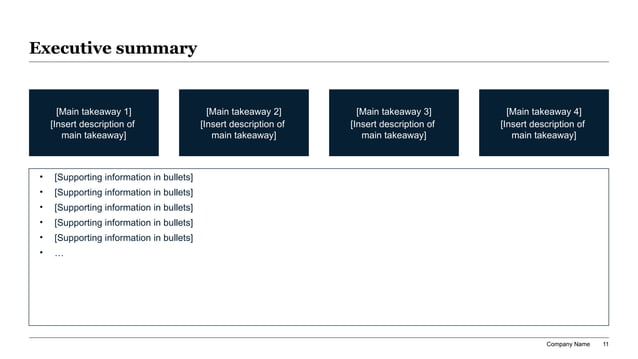
An executive-ready launch presentation needs to answer five questions quickly. What customer problem or commercial opportunity justifies this launch? Which audience is the first wave built for? What evidence supports the message, timing, and channel choice? Which dependencies remain open across product, sales, marketing, support, legal, analytics, or operations? What exact decision or commitment is leadership being asked to make today?
That framing makes the launch deck different from a broader go-to-market strategy presentation. A GTM deck may still be debating the segment, pricing architecture, or route-to-market design. A product launch deck is usually closer to execution. It translates a chosen strategy into a credible release story, a launch calendar, a readiness checkpoint, and a set of metrics that prove the release is working after it leaves the building.
Inputs To Lock Before You Turn Launch Notes Into Slides
Product Launch Deck Vs. GTM Deck Vs. Sales Kickoff Vs. Release Notes
These assets often get mixed together. The launch deck should clarify the go-live decision, not replace every adjacent document.
| Asset | Primary Question | Typical Audience | Common Failure Mode |
|---|---|---|---|
| Product launch deck | Are we ready to launch this offer, to this audience, with this evidence and this operating plan? | CEO, CPO, CMO, CRO, launch lead, support lead | Looks polished but hides open dependencies and unclear ownership |
| Go-to-market strategy deck | What segment, value proposition, pricing, and route to market should we choose? | Founders, PMM, strategy, revenue, board observers | Treats launch execution as if the strategic choices are already resolved |
| Sales kickoff or enablement deck | How should the field position, demo, objection-handle, and sell the launch? | AEs, AMs, sales managers, enablement | Assumes the executive launch rationale has already been translated for the field |
| Release notes or product update pack | What changed in the product and how should users use it? | Customers, users, support, CS | Explains features without proving the business reason for launch timing or scope |
Why Launch Presentations Fail Even When The Product Is Ready
Many launch decks fail because the team confuses output volume with readiness. Product adds feature lists, marketing adds assets, sales adds talk tracks, and operations adds dates. The deck gets longer, but the executive question remains unanswered: is the company ready to expose this product to a real market with a clear promise and a credible support model?
Another failure mode is leading with internal pride instead of external change. The slides celebrate shipping effort, engineering complexity, or visual brand work, but they never show what the buyer will understand faster, what the seller can now say with confidence, or what the customer-success team is prepared to support on day one. Senior readers care about behavior, not effort.
The third problem is that launch risk is often written as a footnote. Security approvals, analytics instrumentation, pricing-page updates, sales objection handling, migration edge cases, and support training are all treated as side issues. In practice, those details determine whether the launch creates momentum or rework. The deck should make them visible without turning into a project dump.
Launch Readiness And Stage-Gate Reference
Treat The Deck As A Cross-Functional Contract, Not A Marketing Artifact
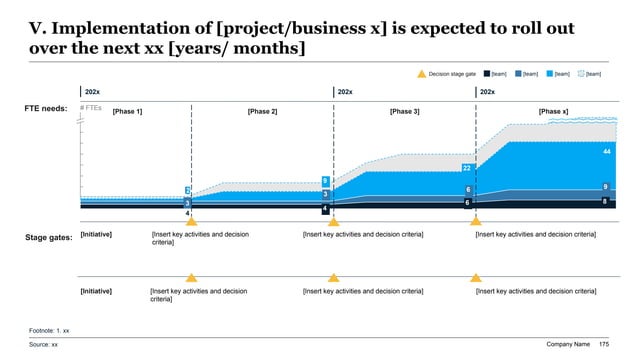
A good launch deck behaves like a shared contract between functions. Product needs the story to match what is actually shipping. Marketing needs a message that the product can support. Sales needs a positioning story that does not overpromise. Customer success and support need to know what questions will hit them first. Finance and leadership need to understand what success looks like and what additional spend the launch requires.
That means the deck should expose decisions, tradeoffs, and ownership. It should show which audience gets the first wave, which use cases are intentionally not in scope, what proof supports the claim, and what happens if adoption is slower or support tickets spike faster than planned. This is why launch decks deserve more rigor than a typical campaign recap. They coordinate the moment when multiple teams become publicly accountable for the same promise.
For XLSlides, this is a strong workflow fit. Launch teams usually have source material scattered across product briefs, planning docs, Slack threads, pilot notes, support concerns, pricing drafts, and campaign calendars. The useful AI job is to turn that mess into a first-pass deck structure with answer-first titles, workstream logic, and editable PowerPoint-style pages that humans can pressure-test before launch.
Recommended 12-Slide Product Launch Deck Sequence
A launch deck should move from launch thesis to proof, readiness, and explicit approval asks.
| Slide | Purpose | Executive Question Answered |
|---|---|---|
| Launch summary | State the audience, promise, timing, and approval ask | What are we launching and what decision is needed now? |
| Why now | Explain the market trigger, customer pain, or release window | Why should we launch at this moment? |
| Target audience | Show the first-wave segment and user job to be done | Who is the launch really for? |
| Value proposition | Translate product capabilities into customer and commercial outcomes | Why will the audience care? |
| Proof points | Use beta data, pilot results, interviews, or usage evidence | What evidence says this will work? |
| Competitive context | Clarify where the launch is differentiated or late | How does this compare with alternatives? |
| Commercial model | Show pricing, packaging, eligibility, or expansion path if relevant | How will the launch make money or protect revenue? |
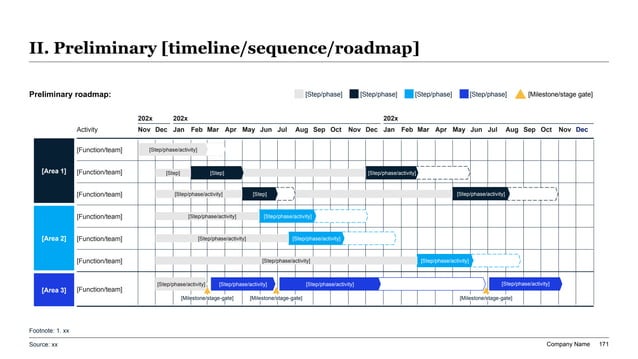
| Launch plan and channels | Map key dates, channels, and launch motions | How will the market hear about it? |
| Readiness and dependencies | Surface open risks, dependencies, and mitigations | What could delay or damage the launch? |
| Field and support enablement | Show what sellers, support, and CS will have before go-live | Can the operating teams carry the promise? |
| Success metrics | Define week-one, month-one, and quarter-one launch KPIs | How will we know the launch is working? |
| Decision and next steps | Request approval, scope changes, or resource commitments | What should leadership approve today? |
Prompt Recipe For An Executive Product Launch Deck
Create a 12-slide product launch deck for an executive audience. Audience: CEO, CPO, CMO, CRO, support lead, and finance partner. Context: the team is launching a new workflow product to a defined first-wave customer segment and needs approval on timing, messaging, launch channels, readiness status, and post-launch metrics. Include an answer-first launch summary, why-now framing, target audience, value proposition, proof points from pilots or beta usage, competitive context, pricing or packaging implications, launch calendar, readiness and dependency heat map, field and support enablement, KPI scorecard, top risks, and explicit go-live decision asks. Use consulting-style action titles, MECE structure, and editable PowerPoint-ready layouts rather than decorative AI slides.
Cross-Functional Launch Roadmap Reference
What Belongs In The Main Story, Appendix, And Field Pack
Keep the executive launch deck tight by separating approval content from supporting detail and field enablement assets.
| Content Type | Main Launch Story | Appendix Or Separate Asset |
|---|---|---|
| Pilot proof | One page with the most decision-relevant signal and caveats | Detailed experiment logs, user comments, and raw screenshots |
| Readiness risk | Top open dependencies with owner and mitigation | Full ticket list, project-plan dumps, and sub-workstream status tables |
| Pricing or packaging | What customers will see now and why it supports launch goals | Every historical pricing option or internal scenario tab |
| Sales enablement | Field-readiness summary and what assets will exist by launch | Full talk tracks, objection libraries, demo scripts, and manager coaching notes |
| Support readiness | Escalation model, training status, and top expected issue types | Complete internal SOPs or all help-center drafts |
| Metrics | A short KPI stack with thresholds and owners | Every operational dashboard field or long analytics schema list |
Write Action Titles That Force The Team To State The Real Bet
Launch decks get much sharper when the titles stop behaving like folder names. A weak slide says Product Overview, Launch Plan, Competitive Landscape, or Metrics. A strong slide says the first launch wave should target existing enterprise customers before paid acquisition, beta usage proves onboarding speed is the differentiator, or support is ready for launch if migration tickets stay below the defined threshold. Those titles force the team to state the bet and its conditions.
That matters because launch work usually contains hidden disagreements. Product may think the story is about innovation. Marketing may think it is about category language. Sales may want a broader audience. Support may want a narrower scope. Writing action titles exposes those conflicts early because each title becomes a claim that someone can challenge.
This is also where AI is useful in a narrow way. It can turn raw section labels into stronger conclusion-style drafts. But the team still needs to decide whether the sentence is true, whether the evidence really proves it, and whether the implied risk tolerance is acceptable. Titles are not just copy. They are compressed management judgment.
Short Answers For Product Launch Owners
What should be on the first slide of a product launch deck?
The first slide should state what is launching, for which audience, why it matters now, what proof supports the launch, and the exact approval or decision leadership is being asked to make.
How is a product launch deck different from a product roadmap presentation?
A roadmap presentation explains what is being built over time. A launch deck explains why a specific release should go live now, which audience gets it first, which teams are ready, and how success will be measured after launch.
How many slides should an executive product launch presentation have?
Most serious launch decks work in roughly 10 to 12 core slides plus appendix detail. The number matters less than whether each page answers a real launch decision question.
Can AI create a credible first draft of a product launch deck?
Yes, if the source material includes real launch inputs such as audience choices, pilot proof, launch dates, pricing implications, channel plans, and open risks. Human owners still need to validate the message, the readiness call, and the launch thresholds.
Launch Timing And Product Life Cycle Reference
Signals Your Launch Deck Still Sounds Internally Focused
Launch KPI Stack And Evidence Standards
The right metrics depend on launch type, but the deck should show how adoption, quality, and commercial performance will be judged.
| KPI Layer | Examples | Evidence Standard |
|---|---|---|
| Readiness before launch | Training completion, asset completion, instrumentation coverage, open critical defects | Show owner, cutoff date, and what blocks launch if the threshold is missed |
| Launch awareness | Email engagement, webinar registrations, landing-page conversion, partner sign-ups | Tie awareness metrics to the target audience rather than broad traffic volume |
| Activation and adoption | Trial start rate, onboarding completion, first key action, first weekly active use | Define the event and the time window clearly so adoption is not overstated |
| Commercial quality | Pipeline created, conversion rate, expansion demand, average contract value, price realization | Separate real bookings or qualified pipeline from softer interest signals |
| Support and customer quality | Ticket volume, escalation rate, implementation delay, churn risk, NPS or CSAT movement | Show both the level and the threshold that triggers intervention |
| Decision cadence | Week-one review, day-30 readout, day-90 scale-or-reset checkpoint | Name the owner and the corrective action path if the KPI misses |
Metrics Should Prove Adoption, Readiness, And Commercial Quality
Launch teams often over-index on attention metrics because they arrive first and look flattering. Visits, sign-ups, downloads, and webinar registrations can be useful, but they are not enough on their own. A serious launch deck should show the operating chain from awareness to activation to commercial outcome. If people show up but do not activate, the message or onboarding may be wrong. If they activate but do not buy or expand, the value proposition, pricing, or audience choice may be wrong.
The most useful launch KPI section also names the thresholds that change management behavior. For example, if onboarding completion falls below a set level, the team pauses outbound spend and fixes the activation path. If support escalations exceed the defined band, the next wave narrows. If a pricing experiment produces strong activation but weak conversion, the commercial page needs revision. Metrics are useful when they trigger action, not when they merely decorate the appendix.
This is another place where the launch deck should remain more disciplined than a generic product update. Senior leaders want to know how the company will learn fast after go-live. The deck should make that review cadence visible so the launch feels like a managed experiment rather than a one-time announcement.
Competitive Context And Differentiation Reference
Action-Title Rewrite Matrix For Product Launch Slides
The title should tell leadership what to conclude from the page, not just what topic the page covers.
| Weak Topic Title | Conclusion-Style Rewrite | Why The Rewrite Works |
|---|---|---|
| Launch plan | Wave one should prioritize existing customers before broad paid acquisition | It makes the sequencing choice explicit |
| Target audience | Mid-market ops leaders are the fastest route to credible first-use proof | It states who matters first and why |
| Product overview | The launch wins because it removes weekly reporting friction without new admin work | It converts features into user value |
| Proof points | Pilot usage shows onboarding friction is low enough for a July go-live | It ties evidence to a launch decision |
| Risks | The launch should stay in controlled rollout until support macros and legal FAQs are complete | It links the risk to a concrete operating action |
| Next steps | Leadership needs to approve scope, spend, and success thresholds before release freeze | It makes the approval ask unavoidable |
XLSlides Resources For Launch Planning, Messaging, And Review Packs
What AI Should Automate In A Launch Workflow And What Leaders Must Still Own
AI is useful in launch work because the source material is fragmented and time-sensitive. It can absorb a launch brief, beta notes, pricing snippets, release milestones, support concerns, campaign dates, and meeting notes, then propose a cleaner narrative, stronger section titles, and a slide-level outline. That saves the team from spending its last pre-launch week formatting slides instead of pressure-testing the message.
What AI should not own is the final launch call. It cannot judge whether the pilot evidence is representative enough, whether the product is stable enough for a broader wave, whether the sales team can honestly sell the promise, or whether the support function can absorb the likely ticket load. Those are management decisions because they define how much operational and reputational risk the company is taking.
The right operating model is therefore draft fast, review hard. Use AI to compress the first assembly step, convert rough notes into a better executive structure, and create editable PowerPoint-style output. Then let the product lead, PMM, revenue lead, and support owner make the final judgment on message truth, launch timing, scope control, and escalation thresholds.
Immediate Next Steps And Owner Hand-Off Reference
Build The Launch Deck In XLSlides
Use XLSlides to turn launch briefs, pilot notes, rollout calendars, pricing updates, support concerns, and field-readiness inputs into an editable product launch deck with action titles, launch sequencing, KPI logic, and a clearer go-live decision path.
Generate Launch Deck