Direct Answer: What A Go-To-Market Strategy Presentation Must Do
A go-to-market strategy presentation is not a launch pep talk. It is the working document that explains where the business will win, which buyers matter first, why the offer is meaningfully better, how demand will be created, which channels will carry the motion, what the economics look like, and what the executive team needs to approve before money is committed.
That makes the deck fundamentally different from a generic product launch slide pack. A serious GTM deck needs to connect market selection, value proposition, pricing, enablement, and rollout sequencing into one answer-first story. If product wants one segment, sales wants another, and finance cannot see how payback works, the presentation has failed even if the slides look polished.
For founders, product marketers, and revenue leaders, the real standard is simple: can a skeptical executive read the titles, scan the exhibits, and understand the bet, the proof, the risks, and the immediate actions? If not, the team does not have a decision-ready GTM plan yet. That is why this page focuses on structure, evidence, and review discipline rather than generic launch inspiration.
Key Takeaways
- A GTM presentation should show the market bet, the buyer logic, the offer, the route to demand, and the execution sequence in one coherent narrative.
- The strongest GTM decks use conclusion-style titles, segment-specific evidence, and clear economic assumptions instead of broad launch language.
- AI is valuable for drafting structure, headlines, and first-pass page layouts, but human leaders still need to decide the segment choice, pricing tradeoffs, and approval asks.
- XLSlides fits this workflow when the team needs an editable PowerPoint-style first draft rather than a decorative browser-only presentation.
Go-To-Market Deck Vs. Launch Plan Vs. Sales Kickoff Vs. Board Update
These artifacts often appear in the same program, but they do different jobs. Confusing them is one of the fastest ways to weaken executive alignment.
| Artifact | Primary Question | Typical Audience | Common Failure Mode |
|---|---|---|---|
| Go-to-market strategy presentation | What market bet are we making and how will we win it? | CEO, CRO, CMO, product leader, strategy lead, founders | Lists activities without stating the core commercial bet |
| Launch plan | What exactly happens by date, owner, and milestone? | PMM, marketing, product, operations, program leads | Detailed timeline with no strategic prioritization |
| Sales kickoff deck | How do we mobilize the field behind the plan? | Sales leadership, account teams, enablement | Motivation-heavy content with weak market logic |
| Board update | Should leadership support, fund, or challenge the motion? | Board, investors, executive committee | Too much campaign detail before the decision ask |
| QBR or operating review | What results did the GTM motion produce and what changes now? | Revenue leadership, finance, operators | Backward-looking reporting with no forward tradeoff |
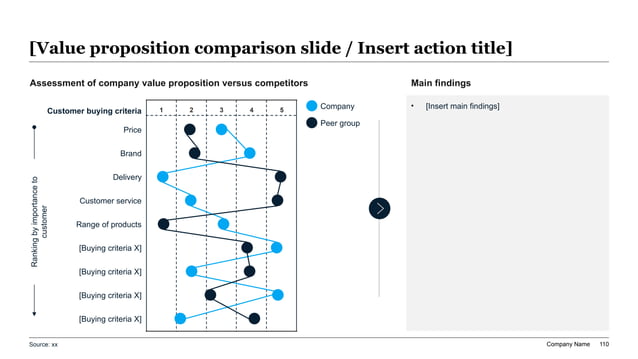
Value Proposition Teaching Visual
Why Serious Teams Build The GTM Narrative Before Spending The Budget
Many teams jump from product readiness to channel activity too quickly. They approve launch assets, field training, campaign calendars, and pricing pages before the leadership team has made the harder choices about target buyer, wedge use case, competitive angle, and proof standard. The result is activity without conviction. Everyone is busy, but the business still cannot explain the launch in one clean narrative.
A strong GTM presentation prevents that drift by forcing the commercial logic into view. Which segment is first and why? What pain is urgent enough to break inertia? What claim can the product actually prove in the first six months? Which route to market is efficient enough for the budget and the average contract value? Where will the first objections come from? A good deck turns those questions into slides that can be challenged before the company commits spend.
This is where executive readers care less about volume and more about synthesis. They want to see the market thesis, the segment choice, the positioning, the pricing logic, the channel motion, the rollout sequencing, and the leading indicators that will tell them whether the bet is working. If the deck cannot create that clarity, the team will end up re-litigating the same decisions in every review meeting.
Recommended 11-Slide Go-To-Market Strategy Sequence
This sequence is built for executive review, not for a generic all-hands launch announcement.
| Slide | Purpose | Executive Question Answered |
|---|---|---|
| 1. Executive summary | State the launch bet, expected outcome, and approval ask | What are we doing and why now? |
| 2. Market problem and trigger | Define the external change or internal opportunity | Why does this motion matter now? |
| 3. ICP and segment choice | Show who matters first and what was deprioritized | Who are we targeting first? |
| 4. Value proposition and proof | Explain why the offer is better for that segment | Why will buyers care? |
| 5. Competitive position | Clarify the alternatives and switching barriers | Why will we win? |
| 6. Pricing and packaging | Connect monetization to buyer value and sales motion | How do we make money without slowing adoption? |
| 7. Channel strategy | Map direct, partner, product-led, or hybrid routes | How will demand become pipeline and revenue? |
| 8. Enablement and launch assets | Show what sales, CS, and marketing need to execute | What must be ready before launch? |
| 9. Rollout roadmap | Sequence pilots, milestones, and expansion waves | How do we de-risk the first 90 to 180 days? |
| 10. KPI scorecard | Name the early signals and thresholds | How will we know if the motion is working? |
| 11. Risks and leadership asks | State the tradeoffs, dependencies, and approvals | What decision is needed today? |
ICP Segmentation Reference
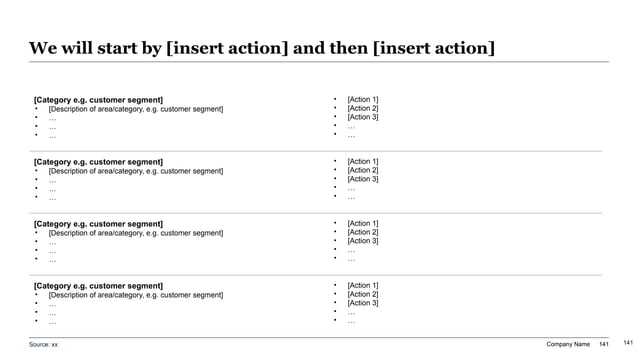
How To Choose The First ICP Without Turning The Deck Into A Fiction
The weakest GTM decks target everyone who could plausibly buy. That usually happens because the team is trying to keep options open, or because early research created several promising audiences and no one wants to rule one out. But broad targeting is expensive. It forces vague messaging, unclear enablement, and channel sprawl. A serious presentation should show the first segment the company will prioritize, the reason it wins on urgency or access, and the segments it will intentionally leave for later.
That argument becomes stronger when the page shows selection criteria rather than intuition. Teams should compare segments on pain intensity, buyer authority, ease of access, implementation complexity, willingness to pay, competitive density, and ability to create visible proof quickly. The best launch segment is often not the biggest theoretical market. It is the group where the company can establish repeatable wins, referenceability, and a cleaner sales story first.
Executives also want honesty about what has not been proven yet. If the segment choice depends on a new buyer persona, an untested pricing metric, or a partner-led route that the company has never executed before, the deck should say so. That is a strength, not a weakness. A GTM presentation gains trust when it distinguishes confirmed evidence from working assumptions.
Questions Leadership Should Answer Before Approving The GTM Motion
ICP And Segment Qualification Scorecard
An executive GTM deck usually improves when it makes the segment choice visible as a weighted decision instead of an implied preference.
| Criterion | Why It Matters | High-Confidence Signal |
|---|---|---|
| Pain intensity | Urgent pain improves conversion and message clarity | Buyers already spend time or budget trying to solve it |
| Decision authority | The motion stalls when the user cannot sponsor the deal | The target buyer controls budget, rollout priority, or a major workflow |
| Implementation fit | Fast proof matters more than broad ambition in the first wave | Onboarding can succeed without major services overhead |
| Willingness to pay | Pricing power determines CAC tolerance and channel choice | Comparable spend or budget line already exists |
| Referenceability | The first wins should create reusable proof for the next segment | Early customers are credible logos or strong case-study sources |
| Competitive whitespace | The team needs a reason to win besides being new | Incumbents are weak on speed, usability, economics, or positioning |
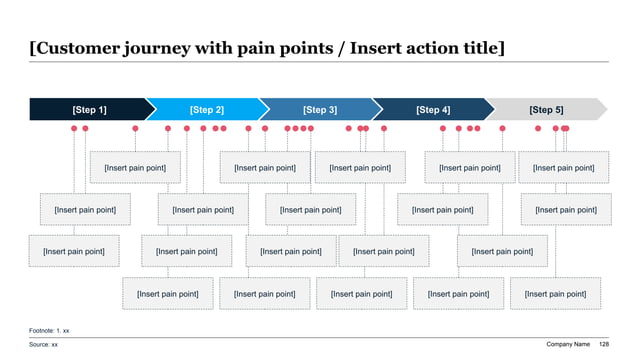
Customer Journey Friction Map
Pricing, Packaging, And Channel Strategy Need One Economic Story
Pricing cannot sit in a side appendix if it changes the viability of the whole motion. A premium direct-sales strategy, a usage-based product-led strategy, and a partner-distribution strategy all carry different expectations for payback, implementation support, discounting pressure, and speed to proof. The GTM deck should therefore connect pricing to channel design instead of treating them as separate workstreams.
The same rule applies to packaging. Executives do not need a page with every feature tier on day one. They need to understand which package maps best to the first segment, which metric the business expects buyers to pay for, what expansion path exists later, and where the sales team may need discretion or guardrails. If the packaging design confuses the field or hides the economic engine, the launch will slow even if lead generation looks healthy.
This is also where many GTM slides become too optimistic. They show the ideal route to market without showing the friction cost: services requirements, partner ramp time, long legal review cycles, implementation dependencies, or product gaps that require workarounds. Serious decks surface those constraints early. They do not merely celebrate the opportunity.
Action-Title Rewrite Matrix For GTM Presentations
A better headline tells the executive what to conclude, not just what the slide is about.
| Weak Topic Title | Conclusion-Style Rewrite | Why The Rewrite Works |
|---|---|---|
| Target customers | Mid-market operations leaders are the fastest path to repeatable proof | It states who matters first and why |
| Value proposition | The offer wins because it removes reporting friction without new headcount | It ties product value to a concrete business outcome |
| Pricing | Seat-plus-usage pricing protects expansion upside without blocking entry | It explains the monetization logic |
| Channels | Direct sales should lead wave one while partners stay in validation mode | It clarifies sequencing rather than listing options |
| Competition | Incumbents are strong in reach but weak in speed-to-value for this segment | It translates benchmarking into a strategic implication |
| Next steps | Leadership needs to approve pilot scope, pricing guardrails, and launch owners this month | It makes the decision explicit |
Competitive Assessment Reference
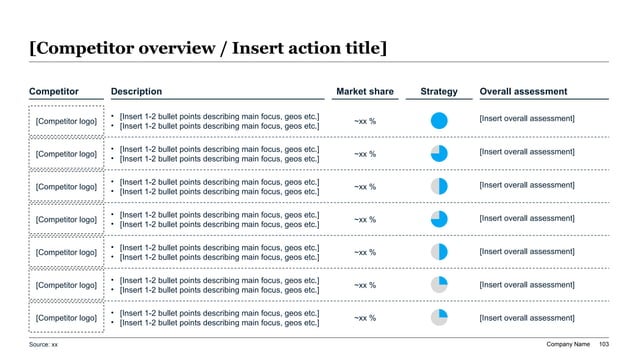
How To Turn Competitive Assessment Into A Sales-Usable Narrative
Competitive analysis is not useful when it becomes a museum of logos and feature lists. The point of a GTM presentation is to decide how the company will position itself in a live market. That means the competitor slide should help the team answer three practical questions: which alternatives buyers compare us against, where we actually have an edge, and which objections the field must be ready to handle in the first conversations.
The most effective page usually combines a tight market map with a few commercial implications. For example: incumbents have distribution and brand trust but slow implementation; point solutions are easy to land but weak on cross-functional value; adjacent manual workflows remain common in the segment and create a low-cost baseline to displace. That framing is more useful than a long matrix showing twenty feature rows with no narrative.
A GTM deck should also distinguish between positioning for executives and battlecards for the field. Leadership needs the strategic story and the choice of lane. Sales enablement teams then turn that choice into talk tracks, objection handling, proof assets, and competitor-specific rebuttals. The presentation should show the first layer of that logic, not try to replace the whole enablement package.
Message Architecture Reference
Channel Design Choices And Evidence Standards
Channel decisions should be defended with operating evidence, not preference or habit.
| Route To Market | Best When | Evidence Leadership Should Demand |
|---|---|---|
| Direct sales | Deal size and solution complexity justify higher acquisition cost | Win-rate assumptions, cycle length, ramp plan, and required proof assets |
| Product-led | Users can reach value fast and expand later with light touch | Activation thresholds, self-serve funnel math, and upgrade triggers |
| Partner-led | Channel access or implementation trust matters more than pure brand pull | Recruitment economics, enablement effort, margin structure, and conflict rules |
| Founder-led or executive-led | The category is early and trust must be built through senior credibility | Capacity limits, reference strategy, and conditions for handoff to the field |
| Hybrid direct plus partner | The company needs control in a few priority accounts but leverage elsewhere | Account ownership logic, compensation design, and escalation paths |
| Geography-staged rollout | Localization or compliance makes a broad launch too risky at first | Market-selection logic, localized support readiness, and proof milestones |
Copy-Paste XLSlides Prompt For A Go-To-Market Strategy Presentation
Create an 11-slide go-to-market strategy presentation for a B2B software company launching a workflow analytics product. Audience: CEO, CRO, CMO, VP Product, and board observer. Goal: align leadership on the first ICP, value proposition, pricing and packaging, channel motion, launch milestones, success metrics, and approval asks. Include an answer-first executive summary, market trigger, ICP selection logic, buyer pain points, differentiated value proposition, competitive positioning, pricing strategy, channel design, enablement needs, 90-180 day rollout roadmap, KPI scorecard, top risks, and explicit decisions required. Use conclusion-style slide titles, MECE structure, and editable PowerPoint-ready page layouts rather than decorative AI slides.
Review Checklist Before The GTM Deck Goes To Executives
What AI Should Automate In A GTM Workflow And What Leaders Must Still Own
AI is valuable in GTM preparation because the raw material is fragmented. Teams usually have market notes, customer interviews, pricing hypotheses, sales objections, product launch lists, campaign calendars, and comments from several executives spread across different documents. XLSlides can help turn that mess into a first-pass storyline with structured sections, action titles, draft tables, and slide-ready layouts. That removes a large amount of formatting and assembly work.
What AI should not own is the commercial judgment. It cannot decide which segment is strategically right when two plausible options exist. It cannot set discounting boundaries, determine whether the field is truly ready, or choose which objection deserves the primary message. Those are management calls because they change revenue quality, organizational focus, and capital efficiency.
The right operating model is therefore asymmetric. Use AI to compress the first-draft effort and to convert messy source material into a cleaner executive artifact. Then have the founder, PMM, revenue lead, or strategy owner pressure-test the segment logic, rewrite any vague headlines, validate every metric assumption, and make the final ask explicit. That is how the deck gets faster without becoming generic.
Rollout Roadmap Reference
Common Failure Modes In Go-To-Market Presentations
The first failure mode is treating the deck like a manifesto instead of a decision tool. Teams describe category ambition, product vision, and campaign energy, but they never state the exact wedge, the commercial tradeoff, or the approval request. Executives leave with a positive feeling and no concrete decision path.
The second failure mode is mixing strategy and execution without hierarchy. A launch calendar appears before the segment choice is resolved. Enablement assets are listed before the pricing logic is settled. Channel plans are shown without any discussion of payback or owner capacity. This creates false precision. The deck looks complete, but the most important choices are still unresolved.
The third failure mode is letting every function add pages without forcing synthesis. Product adds features, marketing adds campaigns, sales adds objections, and finance adds model tabs. Soon the presentation becomes a document dump. The higher standard is to make every page earn its place by answering one executive question. If it does not advance the decision, move it to appendix or a working file.
Short Answers For GTM And Launch Teams
What should be on the first slide of a go-to-market strategy presentation?
The opening slide should state the market bet, the target segment, the core value proposition, the expected business outcome, and the exact approval or decision needed from leadership. Executives should understand the headline before they read the detail.
How is a GTM deck different from a product launch deck?
A GTM deck is broader and more commercial. It explains the buyer, value proposition, pricing, channel motion, economics, and rollout choices. A product launch deck is often narrower and more execution-focused, covering release timing, assets, and coordination.
How many slides should an executive GTM presentation have?
Most serious GTM presentations can work in roughly 10 to 12 main slides plus appendix detail. The right number depends on complexity, but every page should answer a real leadership question rather than repeat internal workstream detail.
Can AI create a credible first draft of a GTM presentation?
Yes, if the input includes real customer notes, segment hypotheses, pricing logic, channel assumptions, and launch goals. AI is useful for structure and synthesis, but leadership still has to validate the bet, the economics, and the final decision ask.
XLSlides Resources For GTM Planning And Launch Reviews
Draft The GTM Deck In XLSlides
Use XLSlides to turn customer notes, segment choices, value proposition drafts, pricing hypotheses, channel plans, and launch milestones into an editable go-to-market strategy presentation with conclusion-style titles, executive-ready visuals, and a clearer approval path.
Generate GTM Deck