Professional GTM Strategy Presentation Templates

Stop wasting hours on manual formatting. Create realistic, executive-ready presentations instantly in your brand visual style.

ICP & persona mapping
Pricing & packaging visuals
Sales enablement roadmaps

1What is a Go-To-Market (GTM) Strategy Presentation?

A Go-To-Market (GTM) Strategy Presentation is a comprehensive, multi-disciplinary corporate blueprint designed to align product development, marketing operations, and sales execution before launching a new offering, expanding into international territories, or entering a new competitive vertical. In today's highly competitive business landscape, relying on disjointed spreadsheets, unstructured documents, or text-heavy memos is a major operational risk. Strategy teams, executive boards, and institutional investors require high-fidelity, boardroom-grade presentations that translate strategic launch hypotheses into clear, actionable, and visual plans. This premium GTM template provides strategy leaders, product marketers, and growth directors with the precise structural layouts needed to map out customer acquisition funnels, brand positioning, pricing packages, and sales enablement resources. Standardizing your GTM presentation on this brand-locked visual system ensures that all stakeholders, product leads, and joint-venture partners receive critical launch milestones in a professional, authoritative format. This eliminates tedious manual formatting struggles and lets strategy managers focus on refining target metrics, optimizing marketing campaigns, and securing partner commitments, establishing a standard of absolute operational discipline, absolute clarity, and supreme professional authority.
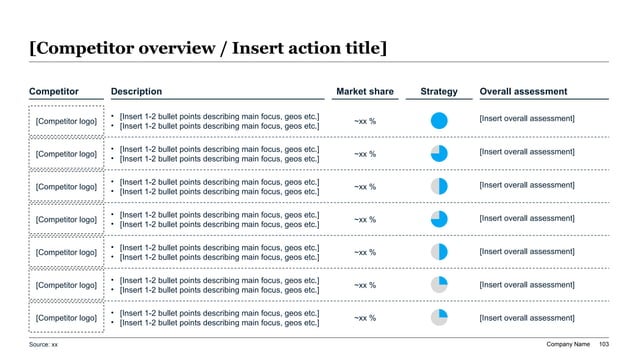
Competitor assessment slide featuring a 7-competitor comparison grid with Harvey Balls, market share percentages, and blue styling elements in a 16:9 layout.
Template Design LayoutProfessional GTM Strategy Presentation Templates

2Target Audience & Strategic Use Cases: When to Deploy This Deck

This strategic GTM presentation template is explicitly engineered for growth-stage founders, product marketing managers, heads of sales, enterprise marketing directors, and corporate strategy teams who must deliver high-stakes launch proposals to internal boards or external capital partners. In rapid-scaling SaaS and high-tech environments, presenting unstructured or poorly aligned slides severely damages a team's professional credibility and risks losing critical market windows. General managers deploy this deck to pitch product-market fit strategies during executive alignment meetings, while sales enablement leads use it to train regional outbound sales representatives on competitive battlecards. Beyond standard SaaS product launches, this template is highly effective for planning brand repositioning campaigns, introducing tier-structured enterprise pricing changes, or outlining geographic market expansion roadmaps. By locking typography scales, container grids, and layout alignment rules, corporate teams can prevent layout errors and maintain absolute brand consistency. This communicates executive readiness, operational competence, and extreme attention to detail to underwriting syndicates and joint-venture partners, ensuring rapid consensus and accelerated deployment timelines.

3Aesthetics & Design Rationale of the silicon-pitch Theme

To capture executive attention and command strategic authority, the GTM presentation utilizes our advanced 'silicon-pitch' design preset, engineered specifically for high-growth tech companies and modern SaaS platforms. The visual theme employs a dominant, deep corporate slate background (60% weight) combined with high-contrast neutral containers (30% weight) and single vibrant electric accents (10% weight) to organize complex data matrices and timelines. Contrast ratios strictly exceed 4.5:1, ensuring flawless legibility on older boardroom projectors, tablets, and mobile displays alike. The layout is locked to a 16:9 widescreen format to ensure structural authority and professional rendering across all conference monitors. A critical design guardrail is maintaining at least 30% negative space on every layout card, which prevents cognitive overload and guides reviewer focus directly to key metrics. The alignment locks all text, icons, and diagrams to a strict 12-column corporate grid, eliminating layout errors and cognitive drift. Implementing this cohesive aesthetic represents a premium alternative to basic public layouts, conveying strict design standards, technical control, and extreme professional precision.

4Applying Barbara Minto's Pyramid Principle to GTM Narratives

GTM decks frequently fail by burying high-impact value propositions under a mountain of unstructured feature descriptions and dense technical paragraphs. To avoid this narrative failure, elite strategy leaders structure their slide decks around Barbara Minto's legendary Pyramid Principle. Under this elite communication standard, every single slide headline must serve as an active, key conclusion rather than a passive descriptive label. For example, instead of titling a slide 'Target Personas,' write an active headline like 'Our enterprise buyer persona controls 70% of IT budgets and prioritizes rapid deployment cycles.' Every supporting data point, bullet list, or comparative table must represent a MECE (Mutually Exclusive, Collectively Exhaustive) sub-argument that logically validates the main conclusion of that specific slide. Ideas must flow in chronological, structural, or comparative order to build an undeniable case. By enforcing this narrative discipline across all presentation modules, you eliminate visual noise and cognitive drag, allowing busy directors and venture partners to grasp your entire launch strategy in under two minutes.

5Defining the Ideal Customer Profile (ICP) and Market Moats

A successful Go-To-Market strategy is built on a precise, data-driven definition of the Ideal Customer Profile (ICP) and the establishment of defensible competitive moats. Targeting too broad an audience dilutes marketing efficiency and increases Customer Acquisition Cost (CAC), leading to rapid capital depletion. Strategic teams must use this template to segment high-intent accounts based on firmographics, technographics, and clear pain points. By detailing target buyer personas, jobs-to-be-done, and specific purchasing triggers, product marketers can align messaging directly with user needs. Furthermore, the deck must highlight how the product builds structural switching costs, network effects, or proprietary data moats that protect market share from rapid follower imitation. Outlining these defensive elements in our premium widescreen slides ensures that investment partners and board underwriters can assess long-term revenue sustainability. This structured segmentation proves that your customer acquisition plan is backed by rigorous empirical market analysis rather than optimistic guesses, establishing absolute commercial credibility.

6Competitor Strategic Assessment and Positioning Battlecards

To successfully capture market share in competitive spaces, product marketing managers must deliver a clear, structured competitive analysis. Presenting unaligned or vague lists of rival features fails to convince strategic partners. Our GTM template incorporates an advanced competitor strategic assessment layout, enabling deal teams to present comparative details with absolute clarity. Using this data-heavy slide, you can map out rival positioning, market share, and functional gaps, creating high-impact battlecards for outbound sales teams. Below is a structured quantitative representation of the competitive landscape, showing how the target platform compares to primary market alternatives across critical strategic dimensions:

Competitor TierMarket ShareKey Value PropositionHarvey Ball RatingStrategic Advantage
Platform Alpha35%High-cost legacy enterprise systems2/4 (Inflexible)Established corporate contracts but high churn risk
Solution Beta20%Mid-market point product3/4 (Moderate)Rapid onboarding but limited platform scalability
System Gamma15%Low-cost developer-centric tool2/4 (Complex)Strong developer adoption but weak C-suite appeal
XLSlides AI5% (Emerging)Automated high-density presentation generation4/4 (Exceptional)Zero formatting debt, instant compilation, 100% brand-locked

By organizing your competitive analysis in this highly professional table, you prove to board members that your market positioning is backed by balanced, rigorous due diligence.

7Pricing & Packaging Strategy: Visualizing Monetization Models

A product's pricing and packaging structure represents the most powerful lever for maximizing Average Contract Value (ACV) and accelerating Net Revenue Retention (NRR). Strategy leaders must avoid arbitrary pricing numbers, grounding monetization in value-metric alignment where customer charges scale directly with usage benefits. Our template provides dedicated, high-contrast monetization modules to help finance directors visualize tiered SaaS packages, usage-based add-ons, and enterprise customization terms. Below is a structured comparative pricing matrix designed to demonstrate how value-metric alignment drives corporate contract expansions:

Pricing Package TierCore Value MetricMonthly Entry CostIdeal Target AudienceKey Feature Inclusions
Professional SinglePer individual user seat$49 per seatStrategic solo consultantsStandard widescreen layouts, basic vector downloads
Collaborative TeamShared workspace capacity$199 per teamHigh-growth marketing agenciesMulti-user editing, unified brand-kit styling locks
Enterprise PillarCustom API & private cloudCustom PricingMultinational strategy groupsDedicated servers, custom templates, 24/7 priority support

Presenting these packages in a high-contrast matrix ensures that your board understands the strategic expansion path of your monetization model, proving financial sustainability to key capital allocators.

8Distribution Channels & Sales Enablement Execution

An exceptional product and pricing strategy will fail without a disciplined, multi-channel distribution plan that scales lead generation and accelerates sales velocity. GTM leads must clearly define the balance between product-led growth (PLG) self-serve loops and sales-led growth (SLG) enterprise outbound motions. This presentation outlines specific marketing channels, outbound email sequences, sales enablement assets, and customer success handoff playbooks. By structuring these channels in visual roadmaps, marketing teams can assign clear ownership to functional leads across the 100-day launch schedule. The playbook focuses on these key distribution pillars:

  • Inbound Content Marketing**: Creating high-density SEO/AEO-optimized pillar pages to capture organic interest.
  • Outbound Account-Based Marketing**: Targeting key decision-makers at high-value enterprise accounts with personalized collateral.
  • Sales Battlecards & Demos**: Equipping sales representatives with copy-pasteable prompt recipes and layout guidelines.
  • Partner Channel Networks**: Leveraging system integrators and technology consulting partners to expand market reach.

Using these visual roadmaps ensures that all departments remain aligned on distribution milestones, accelerating pipeline creation.

9Interactive Prototyping on the AI Visual Studio Canvas

To streamline presentation assembly and eliminate design overhead, this premium template integrates directly with the AI Visual Studio Canvas, our interactive drag-and-drop workspace. Strategy teams can click and drag anywhere on the 16:9 canvas area to draw custom text container placeholders, making layout drafting exceptionally visual. You can assign structural tags (such as metrics grids, competitor comparison tables, process timelines, or visual quotes) to each drafted card to define the AI's rendering constraints. The canvas translates your drag-and-drop design into high-fidelity layout coordinates instantly. This visual workspace bridges the gap between raw textual briefs and structured spatial design, giving developers ultimate creative control while maintaining the rigorous alignment guardrails of our design system. To try it now, click the Open Interactive Canvas button in the sidebar or mobile stream to map out your slide layouts in real time, making custom presentation drafting exceptionally responsive, clear, highly visual, and perfectly aligned to your corporate launch goals.

10GTM Velocity: Traditional Slide Formatting vs. XLSlides AI Automation

Designing a beautiful, data-intensive Go-To-Market presentation manually in traditional tools like Microsoft PowerPoint or Google Slides usually consumes 10 to 15 hours of tedious formatting, dealing with misaligned metric dashboards, and trying to make positioning tables look clean. Our advanced artificial intelligence presentation generator completely eliminates this operational design debt, compiling professional, boardroom-ready decks in under sixty seconds. The AI maps your launch brief automatically to expert visual structures, including 3-column splits, pricing matrices, and GTM timelines. Below is a structured performance comparison highlighting the operational gains achieved by transitioning from manual slide design to XLSlides AI automation:

Performance IndicatorTraditional Manual Presentation DesignAutomated AI Generation (XLSlides)
Design Time Invested10 to 15 hours of tedious draftingUnder 60 seconds compilation
Visual ConsistencyHigh risk of font and margin drift100% brand-locked margins and consistent grids
Visual Asset QualityBasic clip-art or simple chartsReady-to-use vector diagrams matching reference slides
AEO Semantic QualityNon-indexable headers and simple layoutsFully optimized schema with data-aeo attributes

Transitioning to this automated workflow represents a major productivity gain, allowing teams to focus on active strategic campaigns rather than manual formatting.