Vertical Farming Business Plan Presentation Template

Stop wasting hours on manual formatting. Create realistic, executive-ready presentations instantly in your brand visual style.

Crop mix, yield-per-square-foot, and revenue model slides
Facility economics, energy load, and operating cost dashboards
Go-to-market, funding, partnership, and scale-up roadmap visuals

1What Is a Vertical Farming Business Plan Deck?

A vertical farming business plan deck explains how an indoor agriculture venture will create reliable supply, attractive margins, and differentiated market access. It should connect the agronomic model to the commercial model. That means showing crop selection, yield assumptions, growing technology, facility design, energy load, labor model, distribution strategy, customer demand, pricing, capex, opex, and funding needs in one coherent story. A strong deck avoids vague claims about local food or sustainability and instead proves that the operating system can produce consistent quality at a cost structure customers will support. It should also clarify what makes the farm defensible: proprietary grow recipes, location advantage, supply contracts, automation, brand, partnerships, or data. This template gives teams a structured way to present the farm as a business with measurable unit economics, realistic risks, and clear scaling logic for investors, lenders, partners, or internal executives. That added discipline helps teams keep the story grounded in customer demand, operational constraints, financial sensitivity, risk ownership, and the next milestone leadership must approve.
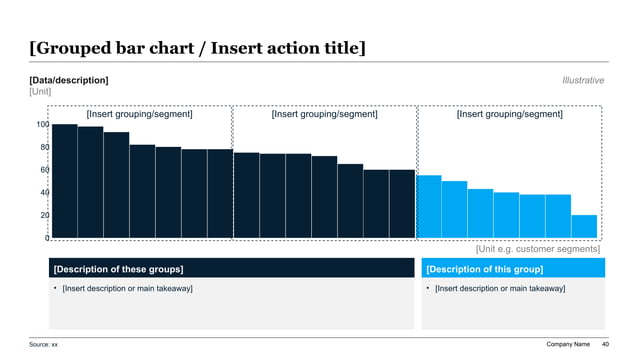
Vertical farming business plan slide with segmented grouped column chart showing production, yield, and operating metrics across facility segments.
Template Design LayoutVertical Farming Business Plan Presentation Template

2When to Use This Vertical Farming Template

Use this template when a vertical farming concept needs to move from idea to financial and operating plan. It is useful for seed or Series A fundraising, bank financing, facility expansion, grocery partnership discussions, food service bids, municipal economic development conversations, and corporate innovation reviews. The deck is also valuable when a company needs to compare controlled-environment agriculture against greenhouse, traditional field production, imported produce, or contract grower supply. Founders can use it to explain how crop mix, facility footprint, energy rates, automation, and demand commitments affect profitability. Strategy teams can use it to assess whether vertical farming belongs in a food resilience, sustainability, or supply chain portfolio. Investors can use it to challenge assumptions around yield, utilization, shelf life, distribution cost, and customer acquisition. The template keeps the conversation focused on the economics that determine whether the farm can scale. That added discipline helps teams keep the story grounded in customer demand, operational constraints, financial sensitivity, risk ownership, and the next milestone leadership must approve.

3Recommended Business Plan Deck Structure

A strong vertical farming business plan starts with the investment thesis: the market pain, target customer, product mix, and economic reason the farm should exist. The next section should define the market opportunity, including demand for local produce, price premiums, supply volatility, food safety concerns, and distribution gaps. Then explain the crop strategy, showing why specific products were selected based on cycle time, yield density, perishability, margin, and buyer demand. Add a facility and technology section covering growing system, lighting, climate control, automation, water use, data systems, and footprint. Follow with unit economics, capex, opex, revenue model, utilization, break-even volume, and sensitivity analysis. Include go-to-market pages for retailers, restaurants, institutions, distributors, or direct-to-consumer channels. Close with funding ask, milestone roadmap, risk mitigation, and team capability. This sequence turns the plan into an investor-reviewable operating case. That added discipline helps teams keep the story grounded in customer demand, operational constraints, financial sensitivity, risk ownership, and the next milestone leadership must approve.

4Market Demand and Customer Segmentation

Market demand pages should prove that the farm is solving a real purchasing problem. Segment customers by channel, such as grocery chains, premium retailers, restaurants, meal kit providers, schools, hospitals, corporate cafeterias, food distributors, or direct subscription buyers. For each segment, show what they value: consistent supply, local sourcing, reduced spoilage, year-round availability, traceability, pesticide-free production, shorter lead times, or differentiated freshness. A useful slide also compares buyer willingness to pay with the cost structure needed to serve each channel. Not every customer is equally attractive. Restaurants may value freshness but buy lower volumes. Grocery partners may offer scale but demand strict pricing and service levels. Institutional buyers may value resilience and supply assurance. The deck should identify the beachhead customer group and explain how early contracts, pilots, letters of intent, or demand research support the revenue plan. That added discipline helps teams keep the story grounded in customer demand, operational constraints, financial sensitivity, risk ownership, and the next milestone leadership must approve.

5Crop Mix, Yield Assumptions, and Production Planning

Crop strategy is central to the vertical farming business model. A deck should show why the chosen crops fit the facility, market, and margin target. Common choices include leafy greens, herbs, microgreens, strawberries, specialty greens, and other high-value crops where freshness, consistency, and local supply matter. Each crop should be assessed by growth cycle, yield per square foot, labor intensity, energy requirement, shelf life, packaging needs, wholesale price, and waste rate. It is important to separate theoretical biological yield from saleable yield after quality control, harvest loss, packaging loss, and demand variability. Production planning should also show how the farm balances capacity utilization with customer commitments. A simple crop portfolio chart can highlight which products drive base revenue, which support premium margins, and which remain experimental. This gives investors confidence that the plan is operationally grounded. That added discipline helps teams keep the story grounded in customer demand, operational constraints, financial sensitivity, risk ownership, and the next milestone leadership must approve.

6Facility Design, Technology Stack, and Operating Model

The facility design section should translate the concept into a working operating system. Include the site requirements, footprint, rack configuration, growing method, lighting strategy, climate systems, irrigation, nutrient delivery, automation, sensors, food safety workflows, and post-harvest handling. Explain how the design affects throughput, labor productivity, crop quality, and energy usage. The technology stack should be tied to economics rather than presented as novelty. For example, automated seeding, monitoring, harvesting support, environmental controls, and production software should reduce waste, improve consistency, or lower labor cost. The operating model should identify key roles, shift structure, quality assurance, maintenance, inventory planning, and customer fulfillment routines. A strong slide also explains what is outsourced versus owned internally. This helps stakeholders see that the business can operate beyond a prototype and can meet commercial delivery expectations. That added discipline helps teams keep the story grounded in customer demand, operational constraints, financial sensitivity, risk ownership, and the next milestone leadership must approve.

7Unit Economics, Capex, Opex, and Break-Even Logic

Vertical farming plans succeed or fail on unit economics. The deck should show capex by major category, including buildout, growing systems, lighting, HVAC, controls, automation, water systems, packaging area, refrigeration, and working capital. Opex should include energy, labor, rent, seeds, nutrients, packaging, maintenance, distribution, insurance, software, and administrative costs. Revenue assumptions should be tied to saleable volume, realized price, customer mix, and utilization rate. A clear break-even slide helps investors understand the minimum volume and price required to cover fixed and variable costs. Sensitivity analysis is especially important because energy rates, labor productivity, yield, spoilage, and pricing can move materially. The goal is not to make every assumption look perfect. The goal is to show which levers matter most, what buffer exists, and what operating milestones prove the model is improving. That added discipline helps teams keep the story grounded in customer demand, operational constraints, financial sensitivity, risk ownership, and the next milestone leadership must approve.

8Energy, Sustainability, and Resource Efficiency

Energy is one of the most important and scrutinized parts of a vertical farming business plan. A sustainability slide should not only describe water savings or reduced food miles. It should show how lighting, HVAC, dehumidification, automation, renewable power procurement, demand management, and facility design affect cost and emissions. Investors and partners will want to know whether the farm can remain competitive under different energy price scenarios. Resource efficiency metrics may include kilowatt-hours per kilogram, water use per kilogram, percentage of renewable energy, waste rate, packaging footprint, and transport distance reduction. The deck should also explain tradeoffs honestly. Local indoor production may improve freshness and resilience, but it must be supported by efficient operations and credible energy planning. Strong sustainability pages connect environmental benefits to operating discipline, buyer value, brand differentiation, and compliance or reporting advantages. That added discipline helps teams keep the story grounded in customer demand, operational constraints, financial sensitivity, risk ownership, and the next milestone leadership must approve.

9Go-to-Market, Partnerships, and Distribution Strategy

The go-to-market section should identify how produce reaches customers profitably. For grocery, the deck should show buyer targets, SKU strategy, packaging, shelf placement, quality requirements, replenishment cadence, and service level expectations. For restaurants or food service, it should show chef relationships, menu integration, order frequency, and delivery logistics. For distributors, it should explain margin sharing, volume commitments, and cold-chain handling. Direct-to-consumer models need customer acquisition, retention, delivery cost, subscription logic, and brand positioning. Partnerships may include grocery chains, real estate owners, energy providers, automation vendors, local governments, universities, or food brands. The deck should make clear which channels are launch priorities and which come later. A practical GTM slide also links channel strategy to production planning so stakeholders can see how demand commitments reduce utilization risk. That added discipline helps teams keep the story grounded in customer demand, operational constraints, financial sensitivity, risk ownership, and the next milestone leadership must approve.

10Risk, Funding Ask, and Scale-Up Roadmap

A credible vertical farming deck should name the risks directly. These may include energy volatility, capex overruns, crop disease, yield underperformance, labor shortages, automation delays, customer concentration, distribution complexity, pricing pressure, food safety issues, or slower-than-expected demand. Each risk should have a mitigation plan and an owner. The funding slide should show how much capital is required, how proceeds will be used, which milestones the funding unlocks, and what evidence investors should expect before the next financing event. A scale-up roadmap should move from pilot or first facility to validated operations, customer expansion, capacity additions, and regional replication. Include decision gates for yield stability, cost reduction, customer contracts, and facility utilization. This gives leadership a disciplined path from concept to commercial scale while preserving room to adapt as operating data improves. That added discipline helps teams keep the story grounded in customer demand, operational constraints, financial sensitivity, risk ownership, and the next milestone leadership must approve.

11Prompt Recipe for Better Vertical Farming Decks

A strong AI prompt improves the quality of the generated vertical farming deck. Start by specifying the farm location, target customer, crop mix, production system, facility size, funding stage, and intended audience. Ask for an investor-ready business plan covering market demand, crop strategy, facility design, technology stack, capex, opex, unit economics, energy efficiency, sustainability metrics, partnerships, go-to-market, funding ask, risks, and implementation roadmap. Include known assumptions such as expected yield per square foot, energy rate, planned channel mix, available contracts, and target pricing. Ask the output to distinguish proven facts from assumptions and to include sensitivity analysis for energy cost, yield, utilization, and price. This prompt helps XLSlides produce a deck that is specific enough for serious review. It also reduces the risk of generic AgTech language replacing the operating detail investors need. That added discipline helps teams keep the story grounded in customer demand, operational constraints, financial sensitivity, risk ownership, and the next milestone leadership must approve.

12How XLSlides Speeds Up Vertical Farming Planning

XLSlides helps teams turn operational research, spreadsheets, and founder notes into a structured presentation faster. Vertical farming plans often involve many disconnected inputs: crop trials, engineering quotes, utility assumptions, sales conversations, pricing benchmarks, facility layouts, and sustainability claims. The AI workflow organizes those inputs into an executive deck with a clear sequence: market need, crop portfolio, facility model, economics, energy plan, channel strategy, funding ask, and roadmap. The output is not a substitute for farm design, agronomy, or financial diligence, but it gives the team a strong working draft for investor meetings, partner discussions, and internal decision reviews. Users can then refine assumptions, add real facility data, and update the visuals as contracts or pilot results improve. This reduces time spent formatting slides and increases time available for validating the business model. That added discipline helps teams keep the story grounded in customer demand, operational constraints, financial sensitivity, risk ownership, and the next milestone leadership must approve.