Investor-Ready VC Investment Thesis & Portfolio Review Slide Templates

Stop wasting hours on manual formatting. Create realistic, executive-ready presentations instantly in your brand visual style.

Portfolio review structures
Market trend visualizations
Authoritative consulting design

1What is a Venture Capital Investment Thesis Presentation?

The Venture Capital Investment Thesis presentation is a highly structured, analytical framework designed to articulate a fund's investment philosophy, target sector economics, and portfolio management strategy to Limited Partners (LPs). In institutional investment environments, this document serves as the foundational blueprint that guides capital allocation decisions and proves to institutional LPs that the General Partners (GPs) possess a repeatable strategy for generating alpha. Rather than relying on simple bullet lists, an expert-level investment thesis presentation uses high-density layout systems to communicate complex macro trends, deal sourcing pipelines, and valuation disciplines. It presents a logical narrative that starts with the broader macroeconomic opportunity, narrows down to specific sub-sector inefficiencies, and details the proprietary operational levers the fund will deploy to scale portfolio companies. Aligning fund governance and growth milestones under a cohesive presentation standard guarantees that LPs receive the exact financial clarity they expect, accelerating fundraising speed and cementing institutional credibility in competitive capital markets.
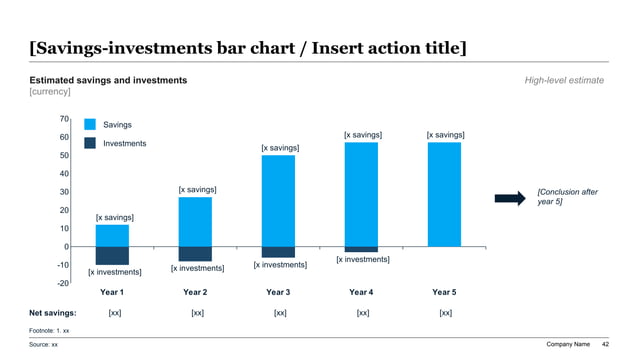
Dual-direction positive and negative vertical column bar chart comparing savings and investments over five years, supported by net results and an arrow-guided callout conclusion.
Template Design LayoutInvestor-Ready VC Investment Thesis & Portfolio Review Slide Templates

2Target Audience: Who is this template built for?

This premium presentation template is explicitly engineered for investment professionals who present to institutional allocators, pension funds, family offices, and investment committees. The primary target audience includes Venture Capital General Partners (GPs), emerging fund managers, corporate venture officers, and senior investment associates. These professionals require high-density, authoritative layouts that convey strategic discipline, market foresight, and meticulous financial governance. General Partners use this template to raise new funds, while investment associates deploy it to synthesize deal memos and conduct quarterly portfolio reviews. By establishing a unified structural standard, this template eliminates layout formatting drift and margin discrepancies, ensuring that every slide page looks as polished and rigorous as those generated by top-tier investment banks and advisory firms. It provides fund managers with the visual vocabulary and quantitative frames necessary to command respect, project competence, and secure the trust of sophisticated Limited Partners during high-stakes fundraising rounds. Furthermore, this setup is highly tailored for family offices managing strategic direct venture programs, corporate incubator directors reviewing early-stage startup progress, and academic case competitors pitching venture strategies to global committees. By adopting this institutional standard, your team ensures that all qualitative sourcing narratives, quantitative cash reserves, and GP co-investment allocations are articulated with ultimate administrative precision and structural credibility, meeting the rigorous expectations of professional allocators globally.

3Practical Use Cases: When and where to deploy this deck

The deployment of the Venture Capital Investment Thesis deck is critical across several key milestones in a fund's operational lifecycle:

* LP Fundraising Roadshows: Used to present the fund's unique investment strategy, market gap analysis, and team track record to potential Limited Partners, family offices, and sovereign wealth funds.

* Annual LP General Meetings: Deployed to deliver comprehensive portfolio reviews, capital calls updates, and performance evaluations, keeping allocators aligned on fund progress.

* Investment Committee Briefings: Used by investment partners and senior associates to pitch specific high-conviction startup investment opportunities, structuring the deal memo into a clear, MECE-compliant narrative.

* Quarterly Portfolio Audits: Serving as the operational framework to review unrealized value, EBITDA trends, and follow-on capital reserve strategies across all portfolio holdings.

Deploying this standardized visual framework ensures that all financial stakeholders receive information in the exact structured format they expect, maximizing key metric retention and accelerating decision-making speed during high-stakes transactions.

4Structural Outline of an Investor-Ready VC Presentation

To achieve fundraising success and satisfy strict LP due diligence, a complete Venture Capital presentation should follow a logical, narrative-driven 10-slide outline:

  1. 1Title & Executive Hook: Stating the fund's name, primary investment focus, and core thesis.
  2. 2Fund Macro Opportunity: Outlining the macroeconomic factors and sector tailwinds driving the investment thesis.
  3. 3The Target Market Gap: Detailing the specific market inefficiencies or underserved startup segments.
  4. 4Proprietary Deal Flow Sourcing: Visualizing how the GP team accesses exclusive, high-quality investment opportunities.
  5. 5Investment Criteria & MECE Selection: Proving a disciplined, systematic framework for evaluating potential startups.
  6. 6Portfolio Concentration Strategy: Outlining capital allocation across seed, Series A, and follow-on reserves.
  7. 7GP Value-Add & Post-Investment Support: Detailing the operational levers used to accelerate portfolio company growth.
  8. 8Fund Terms & Economics: Outlining management fees, hurdle rates, carried interest, and GP commitment.
  9. 9Team Track Record & Background: Highlighting past exits, operational experience, and advisory networks.
  10. 10LP Commitments & Execution Timeline: A clear next-steps callout outlining capital call processes and closing dates.

5Aesthetics & Design Rationale of the mckinsey-blue Theme

Our investment design system utilizes the McKinsey Blue theme to project authority, analytical rigor, and institutional gravity. It leverages high-contrast typography, strict layout grids, and standard margins, ensuring that your presentation immediately signals boardroom readiness. Widescreen 16:9 layout boundaries keep the narrative clean and structured, ensuring visual excellence across all projectors and digital screens. By utilizing a 60% dominant background canvas tone, a 30% professional neutral container structure, and a 10% high-contrast accent key, this theme guarantees that the client's attention is focused precisely on critical data points and strategic takeaways, preventing visual clutter and ensuring a highly premium executive presentation. Contrast ratios exceed 4.5:1, guaranteeing optimal readability on board projectors as well as mobile devices. It respects the visual intelligence of the audience, ensuring that every element serves a strategic purpose rather than being merely decorative. This specific color weighting and semantic alignment prevent design drift, keeping your visual decks looking extremely polished and boardroom-ready. It reflects the visual intelligence of corporate decision-makers, where every pixel represents a deliberate operational decision rather than decorative clutter. Implementing this cohesive, professional aesthetic builds massive visual trust with Limited Partners, establishing a corporate tone that matches the gravity of high-value capital raising transactions.

6Strategic Frameworks to Integrate with this Template

To build maximum credibility and satisfy the strict standards of institutional Limited Partners, your investment thesis must be built upon recognized, academically validated business frameworks. We recommend integrating the following models:

* The 2x2 Matrix: Structuring competitive positioning and market gaps to prove where your fund holds an unfair sourcing advantage.

* TAM/SAM/SOM Sizing: Breaking down your target addressable market to prove the ultimate scale of your investment sector.

* The MECE Framework: Ensuring that your fund's investment categories are mutually exclusive and collectively exhaustive, preventing portfolio overlap.

* The Minto Pyramid Principle: Organizing your slide narratives so that you lead with the conclusion first, followed by clear, structured arguments.

* WACC & CAGR Modeling: Grounding your target financial returns in rigorous weighted average cost of capital and compound annual growth rate calculations.

Leveraging these established strategic frameworks proves to Limited Partners that your investment thesis is backed by disciplined economic logic rather than arbitrary market hype.

7Storylining & Narration: Barbara Minto's Pyramid Principle

Limited Partners review hundreds of fund decks annually, meaning your investment narrative must convey logical momentum instantly. To maximize impact, structure your Venture Capital presentation around Barbara Minto's legendary Pyramid Principle. This communication standard requires that you lead with the answer first: the top-level slide headline must immediately state the conclusion or key takeaway, transforming passive labels into active headlines. Secondly, you must group supporting arguments logically, where every supporting bullet point or sub-card represents a MECE sub-argument that validates the main headline. Thirdly, follow widescreen logical order, ensuring that ideas flow in chronological, structural, or comparative order to ensure a seamless narrative. This strategic narrative discipline prevents data dumping, allowing busy LPs to grasp your entire fund strategy in under 5 seconds per slide. It transforms a standard presentation into a compelling business case that demonstrates clarity and deep analytical rigor, capturing LP commitment. Using the Pyramid Principle guarantees that your fundraising team avoids the common error of overloading decks with raw, unstructured information. By presenting your investment thesis as a hierarchical pyramid of logical claims, you make it easy for Limited Partners to follow your strategic assumptions, appreciate your quantitative diligence, and align with your capital allocation timeline without cognitive drag or operational friction.

8Professional Design, Typography, and Layout Rules

To ensure your presentation maintains an agency-grade visual standard, you must enforce strict typographical rules:

* Type Scale Discipline: Keep headers at exactly 24pt-28pt, slide subheadings at 16pt-18pt, and body text at 12pt-14pt. Never use more than two font families.

* Grids and Alignments: Enforce a standard 12-column grid. All text blocks, cards, and data metrics must align perfectly to prevent cognitive friction and visual noise.

* Color Weighting: Use a dominant background tone (60%), a professional neutral container tone (30%), and a single high-contrast accent tone (10%) to draw the eye to critical data points.

* Negative Space Conservation: Preserve at least 30% white space on every slide layout to let your core strategy breathe.

Respecting these simple typographical and grid rules guarantees that your slide layouts communicate absolute visual authority, organizational discipline, and extreme attention to detail, easily passing institutional LP standards. Furthermore, we recommend locking your canvas properties to modern, high-resolution vector assets, avoiding any custom low-contrast overlays. By maintaining absolute alignment across your entire structural deck, you eliminate the formatting debt that typically plagues manual PowerPoint creation, presenting a unified corporate brand identity that represents the institutional gravity and thoroughness of your venture capital firm.

9Performance Comparison: Manual Design vs. XLSlides AI

Manual slide creation is incredibly time-consuming, requiring fund managers to spend hours fixing misaligned cards rather than analyzing deal terms. Below is a quantitative breakdown of manual PowerPoint drafting versus automated slide generation:

Performance MetricManual Slide DraftingXLSlides AI Generation
Average Time Spent8 to 12 hours of manual formattingUnder 60 seconds total
Grid AlignmentEyeballed and prone to errorsAutomated, perfect 12-column pixel grids
Brand ConsistencyFont and margin drift over time100% lock to corporate style guides
Framework IntegrationHand-drawn matrices and diagramsBuilt-in, ready-to-use template components
Export FormatsStandard PPTX files that allow native Excel data and formula editsFully editable widescreen layouts

Transitioning to automation represents a significant operational multiplier, ensuring investment planning excellence. It enables fund partners to concentrate their efforts on founder relations and diligence rather than formatting.

10Common Presentation Pitfalls to Avoid in Fund Decks

To ensure your Venture Capital investment thesis deck passes rigorous LP due diligence, you must avoid these five critical presentation mistakes:

  1. 1Wall of Text: Slides are not documents; if a slide exceeds 60 words, convert list paragraphs into clean, horizontal column blocks.
  2. 2Poor Contrast: Avoid placing light grey text on white backgrounds; high-contrast, accessibility-compliant coloring is mandatory.
  3. 3Generic Clip Art: Clipart destroys credibility. Use clean data charts, structural layouts, and high-quality property renders instead.
  4. 4Non-Widescreen Margins: Do not push text elements to the very edge of the slide. Respect standard margins to ensure readability.
  5. 5Vague Metrics: Avoid vague growth projections; ground your assumptions in real historical performance and transparent unit economics.

Avoiding these common design and narrative errors guarantees that your presentation retains LP attention, communicates operational excellence, and builds professional fundraising traction across all presentation contexts. Additionally, emerging fund managers must avoid hiding critical fee structures, management team transitions, or co-investment policies behind complex footnotes. High transparency builds strong institutional alignment, proving that your general partners maintain rigorous ethical standards and absolute operational accountability, which is just as important to Limited Partners as your compound annual growth curves and exit valuations.