Professional Corporate Succession Planning Roadmap Templates

Stop wasting hours on manual formatting. Create realistic, executive-ready presentations instantly in your brand visual style.

Leadership bench risk assessment grids
Phased executive transition timelines
MECE-compliant talent retention models

1The Strategic Imperative of Executive Succession Planning in Corporate Governance

Executive succession planning is not merely a human resources exercise; it is a critical corporate governance framework that ensures business continuity, protects shareholder value, and preserves operational stability during periods of leadership transition. In high-stakes corporate environments, the sudden departure or planned retirement of a Chief Executive Officer (CEO) or key C-suite executive can trigger market volatility, internal organizational misalignment, and strategic paralysis. By implementing a structured, boardroom-grade succession planning roadmap, board directors and strategy leaders establish a proactive process for identifying, developing, and transitioning senior leadership talent. This systematic approach transforms succession planning from a reactive emergency measure into a continuous strategic initiative, aligning leadership development with the long-term strategic vision of the enterprise. A premium, MECE-compliant succession deck acts as a high-fidelity visual tool, allowing corporate boards to communicate transition readiness to investors, employees, and internal stakeholders with absolute clarity, structural precision, and professional authority. This continuous process also helps identify potential skills gaps early, enabling targeted professional training programs.
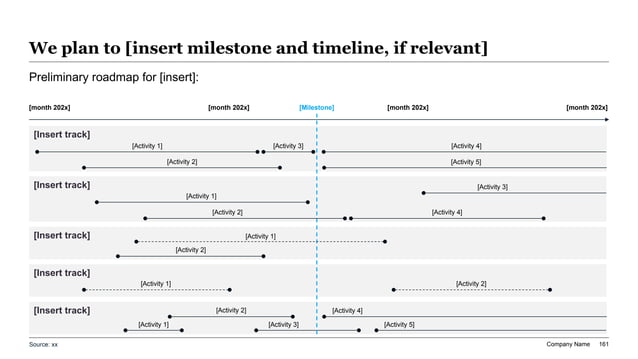
McKinsey-style succession planning swimlane roadmap with a dashed milestone divider, mapping executive transition phases and key leadership talent milestones.
Template Design LayoutProfessional Corporate Succession Planning Roadmap Templates

2Applying the Minto Pyramid Principle to Executive Transition Presentations

To secure board-level buy-in and maintain organizational alignment during critical leadership changes, succession planning proposals must be structured using Barbara Minto’s legendary Pyramid Principle. Instead of presenting talent pipelines as a series of passive biographical details, each slide in your succession deck must lead with an active, conclusion-focused headline that clearly highlights strategic implications. For example, rather than using a passive header like "Talent Bench Summary," write an active headline such as "Our leadership pipeline secures two immediate successors for each critical C-suite role, mitigating transition risk." The supporting data, competency assessments, and timeline milestones must serve as mutually exclusive and collectively exhaustive (MECE) arguments that validate this core thesis. This narrative discipline ensures that busy board members, strategy directors, and advisory partners can scan the transition plan and evaluate the leadership pipeline in under two minutes, significantly reducing decision-making friction and accelerating corporate alignment during high-stakes governance sessions. It turns a standard slideshow into an authoritative business proposal.

3Structuring the Leadership Bench Assessment and Talent Identification Process

A robust succession planning roadmap must be built upon a quantitative, data-driven assessment of the organization’s current leadership bench strength. Strategy teams and Chief Human Resources Officers (CHROs) utilize structured evaluation grids—such as the classic 9-Box talent matrix—to categorize high-potential employees based on their current performance levels and future leadership growth capabilities. This analytical framework ensures that talent assessment is conducted objectively, minimizing personal bias and standardizing the criteria for executive advancement across diverse business units. The succession deck should clearly outline this talent pipeline, highlighting immediate, medium-term (1-3 years), and long-term (3-5 years) readiness states for each critical C-suite position. Outlining these performance-linked capabilities in a clean, visual grid proves to board members and corporate governance committees that the company is actively cultivating its next generation of leaders, thereby securing long-term operational resilience and maintaining stakeholder confidence. This structured evaluation helps prioritize leadership development budgets where they are needed most.

4Aesthetics and Visual Design Rules for Boardroom-Ready Transition Decks

Corporate governance presentations demand a design aesthetic that projects absolute authority, operational trust, and structural rigor. Our succession planning template utilizes the premium "mckinsey-blue" design system, which features deep navy blue and corporate blue tones paired with sharp white background containers to maximize readability on high-resolution screens and boardroom projectors. The visual system enforces a strict 60-30-10 color distribution rule: 60% dominant light background, 30% structured neutral panels, and 10% high-contrast deep blue accents to guide the board's attention to critical path items, milestone dates, and key succession metrics. All elements, text containers, and swimlane tracks lock into a perfect 12-column grid, eliminating margin drift and visual noise that can distract from the strategic message. Maintaining at least 30% negative space on each slide ensures that complex transition roadmaps and talent assessment cards remain clean, readable, and highly polished, conveying a professional standard of corporate excellence. Using standard margins and professional font sizes completes this design.

5Standardizing the 10-Slide Outline for Executive Transition roadmaps

To present your succession planning strategy cohesively and guide board directors through the transition process, the presentation deck should adhere to a logical, narrative-driven 10-slide outline structure:

  1. 1Executive Title & Governance Thesis — Establishing the transition objectives and board alignment.
  2. 2Current Leadership State & Mandate — Analyzing the executive team's tenure and retirement horizons.
  3. 3Critical Position Risk Audit — Highlighting key dependencies and vacancy impact levels.
  4. 4Talent Bench Strength Summary — Visualizing the 9-Box matrix and talent pipeline health.
  5. 5Immediate Successor Profiles — Detailed competency profiles and readiness scores.
  6. 6Leadership Development Roadmaps — Defining the training, mentoring, and rotation milestones.
  7. 7Emergency Transition Protocol — Detailing immediate action steps for unplanned vacancies.
  8. 8Phased Transition Timeline — A multi-year Gantt chart outlining handovers and onboarding.
  9. 9Stakeholder Communication Plan — Aligning public relations, client alerts, and internal announcements.
  10. 10Governance Oversight & Review Schedule — Setting the cadence for future progress audits.

Following this ten-slide roadmap sequence ensures that your corporate board receives a comprehensive, analytical view of the entire leadership transition strategy, facilitating structured decision-making.

6Establishing emergency Succession Workflows for Unplanned Leadership Vacancies

While long-term planned transitions are ideal, corporate governance boards must also prepare for unexpected leadership disruptions, such as sudden health crises, resignations, or unforeseen departures. An emergency succession protocol defines the exact operational workflows, communication channels, and interim leadership designations that trigger immediately upon a C-suite vacancy. Strategy leads must outline a clear decision tree within the deck, indicating who takes temporary operational control (e.g., designating the Chief Financial Officer or Chief Operating Officer as interim CEO) and how the board will conduct the subsequent search for a permanent successor. Furthermore, the plan must outline immediate public relations and stakeholder relations communication protocols to prevent market panic and secure client trust. By documenting these emergency workflows in a clear, visual flowchart, the board proves to institutional investors, rating agencies, and financial markets that the organization possesses the administrative maturity, strategic depth, and leadership resilience to maintain operational control and continuity under any circumstances, preserving shareholder value and client trust.

7Succession Readiness Scorecards and Performance Metrics Benchmarking

A successful transition plan requires a quantitative system to measure readiness and monitor leadership development milestones. Chief Human Resources Officers (CHROs) and corporate strategy teams deploy structured scorecards to track KPIs such as talent bench ratio, time-to-readiness for internal candidates, and retention rates of high-potential employees. These metrics provide the board with objective data to verify the effectiveness of internal leadership training programs and mentoring initiatives. The table below represents a standard succession planning scorecard used by corporate boards to monitor organizational readiness:

Succession Readiness MetricPerformance TargetCurrent BenchmarkStrategic Lead OwnerStatus Indicator
Bench Strength Ratio>= 2.0 ready successors per key role1.8 SuccessorsChief HR OfficerIn Progress (Calibration)
Internal Promotion Rate>= 75% of senior executive openings80.0% PromotionVP of TalentCompleted & Approved
High-Potential Retention>= 95% annual retention rate92.5% RetentionTalent Acquisition LeadRequires Action
Transition Onboarding Time<= 90 days to full operational scale120 DaysCorporate Governance ChairNeeds Optimization

By organizing compliance metrics in this structured format, organizations can identify recurring design errors and track brand consistency over time, ensuring all public assets meet elite professional standards.

8Designing Leadership Development Programs to Accelerate Transition Readiness

Identifying high-potential successors is only the first step; the organization must actively prepare these candidates for the cognitive, strategic, and operational demands of senior leadership. Strategy teams must design customized development roadmaps that address specific skill gaps, including executive coaching, board simulation exercises, and cross-functional operational rotations. These tailored programs are structured to expand the successor’s business acumen and leadership capabilities, ensuring they can assume strategic responsibilities with confidence. Within the succession planning deck, the development timeline should be mapped alongside the transition schedule, demonstrating a clear progression from skills acquisition to active leadership shadow phases. Proposing this structured development roadmap to board directors proves that internal promotions are backed by a rigorous preparation pipeline rather than arbitrary seniority. This systematic investment in executive capability reduces onboarding time, mitigates transition friction, and secures the long-term success of the organization's C-suite leadership team. By establishing clear milestones, the board can track candidate progress objectively over time.

9Managing Communications and Stakeholder Relations During Executive Handovers

The announcement of an executive transition is a critical public relations milestone that must be managed with extreme care to protect corporate reputation and brand value. Succession planning decks must detail a comprehensive communications roadmap targeting key stakeholder groups, including:

  • Institutional Investors & Analysts**: Outlining the continuity of strategic goals and financial policies.
  • Customers & Strategic Partners**: Reassuring key accounts of operational stability and service commitments.
  • Internal Employees & Staff**: Building trust and maintaining productivity through clear, transparent transition timelines.
  • Media & Regulatory Bodies**: Delivering a consistent, positive narrative through official press channels.

Defining the exact timing, message points, and spokespeople for each communication phase prevents information leaks, reduces market uncertainty, and guarantees a smooth public handover. This coordinated approach demonstrates to the market that the transition is a planned, orderly step in the company's long-term strategy, preserving enterprise value. In addition, a detailed communication checklist ensures that no critical audience or channel is overlooked during the transition announcement.

10Traditional Slide Design vs. XLSlides AI Presentation Generation for Board Decks

Designing complex, data-heavy corporate governance presentations and succession roadmaps manually in legacy software like Microsoft PowerPoint or Google Slides is a slow and frustrating process. Corporate strategy partners, HR directors, and board advisors frequently spend 8 to 12 hours adjusting swimlane alignments, formatting talent grids, and fixing margin drift. This administrative overhead consumes valuable executive energy that should instead be focused on leadership assessment, due diligence, and stakeholder relations. Our advanced artificial intelligence presentation generator completely eliminates this manual formatting debt, compiling professional, boardroom-ready widescreen decks in under sixty seconds. The AI matches your succession briefs automatically to premium, grid-aligned templates that keep your swimlane roadmaps and data tables perfectly balanced. Below is a comparison showing the productivity gains achieved by transitioning from manual presentation design to XLSlides AI automation:

  • Time Invested**: 8 to 12 hours of manual layout adjustments versus under 60 seconds total with XLSlides AI.
  • Grid Alignment Precision**: Eyeballed manual slides prone to error versus automated, perfect 12-column pixel grids.
  • Brand Consistency**: Font and margin drift over time versus 100% lock to corporate style guides and colors.
  • Widescreen Compliance**: Hard manual formatting versus native, vector 16:9 widescreen PPTX layouts ready for PowerPoint.

Transitioning to automation represents a significant operational multiplier for corporate strategy teams, enabling you to present polished, professional succession plans with ultimate confidence.