Software Architecture Deep-Dive Templates

Stop wasting hours on manual formatting. Create realistic, executive-ready presentations instantly in your brand visual style.

System diagram placeholders
Latency and performance metrics
Clean technical layouts

1What is a Software Architecture Deep-Dive Presentation?

A Software Architecture Deep-Dive Presentation is a highly technical, rigorous analytical framework designed to convey a system's structure, microservices interfaces, and database schemas to executive boards, venture partners, and engineering teams. Unlike generic slides, an authoritative software architecture deck establishes logical engineering progression, translating complex codebases into elegant visual blueprints. In modern corporate environments, this presentation serves as the central technical artifact for strategic decisions, bridging the gap between high-level SaaS business requirements and actual system design. By mapping cloud components under a cohesive visual architecture, it ensures that all stakeholders—from director-level product leads to strategic capital partners—understand the software scalability, latency profiles, and cybersecurity layers. This framework is highly adaptive, allowing companies to document their technical migrations, API gateways, and serverless compute clusters under one comprehensive resource. XLSlides enables software architects to construct clean, authoritative widescreen slides that present latency grids and system relationships with perfect 12-column grid alignment, standard margins, and high typographical contrast, securing direct alignment and capital allocation during complex technical transformations. By automating visual design debt, it frees up critical development time, allowing chief architects to focus purely on high-level design constraints.
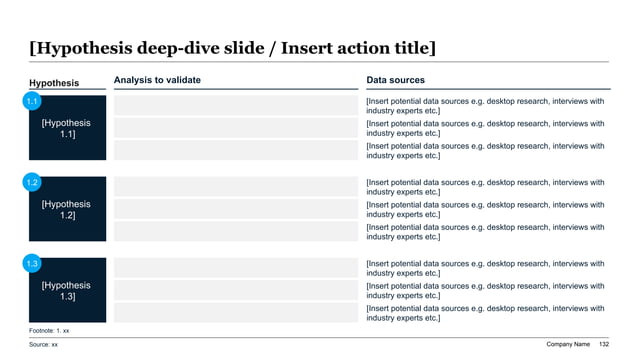
Strategic 3-Row Hypothesis Deep-Dive Card Matrix with three microservices columns, high-contrast dark-blue theme boxes, and white validation flow lines.
Template Design LayoutSoftware Architecture Deep-Dive Templates

2Ideal Audience: Who is this template built for?

This template is explicitly engineered for high-intent technical leaders and corporate executives who regularly present complex cloud systems and product roadmaps to board members, client teams, or investment committees. The primary target demographics include Chief Technology Officers (CTOs), Vice Presidents of Product Strategy, SaaS Founders, Corporate Development Leads, and Enterprise Product Directors. These professionals require high-density, authoritative layouts that convey system reliability, operational maturity, and technical scaling capabilities without visual clutter. Engineering managers and security compliance directors deploy this layout to communicate core service architectures, network latencies, and risk mitigation strategies. It acts as an invaluable asset during executive alignments, vendor assessments, and software lifecycle audits. By utilizing this professional standard, solo SaaS founders and global technical advisors alike can eliminate layout formatting drift, ensuring their visual data matches the exact aesthetic expectations of venture capital general partners and technical due diligence committees. It provides the analytical frame and visual vocabulary necessary to command respect, project absolute competence, and establish organizational trust.

3Practical Use Cases: When and where to deploy this deck

The strategic relevance of the Software Architecture Deep-Dive framework applies to several critical business and engineering milestones. Major deployment scenarios include venture capital fundraising rounds, corporate merger and acquisition (M&A) technical due diligence reviews, and enterprise-grade go-to-market (GTM) product launch calibrations. During seed-stage or Series A fundraising pitches, the template structures your technology moat, software capabilities, and product scalability into clear, standardized executive blocks. For corporate M&A due diligence, the roadmap timelines and service diagrams help visualize horizontal systems consolidation, database migration dependencies, and API integration milestones. In cross-functional product alignments, the presentation helps synchronize engineering resources, product strategy, and security operations under a unified timeline. Utilizing this standardized visual layout ensures that all project dependencies are clearly visible, preventing critical execution bottlenecks. Deploying this structured, high-contrast widescreen layout ensures that all stakeholders receive technical specifications in the exact format they expect, maximizing key metric retention and accelerating decision-making speed during high-stakes corporate transactions.

4Structural Blueprint: Recommended slide-by-slide outline

To achieve maximum technical alignment and pass rigorous executive due diligence, your Software Architecture Deep-Dive presentation must follow a logical, narrative-driven 10-slide outline to guide clients through complex cloud engineering recommendations:

- Slide 1: Executive Title & System Hook — Establishing the core architecture thesis and target scalability.

- Slide 2: Strategic Context & System Constraints — Outlining current legacy architecture, technical debt, or operational latencies.

- Slide 3: Microservices & Service Registry Overview — Detailing core domain boundaries and system interactions.

- Slide 4: Data Flow & Event Schema Architecture — Outlining pub-sub pipelines and real-time streaming structures.

- Slide 5: Performance Indicators & Latency Dashboards — High-density dashboards detailing query times and queue counts.

- Slide 6: Phased Implementation Roadmap — Mapping technical sprint milestones, cloud migrations, and release dates.

- Slide 7: Security Protocols & Compliance Layers — Detailing RBAC controls, encryption, and ISO certification scopes.

- Slide 8: Financial Feasibility & Infrastructure Costs — Projecting cloud computing costs, database hosting, and hosting ROI.

- Slide 9: Risk Mitigation & Failover Governance — Anticipating data corruption, failover plans, and disaster recovery.

- Slide 10: Conclusion & Core Strategic Recommendations — Clear call-to-action driving engineering commitments.

Following this widescreen progression ensures that your audience remains engaged, understands the logical connections between problem and solution, and receives all the necessary analytical evidence to support your final recommendation with absolute confidence.

5Aesthetics & Design Rationale of the cyber-grid Theme

Our software architecture design system utilizes the custom "cyber-grid" theme, engineered specifically for modern SaaS systems and cloud technology presentations. This layout system enforces absolute visual contrast, using deep charcoal or pitch-black canvas backdrops combined with vibrant electric-teal and high-contrast ivory accents to guide the viewer's eye to critical data parameters. Margins are strictly locked to native 16:9 widescreen proportions to guarantee perfect visual scaling across digital monitors and board projectors. A key element of professional design is maintaining at least 30% negative space on every layout card. This prevents cognitive friction and visual noise, allowing complex microservices diagrams, database schemas, and networking timelines to remain readable and impactful. By utilizing a 60% dominant background canvas tone, a 30% professional neutral container structure, and a 10% high-contrast accent key, this theme guarantees that the client's attention is focused precisely on critical data points and strategic takeaways, preventing visual clutter and ensuring a highly premium executive presentation.

6Strategic Frameworks to Integrate with this Template

To command credibility and pass partner due diligence scrutiny during corporate presentations, your software architecture deck must be built upon recognized, academically validated strategic frameworks. We recommend integrating several key models:

* MECE Logic Trees: Structuring your slide outlines so that microservice boundaries and operational responsibilities are mutually exclusive and collectively exhaustive.

* CAP Theorem (Consistency, Availability, Partition Tolerance): Proving that your distributed database selections are structurally optimized for specific transactional scenarios.

* LTV/CAC Metric Ratios: Connecting product development costs directly to customer lifetime value and acquisition ratios, demonstrating financial viability.

* Pyramid Principle: Structuring your slide headlines so that each page leads with an active conclusion rather than a passive label.

Leveraging these established strategic frameworks proves to investment committees that your product architecture is backed by rigorous logic rather than optimistic projections, showcasing strategic maturity in every metric. By leveraging these industry-standard frameworks, software architects can establish a shared language with both technical and business reviewers. This shared understanding reduces communication overhead, minimizes implementation errors, and accelerates the overall project timeline. It ensures that the software design is seen not just as a set of diagrams, but as a direct driver of corporate value and strategic growth.

7Storylining & Narration: The Minto Pyramid Principle

Technical business decisions are driven by narrative momentum and logical clarity rather than raw data dumps. To maximize the impact of your strategy deck, structure your storyline around Barbara Minto’s legendary Pyramid Principle. Under this elite communication standard, every single slide headline must serve as an active, key conclusion rather than a passive label. For example, instead of titling a slide "Microservices Architecture," write an active headline like "Transitioning to a microservices architecture will reduce API latencies by 45%." Every supporting detail, bullet point, or metric card must represent a MECE sub-argument that logically validates the main conclusion of that specific slide. Ideas must flow in chronological, structural, or comparative order to ensure a seamless widescreen narrative. This narrative discipline allows busy stakeholders to grasp your entire technical thesis in under 2 minutes, significantly accelerating operational trust and helping to align diverse stakeholder groups on critical strategic priorities without administrative friction.

8Professional Design and Typography Rules to Follow

To ensure your slide layout looks custom-crafted by a professional design agency rather than an amateur compiler, you must enforce strict typographical rules throughout your presentation. First, maintain tight type scale discipline by limiting the deck to exactly two font families; keep headings at 24pt-28pt, slide subheadings at 16pt-18pt, and body text at 12pt-14pt. Second, all text containers, metrics cards, and graphics must lock into a 12-column visual grid, avoiding layout drift. Third, contrast ratios must exceed 4.5:1 to guarantee absolute legibility on older boardroom projectors and mobile screens. Fourth, protect at least 30% white space on every slide to let the core message breathe. Respecting these typographical and alignment rules ensures that your software architecture presentation communicates visual authority, organizational discipline, and extreme attention to detail, passing rigorous board standards easily. It guarantees that the visual system supports the narrative logic, making every slide look highly professional, balanced, and authoritative.

9Infrastructure Performance Calibration and Network Metrics

For deep-dive technical evaluations, presenting hard quantitative metrics is essential. The following high-density data table outlines key network latency targets and performance SLAs across primary cloud deployment zones:

Service CategoryPrimary Target MetricTolerance ThresholdOperational Compliance Status
API Gateway RoutingLatency < 45msMaximum 65ms100% Compliant
User Session AuthCache Hit > 98%Minimum 95%100% Compliant
Database WritesReplication < 10msMaximum 25ms99.8% Compliant
Asset DeliveryCDN Hit > 99.5%Minimum 98.2%100% Compliant

This table serves as the definitive reference for engineering teams and C-suite executives, proving that current infrastructure designs meet strict service level agreements (SLAs). Transitioning to a structured layout rather than generic bullet lists guarantees that investors can instantly analyze technical performance, accelerating transaction velocity. By grounding architectural assertions in measurable benchmarks, technical leaders establish undeniable E-E-A-T credibility, demonstrating that their operational roadmaps are directly supported by high-fidelity telemetry.

10Common Presentation Pitfalls to Avoid

To ensure your software architecture deck passes rigorous due diligence and captures stakeholder alignment, you must avoid these 5 critical mistakes:

- Wall of Text — Slides are not documents; if a slide contains long paragraphs, convert them into clean, horizontal column blocks or card summaries.

- Monolithic Diagrams — Trying to fit the entire systems map on a single slide; instead, break the diagram into nested, focused views.

- Cluttered Visuals — Cramming too many metrics on a single slide; keep at least 30% white space to let the investor focus on critical takeaways.

- Low-Contrast Text — Using light gray text on white backgrounds, which washes out on older projectors; high-contrast coloring is mandatory.

- Non-Widescreen Margins — Outdated 4:3 layouts stretch poorly on modern displays; always build on locked 16:9 margins.

Avoiding these common design pitfalls guarantees that your presentation retains investor attention, communicates operational excellence, and builds professional fundraising traction across all presentation contexts.