Smart City Infrastructure Proposal Presentation Template

Stop wasting hours on manual formatting. Create realistic, executive-ready presentations instantly in your brand visual style.

IoT architecture, sensor network, and city data platform slides
Mobility, energy, public safety, and service modernization layouts
Funding, staffing, governance, vendor, and rollout roadmap visuals

1What Is a Smart City Infrastructure Proposal Deck?

A smart city infrastructure proposal deck explains how a municipality or partner ecosystem will deploy connected systems to improve public outcomes. It should cover more than sensors and dashboards. A strong proposal connects city priorities, use cases, infrastructure architecture, data governance, cybersecurity, staffing, procurement, funding, vendor roles, public trust, and phased implementation. Typical programs may include intelligent traffic management, smart lighting, energy optimization, waste management, flood monitoring, public safety analytics, parking systems, digital citizen services, or integrated operations centers. The deck should show why these initiatives matter, how they will be delivered, and how performance will be measured. It should also make tradeoffs explicit because cities must balance innovation with budget constraints, privacy expectations, equity, service reliability, and operational capacity. This structure helps stakeholders review smart city infrastructure as a public-service transformation, not only as a technology purchase. This discipline keeps the proposal grounded in public value, operational capacity, funding realism, privacy expectations, vendor accountability, maintenance needs, and the next decision gate before citywide deployment across departments and districts.
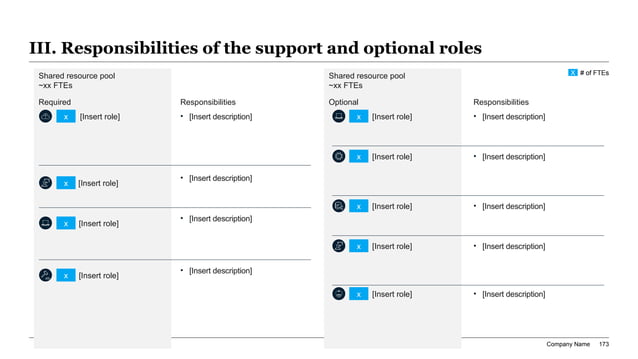
Smart city infrastructure proposal slide with split-panel staffing grid showing required and optional resource pools for implementation.
Template Design LayoutSmart City Infrastructure Proposal Presentation Template

2When to Use This Smart City Proposal Template

Use this template when a city, agency, vendor, systems integrator, infrastructure investor, or consulting team needs to present a connected infrastructure program for approval. It is useful for municipal budget cycles, grant applications, public-private partnership proposals, vendor pitches, smart mobility planning, resilience programs, energy efficiency initiatives, digital government roadmaps, and urban innovation portfolios. The deck is especially useful when stakeholders agree that technology could help but need clarity on what comes first, who owns delivery, how funding works, and which public outcomes justify investment. City leaders can use it to align departments. Vendors can use it to communicate value without sounding like a product brochure. Consultants can use it to convert fragmented use cases into a sequenced transformation plan. The template keeps the discussion focused on operational feasibility and measurable citizen impact. This discipline keeps the proposal grounded in public value, operational capacity, funding realism, privacy expectations, vendor accountability, maintenance needs, and the next decision gate before citywide deployment across departments and districts.

3Recommended Smart City Proposal Structure

A strong proposal starts with the city challenge and desired outcomes: congestion reduction, public safety, resilience, service speed, energy savings, emissions reduction, or economic development. Then prioritize use cases by value, feasibility, urgency, equity impact, and implementation complexity. Add an infrastructure architecture section that covers sensor networks, connectivity, edge devices, cloud platforms, data integration, APIs, identity, cybersecurity, and command center operations. Include an operating model section for staffing, department roles, vendor responsibilities, procurement, and maintenance. Add data governance, privacy, and public engagement pages because smart city programs require trust. Follow with funding sources, cost categories, benefits, KPIs, and implementation phases. Close with a roadmap, decision gates, risks, and next steps. This sequence helps decision-makers see the full program logic from public need to executable plan. This discipline keeps the proposal grounded in public value, operational capacity, funding realism, privacy expectations, vendor accountability, maintenance needs, and the next decision gate before citywide deployment across departments and districts.

4Prioritizing Smart City Use Cases

Smart city portfolios can become unfocused if every department adds a technology idea. A prioritization slide helps leadership choose use cases that matter most. Evaluate initiatives by citizen value, operational savings, implementation complexity, data readiness, cybersecurity risk, privacy sensitivity, funding availability, and cross-department dependency. Near-term candidates often include smart street lighting, traffic signal optimization, parking sensors, asset monitoring, water leak detection, emergency response coordination, or digital service workflows. More complex initiatives may include integrated mobility platforms, predictive public safety analytics, digital twins, dynamic energy management, or citywide operations centers. The proposal should explain why some use cases are immediate pilots while others require foundational data or connectivity work first. This creates a roadmap that is politically and operationally realistic rather than a long list of disconnected smart city concepts. This discipline keeps the proposal grounded in public value, operational capacity, funding realism, privacy expectations, vendor accountability, maintenance needs, and the next decision gate before citywide deployment across departments and districts.

5IoT Architecture, Connectivity, and City Data Platform

The technical architecture section should explain how connected infrastructure will work without overwhelming non-technical stakeholders. Include device types, sensor locations, network connectivity, edge processing, cloud or on-premise systems, integration with existing city platforms, data standards, APIs, storage, analytics, cybersecurity controls, and resilience requirements. The city data platform should be positioned as an enabling layer, not just a dashboard. It needs to support data quality, interoperability, permissioning, real-time alerts, historical analysis, and reporting across departments. Connectivity choices should be tied to use-case needs, such as latency, coverage, power usage, bandwidth, and reliability. A strong architecture slide also identifies where legacy systems remain in place and where new integration is required. This helps leadership understand cost, complexity, and operational dependency before approving the program. This discipline keeps the proposal grounded in public value, operational capacity, funding realism, privacy expectations, vendor accountability, maintenance needs, and the next decision gate before citywide deployment across departments and districts.

6Staffing, Operating Model, and Vendor Responsibilities

Smart city programs need a clear operating model because technology often crosses departmental boundaries. The deck should identify required roles, such as program leadership, city IT, cybersecurity, data governance, field operations, procurement, legal, privacy, community engagement, analytics, vendor management, and department-specific owners. It should also separate required and optional capacity, which makes staffing needs more transparent for budget review. Vendor responsibilities should be explicit: device installation, platform implementation, managed services, data integration, maintenance, training, support, and performance reporting. The proposal should avoid assuming that vendors can own public accountability. City teams still need the capability to govern outcomes, respond to incidents, and manage change. A staffing grid helps leadership see whether the program is deliverable with current capacity or needs new resources. This discipline keeps the proposal grounded in public value, operational capacity, funding realism, privacy expectations, vendor accountability, maintenance needs, and the next decision gate before citywide deployment across departments and districts.

7Funding, Procurement, and Business Case

A smart city proposal should show how the program will be funded and why investment is justified. Funding may come from municipal budgets, grants, federal or state programs, public-private partnerships, utility incentives, infrastructure funds, vendor financing, or phased capital planning. The business case should include cost categories such as devices, connectivity, platforms, integration, implementation services, maintenance, staff, training, cybersecurity, and change management. Benefits may include reduced energy cost, lower maintenance expense, faster incident response, improved service levels, fewer disruptions, better asset utilization, emissions reduction, or increased grant competitiveness. Procurement pages should explain whether the city will use pilots, framework contracts, competitive RFPs, outcome-based contracts, or consortium models. This makes the proposal financially reviewable and reduces the risk of approving technology without lifecycle funding. This discipline keeps the proposal grounded in public value, operational capacity, funding realism, privacy expectations, vendor accountability, maintenance needs, and the next decision gate before citywide deployment across departments and districts.

8Privacy, Cybersecurity, Equity, and Public Trust

Smart city infrastructure can raise public concern if privacy and equity are not designed from the start. The deck should explain what data is collected, why it is needed, how long it is retained, who can access it, how it is protected, and how residents can understand the program. Cybersecurity pages should address device security, network segmentation, identity management, logging, incident response, vendor requirements, and resilience. Equity analysis should show whether benefits reach underserved neighborhoods and whether surveillance or service impacts are uneven. Public engagement should be part of the roadmap, not a final communication step. A transparent governance model helps cities earn trust and avoid backlash. These pages make clear that responsible smart city infrastructure must serve residents while protecting rights, safety, and reliability. This discipline keeps the proposal grounded in public value, operational capacity, funding realism, privacy expectations, vendor accountability, maintenance needs, and the next decision gate before citywide deployment across departments and districts.

9Implementation Roadmap, KPIs, and Decision Gates

The roadmap should sequence pilots, platform foundations, department adoption, procurement milestones, integrations, staffing, public engagement, and scale-up. A phased plan might start with use-case validation and architecture design, move to pilots in selected corridors or districts, then expand to cross-department integration and citywide operations. KPIs should match the use cases: traffic delay reduction, lighting energy savings, asset downtime, response times, service request closure, water loss, emissions, resident satisfaction, platform uptime, cybersecurity findings, and budget variance. Decision gates should define what evidence is needed before expanding from pilot to deployment. A roadmap slide helps leaders see dependencies and prevents the program from becoming a collection of pilots that never scale. It also supports transparent communication with funders, departments, vendors, and residents. This discipline keeps the proposal grounded in public value, operational capacity, funding realism, privacy expectations, vendor accountability, maintenance needs, and the next decision gate before citywide deployment across departments and districts.

10How XLSlides Speeds Up Smart City Proposal Planning

XLSlides helps teams convert smart city notes, technical inputs, grant requirements, vendor material, and city priorities into a structured proposal deck faster. These projects often involve many stakeholders, including transportation, utilities, public safety, IT, finance, legal, procurement, community engagement, and external vendors. The AI workflow organizes inputs into a clear executive sequence: public outcomes, priority use cases, architecture, operating model, staffing, funding, governance, trust, roadmap, and KPIs. The result is not a substitute for engineering, procurement, or policy review, but it gives teams a strong starting point for decision meetings. Users can refine the assumptions, add local infrastructure data, and replace generic use cases with city-specific initiatives. This reduces formatting effort and creates more time for validating delivery feasibility. This discipline keeps the proposal grounded in public value, operational capacity, funding realism, privacy expectations, vendor accountability, maintenance needs, and the next decision gate before citywide deployment across departments and districts.