Precision Medicine and Genomics Roadmap Presentation Template

Stop wasting hours on manual formatting. Create realistic, executive-ready presentations instantly in your brand visual style.

Patient stratification, genomics, and biomarker roadmap slides
Clinical workflow, data integration, and evidence-generation layouts
Privacy, reimbursement, governance, and implementation milestone visuals

1What Is a Precision Medicine Roadmap Deck?

A precision medicine roadmap deck explains how an organization will use genomic, biomarker, clinical, and patient data to deliver more targeted care. It should translate scientific ambition into implementation choices that executives, clinicians, data teams, and partners can understand. A strong deck defines the target populations, clinical use cases, data sources, diagnostic pathways, care protocols, evidence requirements, reimbursement assumptions, and governance model. It should also show what must happen over time: pilot design, patient identification, sequencing workflows, consent, data integration, provider training, analytics, clinical decision support, outcomes measurement, and scale-up. The goal is to avoid a vague innovation narrative and create a sequenced roadmap with milestones, owners, dependencies, and risk controls. This template gives teams a practical structure for presenting precision medicine as an operational transformation. This discipline keeps the roadmap grounded in patient value, clinical feasibility, data readiness, privacy obligations, reimbursement evidence, operating ownership, and the next decision gate before wider deployment across clinical sites and partner workflows.
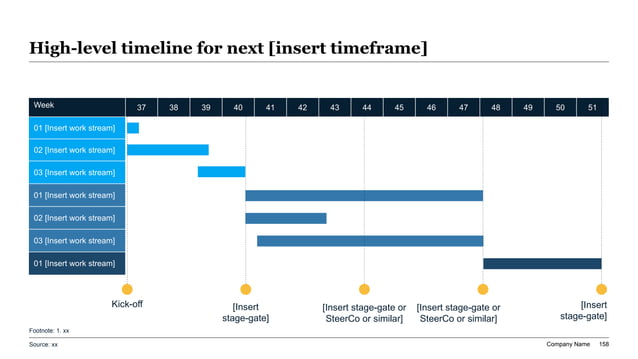
Precision medicine roadmap slide with Gantt-style clinical workstreams, milestone markers, and timeline gates for genomics implementation.
Template Design LayoutPrecision Medicine and Genomics Roadmap Presentation Template

2When to Use This Precision Medicine Template

Use this template when a healthcare provider, payer, life sciences company, diagnostics business, or public health organization needs to plan precision medicine adoption. It is useful for executive strategy sessions, clinical innovation roadmaps, genomics program launches, companion diagnostic planning, oncology transformation, rare disease initiatives, pharmacogenomics programs, payer value discussions, and partnership proposals. It can also support consulting work where stakeholders need to compare disease areas, patient cohorts, clinical readiness, data infrastructure, and evidence needs. The deck is especially valuable when enthusiasm for precision medicine is high but implementation responsibilities are unclear. Clinicians need workflow clarity. Data teams need integration requirements. Executives need investment logic. Legal and privacy teams need consent and governance. The template brings those perspectives into one roadmap so decisions can be made across functions. This discipline keeps the roadmap grounded in patient value, clinical feasibility, data readiness, privacy obligations, reimbursement evidence, operating ownership, and the next decision gate before wider deployment across clinical sites and partner workflows.

3Recommended Precision Medicine Roadmap Structure

A useful precision medicine roadmap starts with the strategic rationale: which patient outcomes, clinical gaps, or economic pressures justify the program. Then define the population and use cases, such as oncology treatment selection, rare disease diagnosis, pharmacogenomics, cardiovascular risk, or preventive screening. Add a data and diagnostics section covering genomic testing, biomarkers, EHR integration, lab partnerships, consent, interoperability, and data quality. Include a clinical workflow section that shows how patient identification, ordering, interpretation, treatment selection, and follow-up will work. Follow with evidence-generation pages for outcomes, cost, utilization, equity, and safety. Add privacy, ethics, reimbursement, and governance pages because these determine whether adoption can scale. Close with a phased roadmap, milestones, owners, budget, risks, and KPIs. This sequence keeps the presentation grounded in implementation rather than abstract science. This discipline keeps the roadmap grounded in patient value, clinical feasibility, data readiness, privacy obligations, reimbursement evidence, operating ownership, and the next decision gate before wider deployment across clinical sites and partner workflows.

4Patient Stratification and Cohort Prioritization

Patient stratification is the core of a precision medicine roadmap. The deck should explain how the organization will identify which patients benefit most from targeted testing, personalized treatment, or risk-based care pathways. Stratification criteria may include diagnosis, disease stage, genotype, biomarkers, family history, treatment response, comorbidities, demographic factors, risk scores, or care utilization patterns. A good slide compares cohorts by clinical impact, population size, data availability, testing feasibility, equity implications, cost, and readiness of intervention options. It should also show which cohorts are best suited for pilots and which require more evidence or infrastructure. Prioritization prevents the roadmap from becoming too broad. It gives leadership a clear view of where precision medicine can create near-term learning, where patient benefit is strongest, and where scale-up should wait for better evidence. This discipline keeps the roadmap grounded in patient value, clinical feasibility, data readiness, privacy obligations, reimbursement evidence, operating ownership, and the next decision gate before wider deployment across clinical sites and partner workflows.

5Genomic Data, Biomarkers, and Interoperability

Precision medicine depends on reliable data flows. The deck should identify which genomic, biomarker, clinical, claims, imaging, pharmacy, and patient-reported data sources are required. It should also show how data will move between laboratories, EHR systems, analytics platforms, clinicians, care teams, and patients. Interoperability issues can create major barriers, so the roadmap should address standards, data models, result formats, identity matching, consent metadata, and integration with clinical decision support. Biomarker strategy should clarify which tests are already validated, which require external lab partnerships, and which remain research-oriented. Data governance should define who can access results, how long data is retained, and how secondary use is approved. These pages help stakeholders see that genomics implementation is not only a testing decision. It is a data architecture and workflow decision. This discipline keeps the roadmap grounded in patient value, clinical feasibility, data readiness, privacy obligations, reimbursement evidence, operating ownership, and the next decision gate before wider deployment across clinical sites and partner workflows.

6Clinical Workflow and Decision Support

A precision medicine roadmap must show how care teams will use information at the point of decision. Workflow pages should map patient identification, ordering criteria, specimen collection, test processing, result interpretation, clinician notification, treatment recommendation, patient counseling, documentation, and follow-up. Decision support must be embedded where clinicians already work, otherwise adoption remains limited. The deck should also explain who interprets results: specialists, genetic counselors, molecular tumor boards, pharmacists, laboratory directors, or AI-supported review teams. Training needs should be clear because clinicians may not have equal comfort with genomic or biomarker data. A good workflow slide also shows exception handling, such as uncertain results, incidental findings, conflicting evidence, or patient consent limitations. This makes the roadmap practical and reduces the risk that scientific capability fails because operational adoption is underdesigned. This discipline keeps the roadmap grounded in patient value, clinical feasibility, data readiness, privacy obligations, reimbursement evidence, operating ownership, and the next decision gate before wider deployment across clinical sites and partner workflows.

7Evidence Generation, Outcomes, and Value Measurement

Precision medicine programs need evidence to scale. A roadmap deck should define which outcomes will prove value for patients, clinicians, payers, and executives. Measures may include diagnostic yield, time to diagnosis, treatment match rate, adverse event reduction, progression-free survival, hospital utilization, medication changes, patient satisfaction, health equity, cost avoidance, and total cost of care. The evidence plan should separate pilot learning from enterprise-scale proof. Early pilots may focus on workflow feasibility and cohort response, while later phases may require comparative outcomes, payer evidence, or publication-grade analysis. The deck should also define baselines, data capture methods, control groups where appropriate, and review cadence. This prevents the program from relying only on anecdotal success stories. It gives leadership a clear view of what evidence must be generated before further investment. This discipline keeps the roadmap grounded in patient value, clinical feasibility, data readiness, privacy obligations, reimbursement evidence, operating ownership, and the next decision gate before wider deployment across clinical sites and partner workflows.

8Privacy, Consent, Ethics, and Equity

Precision medicine raises sensitive privacy and ethics questions because genomic and biomarker data can affect patients and families. The deck should explain how consent will be collected, what data can be used for care, what data can be used for research, and how patients can understand their choices. Privacy controls should cover access, retention, sharing, de-identification, secondary use, vendor agreements, and breach response. Ethics pages should address incidental findings, family implications, algorithmic bias, representation in genomic datasets, and equitable access to testing and follow-up care. Equity is especially important because precision medicine can widen gaps if access is limited to certain populations or facilities. A strong roadmap treats privacy and ethics as design requirements, not afterthoughts. This increases trust and reduces implementation risk. This discipline keeps the roadmap grounded in patient value, clinical feasibility, data readiness, privacy obligations, reimbursement evidence, operating ownership, and the next decision gate before wider deployment across clinical sites and partner workflows.

9Reimbursement, Partnerships, and Operating Model

A precision medicine roadmap should clarify how the program will be funded and sustained. Reimbursement pages may cover payer coverage, prior authorization, coding, test cost, value-based care incentives, evidence requirements, and patient out-of-pocket exposure. Partnership pages should identify laboratories, sequencing providers, analytics vendors, technology platforms, academic institutions, pharmaceutical companies, payers, and community providers. The operating model should define what capabilities are internal versus partner-led. For example, a hospital may own clinical workflows and patient relationships while relying on external labs for sequencing and specialized interpretation. The deck should also show governance across clinical, technology, legal, privacy, finance, and research stakeholders. These decisions matter because precision medicine programs often fail when funding, ownership, or partner accountability is unclear. This discipline keeps the roadmap grounded in patient value, clinical feasibility, data readiness, privacy obligations, reimbursement evidence, operating ownership, and the next decision gate before wider deployment across clinical sites and partner workflows.

10Implementation Roadmap, Milestones, and Governance

The roadmap should show a phased implementation path with clear decision gates. Phase one may include use-case selection, cohort definition, partner selection, privacy review, workflow design, and baseline data assessment. Phase two may launch pilots, integrate test ordering, train clinicians, establish review boards, and capture early outcomes. Phase three may expand cohorts, refine decision support, secure reimbursement pathways, publish evidence, and scale governance. Milestones should be tied to evidence and operational readiness, not only calendar dates. The deck should name owners for clinical operations, data integration, privacy, finance, patient engagement, analytics, and program management. A Gantt-style slide works well because it shows workstreams, dependencies, and gate timing. This helps leadership manage complexity and see where delays could affect patient impact. This discipline keeps the roadmap grounded in patient value, clinical feasibility, data readiness, privacy obligations, reimbursement evidence, operating ownership, and the next decision gate before wider deployment across clinical sites and partner workflows.

11Prompt Recipe for Better Precision Medicine Roadmaps

A strong AI prompt helps generate a more specific precision medicine roadmap. Start by naming the healthcare setting, disease area, target patient population, audience, available data sources, and implementation stage. Ask for an executive precision medicine and genomics roadmap covering patient stratification, biomarker strategy, genomic testing, data integration, clinical workflow, decision support, evidence generation, privacy, consent, equity, reimbursement, partnerships, operating model, milestones, risks, and KPIs. Include known constraints such as EHR limitations, lab partners, payer requirements, clinical staffing, budget, or regulatory context. Ask the output to separate near-term pilots from long-term scale-up and to identify dependencies by workstream. This prompt helps XLSlides produce a roadmap that is practical for clinical leadership review rather than a generic healthcare innovation overview. This discipline keeps the roadmap grounded in patient value, clinical feasibility, data readiness, privacy obligations, reimbursement evidence, operating ownership, and the next decision gate before wider deployment across clinical sites and partner workflows.

12How XLSlides Speeds Up Precision Medicine Planning

XLSlides helps teams organize complex precision medicine planning into a clear executive deck. These programs often begin with disconnected inputs from clinicians, lab partners, data teams, privacy counsel, finance, payers, researchers, and technology vendors. The AI workflow converts those inputs into a sequenced narrative: strategic rationale, target cohorts, data and diagnostics, clinical workflow, evidence plan, privacy, reimbursement, operating model, roadmap, and KPIs. The output is not a substitute for clinical, legal, or scientific review, but it gives teams a strong working draft for leadership discussion. Users can then refine assumptions, insert local workflow details, and add real evidence from pilots or published studies. This reduces time spent formatting roadmap slides and creates more time for aligning stakeholders around implementation choices. This discipline keeps the roadmap grounded in patient value, clinical feasibility, data readiness, privacy obligations, reimbursement evidence, operating ownership, and the next decision gate before wider deployment across clinical sites and partner workflows.