Law Firm Partnership Presentation Template

Stop wasting hours on manual formatting. Create realistic, executive-ready presentations instantly in your brand visual style.

Practice performance, client pipeline, and partner contribution scorecard layouts
Partner economics, equity model, compensation, and governance slides
Growth roadmap, talent plan, succession, KPI, and partnership decision sections

1What Is a Law Firm Partnership Presentation?

A law firm partnership presentation explains the commercial, operational, and governance agenda that partners need to review together. It may cover practice performance, client growth, matter mix, profitability, partner contribution, compensation principles, equity structure, succession planning, talent development, investment priorities, and firmwide strategic choices. The deck should respect the sensitivity of partnership topics while still presenting evidence clearly. A strong presentation avoids vague updates and shows what decisions are required, why they matter, and how the proposed path supports long-term firm health. This gives managing partners, executive committees, practice leaders, finance teams, business development teams, lateral hiring committees, and external advisors enough evidence to assess growth quality, profitability, partner alignment, governance risk, succession readiness, talent capacity, client concentration, and implementation sequencing. It keeps the discussion grounded in firm economics, client needs, partner accountability, cultural fit, and measurable next decisions. The narrative should also identify decision owners, confidential assumptions, partner commitments, review cadence, and follow-up evidence for each major recommendation.
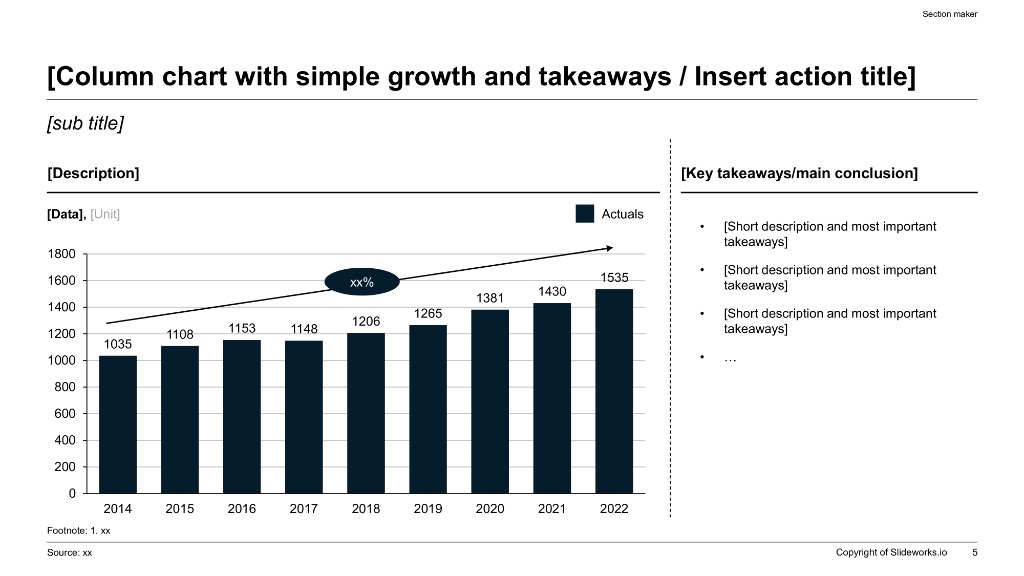
Law firm partnership presentation slide with upward column chart, growth trend line, and key takeaway bullets for partner review.
Template Design LayoutLaw Firm Partnership Presentation Template

2When to Use This Law Firm Partnership Template

Use this template when firm leadership needs to prepare a partner meeting, annual planning session, compensation review, equity discussion, practice group strategy, merger conversation, lateral partner business case, succession update, or governance reform proposal. It is especially useful when partners need a balanced view of financial performance and strategic direction. Law firm audiences often expect a concise narrative supported by reliable data, not a generic corporate strategy deck. The presentation should show where growth is coming from, whether profitability is sustainable, which practices require investment, and what leadership expects from the partnership. This gives managing partners, executive committees, practice leaders, finance teams, business development teams, lateral hiring committees, and external advisors enough evidence to assess growth quality, profitability, partner alignment, governance risk, succession readiness, talent capacity, client concentration, and implementation sequencing. It keeps the discussion grounded in firm economics, client needs, partner accountability, cultural fit, and measurable next decisions. The narrative should also identify decision owners, confidential assumptions, partner commitments, review cadence, and follow-up evidence for each major recommendation.

3Recommended Law Firm Partnership Deck Structure

A decision-ready law firm partnership deck usually starts with the executive message, firm performance snapshot, market context, and strategic priorities. It then moves into practice group economics, client portfolio health, partner contribution, talent pipeline, compensation or equity considerations, governance choices, investment requirements, risk areas, and implementation roadmap. The storyline should be transparent enough for partners to trust the analysis but disciplined enough to avoid overwhelming the meeting with raw tables. Each section should answer a practical question: what changed, why it matters, what options exist, what leadership recommends, and what decision is needed. This gives managing partners, executive committees, practice leaders, finance teams, business development teams, lateral hiring committees, and external advisors enough evidence to assess growth quality, profitability, partner alignment, governance risk, succession readiness, talent capacity, client concentration, and implementation sequencing. It keeps the discussion grounded in firm economics, client needs, partner accountability, cultural fit, and measurable next decisions.

4Practice Performance, Revenue Growth, and Profitability

The performance section should show revenue, margin, realization, utilization, leverage, matter mix, billing rates, collections, write-offs, client concentration, and growth by practice or office. Partners need to understand whether growth is profitable, repeatable, and aligned with firm strategy. A strong deck distinguishes headline revenue growth from quality of earnings and explains which practices are expanding because of demand, pricing, cross-selling, lateral hires, or one-time matters. It should also show where underperformance reflects market pressure, staffing constraints, operational inefficiency, or weak pipeline. This gives managing partners, executive committees, practice leaders, finance teams, business development teams, lateral hiring committees, and external advisors enough evidence to assess growth quality, profitability, partner alignment, governance risk, succession readiness, talent capacity, client concentration, and implementation sequencing. It keeps the discussion grounded in firm economics, client needs, partner accountability, cultural fit, and measurable next decisions. The narrative should also identify decision owners, confidential assumptions, partner commitments, review cadence, and follow-up evidence for each major recommendation.

5Client Pipeline, Market Position, and Business Development

The client section should connect partner activity to market opportunity. Useful slides may cover top client trends, new matter pipeline, cross-sell opportunities, referral sources, industry focus, win rates, client retention, pricing pressure, and competitive positioning. The deck should identify which clients or sectors deserve coordinated investment and which relationships create concentration risk. Business development should be shown as a partnership discipline, not only an individual partner activity. Partners should see how relationship ownership, marketing support, sector expertise, and associate staffing contribute to sustainable growth. This gives managing partners, executive committees, practice leaders, finance teams, business development teams, lateral hiring committees, and external advisors enough evidence to assess growth quality, profitability, partner alignment, governance risk, succession readiness, talent capacity, client concentration, and implementation sequencing. It keeps the discussion grounded in firm economics, client needs, partner accountability, cultural fit, and measurable next decisions. The narrative should also identify decision owners, confidential assumptions, partner commitments, review cadence, and follow-up evidence for each major recommendation.

6Partner Contribution, Equity, and Compensation Logic

Partner economics require careful framing because they affect trust, retention, and firm culture. The deck should explain contribution dimensions such as originations, working attorney revenue, client stewardship, matter leadership, mentoring, management roles, firm citizenship, cross-selling, and strategic investment. If the presentation discusses compensation or equity changes, it should make the principles explicit before showing implications. Partners need to see how the model balances individual performance with firmwide collaboration and long-term value creation. The analysis should also highlight unintended incentives or fairness concerns. This gives managing partners, executive committees, practice leaders, finance teams, business development teams, lateral hiring committees, and external advisors enough evidence to assess growth quality, profitability, partner alignment, governance risk, succession readiness, talent capacity, client concentration, and implementation sequencing. It keeps the discussion grounded in firm economics, client needs, partner accountability, cultural fit, and measurable next decisions. The narrative should also identify decision owners, confidential assumptions, partner commitments, review cadence, and follow-up evidence for each major recommendation.

7Talent Pipeline, Succession, and Practice Resilience

A credible partnership deck should show whether the firm has the talent depth to support its strategy. Useful slides may cover associate leverage, counsel pipeline, partner succession risk, lateral hiring priorities, retention, utilization, skill gaps, diversity goals, and leadership development. Succession is especially important for practices with concentrated relationships or aging rainmakers. The deck should identify where client transition plans, mentoring, staffing models, or lateral hiring are needed to protect revenue and service quality. It should also show which investments are required to keep the firm attractive to high-performing lawyers. This gives managing partners, executive committees, practice leaders, finance teams, business development teams, lateral hiring committees, and external advisors enough evidence to assess growth quality, profitability, partner alignment, governance risk, succession readiness, talent capacity, client concentration, and implementation sequencing. It keeps the discussion grounded in firm economics, client needs, partner accountability, cultural fit, and measurable next decisions. The narrative should also identify decision owners, confidential assumptions, partner commitments, review cadence, and follow-up evidence for each major recommendation.

8Governance, Decision Rights, and Operating Cadence

Partnership presentations often fail when governance expectations are unclear. The deck should define which issues require full partner approval, executive committee decision, practice leader accountability, finance review, or management team execution. It should also clarify the cadence for performance reviews, compensation discussions, investment approvals, lateral partner evaluation, client planning, and risk escalation. Governance slides should be practical, not ceremonial. Partners need to know how decisions will be made, who owns follow-through, and how progress will be reported. This gives managing partners, executive committees, practice leaders, finance teams, business development teams, lateral hiring committees, and external advisors enough evidence to assess growth quality, profitability, partner alignment, governance risk, succession readiness, talent capacity, client concentration, and implementation sequencing. It keeps the discussion grounded in firm economics, client needs, partner accountability, cultural fit, and measurable next decisions. The narrative should also identify decision owners, confidential assumptions, partner commitments, review cadence, and follow-up evidence for each major recommendation.

9Strategic Roadmap, KPIs, and Partner Commitments

The roadmap should translate partnership priorities into actions, owners, milestones, and measurable outcomes. It may include practice investments, client teams, pricing initiatives, lateral hiring, technology adoption, knowledge management, associate development, succession plans, governance updates, or compensation model refinements. KPIs should be specific enough to track progress without turning the partnership meeting into an accounting exercise. Useful measures include revenue growth, margin, realization, leverage, client retention, cross-sell revenue, pipeline conversion, partner contribution, matter quality, talent retention, and succession readiness. This gives managing partners, executive committees, practice leaders, finance teams, business development teams, lateral hiring committees, and external advisors enough evidence to assess growth quality, profitability, partner alignment, governance risk, succession readiness, talent capacity, client concentration, and implementation sequencing. It keeps the discussion grounded in firm economics, client needs, partner accountability, cultural fit, and measurable next decisions. The narrative should also identify decision owners, confidential assumptions, partner commitments, review cadence, and follow-up evidence for each major recommendation.

10How XLSlides Speeds Up Partnership Presentation Planning

XLSlides helps law firm leaders convert financial reports, practice updates, partner notes, compensation principles, client pipeline data, talent plans, and governance questions into a structured partnership presentation. The AI workflow can organize the story into firm performance, practice economics, client growth, partner contribution, compensation logic, talent pipeline, succession risk, governance model, roadmap, KPIs, and executive decisions. This is useful when leadership has sensitive inputs but needs a polished deck that is clear, professional, and easy for partners to discuss. The generated output is not a substitute for legal, tax, compensation, or governance advice, but it gives teams a strong working draft. This gives managing partners, executive committees, practice leaders, finance teams, business development teams, lateral hiring committees, and external advisors enough evidence to assess growth quality, profitability, partner alignment, governance risk, succession readiness, talent capacity, client concentration, and implementation sequencing. It keeps the discussion grounded in firm economics, client needs, partner accountability, cultural fit, and measurable next decisions.