Sustainable Aviation Fuel SAF Roadmap Presentation Template

Stop wasting hours on manual formatting. Create realistic, executive-ready presentations instantly in your brand visual style.

Turn SAF supply constraints, emissions targets, policy incentives, and airline commitments into an executive roadmap.
Explain feedstocks, production pathways, offtake models, airport readiness, blending economics, and compliance exposure.
Build slides for airlines, airports, fuel producers, investors, sustainability teams, and aviation strategy consultants.

1What Is a Sustainable Aviation Fuel Roadmap Deck?

A sustainable aviation fuel roadmap deck explains how an airline, airport, fuel producer, investor, or aviation ecosystem partner will scale SAF adoption over time. It should connect decarbonization ambition to practical constraints: feedstock supply, production technology, fuel certification, blending logistics, airport infrastructure, airline procurement, customer demand, policy incentives, emissions accounting, and price premiums. The deck usually covers the emissions baseline, SAF pathway options, supply scenarios, offtake strategy, regulatory context, infrastructure needs, cost curve, implementation roadmap, governance, and KPIs. The strongest version avoids presenting SAF as an instant replacement for conventional jet fuel. It shows what must be true for supply, cost, logistics, and reporting to scale. This gives airline leaders, airport operators, fuel suppliers, investors, regulators, corporate travel buyers, and sustainability teams enough evidence to assess feasibility, emissions impact, procurement risk, infrastructure readiness, economics, and the next investment gate. It also helps decision makers compare near-term procurement, long-term offtake, airport constraints, certificate quality, customer funding, and policy exposure before approving scale-up.
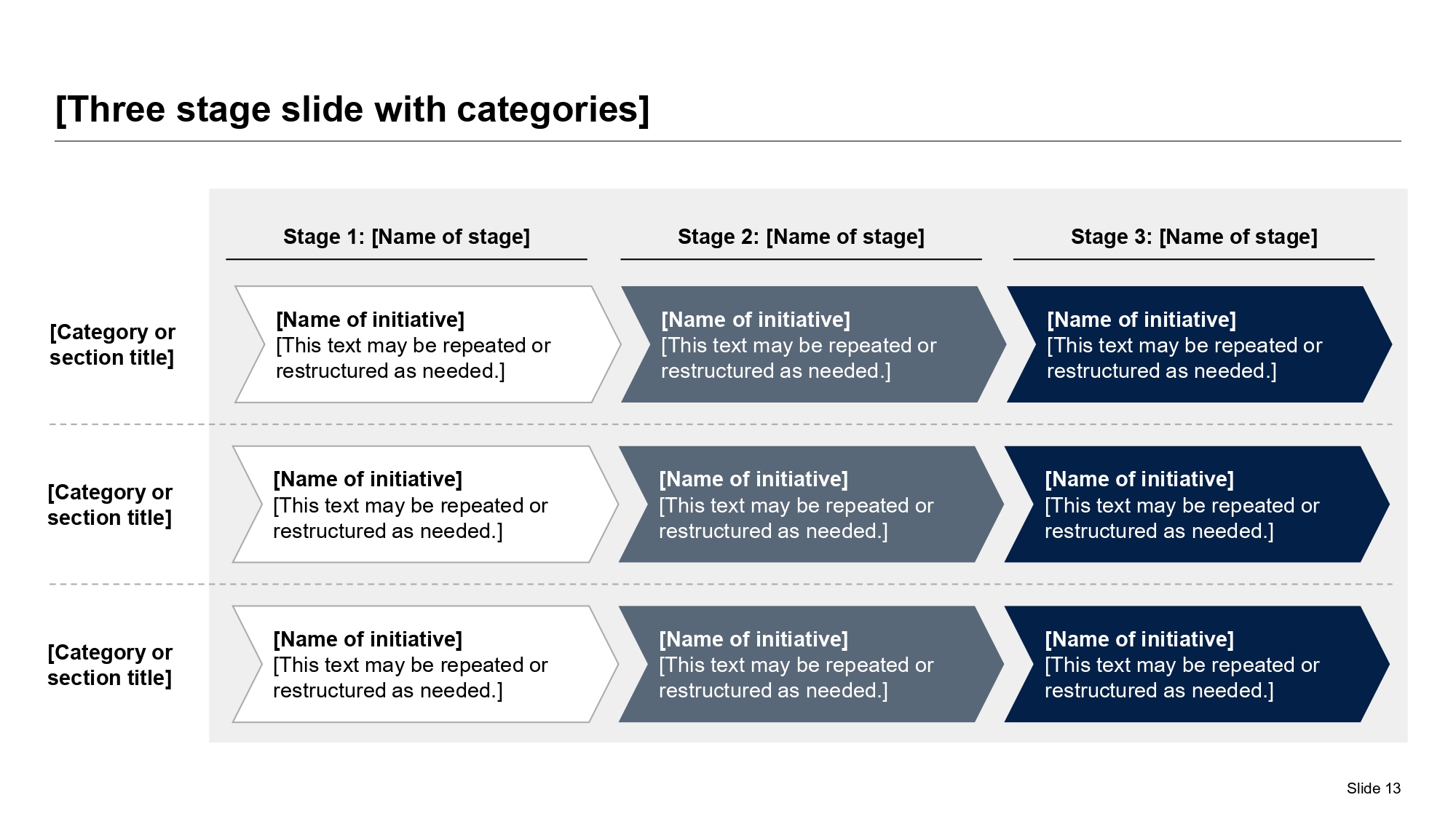
Sustainable aviation fuel roadmap slide with three-stage chevron process flow across workstreams for supply, policy, and rollout.
Template Design LayoutSustainable Aviation Fuel SAF Roadmap Presentation Template

2When to Use This SAF Roadmap Template

Use this template when you need to make sustainable aviation fuel planning clear for senior stakeholders. It works for airline net-zero strategy reviews, SAF procurement planning, airport infrastructure discussions, fuel producer investor decks, corporate travel emissions programs, government policy briefings, and aviation decarbonization partnership proposals. An airline can use it to explain procurement and emissions impact, an airport can use it to show readiness, and a fuel producer can use it to present capacity expansion and offtake logic. The template is especially useful when audiences need to compare ambition with delivery constraints. It organizes the story around supply, demand, regulation, operations, economics, and phased rollout. This gives airline leaders, airport operators, fuel suppliers, investors, regulators, corporate travel buyers, and sustainability teams enough evidence to assess feasibility, emissions impact, procurement risk, infrastructure readiness, economics, and the next investment gate. It also helps decision makers compare near-term procurement, long-term offtake, airport constraints, certificate quality, customer funding, and policy exposure before approving scale-up.

3Recommended SAF Roadmap Structure

A strong SAF roadmap deck should begin with the aviation emissions baseline and the role SAF can play relative to fleet renewal, operational efficiency, offsets, hydrogen, electrification, and demand management. The next section should explain SAF pathways, including HEFA, alcohol-to-jet, power-to-liquid, gasification, and other emerging routes. Then the deck should cover supply availability, feedstock constraints, certification, offtake contracts, policy incentives, blending logistics, airport readiness, customer commitments, cost curve, and emissions accounting. The roadmap should sequence near-term procurement, partnership development, pilot routes, infrastructure preparation, and longer-term capacity scale-up. Close with KPIs, risks, governance, and the executive ask. This gives airline leaders, airport operators, fuel suppliers, investors, regulators, corporate travel buyers, and sustainability teams enough evidence to assess feasibility, emissions impact, procurement risk, infrastructure readiness, economics, and the next investment gate. It also helps decision makers compare near-term procurement, long-term offtake, airport constraints, certificate quality, customer funding, and policy exposure before approving scale-up.

4SAF Supply, Feedstocks, and Production Pathways

The supply section should explain where SAF will come from and what constraints may limit growth. Feedstocks may include used cooking oil, animal fats, agricultural residues, municipal waste, forestry residues, ethanol, captured carbon, and renewable hydrogen depending on the pathway. Each option has different availability, sustainability profile, certification requirements, cost, and scalability. The deck should compare mature routes with emerging technologies and clarify which pathways support near-term procurement versus long-term supply diversification. It should also address competition for feedstocks from road transport, chemicals, renewable diesel, and other sectors. A credible supply slide avoids assuming that announced capacity equals available fuel. This gives airline leaders, airport operators, fuel suppliers, investors, regulators, corporate travel buyers, and sustainability teams enough evidence to assess feasibility, emissions impact, procurement risk, infrastructure readiness, economics, and the next investment gate. It also helps decision makers compare near-term procurement, long-term offtake, airport constraints, certificate quality, customer funding, and policy exposure before approving scale-up.

5Policy, Regulation, Incentives, and Emissions Accounting

SAF economics are heavily influenced by policy and reporting rules. The deck should explain the regulatory context, including blending mandates, tax credits, low-carbon fuel standards, CORSIA, regional aviation emissions schemes, book-and-claim models, and sustainability certification. It should also clarify how lifecycle emissions are calculated, what documentation is required, and how claims can be used with customers or corporate travel buyers. Incentives can change the cost curve, but they may vary by geography, pathway, and time period. The roadmap should show which policy assumptions are stable and which remain uncertain. This is important because compliance, voluntary demand, and investment returns may depend on regulatory treatment. This gives airline leaders, airport operators, fuel suppliers, investors, regulators, corporate travel buyers, and sustainability teams enough evidence to assess feasibility, emissions impact, procurement risk, infrastructure readiness, economics, and the next investment gate. It also helps decision makers compare near-term procurement, long-term offtake, airport constraints, certificate quality, customer funding, and policy exposure before approving scale-up.

6Airport Readiness, Logistics, and Operational Integration

Scaling SAF requires airport and fuel logistics readiness. The deck should explain how fuel will be delivered, stored, blended, certified, and uplifted at target airports. Some programs may rely on existing hydrant systems and drop-in compatibility, while others require new supply chain coordination, documentation, storage procedures, or blending controls. Route selection matters because SAF availability may be concentrated at specific airports or regions. The roadmap should identify priority airports, fuel partners, infrastructure gaps, operational risks, and dependencies. It should also explain how pilots will verify quality, documentation, and chain-of-custody processes. This prevents the strategy from assuming procurement is enough when actual delivery requires coordinated airport execution. This gives airline leaders, airport operators, fuel suppliers, investors, regulators, corporate travel buyers, and sustainability teams enough evidence to assess feasibility, emissions impact, procurement risk, infrastructure readiness, economics, and the next investment gate. It also helps decision makers compare near-term procurement, long-term offtake, airport constraints, certificate quality, customer funding, and policy exposure before approving scale-up.

7Offtake Strategy, Partnerships, and Demand Aggregation

SAF scale-up depends on bankable demand and credible partnerships. The deck should explain whether the organization will use spot purchases, long-term offtake agreements, joint ventures, prepayment structures, customer co-funding, book-and-claim certificates, or demand aggregation with corporate travel buyers. Fuel producers need offtake to finance capacity. Airlines need supply certainty and cost visibility. Airports need enough demand to justify logistics readiness. Corporate customers may want emissions reductions tied to business travel or cargo. A good partnership slide maps each stakeholder to incentives, commitments, risks, and decisions required. It should also show which agreements are signed, under negotiation, or aspirational. This gives airline leaders, airport operators, fuel suppliers, investors, regulators, corporate travel buyers, and sustainability teams enough evidence to assess feasibility, emissions impact, procurement risk, infrastructure readiness, economics, and the next investment gate. It also helps decision makers compare near-term procurement, long-term offtake, airport constraints, certificate quality, customer funding, and policy exposure before approving scale-up.

8Cost Curve, Premium Management, and Business Case

A SAF roadmap needs a clear economics section because fuel premiums can be significant. The deck should compare current SAF prices, expected cost declines, policy incentives, conventional jet fuel benchmarks, carbon cost exposure, customer willingness to pay, and procurement volume scenarios. It should separate controllable levers such as offtake structure, supplier diversification, route prioritization, and customer programs from external assumptions such as feedstock prices, renewable power costs, and policy support. The business case may include avoided compliance costs, customer revenue, brand value, financing benefits, and progress toward emissions targets. A cost curve should show sensitivity rather than a single optimistic forecast. This gives airline leaders, airport operators, fuel suppliers, investors, regulators, corporate travel buyers, and sustainability teams enough evidence to assess feasibility, emissions impact, procurement risk, infrastructure readiness, economics, and the next investment gate. It also helps decision makers compare near-term procurement, long-term offtake, airport constraints, certificate quality, customer funding, and policy exposure before approving scale-up.

9Implementation Stages, Governance, and KPIs

The implementation roadmap should sequence SAF adoption in stages. Stage one may include emissions baseline, policy mapping, supplier screening, airport prioritization, customer engagement, and pilot procurement. Stage two may expand offtake agreements, route deployment, infrastructure readiness, documentation, and reporting processes. Stage three may scale volumes, diversify pathways, integrate corporate customer programs, and align with fleet and network planning. Each stage should have owners, milestones, dependencies, risks, and decision gates. KPIs should include SAF volume, share of fuel, lifecycle emissions reduction, cost premium, contracted supply, airport coverage, customer participation, claim quality, and progress against regulatory obligations. This gives airline leaders, airport operators, fuel suppliers, investors, regulators, corporate travel buyers, and sustainability teams enough evidence to assess feasibility, emissions impact, procurement risk, infrastructure readiness, economics, and the next investment gate. It also helps decision makers compare near-term procurement, long-term offtake, airport constraints, certificate quality, customer funding, and policy exposure before approving scale-up.

10How XLSlides Speeds Up SAF Roadmap Planning

XLSlides helps aviation teams turn emissions data, SAF supplier notes, policy research, airport readiness inputs, customer commitments, cost assumptions, and implementation ideas into a structured roadmap presentation faster. The AI workflow can organize the story into emissions baseline, pathway comparison, supply constraints, policy incentives, airport logistics, offtake strategy, cost curve, rollout stages, governance, KPIs, risks, and executive ask. This is useful when teams have many technical inputs but need a clear deck for leadership, investors, partners, or customers. The generated output is not a substitute for fuel certification, regulatory advice, engineering review, or financial modeling, but it gives teams a strong working draft. This gives airline leaders, airport operators, fuel suppliers, investors, regulators, corporate travel buyers, and sustainability teams enough evidence to assess feasibility, emissions impact, procurement risk, infrastructure readiness, economics, and the next investment gate. It also helps decision makers compare near-term procurement, long-term offtake, airport constraints, certificate quality, customer funding, and policy exposure before approving scale-up.