PhD Thesis Defense & Research Commercialization Slide Templates

Stop wasting hours on manual formatting. Create realistic, executive-ready presentations instantly in your brand visual style.

Academic research framework blocks
Deep-tech commercialization roadmaps
Scholarly methodology & data visuals

1The Strategic Imperative of Academic Research Commercialization

Translating academic research from the laboratory to the commercial marketplace represents a critical bridge between theoretical scientific discovery and real-world economic impact. Doctoral candidates and deep-tech founders face the unique challenge of presenting years of complex scientific investigation to both academic committees and potential venture capital investors. A structured, professional thesis defense presentation serves as the initial business case for this transition, establishing the foundational credibility of the technology. To successfully secure corporate partnerships, government research grants, or seed-stage venture funding, researchers must articulate not just the scientific novelty of their work, but also the commercial scalability and intellectual property value of their discoveries. Using a disciplined slide format helps present these complex ideas with clarity and professional authority. By framing academic findings within a structured narrative, candidates can project the corporate gravity required to navigate post-doctoral spin-off paths, capture investor interest, build organizational momentum, and launch successful deep-tech startups. This structured approach ensures that the commercial potential of scientific innovations is fully understood by non-technical board members and investment partners alike.
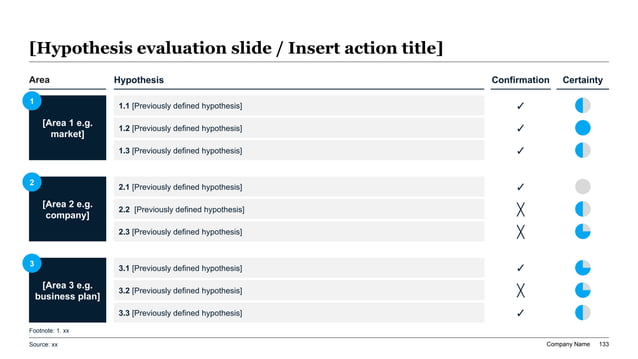
A qualitative assessment matrix slide layout pairing a 3-area, 4-column framework with custom checkmarks, detailed hypothesis cards, and light-blue Harvey Ball indicators.
Template Design LayoutPhD Thesis Defense & Research Commercialization Slide Templates

2Structuring the Scientific Methodology and Hypothesis Framework

To satisfy the rigorous standards of both doctoral thesis committees and corporate technical due diligence teams, a defense deck must present a highly structured research methodology and hypothesis framework. Candidates should organize their presentation using Barbara Minto's Pyramid Principle, starting with the primary thesis conclusion before diving into supporting scientific data. This prevents the common mistake of delivering a confusing chronological diary of laboratory activities, replacing it with a clear, logical hierarchy. Grouping experimental methods, computational models, and analytical frameworks into mutually exclusive, collectively exhaustive (MECE) categories ensures complete coverage of the research domain. Each slide's header must be an active, conclusion-focused headline rather than a passive label, immediately conveying the key insight. This level of communication discipline projects outstanding technical control, helping the audience grasp the core methodology, variables, and controls without administrative friction, thereby securing academic validation and commercial trust. Furthermore, this clear structural blueprint allows future research teams to replicate study parameters and extend the scientific contribution.

3Data-Driven Experimental Design and Quantitative Validation

A successful PhD thesis defense and venture capital evaluation relies heavily on robust, reproducible data and rigorous statistical validation. Presenting experimental results requires high-density visuals that communicate complex trends, error margins, and confidence intervals clearly. To capture the attention of technical committee members and venture partners, candidates must present their data in structured comparison tables rather than confusing, unaligned text blocks. This ensures that the audience can easily evaluate sample sizes, control groups, and statistical significance metrics. By organizing quantitative discoveries into clean, high-contrast matrix layouts, you project a standard of empirical rigor and operational excellence. Standardizing these data structures helps reviewers assess target parameters against baseline performance indicators, minimizing diligence risks. Enforcing this data discipline across your slides proves that your scientific claims are backed by rigorous methodology, which is vital for securing both academic approval and early-stage capital commitments. This quantitative clarity establishes a baseline for future scale-up trials. Additionally, presenting clear data tables helps investors model target market assumptions based on actual clinical or technical output.

4Key Academic Findings and Deep-Tech Commercial Potential

The ultimate value of a doctoral thesis lies in its novel contribution to the field and its potential to solve real-world industry challenges. Candidates must clearly delineate their core academic findings, highlighting the specific breakthroughs, patents, or proprietary algorithms that form their technology's defensive moat. In the context of deep-tech commercialization, these scientific milestones serve as the foundation for future product development and venture creation. Strategy leads must structure the discussion around these findings, explaining how the academic innovation translates into a competitive commercial advantage, such as reduced manufacturing costs, increased processing speeds, or superior biological affinity. Visualizing these milestones in a clean, structured grid helps stakeholders understand the commercial relevance of the science. By linking theoretical discoveries directly to market needs, you prove to investment committees and university technology transfer offices that your research is ready for commercial scaling, maximizing translation speed and funding success. This alignment of science and business strategy is essential for venture creation.

5The Zen-Minimal Design Aesthetic: Academic Clarity Meets Corporate Gravity

To maintain absolute visual clarity and professional authority, this PhD thesis defense template leverages our custom Zen-Minimal design system. Academic presentations are frequently criticized for chaotic layouts, low-contrast coloring, and dense text blocks that exhaust committees and obscure core research findings. Our Zen-Minimal aesthetic solves this by enforcing a dominant, clean canvas structure (60% weight) paired with high-contrast text containers (30% weight) and professional accent highlights (10% weight) to guide the viewer's eye to critical data points and equations. All elements lock to a 12-column grid, eliminating margin errors and layout drift. We require preserving at least 30% negative space on every slide, which prevents cognitive overload and ensures that complex diagrams can breathe. Enforcing this design discipline projects a premium standard of organization and detail, ensuring that your presentation slide layouts look deliberate, polished, and fully ready for both academic and corporate scrutiny. This visual cleanliness ensures your audience remains focused on the intellectual contribution rather than design clutter.

6Translating Complex Academic Theories on the Interactive Canvas

Drafting complex scientific slides with formulas, diagrams, and methodologies can be incredibly time-consuming, often leading to formatting errors and misaligned layouts. To streamline this process and eliminate layout debt, this template integrates with the AI Visual Studio Canvas, our interactive drag-and-drop workspace. Researchers and strategy leads can click and drag anywhere on the 16:9 canvas to draw custom text placeholders, defining the slide's visual structure. You can assign specific structural tags—such as experimental grids, comparative data tables, process timelines, or scientific quotes—to each drafted card to guide the AI's rendering constraints. The canvas translates your design into high-fidelity layout coordinates instantly, bridging the gap between raw text ideas and structured visual design. To try it now, click the Open Interactive Canvas button in the sidebar to map out your slide layouts in real time, making custom defense preparation responsive, clear, and perfectly aligned. This spatial freedom allows you to construct custom academic layouts that reflect the unique requirements of your scientific field.

7Copy-Pasteable Prompt Engineering Recipe for Thesis Defense Generation

To help doctoral candidates and academic advisors generate high-impact defense presentations instantly, our generative models support structured prompt recipes. Feeding a detailed, context-rich brief into the AI generator eliminates hours of manual formatting and slide alignment. Our AI understands structured academic syntax and automatically converts raw text instructions into clean visual components, like methodology grids and timeline roadmaps, letting you focus entirely on your core research defense strategy. Below is a highly optimized, copy-pasteable prompt engineering recipe tailored for this PhD defense template:

```text

Create a professional PhD thesis defense presentation using a Zen-Minimal design preset. The deck must include a 3-column methodology overview, a high-contrast experimental data table, and a 2-stage research commercialization timeline. Focus on clean margins and data readability.

```

Using this recipe ensures the AI applies correct grid alignments, mapping your scientific context to appropriate visual layouts in under 60 seconds. This allows you to iterate rapidly on slide content and structure as new experimental results become available.

8Navigating the Phased Research-to-Venture Commercialization Roadmap

Transitioning a PhD thesis into a viable deep-tech startup requires a structured commercialization roadmap that spans technical validation, intellectual property protection, and market entry. Candidates and university spin-off teams must outline their development phases clearly, mapping out key milestones to demonstrate long-term viability to venture capital partners. This structured roadmap shows how the technology moves from academic proof-of-concept to pilot validation and commercial scale. A clear visual roadmap includes:

  • Technical Validation Phase** - Completing lab prototypes, finishing peer-reviewed validation studies, and securing composition of matter patents.
  • Venture Incubation Phase** - Partnering with university incubators, applying for government research grants, and building the initial advisory board.
  • Market Pilot Phase** - Launching small-scale industrial trials, securing early corporate development partnerships, and calibrating unit economics.

Visualizing these strategic steps helps stakeholders align academic timelines with venture capital models, ensuring complete execution clarity. This ensures a smooth transition from basic science to commercial product. By mapping these phases, researchers can demonstrate a clear path to market viability for potential corporate partners and seed investors.

9Common Presentation Pitfalls to Avoid During Academic Defenses

To ensure your thesis defense passes strict committee reviews and satisfies prospective deep-tech venture capital investors, you must avoid several critical design and narrative errors. First, avoid the wall of text mistake; slides are not publications, so you must convert long paragraphs of scientific text into clean, horizontal columns or bulleted cards. Second, eliminate unformatted data tables; use structured matrices with high-contrast headers to make comparison metrics readable. Third, maintain visual breathing room by keeping at least 30% white space on every slide to prevent cognitive overload. Fourth, check contrast ratios to ensure all text remains legible on washed-out board projectors. Finally, avoid passive labeling in your titles; use active, conclusion-led headers that state the core scientific finding. By avoiding these common pitfalls, you protect the visual and logical integrity of your research, presenting your work with maximum clarity and authority. This attention to slide detail reflects the professionalism of your scientific inquiry.

10Performance Comparison: Manual Formatting vs. XLSlides AI Automation

Constructing academic slides manually is a major operational drain, often costing researchers 12 to 16 hours of frustration with margin drift, font inconsistency, and complex table alignments. Our advanced AI compilation engine handles this formatting debt in under 60 seconds. The model performs context-aware layout matching, automatically translating your scientific text into structured columns, data tables, and process timelines. Brand and design rules are locked based on your chosen preset, ensuring absolute consistency across the entire deck. Finally, the presentation exports as standard, editable PowerPoint vector shapes, allowing native Excel data edits and LaTeX integration. This automation system is a massive productivity multiplier, enabling candidates to spend their valuable time preparing for committee questions and refining their scientific arguments rather than wrestling with slide software, ensuring boardroom-grade excellence at the click of a button. Ultimately, this tool empowers researchers to present their hard work with the aesthetic standards it deserves.